







This Template at a Glance
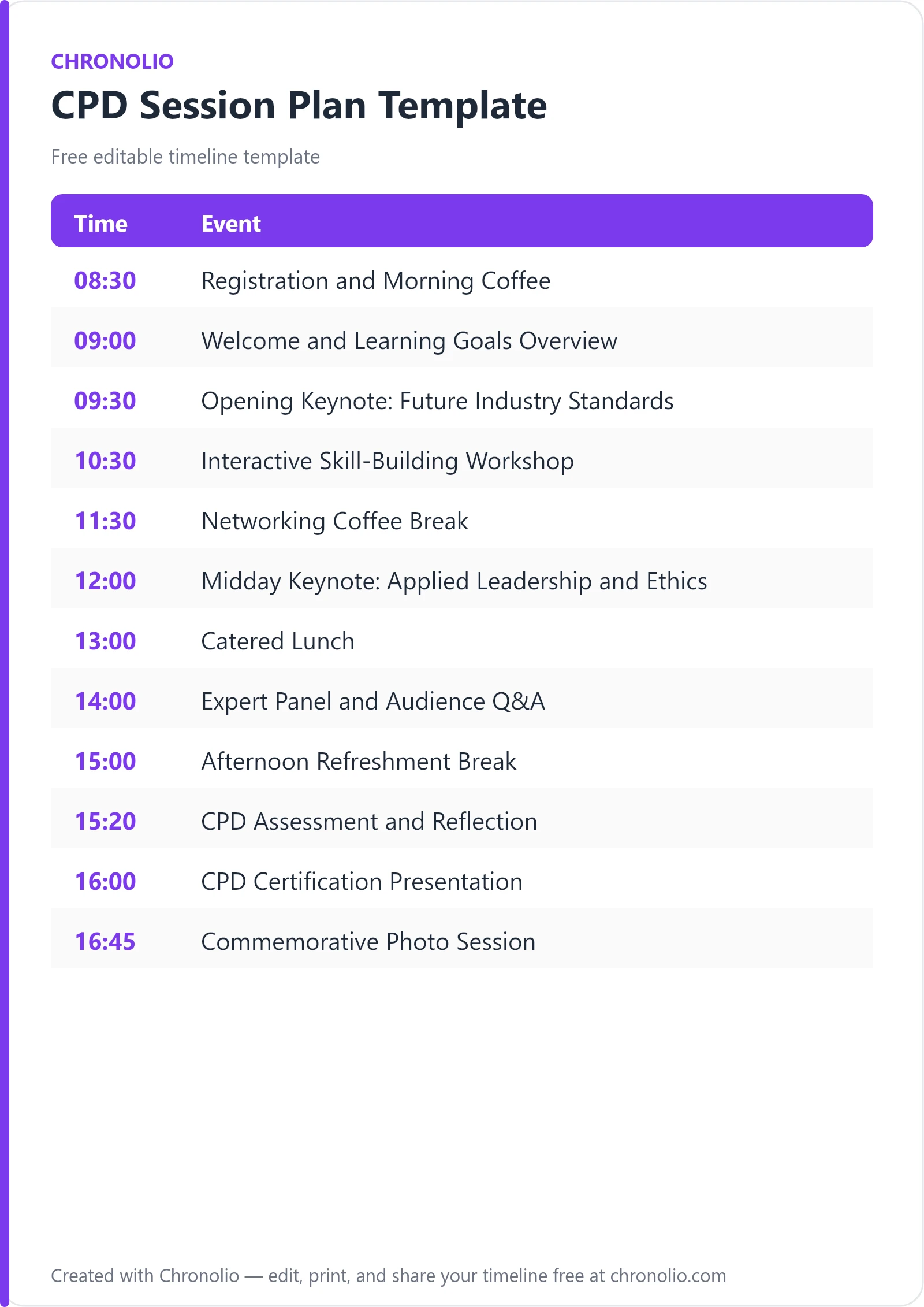
Here is the complete schedule this free template gives you — every time block, ready to edit, download, and share:
| Time | Event |
|---|---|
| 08:30 | Registration and Morning Coffee |
| 09:00 | Welcome and Learning Goals Overview |
| 09:30 | Opening Keynote: Future Industry Standards |
| 10:30 | Interactive Skill-Building Workshop |
| 11:30 | Networking Coffee Break |
| 12:00 | Midday Keynote: Applied Leadership and Ethics |
| 13:00 | Catered Lunch |
| 14:00 | Expert Panel and Audience Q&A |
| 15:00 | Afternoon Refreshment Break |
| 15:20 | CPD Assessment and Reflection |
| 16:00 | CPD Certification Presentation |
| 16:45 | Commemorative Photo Session |
What Is a CPD Session Plan?
A CPD session plan is a master operational schedule and pedagogical roadmap designed to guide continuing professional development seminars, workshops, and training days. In professional education, time is strictly audited; accrediting bodies and licensing boards demand clear proof that contact hours equate to structured, high-value learning rather than passive attendance.
Drawing from extensive venue operations and professional conference planning, this framework incorporates the core elements required by major governing organizations: explicit learning outcomes, peer collaboration, active evaluation, and official certification. Whether you are running technical compliance training, healthcare skill updates, or executive leadership seminars, having a balanced running order prevents speaker overruns, keeps delegates engaged, and ensures every participant leaves with verified CPD points.
Much like formal governance agendas—such as a structured board meeting schedule—a professional learning plan relies on strict timeboxing and clear operational transitions to maintain focus and respect participant schedules.
Build Your CPD Session Plan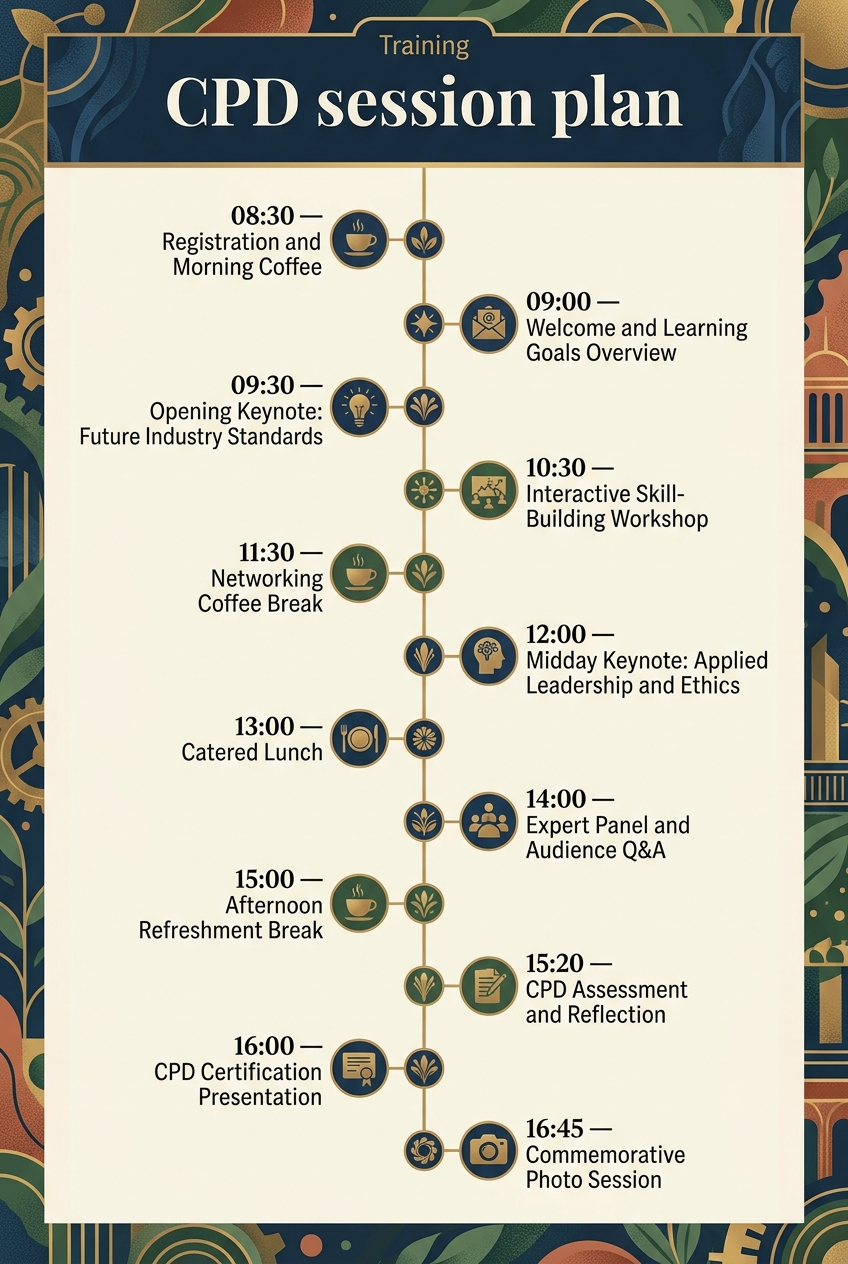
Why CPD Sessions Need a Timeline
Running a successful professional development event requires far more than booking a room and inviting a guest speaker. Delegates attend CPD events to gain actionable industry skills, meet mandatory annual licensing requirements, and network with fellow practitioners. Without a rigorously planned schedule, presentations easily slide off-schedule, interactive exercises get compressed, and delegates miss out on vital reflective learning.
A well-architected session plan balances cognitive load throughout the day. High-intensity keynote presentations are paired with practical workshops, while strategic coffee breaks give delegates time to digest complex regulations and network. Establishing firm time slots for registration, Q&A, and assessment protects the integrity of the educational program and guarantees that mandatory contact hours are fulfilled.
In addition, a published running order gives venue managers, audio-visual technicians, caterers, and guest speakers a single source of truth. When everyone operates off the same timetable, session transitions run smoothly, catering arrives fresh during scheduled intermissions, and the event maintains a polished, professional standard from start to finish.
What to Include in a CPD Session Plan
To satisfy professional accreditation standards and deliver a rewarding experience for delegates, your session plan should always incorporate the following key components:
- Registration and Welcoming Period: Time for delegate check-in, badge collection, and informal networking over morning refreshments.
- Learning Objectives Overview: Explicit orientation framing the target competencies, industry standards, and educational goals of the day.
- Keynote Presentations: Expert-led address sessions focusing on macro industry shifts, regulatory updates, or advanced operational frameworks.
- Interactive Skill Workshops: Practical break-out group sessions where attendees solve scenario-based challenges and apply new knowledge.
- Facilitated Panel Q&A: Open exchange enabling attendees to ask practical, real-world questions to senior specialists.
- Assessment and Reflection: Dedicated time for delegates to complete evaluation forms and self-reflection logs to verify competency.
- CPD Certification Distribution: Formal presentation or digital verification awarding official continuing education credits.
Phase 1: Registration, Orientations, and Opening Keynote
| Time | Event |
|---|---|
| 08:30 | Registration and Morning Coffee |
| 09:00 | Welcome and Learning Goals Overview |
| 09:30 | Opening Keynote: Future Industry Standards |
The initial hour of any professional training event sets the operational tone for the entire day. Arriving delegates need an unhurried, organized check-in environment where they can receive their name badges, physical workbooks, and event credentials. Hosting Registration and Morning Coffee in the Main Foyer allows attendees to settle in, meet colleagues, and transition smoothly out of morning travel stress.
Moving into Auditorium A at 09:00, the event coordinator delivers the Welcome and Learning Goals Overview. This orientation outlines the precise educational objectives and skill competencies delegates will master during the event. Immediately following orientation, the Opening Keynote: Future Industry Standards delivers high-level insights into current market shifts and regulatory changes, anchoring the day's practical work in broader industry realities.
+-------------------------------------------------------------------+ | PHASE 1: FOUNDATIONAL LEARNING | | 08:30 AM [Registration & Coffee] Main Foyer | | 09:00 AM [Learning Goals Overview] Audit. A | | 09:30 AM [Opening Keynote] Audit. A | +-------------------------------------------------------------------+
Phase 2: Interactive Workshops and Applied Leadership
| Time | Event |
|---|---|
| 10:30 | Interactive Skill-Building Workshop |
| 11:30 | Networking Coffee Break |
| 12:00 | Midday Keynote: Applied Leadership and Ethics |
Once key concepts have been established during the opening address, delegates transition from passive listening to active application. At 10:30, attendees move into Workshop Room 1 for the Interactive Skill-Building Workshop. Breaking into smaller working groups allows participants to work through scenario-based problems, test new methodologies, and collaborate directly with industry peers.
After an hour of intensive group problem-solving, a 30-minute Networking Coffee Break in the Exhibition Lounge provides essential cognitive decompression. Attendees discuss workshop findings over espresso, exchange contact details, and view partner exhibits. Delegates then return to Auditorium A at 12:00 for the Midday Keynote: Applied Leadership and Ethics, which shifts focus toward implementing governance standards and ethical decision-making within everyday management operations.
Planning a full-day seminar requires balancing cognitive load across multiple modules. Much like organizing complex corporate events or multi-stage celebrations—such as a detailed birthday party timeline or a structured milestone schedule like an anniversary party schedule—maintaining momentum relies heavily on strategic intermissions and clear transitions between core activities.
Phase 3: Midday Refreshment and Expert Panel Q&A
| Time | Event |
|---|---|
| 13:00 | Catered Lunch |
| 14:00 | Expert Panel and Audience Q&A |
| 15:00 | Afternoon Refreshment Break |
A substantial midday meal is vital for maintaining attendee focus during afternoon sessions. At 13:00, delegates gather in the Dining Hall for a Catered Lunch. A hot buffet service ensures everyone is comfortably fed within the one-hour window while creating an informal environment for deeper conversations between speakers, sponsors, and delegates.
At 14:00, the program reconvenes in Auditorium A for the Expert Panel and Audience Q&A. Senior industry specialists take the stage to field live questions from the audience, addressing real-world operational bottlenecks, implementation hurdles, and fringe regulatory edge cases. Following this interactive discussion, a brief Afternoon Refreshment Break at 15:00 in the Main Foyer offers light refreshments before the final compliance phase.
+-------------------------------------------------------------------+ | PHASE 3: PRACTICAL SYNTHESIS | | 01:00 PM [Catered Lunch] Dining Hall | | 02:00 PM [Expert Panel & Q&A] Audit. A | | 03:00 PM [Afternoon Break] Main Foyer | +-------------------------------------------------------------------+
Phase 4: Assessment, Certification, and Event Wrap-Up
| Time | Event |
|---|---|
| 15:20 | CPD Assessment and Reflection |
| 16:00 | CPD Certification Presentation |
| 16:45 | Commemorative Photo Session |
The final phase transforms informal learning into verified professional accreditation. At 15:20, delegates execute the CPD Assessment and Reflection in Auditorium A. Completing short evaluation questionnaires and structured learning logs allows participants to document their personal competency gains—a critical requirement for claiming formal continuing education units (CEUs) through accreditation services like The CPD Certification Service.
At 16:00, the formal CPD Certification Presentation takes place. Organizers award official certificates of attendance, recognize top-performing workshop teams, and deliver closing summary remarks. The day concludes at 16:45 on the Conference Stage with a Commemorative Photo Session, capturing group photos of speakers, organizers, and delegates for post-event press releases, social media, and organizational reports.
Just as formal ceremonies—such as a traditional Catholic wedding schedule or a structured Christian wedding schedule—require precise master schedules so that every participant knows their placement, a closing certification ceremony relies on disciplined execution to end on a high note.
CPD Session Plan vs CPD Curriculum
Organizers frequently confuse a single-day CPD session plan with a broader educational curriculum or syllabus. While both support professional development, they serve distinctly different operational purposes:
| Feature | CPD Session Plan | CPD Curriculum |
|---|---|---|
| Primary Focus | Daily operational running order and timeboxing | Multi-module educational framework and long-term goals |
| Time Horizon | Hour-by-hour execution for a single event day | Weeks, months, or annual learning pathways |
| Target Audience | Event facilitators, venue staff, speakers, and delegates | Course authors, academic directors, and accrediting boards |
| Key Output | Timely execution, smooth transitions, verified hours | Comprehensive subject mastery and qualification standards |
A CPD session plan focuses on the immediate operational flow of a learning event, translating abstract educational objectives into concrete time slots, speaker shifts, and break periods.
Who Should Use This Template?
This structured schedule template is tailored for professionals responsible for delivering accredited professional education across diverse sectors. Chronolio offers flexible tools tailored for various organizational event planning roles, making it an ideal choice for:
- Corporate L&D Managers: Structuring internal professional growth days and mandatory compliance updates.
- Trade Associations & Governing Bodies: Delivering annual continuing education seminars for accredited members.
- Commercial Training Providers: Managing public skill workshops and technical certification courses.
- Higher Education & Extension Colleges: Conducting professional development short courses and executive workshops.
- Healthcare & Medical Education Coordinators: Organizing clinical updates and verified CME training seminars.
- Legal & Financial Seminars: Running mandatory annual legal education (CLE) or finance regulatory compliance modules.
How to Use This Template
- Download or Duplicate the Template: Select your preferred format using our downloadable Word template or printable PDF template, or customize it directly in Chronolio.
- Define Your Accredited Hours: Adjust overall event start and end times to match the precise contact hours required by your licensing body.
- Insert Speaker and Room Details: Fill in specific presenter names, room numbers, and breakout room assignments for each session block.
- Distribute to Key Roles: Share tailored versions with your audio-visual team, catering staff, guest keynotes, and session moderators.
- Publish to Delegates: Include the final schedule in pre-event welcome packs and digital event apps so attendees can plan their day.
Tips for a Successful CPD Session
- Align Content with Clear Outcomes: Ensure every keynote and workshop maps directly back to the stated learning objectives shared at registration.
- Enforce Strict Time Management: Assign a dedicated session moderator equipped with timing cards to keep keynote speakers from encroaching on workshop windows.
- Incorporate Varied Delivery Formats: Alternate between passive listening (keynotes) and active participation (breakout workshops and Q&A) to maintain high energy.
- Verify AV Requirements Early: Conduct complete technical checks with speakers during the 08:30 registration window to prevent mid-morning delays.
- Streamline Certification Delivery: Use digital evaluation forms with automated certificate generation to avoid administrative bottlenecks at 16:00.
- Collect Immediate Delegate Feedback: Mandate evaluation completion before issuing certificates to capture accurate quality data while the experience is fresh.
Common Mistakes to Avoid
- Overpacking the Agenda: Scheduling back-to-back presentations without adequate breaks leads to cognitive fatigue and dropped engagement.
- Neglecting Active Reflection: Skipping dedicated self-reflection time invalidates CPD accreditation for many professional licensing boards.
- Vague Learning Objectives: Using generic session titles instead of competency-focused descriptors makes accreditation approval difficult.
- Rushing the Q&A Session: Treating Q&A as an optional buffer leads to unsatisfied delegates who missed the chance to ask real-world questions.
- Poor Room Planning: Failing to account for movement time between main auditoriums and breakout rooms causes severe schedule slip.
- Delayed Certificate Issuance: Making delegates wait weeks for post-event certificates creates administrative frustration and poor event reviews.
In Summary
- Purpose: A CPD session plan provides a precise, accredited timeline for executing professional education training days.
- Structure: Balances formal keynotes, interactive skill workshops, expert panel Q&A, and dedicated evaluation periods.
- Compliance: Guarantees mandatory contact hours and reflective learning logs required for formal continuing professional development points.
- Versatility: Adaptable for corporate L&D teams, industry associations, healthcare institutions, legal training bodies, and private seminar providers.
- Execution: Keeps venue operators, catering staff, guest speakers, and attendees aligned throughout a full-day schedule.
A well-structured CPD session plan is the single most effective tool for transforming routine training seminars into engaging, accredited educational experiences. Designed for corporate training directors, industry associations, and commercial seminar leaders, this standard running order balances technical knowledge delivery with active workshop application and verified learning evaluation. Customize this template today in Chronolio to ensure your next professional development event runs seamlessly on time and delivers verified value to every delegate.
Build Your CPD Session Plan