






This Template at a Glance
Here is the complete schedule this free template gives you — every time block, ready to edit, download, and share:
| Time | Event |
|---|---|
| 08:30 | Arrival and Visitor Registration |
| 08:50 | Welcome Refreshments |
| 09:10 | General Site Safety Briefing |
| 09:40 | Emergency Procedures Briefing |
| 10:10 | PPE Demonstration and Fitting |
| 10:40 | Equipment Safety and LOTO Demonstration |
| 11:15 | Guided Hazard Identification Walkthrough |
| 11:55 | Safety Knowledge Assessment |
| 12:15 | Declaration Sign-off and Badge Issuance |
| 12:35 | Final Wrap-up and Departure escort |
What Is a Safety Induction Timeline?
A safety induction timeline is a precise, time-mapped operational schedule that structures the entire onboarding process for new site personnel, contractors, and site visitors. As an experienced facility manager, I have seen firsthand how an unorganized orientation leads to distracted attendees, skipped compliance steps, and elevated workplace risk. This schedule structures the induction into dedicated phases—balancing core classroom policies, hands-on demonstrations, and formal testing.
By mapping every segment down to the minute, site safety coordinators maintain full control over compliance requirements while keeping participants engaged. This template reflects established workplace health and safety standards across heavy manufacturing, construction, energy, and logistics sectors. It ensures your facility fulfills regulatory requirements without stalling daily operations.
Customize Your Safety Induction Timeline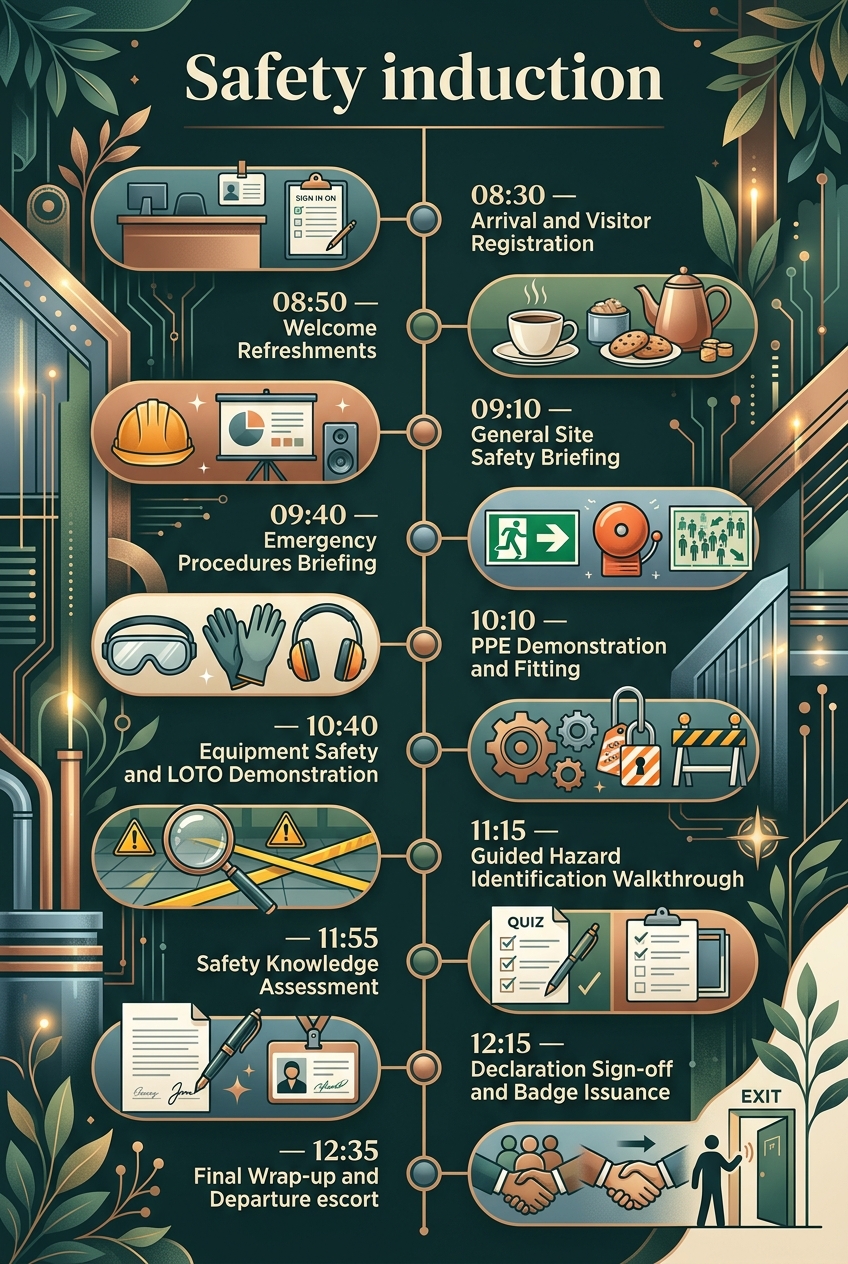
Why Safety Inductions Need a Timeline
Running a workplace orientation without a structured time schedule frequently results in key topics being rushed or completely omitted. When site rules are communicated hastily, new personnel miss vital emergency procedures or proper equipment handling techniques. A strict schedule guarantees that critical safety controls receive dedicated focus before anyone steps onto an active shop floor or construction zone.
Pacing the orientation prevents training fatigue. Sitting through multi-hour lectures on statutory regulations leads to information overload, causing personnel to tune out crucial warnings. Spacing out theoretical modules with practical equipment fittings, live workshop demonstrations, and guided facility walks keeps inductees alert and receptive throughout the morning.
Finally, a defined timeline establishes legal accountability and operational discipline from minute one. Regulators like OSHA and the UK Health and Safety Executive (HSE) require documented proof that site personnel receive comprehensive safety training. Having a structured running order ensures every regulatory requirement is systematically delivered and recorded.
What to Include in a Safety Induction Timeline
A thorough safety induction schedule balances administrative verification, instructional briefings, practical demonstrations, and compliance validation. Every effective orientation program should include:
- Security Gate Check-in & Registration: Identity verification, visitor log signing, and resource packet distribution.
- Orientation Lounge Reception: Informally welcoming inductees and outlining expectations over morning refreshments.
- General Site Safety Briefing: Reviewing core company commitments, zero-harm policies, site rules, and general hazard warnings.
- Emergency Action Plan Review: Detailed instructions on site alarm sounds, primary and secondary evacuation routes, assembly points, and incident reporting.
- PPE Practical Fitting Session: Hands-on inspection, fitting, and adjustment of mandatory high-visibility vests, hard hats, safety eyewear, and steel-toe footwear.
- Machinery Safety & LOTO Demos: Live practical demonstrations showing Lockout/Tagout controls, machine guarding, and energy isolation protocols.
- Guided Zone Hazard Walkthrough: Supervised walk through working zones to identify real-world hazard markings, emergency cut-off switches, and pedestrian thoroughfares.
- Compliance Knowledge Assessment: Digital or written testing to verify comprehension of site safety rules.
- Declaration Sign-off & Badge Issuance: Signing legal compliance declarations and issuing physical or digital site access credentials.
Site Arrival and Initial Orientation
| Time | Event |
|---|---|
| 08:30 | Arrival and Visitor Registration |
| 08:50 | Welcome Refreshments |
The induction begins at the main security gate, where incoming personnel present identification and record their details in the visitor log. Prompt registration prevents delays at the facility gate and ensures security personnel maintain an accurate head count for emergency muster logs. During this initial touchpoint, security officers distribute induction resource folders containing site maps, hazard cheat sheets, and emergency contacts.
Following registration, attendees move directly into the visitor orientation lounge for light refreshments. This short transition allows late arrivals to catch up without disrupting classroom presentations. While attendees enjoy coffee or tea, safety facilitators establish a welcoming environment and set clear expectations for active participation during the morning session.
Core Safety and Policy Briefings
| Time | Event |
|---|---|
| 09:10 | General Site Safety Briefing |
| 09:40 | Emergency Procedures Briefing |
At 09:10, participants move into the training center auditorium for the foundational classroom modules. The Health, Safety, and Environment (HSE) Manager leads the general site safety briefing, outlining company zero-harm values, alcohol and drug policies, personal conduct standards, and baseline hazard awareness. Establishing uncompromising safety standards early in the briefing sets a serious tone for all upcoming site operations.
At 09:40, focus shifts immediately to emergency action protocols. Facilitators present high-resolution floor plans detailing emergency exit paths, fire extinguisher locations, eye-wash stations, and official muster zones. Understanding emergency evacuation procedures is mandatory before any individual enters active processing areas. Facilitators also explain the internal incident reporting software, stressing that every near-miss must be logged immediately.
Much like running structured governance sessions using a board meeting timeline, executing site safety briefings requires strict timing so presenters cover every statutory obligation without losing audience focus.
Hands-on Equipment and Hazard Walkthrough
| Time | Event |
|---|---|
| 10:10 | PPE Demonstration and Fitting |
| 10:40 | Equipment Safety and LOTO Demonstration |
| 11:15 | Guided Hazard Identification Walkthrough |
Transitioning into the practical equipment laboratory at 10:10 keeps energy levels high after classroom lectures. Safety officers demonstrate correct inspection protocols for personal protective equipment, explaining how to identify cracked hard hats, worn boot treads, or damaged eye protection. Personalized gear sizing ensures maximum wearer comfort and guarantees that mandatory safety standards are physically met before individuals enter dangerous environments.
At 10:40, the group moves into the demonstration workshop for an interactive Lockout/Tagout (LOTO) tutorial. Trainers demonstrate zero-energy verification procedures, machine guard testing, and safe clearance distances around heavy mobile plant equipment. Seeing real lockout devices applied to live machinery reinforces theoretical warnings far more effectively than slides or booklets alone.
The practical phase culminates at 11:15 with a guided hazard walkthrough through designated operational zones. Led by safety officers, participants navigate physical walkways, observe overhead crane operation corridors, locate real emergency shut-off switches, and spot warning signage. While regulatory safety compliance is distinct from organizing celebratory events like an anniversary party schedule or a baby shower timeline, both rely on deliberate timing and smooth transitions between physical spaces.
Compliance Testing and Access Credentialing
| Time | Event |
|---|---|
| 11:55 | Safety Knowledge Assessment |
| 12:15 | Declaration Sign-off and Badge Issuance |
| 12:35 | Final Wrap-up and Departure escort |
At 11:55, participants gather in the computer testing room to take a brief digital knowledge assessment. Automated testing evaluates recall of alarm sounds, LOTO safety rules, PPE standards, and hazard reporting protocols. Instant digital scoring provides immediate confirmation that every participant understands site rules before receiving unescorted site access.
Once testing is complete, candidates proceed to the safety administration office at 12:15. Inductees review and sign legal safety declaration forms confirming their understanding of site policies and commitment to safety compliance. Formal written declarations create essential audit trails for safety management systems. Coordinators then log records into the site database and issue active access badges.
The induction session concludes at 12:35 back at the security gate. Facilitators address any remaining questions, gather feedback surveys, and ensure temporary visitors are safely escorted to their designated site hosts or exit points. Whether managing complex workplace compliance schedules or planning milestone events like a birthday party timeline, maintaining structured timeframes ensures every key objective is completed smoothly.
Safety Induction Timeline vs Safety Onboarding Checklist
It is common to confuse a safety induction timeline with a safety onboarding checklist, but they serve distinct roles in workforce management:
| Feature | Safety Induction Timeline | Safety Onboarding Checklist |
|---|---|---|
| Primary Purpose | Schedules real-time orientation events and practical sessions on day one. | Tracks multi-week administrative and task-specific training milestones. |
| Format | Minute-by-minute running order with exact start times and locations. | Categorized master task list marked off over weeks or months. |
| Scope | Covers essential site rules, emergency protocols, and initial access sign-off. | Covers job-specific skill building, equipment certifications, and mentorship. |
| Target Audience | New hires, temporary contractors, external auditors, and site visitors. | Permanent employees undergoing role-specific skills development. |
While a checklist tracks what tasks need to be completed over a worker's first month, a timeline governs when each critical orientation exercise takes place during the initial access briefing.
Who Should Use This Template?
This safety induction schedule is adaptable across diverse heavy industries and commercial operational facilities. It is designed for:
- Manufacturing Plants: Ensuring line operators and maintenance contractors understand high-speed machinery risks and LOTO isolation.
- Construction Site Operators: Orienting sub-contractors on fall protection, high-visibility requirements, and heavy plant movement.
- Logistics & Distribution Warehouses: Training forklift drivers and warehouse staff on pedestrian segregation and rack safety.
- Oil, Gas & Energy Facilities: Instructing personnel on hazardous area classifications, hot work permits, and emergency shutdowns.
- Commercial Property Managers: Onboarding service contractors and facilities maintenance teams safely onto physical premises.
Chronolio supports the different roles involved in orchestrating complex schedules, whether you are an HSE Director, Site Manager, or Workplace Safety Officer.
How to Use This Template
- Download or Duplicate: Access the editable template in your preferred format or edit online. You can also download print-ready versions as a Word document or PDF file.
- Adjust Operational Details: Tailor session times, location names (e.g., room numbers, building wings), and facilitator titles to match your site layout.
- Assign Responsibilities: Clearly delegate modules (e.g., security check-in, LOTO demo, testing supervision) to qualified safety officers.
- Publish and Distribute: Send the running order to facilitators, site hosts, and incoming personnel prior to orientation day.
Tips for a Successful Safety Induction
- Test AV and Practical Gear Early: Verify that projectors, testing computers, and PPE fitting samples are prepared before 08:30.
- Enforce Strict Room Capacity: Keep group sizes under 15–20 participants to ensure everyone gets hands-on time during PPE fitting and LOTO demonstrations.
- Incorporate Interactive Q&A: Encourage participants to speak up during the site walkthrough rather than saving all questions for the end.
- Keep Refreshments Close: Positioning morning drinks inside or near the orientation lounge keeps break transitions on schedule.
- Automate Testing Scoring: Use digital testing tools that grade assessments immediately to avoid manual review bottlenecks at sign-off.
- Audit Walkthrough Routes: Ensure designated hazard inspection routes are clear of temporary obstructions before conducting guided tours.
Common Mistakes to Avoid
- Overloading Morning Lectures: Packing three hours of uninterrupted PowerPoint slides causes attendee fatigue and lowers information retention.
- Rushing Emergency Evacuation Topics: Treating emergency alarm codes and assembly points as quick check-box items leaves workers unprepared for real incidents.
- Skipping Practical PPE Sizing: Distributing generic protective equipment without individual fitting leads to uncomfortable workers who misuse gear.
- Ignoring Contractor Language Barriers: Running briefings exclusively in one language without translation options compromises site safety for non-native speakers.
- Failing to Document Declarations: Neglecting to collect signed compliance declarations before issuing site badges exposes the facility to audit liabilities.
- Allowing Unescorted Floor Access: Permitting inductees onto active operational floors before formal badge issuance breaches fundamental security protocols.
In Summary
- Defined Orientation Structure: A safety induction timeline organizes 4 hours of theoretical, practical, and administrative safety training.
- Regulatory Compliance: Helps organizations meet strict OSHA, HSE, and regional occupational health and safety legal standards.
- Practical Engagement: Combines classroom lectures with hands-on PPE fitting, LOTO demonstrations, and zone walkthroughs.
- Verified Understanding: Integrates digital testing and formal sign-offs before granting physical site access credentials.
- Broad Applicability: Easily tailored for manufacturing, construction, energy, logistics, and industrial facility onboarding.
By implementing this structured safety induction schedule, site management teams ensure that every worker and contractor enters the shop floor fully informed, properly equipped, and committed to zero harm.
Customize Your Safety Induction Timeline