






This Template at a Glance
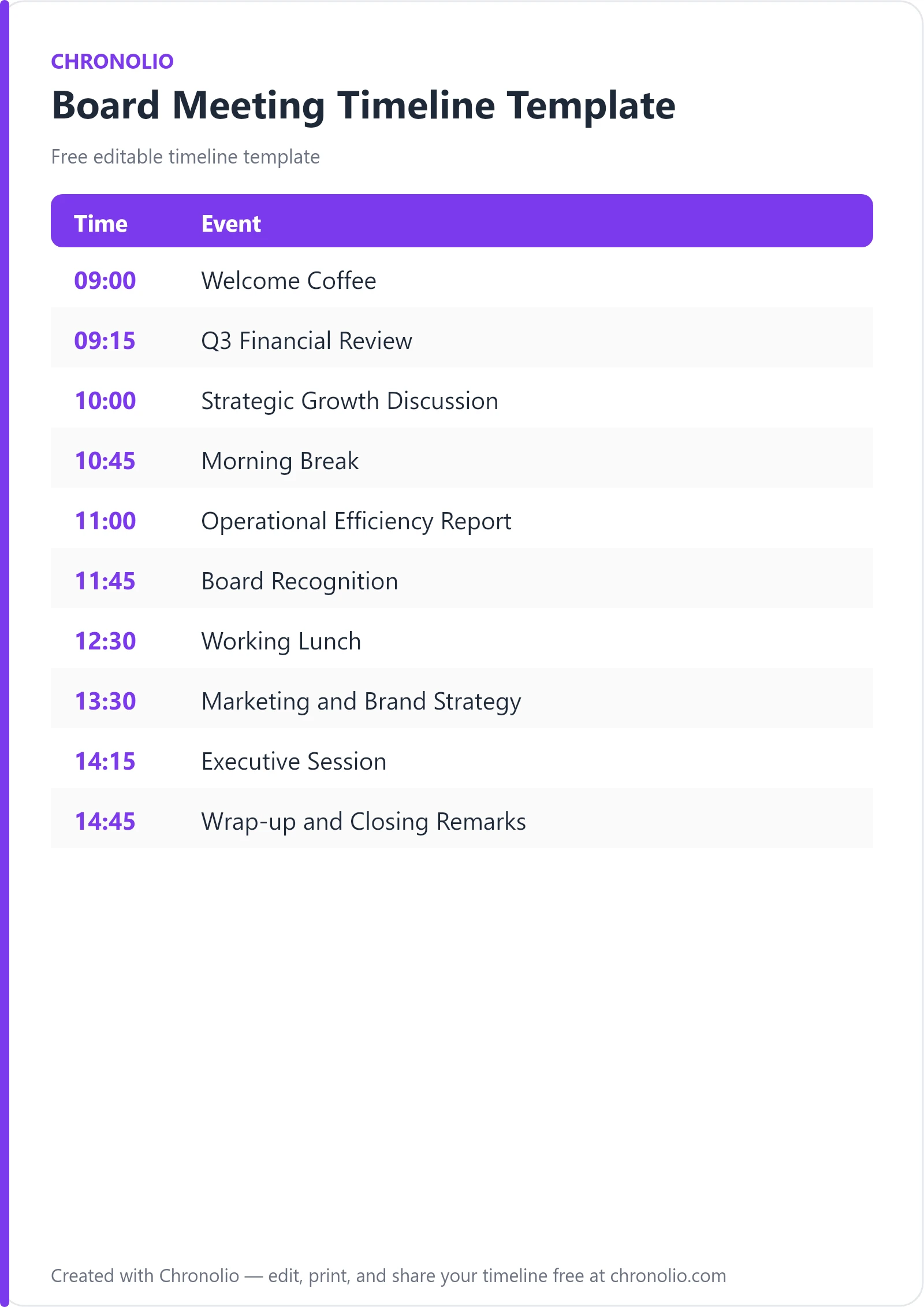
Here is the complete schedule this free template gives you — every time block, ready to edit, download, and share:
| Time | Event |
|---|---|
| 09:00 | Welcome Coffee |
| 09:15 | Q3 Financial Review |
| 10:00 | Strategic Growth Discussion |
| 10:45 | Morning Break |
| 11:00 | Operational Efficiency Report |
| 11:45 | Board Recognition |
| 12:30 | Working Lunch |
| 13:30 | Marketing and Brand Strategy |
| 14:15 | Executive Session |
| 14:45 | Wrap-up and Closing Remarks |
What Is a Board Meeting Timeline?
A board meeting timeline is a precise, time-stamped schedule that dictates the running order, physical venue transitions, and time limits for every item on a board of directors agenda. Unlike a high-level list of topics, a fully realized timeline accounts for the real-world operational pace of high-stakes governance. It maps out when directors assemble, when presentation decks transition, when mandatory legal items are discussed, and when private governance discussions occur.
Having structured dozens of executive board retreats and corporate governance sessions, I have seen firsthand how an unmanaged schedule leads to fatigue, rushed decisions on critical investments, and missed voting items. This schedule reflects real-world board meeting structures, combining strict regulatory compliance with comfortable operational flow. By anchoring your schedule to explicit time blocks, you ensure that high-value discussions—such as capital allocations, leadership succession, or market expansion—get the focused deliberation they deserve.
Customize Your Board Meeting Timeline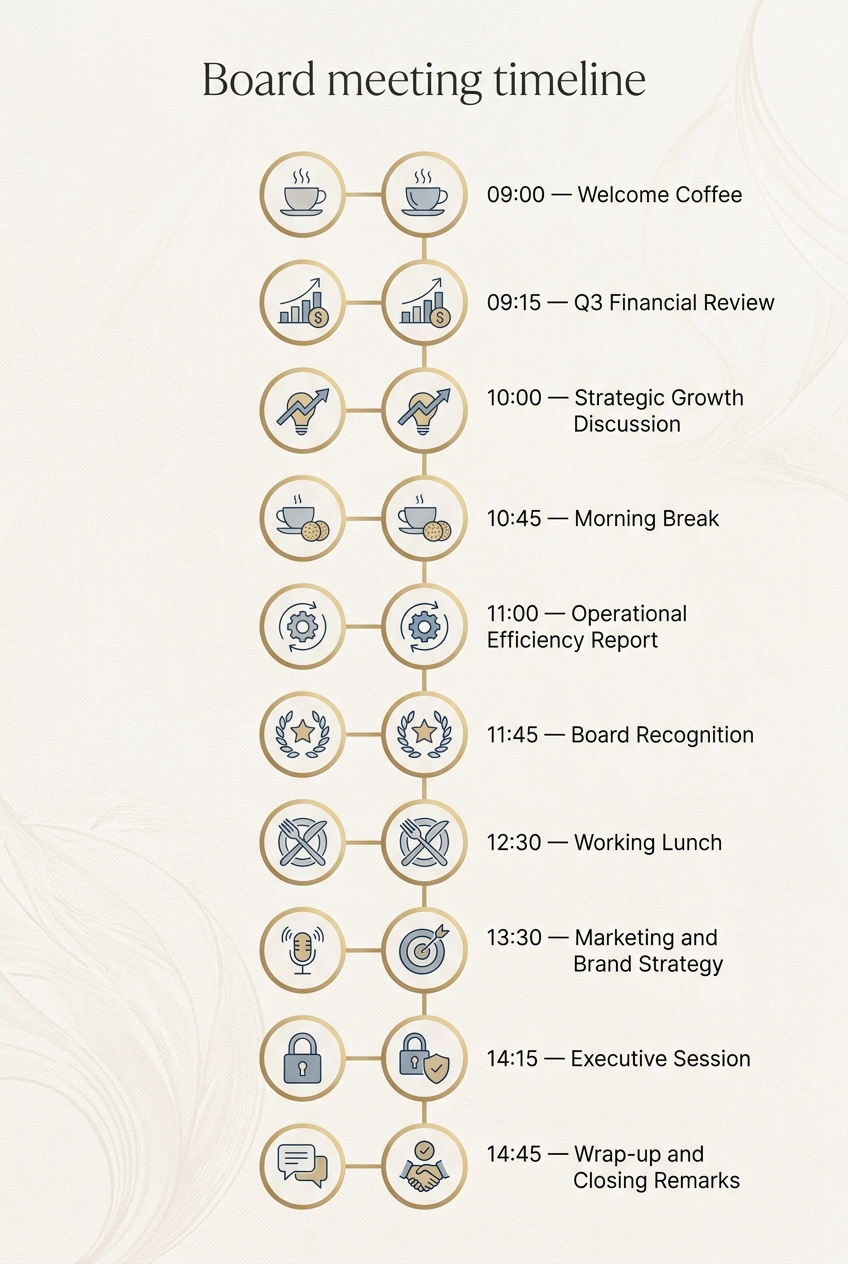
Why Board Meetings Need a Timeline
Running a successful corporate board meeting requires balancing legal compliance, strategic oversight, and respect for attendees' time. Executive directors, independent board members, and corporate officers often travel significant distances to attend, making efficient time management an absolute necessity for effective board governance.
Without a rigid running order, early agenda topics tend to spill over into time reserved for deeper strategic evaluation. A clear schedule serves as an objective tool for the Board Chair, allowing them to redirect tangential debates and keep the floor moving without appearing dismissive.
Furthermore, precise time allocations give executives and guest presenters clarity on when they must be present in the boardroom. CFOs, legal counsel, and operations leaders can prepare their presentations knowing exactly how much time they have to convey key findings and answer inquiries, leading to a far more professional and productive boardroom environment.
What to Include in a Board Meeting Timeline
A comprehensive board schedule must account for both formal governance obligations and practical physical needs. To maintain productivity throughout a full-day session, your meeting structure should always incorporate:
- An informal arrival period: Time for directors to gather, enjoy morning refreshments, and review final board packs before calling the meeting to order.
- Financial performance and budget reviews: Clear time slots dedicated to quarterly financial statements, cash flow analysis, and audit reports led by the CFO.
- Strategic growth and investment discussions: Deliberate focus areas addressing market expansions, capital expenditure, potential acquisition targets, or product roadmaps.
- Structured physical breaks: Mid-morning and mid-afternoon intermissions to prevent cognitive fatigue and facilitate casual peer networking.
- Operational efficiency updates: Departmental deep dives into supply chain management, risk oversight, compliance, and technology infrastructure.
- Governance and recognition milestones: Moments reserved for honoring retiring board members, approving committee charters, or passing formal resolutions.
- A working lunch session: A structured meal period designed for informal executive dialogue without completely losing momentum.
- A closed executive session: Private time reserved exclusively for board directors to discuss sensitive leadership, compensation, and governance matters.
- Formal adjournment and action item logging: A final wrap-up phase where the Board Secretary records action items, confirms voting results, and schedules the next assembly.
Morning Arrival, Financial Oversight, and Strategic Planning
The opening hours of a board meeting set the analytical tone for the entire day. By placing complex financial evaluations and high-stakes growth strategy early in the schedule, you ensure directors address critical topics while their attention and sharpest analytical thinking are at their peak.
| Time | Event |
|---|---|
| 09:00 | Welcome Coffee |
| 09:15 | Q3 Financial Review |
| 10:00 | Strategic Growth Discussion |
| 10:45 | Morning Break |
The day begins in the Main Lobby at 09:00 with light refreshments, allowing directors, executive leadership, and legal counsel to settle in, exchange informal greetings, and finalize their review of the board pack. Promptly at 09:15, the Board Chair calls the assembly to order in Boardroom A, transitioning directly into the Q3 Financial Review. The CFO presents key financial performance metrics, budget variances, and revenue forecasts, opening the floor for director inquiries regarding capital allocation and fiduciary standing.
At 10:00, the board transitions into the Strategic Growth Discussion. This 45-minute block provides space to review market expansion strategies, assess industry risks, and evaluate prospective M&A targets. If your board is currently navigating corporate restructuring or public announcements alongside strategic planning, consider coordinating your schedule with an M&A Announcement Event: A Professional Timeline Guide to ensure seamless corporate alignment. Following this intensive debate, a 15-minute break in the Lounge Area gives directors time to stretch and process early discussions.
Midday Operations, Board Governance, and Working Lunch
The mid-day segment shifts from macro strategy to internal operations, organizational governance, and director recognition. Balancing heavy analytical discussions with personal recognition and catered dining maintains energy levels across the board table.
| Time | Event |
|---|---|
| 11:00 | Operational Efficiency Report |
| 11:45 | Board Recognition |
| 12:30 | Working Lunch |
At 11:00, the meeting reconvenes in Boardroom A with the Operational Efficiency Report. The Operations Director walks the board through key performance indicators, supply chain optimizations, risk management frameworks, and internal process automations. This operational pulse check provides ground-level visibility into how executive leadership is executing on previously approved corporate strategy.
At 11:45, the focus turns to internal governance and board leadership during the Board Recognition segment. The Chairperson leads a formal presentation honoring a retiring board member for their years of dedicated fiduciary service, recording formal board appreciation into the meeting minutes. At 12:30, attendees transition into the adjacent Dining Hall for a catered Working Lunch. This informal setting allows directors to discuss board matters in a relaxed context while refueling for afternoon sessions.
Afternoon Brand Alignment, Executive Session, and Adjournment
The final phase of the board meeting addresses broad commercial strategy before closing non-member attendance for private governance discussions and final administrative wrap-up.
| Time | Event |
|---|---|
| 13:30 | Marketing and Brand Strategy |
| 14:15 | Executive Session |
| 14:45 | Wrap-up and Closing Remarks |
Reassembling in Boardroom A at 13:30, the Chief Marketing Officer presents the Marketing and Brand Strategy, detailing major multi-channel initiatives, public relations positioning, and digital performance metrics. For organizations scheduling public reveals or media outreach alongside board oversight, integrating insights from a Media/press briefing: A Proven Schedule for Success or a Product launch event timeline: A Guide to a Flawless Reveal helps ensure operational handoffs remain coordinated across departments.
At 14:15, all management personnel, guest speakers, and executive officers step out of Boardroom A as the board enters an Executive Session. This restricted session enables independent directors to discuss sensitive personnel issues, executive performance, legal exposure, and corporate governance without staff present. Finally, at 14:45, the Chairperson initiates Wrap-up and Closing Remarks, summarizing key decisions, confirming voting resolutions recorded by the secretary, logging outstanding action items, and formally adjourning the meeting at 15:00.
Board Meeting Timeline vs Board Meeting Agenda
While often used interchangeably by corporate secretaries, a board meeting timeline and a board meeting agenda perform distinct functions in governance administration:
| Aspect | Board Meeting Timeline | Board Meeting Agenda |
|---|---|---|
| Primary Focus | Timing, duration, venue flow, and schedule execution | List of topics, background documents, and discussion points |
| Structure | Time-blocked schedule (e.g., 09:15–10:00) | Numerical sequence of topics (e.g., Item 1.0, Item 2.0) |
| Primary Users | Chair, Board Secretary, and operational event coordinators | Directors, guest presenters, and corporate stakeholders |
| Operational Goal | Ensures discussions remain on schedule and preserve quorum | Ensures all legally required governance topics are introduced |
While the agenda outlines what must be discussed to fulfill corporate oversight, the timeline governs how the meeting flows across the day. Combining a clear agenda with a strict timeline prevents high-priority topics from being cut short due to poor time allocation.
Who Should Use This Template?
This timeline template is designed for organizational leaders, administrative directors, and governance professionals responsible for managing high-level board schedules. It is ideal for:
- Corporate Boards of Directors: Public and private enterprise boards holding quarterly statutory governance meetings.
- Non-Profit Boards of Trustees: Non-profit institutions balancing fiduciary oversight with trustee development and fundraising reviews.
- Executive Leadership Teams: Senior leadership groups conducting quarterly operational reviews and board reporting sessions.
- Startup Advisory Boards: Fast-growing technology firms needing structured investor and advisory board updates.
- Healthcare & Hospital Boards: Governing bodies managing institutional compliance, medical staff appointments, and long-range expansion.
- Higher Education Governing Bodies: University boards overseeing institutional strategy, endowment performance, and administrative policy.
Whether you are managing executive logistics or tracking governance actions, Chronolio offers specialized platform features for diverse leadership roles involved in enterprise event management.
How to Use This Template
Implementing this schedule for your upcoming meeting is simple and straightforward:
- Download or Duplicate: Access the customizable template online or download the offline version as a .docx file or .pdf document.
- Input Meeting Variables: Set your meeting date, physical location details (e.g., specific boardroom numbers), and virtual access links.
- Adjust Time Blocks: Tailor the duration of specific sessions based on your agenda priorities—extending strategic growth discussions during major pivot planning or expanding executive sessions during annual reviews.
- Coordinate Presenters: Share relevant time slots with presenting executives (CFO, Operations Director, CMO) so they know exactly when to arrive.
- Distribute with Board Packets: Send the completed timeline along with board packs to directors at least one week prior to the meeting.
Tips for a Successful Board Meeting
- Distribute Board Packs Early: Provide financial reports, committee notes, and background decks at least 5 to 7 days in advance. Directors should arrive ready to deliberate decisions, not read reports for the first time.
- Assign a Dedicated Timekeeper: While the Board Chair runs the meeting, empower the Board Secretary to signal remaining time limits for each agenda item.
- Enforce Strict Rules of Order: Use established parliamentary rules, such as Robert's Rules of Order, to manage motions, voting, and debate efficiency.
- Buffer High-Debate Topics: Allocate extra time after financial and strategic topics to accommodate intense debate without throwing off subsequent agenda items.
- Protect the Executive Session: Never skip closed-door sessions. Regular executive sessions establish standard governance practice and prevent media speculation when private issues must be discussed.
- Record Action Items in Real-Time: Have the secretary track actionable decisions, assigned owners, and hard deadlines publicly on a display monitor or legal board software.
- Focus on Strategic Priorities: Ensure at least 60% of board time is dedicated to forward-looking strategy rather than backward-looking operational updates, as emphasized by corporate leadership guidelines from the Harvard Law School Forum on Corporate Governance.
Common Mistakes to Avoid
- Overpacking the Agenda: Trying to cover too many minor operational items leaves insufficient time for major strategic and legal deliberations.
- Failing to Track Quorum: Neglecting to log director arrivals and departures, which risks invalidating board votes and formal resolutions.
- Allowing Management to Dominate Time: Overloading meetings with long management slideshows instead of engaging independent board members in active debate.
- Omitting Breaks: Driving through hours of dense financial reporting without a break causes fatigue and decreases analytical focus.
- Ignoring Follow-Up Timelines: Failing to document action item ownership before adjourning, leading to unexecuted board decisions between quarterly meetings.
- Vague Presentation Formats: Allowing presenters to speak without structured presentation bounds or dedicated Q&A buffers.
In Summary
- A board meeting timeline is a time-stamped schedule designed to manage the flow, focus, and legal compliance of executive board meetings.
- The sample schedule provides a balanced 6-hour framework covering financial reviews, growth strategy, operational reporting, executive sessions, and director recognition.
- Dedicated break buffers and working lunches maintain high cognitive focus and support productive peer networking.
- Executive sessions protect independent governance by providing private time for closed-door director discussions.
- Early board pack distribution and clear role assignments ensure directors arrive fully prepared for active deliberation.
Maximizing boardroom efficiency requires blending rigorous corporate governance with structured time management. By adopting a proven board meeting schedule, enterprise boards, executive leadership teams, and corporate secretaries can guarantee that every meeting yields clear decisions, maintains compliance, and respects the time of executive directors.
Customize Your Board Meeting Timeline