






This Template at a Glance
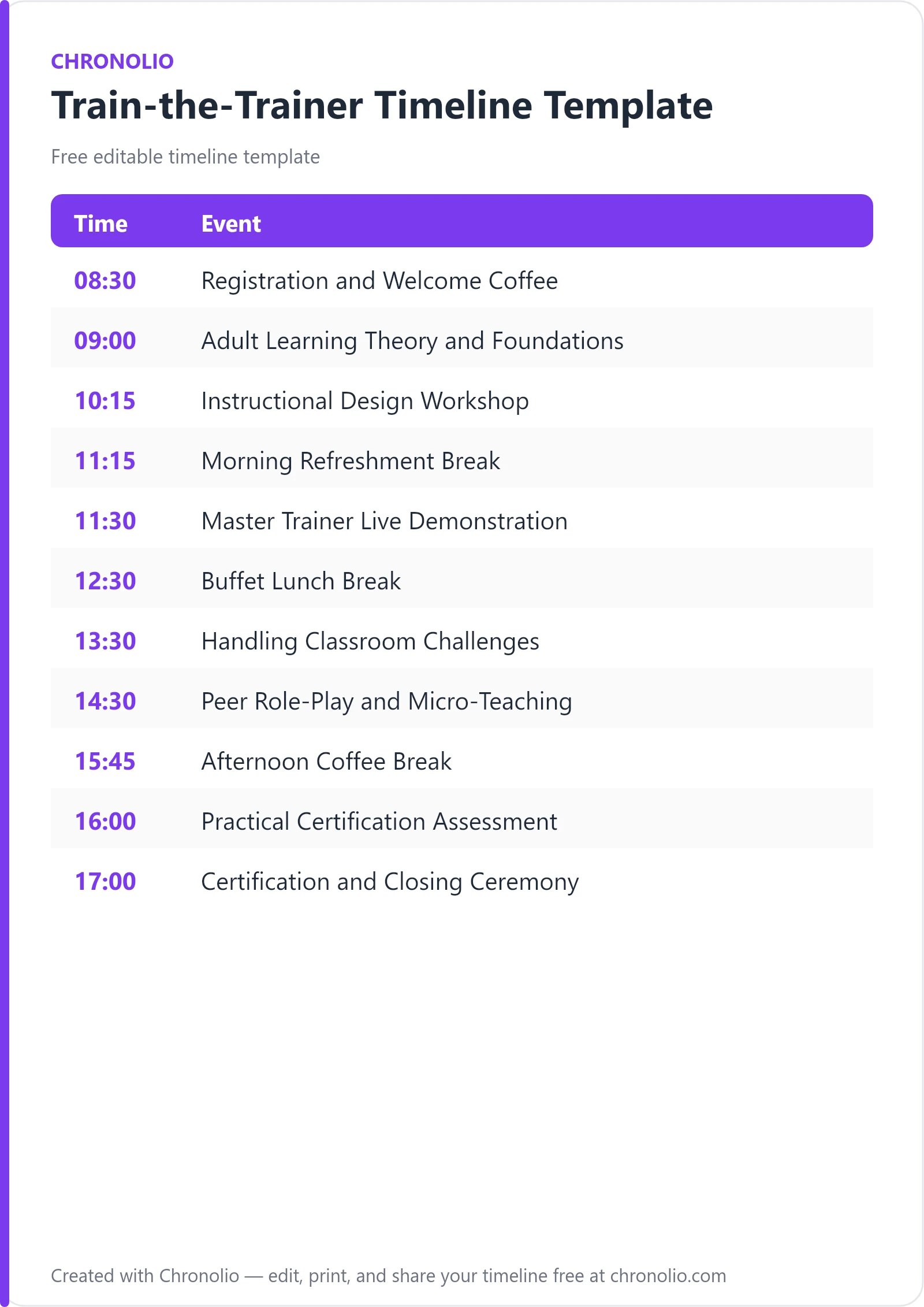
Here is the complete schedule this free template gives you — every time block, ready to edit, download, and share:
| Time | Event |
|---|---|
| 08:30 | Registration and Welcome Coffee |
| 09:00 | Adult Learning Theory and Foundations |
| 10:15 | Instructional Design Workshop |
| 11:15 | Morning Refreshment Break |
| 11:30 | Master Trainer Live Demonstration |
| 12:30 | Buffet Lunch Break |
| 13:30 | Handling Classroom Challenges |
| 14:30 | Peer Role-Play and Micro-Teaching |
| 15:45 | Afternoon Coffee Break |
| 16:00 | Practical Certification Assessment |
| 17:00 | Certification and Closing Ceremony |
What Is a Train-the-Trainer Timeline?
A train-the-trainer timeline is a structured master schedule that organizes the pedagogical, practical, and evaluative phases of a facilitator development workshop. Designed for corporate learning leaders, instructional designers, and external consultants, this roadmap outlines how participants transition from passive listeners to confident classroom presenters over a single day.
Running a successful train-the-trainer (TTT) program requires balancing pedagogical theory with hands-on practice. Without a meticulous schedule, facilitators risk spending too much time on lecturing adult learning models and running out of time for critical micro-teaching sessions. This proven template reflects real-world workshop structures honed across corporate academies, ensuring candidate trainers absorb instructional design principles, observe master behaviors, practice deliverable modules, and complete rigorous certification assessments without feeling rushed.
Edit Your Train-the-Trainer Timeline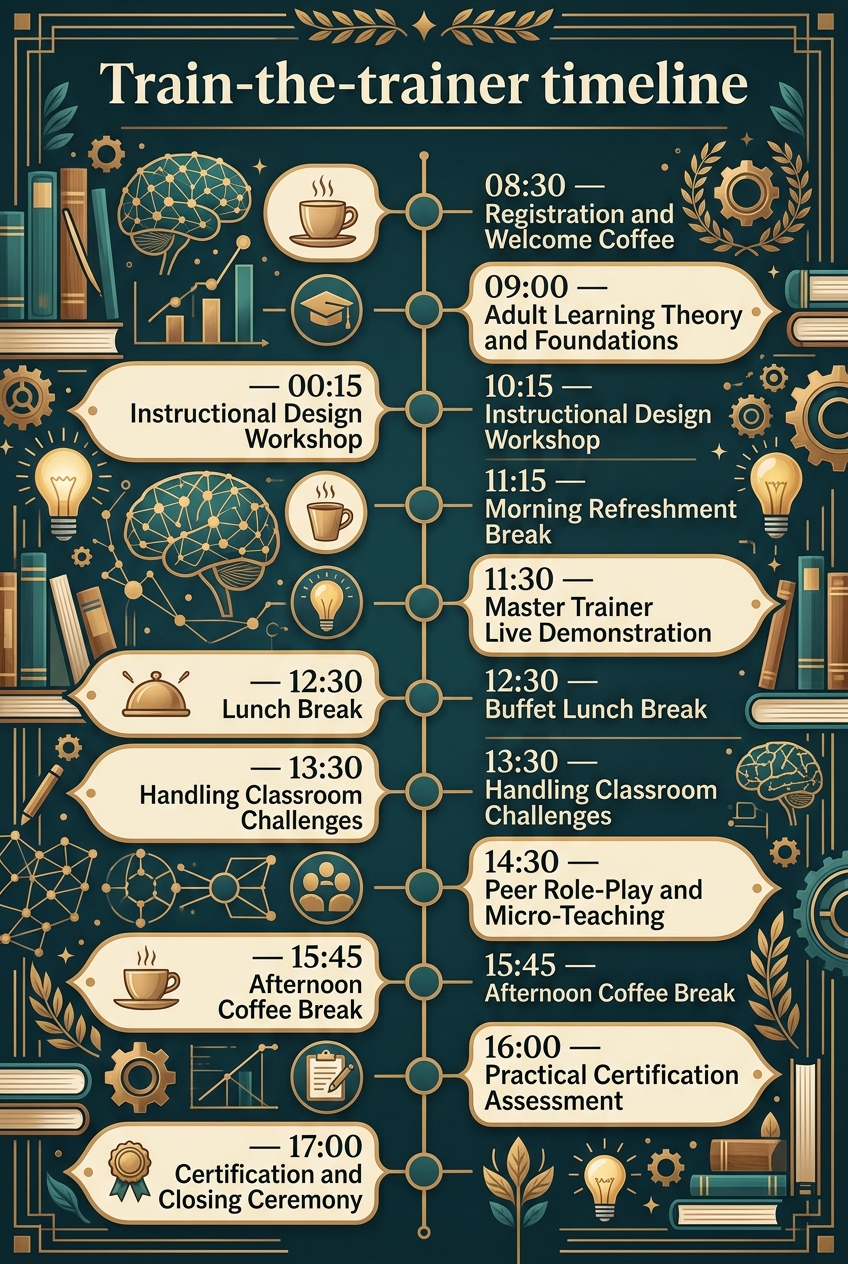
Why Train-the-Trainer Sessions Need a Timeline
Intensive professional development workshops live or die by momentum. When subject matter experts gather to learn facilitation techniques, predictable time blocks build trust and maintain cognitive energy. Adult learners need clear expectations regarding when they will absorb theoretical concepts, when they will practice live delivery, and when they will be evaluated against certification criteria.
Logistically, running a multi-stage corporate workshop requires seamless coordination across multiple venue spaces, including main auditoriums, small breakout rooms, and assessment centers. Just as corporate secretaries rely on a board meeting timeline template to keep executive sessions on schedule, L&D coordinators need a master running order to align catering staff, AV technicians, and lead assessors.
Finally, an explicit timeline guarantees accountability for candidate evaluation. By dedicating fixed hours to practical role-playing and standardized assessments, organizers ensure every candidate receives fair, unhurried feedback against the workshop rubric.
What to Include in a Train-the-Trainer Timeline
To deliver a comprehensive train-the-trainer workshop, your schedule must cover key developmental building blocks:
- Arrival and Welcome: Registration, material distribution, initial icebreakers, and morning networking.
- Theoretical Foundations: Core principles of adult learning theory, retention science, and facilitation styles.
- Instructional Design: Workshop structuring, learning objectives, taxonomy alignment, and multimedia selection.
- Master Trainer Demonstration: Live modeling of vocal variety, body language, and audience engagement techniques.
- Classroom Dynamics: Strategies for handling difficult participants, maintaining energy, and facilitating Q&A sessions.
- Peer Role-Play Micro-Teaching: Small-group teach-backs with immediate peer and facilitator feedback.
- Practical Assessment: Standardized candidate evaluations scored against a formal certification rubric.
- Recognition Ceremony: Final certification distribution, photo opportunities, and workshop debrief.
Morning Foundation & Instructional Design
| Time | Event |
|---|---|
| 08:30 | Registration and Welcome Coffee |
| 09:00 | Adult Learning Theory and Foundations |
| 10:15 | Instructional Design Workshop |
| 11:15 | Morning Refreshment Break |
The workshop opens in the Executive Foyer at 08:30 with registration and informal networking over morning coffee. Starting with a relaxed 30-minute check-in allows participants to settle in, receive their workbook binders, and network before diving into dense theoretical material.
At 09:00, the group transitions into the Main Auditorium for Adult Learning Theory and Foundations. This interactive session explores Malcolm Knowles’ principles of androgeny, Bloom's Taxonomy, and visual-auditory-kinesthetic learning preferences. Establishing these core concepts early gives participants the theoretical lens needed to critique their own facilitation habits throughout the day.
At 10:15, participants move to Workshop Room A for the Instructional Design Workshop. Here, trainers transition from what adults learn to how courseware is engineered. They learn to draft measurable learning objectives, map out lesson plans, and select complementary multimedia tools.
The morning concludes with a well-earned 11:15 Refreshment Break back in the Executive Foyer. Short mid-morning breaks are critical in adult learning environments to clear cognitive overload before live practical sessions begin.
08:30 AM [Registration & Coffee] ---------> Networking & Arrival 09:00 AM [Adult Learning Theory] ---------> Theoretical Foundation 10:15 AM [Instructional Design] ---------> Course Construction 11:15 AM [Morning Break] -----------------> Cognitive Reset
Master Demonstration & Afternoon Dynamics
| Time | Event |
|---|---|
| 11:30 | Master Trainer Live Demonstration |
| 12:30 | Buffet Lunch Break |
| 13:30 | Handling Classroom Challenges |
Promptly at 11:30, participants gather back in the Main Auditorium to witness a Master Trainer Live Demonstration. Rather than just hearing about good delivery, candidate trainers watch an expert model high-impact facilitation, body language shifts, vocal projection, and audience participation strategies. According to research from the Association for Talent Development (ATD), observational learning combined with active feedback drastically improves facilitation retention in corporate environments.
At 12:30, everyone steps into the Dining Hall for a Buffet Lunch Break. A full 60-minute break ensures participants can digest complex ideas, build peer connections, and recharge mentally for the high-intensity afternoon exercises.
At 13:30, the afternoon begins in Workshop Room B with Handling Classroom Challenges. This module addresses real-world practical hurdles: managing talkative or disengaged participants, keeping energy high post-lunch, and handling unexpected technical failures. Learning how to manage difficult classroom dynamics builds psychological safety before candidates step up to perform their own micro-teaching assignments.
Practical Micro-Teaching & Certification
| Time | Event |
|---|---|
| 14:30 | Peer Role-Play and Micro-Teaching |
| 15:45 | Afternoon Coffee Break |
| 16:00 | Practical Certification Assessment |
| 17:00 | Certification and Closing Ceremony |
At 14:30, the workshop enters its most critical phase: Peer Role-Play and Micro-Teaching. Participants split into Breakout Rooms 1–4, where each candidate delivers a 10-minute mini-lesson to their peers. Peer groups use structured evaluation rubrics to give immediate, constructive feedback on non-verbal cues, slide pacing, and questioning techniques.
Following a brief 15:45 Afternoon Coffee Break, candidate trainers move to the Assessment Center at 16:00 for the Practical Certification Assessment. Under the observation of lead assessors, candidates present a final, polished training segment evaluated against strict organizational standards.
The day reaches its climax at 17:00 in the Main Auditorium with the Certification and Closing Ceremony. Candidates receive official facilitator credentials, take group photos, and celebrate their growth into certified trainers. Whether you are running a high-stakes corporate upskilling program or organizing a structured milestone event like a formal gathering, following a clear master plan ensures a rewarding outcome. If you also organize social events or milestone gatherings, our birthday party timeline template and baby shower timeline template offer the same structured approach to time management across different domains.
Train-the-Trainer Timeline vs Standard Workshop Agenda
While both documents guide attendees through an educational event, a train-the-trainer schedule differs significantly from a general training workshop agenda in purpose, structure, and assessment rigor.
| Feature | Train-the-Trainer Timeline | Standard Workshop Agenda |
|---|---|---|
| Primary Goal | Developing delivery, facilitation, and teaching skills | Building subject matter knowledge or technical skill |
| Participant Role | Active practice, micro-teaching, and peer evaluation | Passive listening, Q&A, and guided individual exercises |
| Assessment Type | Live practical delivery evaluated via rubric | Written quiz, project execution, or attendance check |
| Room Requirements | Breakout rooms, assessment centers, main hall | Single main classroom or lecture hall |
| Feedback Mechanism | Immediate peer and master facilitator critiques | Post-event feedback survey |
A standard workshop agenda focuses heavily on content consumption. In contrast, a train-the-trainer timeline allocates over 40% of its total operational runtime to active facilitation practice, micro-teaching segments, and structured performance rubrics.
Who Should Use This Template?
This versatile training schedule is tailored for organizations and leaders responsible for scaling knowledge, maintaining quality control, and certifying educators across various sectors.
- Corporate L&D Departments: Scaling internal onboarding, product training, or compliance workshops across enterprise teams.
- Human Resources & Talent Managers: Professionalizing internal subject matter experts into capable classroom leaders.
- Management Consultants: Delivering white-label train-the-trainer programs to client organization champions.
- Franchise Operations Teams: Ensuring uniform operational standards across multi-location franchise units.
- Healthcare & Safety Educators: Standardizing clinical compliance, emergency safety, and equipment protocols.
- Non-Profit & Community Trainers: Upskilling volunteers and regional organizers to lead community workshops.
Chronolio supports the various specialized roles required to run smooth, time-sensitive training programs, from primary master facilitators to breakout assessors and venue ops teams.
How to Use This Template
- Download or Duplicate the Master Template: Access the schedule via Chronolio or grab a copy in DOCX format or PDF format.
- Set Your Workshop Date and Location: Fill in venue specifics, room numbers (e.g., Main Auditorium, Breakout Rooms 1–4), and logistics contacts.
- Customize Module Durations: Adjust time blocks to match your specific curriculum complexity or certification requirements.
- Assign Assessors and Facilitators: Designate master trainers for the morning demonstration and lead assessors for the afternoon certification blocks.
- Share with Stakeholders: Distribute the finalized running order to participants, venue managers, catering staff, and evaluation panels at least one week prior to the workshop.
Tips for a Successful Train-the-Trainer Event
- Strictly Enforce Break Times: Facilitation workshops are mentally demanding. Keep morning and afternoon coffee breaks non-negotiable to maintain focus.
- Pre-Assign Breakout Groups: Group candidate trainers in advance to avoid wasting valuable minutes during the transition to micro-teaching sessions.
- Use Standardized Scoring Rubrics: Ensure lead assessors evaluate candidate performance using identical criteria for voice control, slide design, and audience engagement.
- Record Practical Sessions: If possible, video record micro-teaching presentations so candidates can review their own body language and delivery posture post-event.
- Keep Catering Light: Serve low-glycemic lunches and light refreshments to prevent afternoon sluggishness during the technical assessment blocks.
- Set Clear Expectation Rules: Inform participants early that micro-teaching involves supportive, constructive peer critique to foster a safe learning space.
Common Mistakes to Avoid
- Overloading Theory at the Expense of Practice: Spending too much time on adult learning concepts leaves insufficient time for candidate micro-teaching.
- Skipping the Live Master Demo: Failing to showcase what "great facilitation" looks like leaves candidates without a clear visual benchmark.
- Inadequate Breakout Space: Attempting role-plays in a single noisy room causes acoustic overlap and distracts presenters.
- Vague Feedback Guidelines: Allowing peers to give uncoordinated feedback leads to non-constructive or surface-level comments.
- Unclear Assessment Criteria: Failing to publish the certification rubric ahead of time creates unnecessary anxiety for candidate trainers.
- Ignoring Room Flip Timings: Forgetting to schedule buffer time between main auditorium presentations and small breakout sessions disrupts workshop flow.
In Summary
- A train-the-trainer timeline organizes facilitation theory, design workshops, master demos, and live assessments into a single seamless day.
- It allocates dedicated hours for adult learning theory, interactive problem-solving, and practical peer role-playing.
- Micro-teaching and micro-assessments form the core of facilitator qualification and confidence building.
- Standardized scoring rubrics guarantee objective certification across all training cohorts.
- Strategic refreshment breaks keep cognitive energy high during intensive single-day workshops.
- Downloadable versions in train-the-trainer timeline DOCX and train-the-trainer timeline PDF format ensure quick deployment for any organization.
Whether you are hosting corporate upskilling sessions, executive seminars, or even personal celebrations like those planned with an anniversary party schedule template or a christian wedding timeline, disciplined scheduling guarantees seamless execution. This train-the-trainer template gives L&D managers, corporate consultants, and master facilitators the perfect framework to build confident, high-performing educators.
Edit Your Train-the-Trainer Timeline