





This Template at a Glance
Here is the complete schedule this free template gives you — every time block, ready to edit, download, and share:
| Time | Event |
|---|---|
| 09:00 | Bridal Preparation |
| 12:00 | Arrival at Church |
| 13:00 | Processional |
| 13:15 | Liturgy of the Word |
| 13:45 | Vows and Ring Exchange |
| 14:10 | Liturgy of the Eucharist |
| 14:45 | Recessional |
| 15:30 | Cocktail Hour |
| 16:30 | Wedding Dinner |
| 18:00 | Cake Cutting |
| 18:30 | Reception Dance |
What Is a Catholic Wedding Timeline?
A Catholic wedding timeline is a structured, chronological schedule that organizes every sacred ritual and logistical detail of a Catholic wedding day, centered around a Holy Nuptial Mass. Unlike standard secular ceremonies that last 20 minutes, a Catholic matrimony liturgy is a deeply spiritual sacrament requiring deliberate timing for scripture readings, liturgical music, the homily, solemn vows, and the Liturgy of the Eucharist.
Navigating the flow between sacred parish requirements and social celebration requires careful planning. This comprehensive outline reflects real-world parish guidelines, vendor standards, and practical timing insights cultivated over decades of church event coordination. Whether you are hosting a full mass or coordinating with a parish coordinator, having an accurate order of events keeps your family, wedding party, officiant, photographer, and guests synchronized from morning prep to the final dance. If you need alternative formats for your planning binder, you can download our template as a Catholic Wedding Timeline DOCX or a Catholic Wedding Timeline PDF.
Customize Your Catholic Wedding Timeline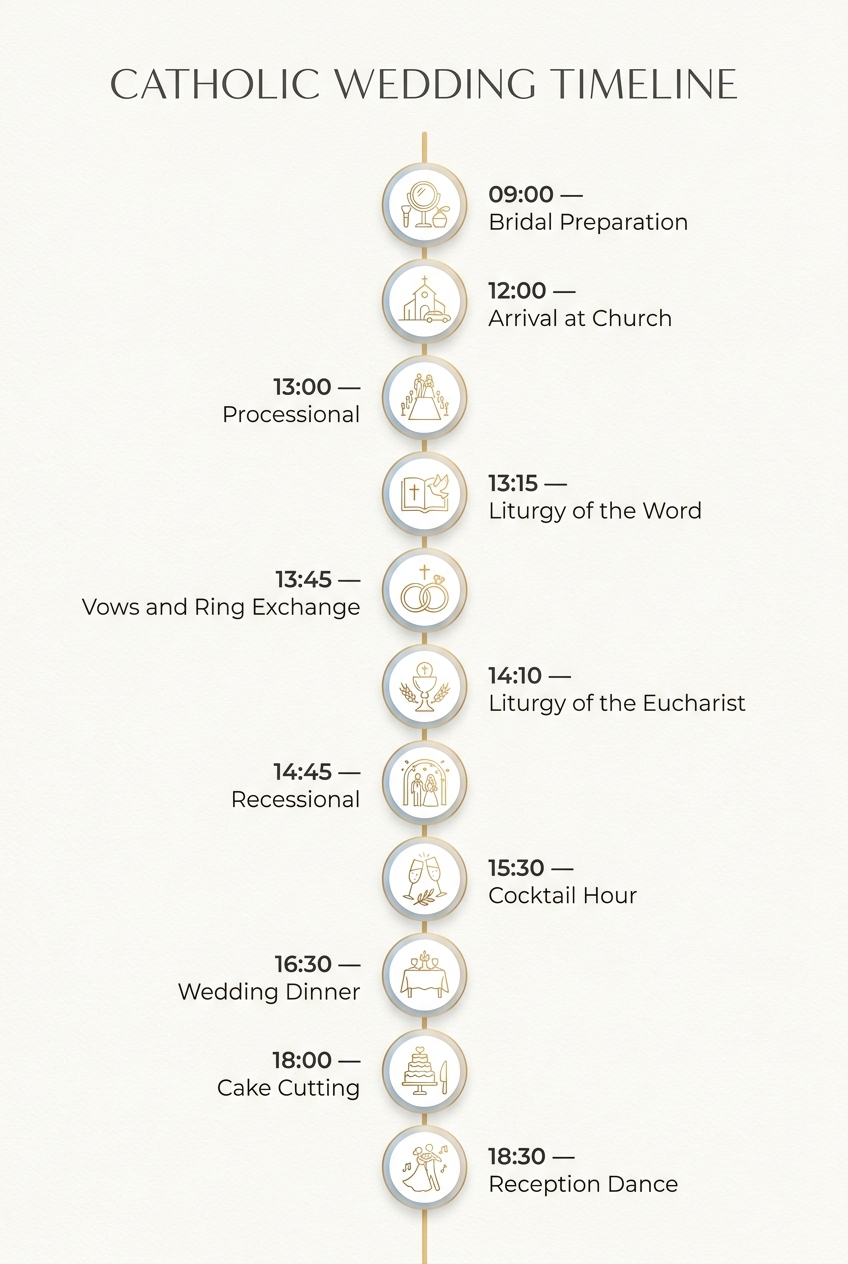
Why Catholic Weddings Need a Timeline
Planning a Catholic matrimony requires balancing the reverent atmosphere of a sacred sanctuary with the energy of a joyful reception. Parishes often operate on strict weekend schedules, hosting Saturday confessions or evening vigil masses immediately following afternoon weddings. Strict church time limits mean your ceremony must start and end on time to respect parish operations and ensure the sanctuary is cleared for evening services.
Beyond sanctuary constraints, a dedicated schedule eliminates confusion for vendors, altar servers, organists, and family members. A well-organized flow prevents rushed morning hair and makeup sessions, protects sacred moments from unnecessary disruptions, and ensures your photographer captures every key moment without interfering with the solemnity of Holy Communion.
Finally, a structured schedule softens the transition across different venues. Because Catholic ceremonies often finish in the mid-afternoon while receptions begin later in the evening, establishing clear times ensures your guests feel cared for and fully aware of where to go throughout the celebration.
What to Include in a Catholic Wedding Timeline
To build an accurate schedule for your wedding day, ensure your itinerary incorporates these crucial stages:
- Bridal Preparation: Hair, makeup, candid photography, and quiet prayer moments in the bridal suite.
- Church Arrival & Gathering: Final touch-ups, greeting early guests, and seating VIP family members.
- Liturgical Processional: Entry of the officiant, liturgical ministers, wedding party, and bride escorted down the main aisle.
- Liturgy of the Word: First reading from the Old Testament, Responsorial Psalm, Second Reading, Gospel, and homily.
- Sacrament of Matrimony: The exchange of marital vows, blessing and exchange of rings, and the Nuptial Blessing.
- Liturgy of the Eucharist: Offertory procession, Eucharistic prayer, Lord's Prayer, and Holy Communion.
- Recessional & Exit: Joyful exit down the center aisle and transition to formal portraiture.
- Cocktail Hour & Reception: Guest refreshment, bridal party portraits, formal sit-down dinner, toasts, cake cutting, and dancing.
Morning Preparation & Parish Arrival
| Time | Event |
|---|---|
| 09:00 | Bridal Preparation |
| 12:00 | Arrival at Church |
The morning begins in the bridal suite, where hair stylists, makeup artists, and the bridal party gather to prepare for the sacred day ahead. Allocating a full two hours for prep provides a comfortable buffer for hair and makeup services, vendor deliveries (such as bouquets and boutonnieres), and candid photography. If your bridal party is large, consider starting earlier or hiring additional stylists. Couples who prefer an earlier practice session often pair this with a structured rehearsal dinner timeline template the evening before to ensure everyone knows their places.
By 12:00, the wedding party transitions from the preparation venue to the church main entrance. Arriving 60 minutes before the mass begins gives the groomsmen time to assist in seating family members, allows the bride and groom time for private prayer in the chapel, and ensures the priest and parish coordinator can verify all liturgical items (such as the unity candle, program booklets, and mass gifts) are prepared at the altar.
The Sacred Nuptial Mass
| Time | Event |
|---|---|
| 13:00 | Processional |
| 13:15 | Liturgy of the Word |
| 13:45 | Vows and Ring Exchange |
| 14:10 | Liturgy of the Eucharist |
| 14:45 | Recessional |
At 13:00, the church doors open for the processional down the main aisle. Accompanied by traditional organ music or sacred choir pieces, the liturgical ministers lead the way, followed by the groomsmen, bridesmaids, maid of honor, and finally the bride escorted by her father. For couples planning traditional non-Eucharistic ceremonies, comparing this schedule with a church wedding ceremony timeline can help illustrate how liturgies vary with or without Holy Communion.
The Liturgy of the Word commences at 13:15 with Old and New Testament passages proclaimed by designated readers, followed by the Responsorial Psalm sung by a cantor and the priest’s homily. The heart of the sacrament unfolds at 13:45 during the exchange of vows and rings at the altar, where the couple pledges lifelong fidelity before God and the congregation. Following the vows, the ceremony moves into the Liturgy of the Eucharist at 14:10, where the couple brings up the gifts of bread and wine, culminating in Holy Communion for Catholic guests. The mass concludes at 14:45 with the solemn Nuptial Blessing and a joyful recessional down the center aisle.
Reception & Evening Celebration
| Time | Event |
|---|---|
| 15:30 | Cocktail Hour |
| 16:30 | Wedding Dinner |
| 18:00 | Cake Cutting |
| 18:30 | Reception Dance |
Following the formal recessional, guests transition from the parish sanctuary to the reception location. At 15:30, the cocktail hour begins on the garden patio, giving guests time to relax with drinks and hors d'oeuvres while the newlyweds and wedding party remain with the photographer for formal family portraits at the altar and church grounds. If you are comparing traditional religious schedules with other celebration styles, exploring a civil ceremony wedding timeline offers great insights into differing guest transitions.
Guests enter the grand ballroom at 16:30 for a formal sit-down dinner service. Spacing dinner across ninety minutes allows ample time for multi-course meal service alongside heartfelt speeches by the best man and maid of honor. At 18:00, the couple cuts the wedding cake, served alongside coffee and dessert tea. By 18:30, the dance floor officially opens for the evening celebration, featuring the first dance, parent dances, and open social dancing through 21:30.
Catholic Wedding Timeline vs Civil Wedding Timeline
Understanding how a full Nuptial Mass schedule differs from a secular or civil timeline is essential for setting expectations with vendors and guests.
| Feature / Phase | Catholic Wedding Timeline | Civil Wedding Timeline |
|---|---|---|
| Primary Focus | Sacred sacrament & Eucharistic liturgy | Personal legal exchange & custom vows |
| Ceremony Duration | 60 to 90 minutes | 15 to 30 minutes |
| Officiant | Ordained Catholic Priest or Deacon | Civil Magistrate, Judge, or Officiant |
| Ceremony Structure | Fixed liturgical order (Readings, Vows, Mass) | Highly customizable script & music |
| Intermission Gap | Common 2–3 hour afternoon gap | Minimal gap before cocktail hour |
| Sacred Elements | Eucharist, Nuptial Blessing, Scripture | Personal vows, ring exchange, unity rites |
While a civil service prioritizes brevity and personalized script choices, a Catholic wedding centers around church canon law and holy sacrament. The formal nature of a Catholic mass requires a longer ceremony block and explicit coordination with parish staff regarding music, attire, and altar etiquette.
Who Should Use This Template?
This schedule is designed specifically for couples, planners, and clergy managing formal Catholic matrimony services. It fits a wide variety of parish sizes and reception styles, including:
- Catholic couples celebrating a full Nuptial Mass with Holy Communion.
- Interfaith couples celebrating Matrimony without Mass inside a Catholic church.
- Wedding planners and coordinators aligning parish rules with private reception venue staff.
- Parish coordinators and directors guiding couples through liturgical ceremony timing.
- Photographers and videographers needing precise times for sanctuary access and lighting limits.
Chronolio helps different roles involved in running the wedding stay perfectly synchronized across multiple venues and timing changes.
How to Use This Template
- Duplicate or download the schedule to your Chronolio workspace or export as a Word/PDF document.
- Set your exact ceremony start time based on your confirmed church mass time (e.g., 11:00 AM, 1:00 PM, or 2:00 PM).
- Adjust prep and reception times relative to your mass, factoring in travel distance between the church and ballroom.
- Share the schedule with your priest, coordinator, vendor team, and bridal party to establish universal alignment.
Tips for a Successful Catholic Wedding
- Confirm parish music rules early: Catholic churches have strict guidelines regarding sacred music versus secular songs. Ensure all ceremony music is approved by the parish music director well in advance.
- Plan for the "Catholic Gap": If your mass finishes at 14:30 but your reception starts at 17:30, provide guests with local coffee shop recommendations or host a early welcome lounge.
- Review photographer sanctuary boundaries: Priests often prohibit photographers from stepping into the sanctuary elevated area or using flash photography during the Eucharistic prayer.
- Assign readers early: Provide scripture readers (Liturgy of the Word) with their assigned passages weeks before the wedding so they can practice proclaiming from the ambo.
- Keep bridal suite snacks light and accessible: Morning prep runs fast; ensure protein-rich snacks and water are on hand so the bridal party remains refreshed before standing through a full mass.
- Prepare the altar gifts in advance: Designate two family members or friends to carry up the offertory gifts during the Liturgy of the Eucharist.
Common Mistakes to Avoid
- Underestimating morning prep time: Hair and makeup almost always take longer than expected; allow a 30-minute buffer before stepping into your transport.
- Forgetting parish dress codes: Ensure modest attire options (or shawls) are prepared for bridesmaids inside the sanctuary if required by parish rules.
- Ignoring travel times between venues: Always calculate peak traffic conditions when moving from the church to the cocktail hour location.
- Failing to distribute printed mass programs: Catholic liturgies involve congregational responses; printed programs help non-Catholic guests follow along and participate.
- Not assigning someone to clear church items: Designate a family member to collect ceremony programs, unity candles, and personal items from the church immediately after the recessional.
In Summary
- A Catholic wedding timeline revolves around a sacred 60- to 90-minute Nuptial Mass requiring dedicated parish planning.
- Morning preparation requires at least two hours for hair, makeup, and candid photography prior to church departure.
- Arrival at the church 60 minutes prior to ceremony start ensures proper seating, altar setup, and priest coordination.
- The ceremony progresses through the Processional, Liturgy of the Word, Matrimonial Vows, Liturgy of the Eucharist, and Recessional.
- Post-ceremony schedule blocks accommodate formal portraiture, guest transitions, cocktail hour, formal dinner, and open dancing.
- Clear communication with your parish priest, wedding coordinator, and vendors guarantees a smooth, spiritually fulfilling wedding day.
Planning your holy matrimony requires careful attention to both sacred tradition and guest comfort. This customizable Catholic wedding schedule provides the ideal structure to balance church requirements with an unforgettable reception, keeping your entire vendor team, family, and wedding party on schedule.
Customize Your Catholic Wedding TimelineFor official guidelines on Catholic matrimony rites and liturgical requirements, refer to the United States Conference of Catholic Bishops (USCCB) Marriage Resource Guide. For additional advice on selecting approved church music and readings, consult Catholic Wedding Help.