






This Template at a Glance
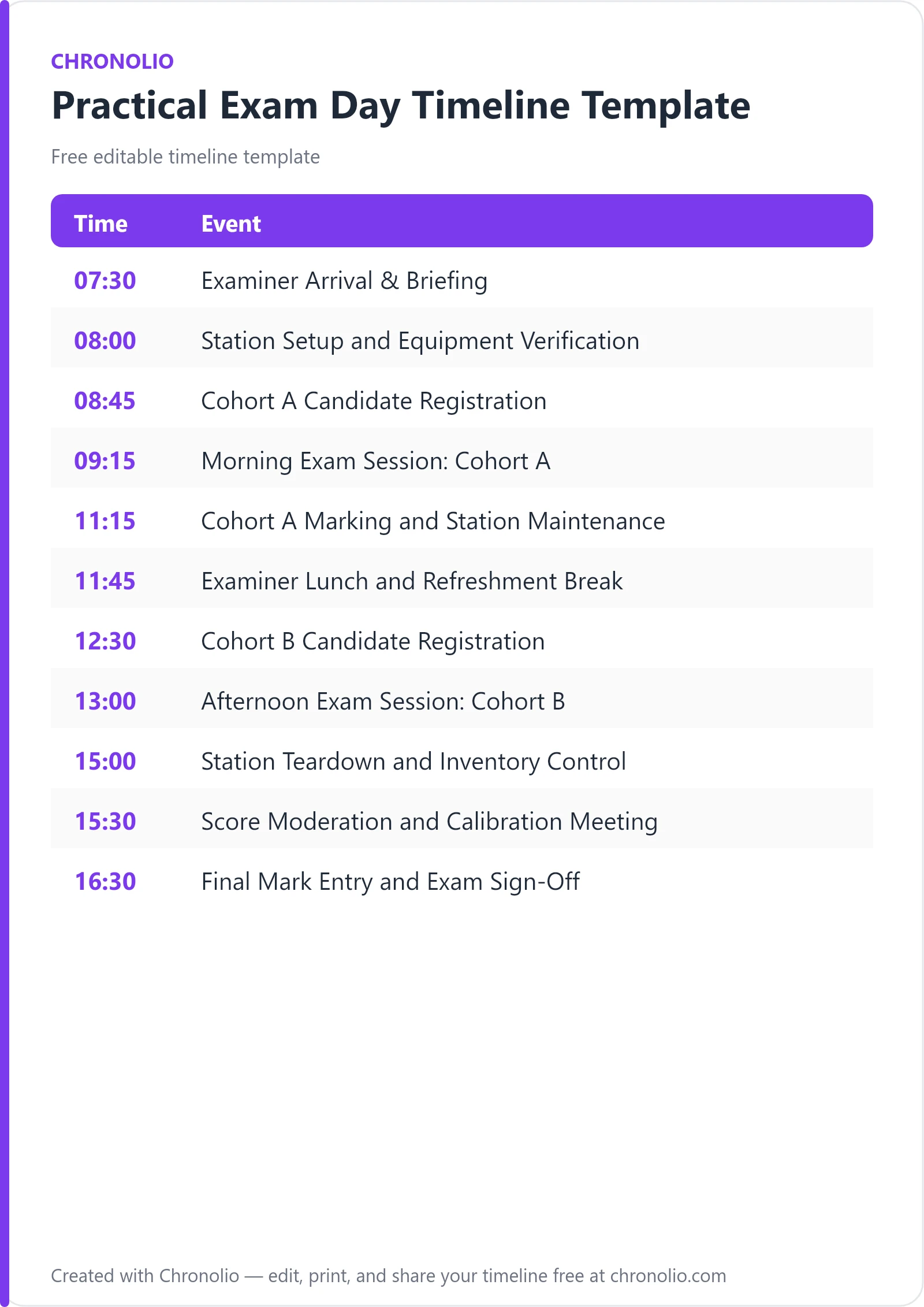
Here is the complete schedule this free template gives you — every time block, ready to edit, download, and share:
| Time | Event |
|---|---|
| 07:30 | Examiner Arrival & Briefing |
| 08:00 | Station Setup and Equipment Verification |
| 08:45 | Cohort A Candidate Registration |
| 09:15 | Morning Exam Session: Cohort A |
| 11:15 | Cohort A Marking and Station Maintenance |
| 11:45 | Examiner Lunch and Refreshment Break |
| 12:30 | Cohort B Candidate Registration |
| 13:00 | Afternoon Exam Session: Cohort B |
| 15:00 | Station Teardown and Inventory Control |
| 15:30 | Score Moderation and Calibration Meeting |
| 16:30 | Final Mark Entry and Exam Sign-Off |
What Is a Practical Exam Day Timeline?
A practical exam day timeline is an essential master control plan that coordinates every technical, administrative, and evaluative event during a performance-based assessment. Unlike traditional written tests where students sit simultaneously in a quiet hall, practical evaluations—such as Objective Structured Clinical Examinations (OSCEs), engineering performance tests, or vocational trade assessments—require synchronized candidate station rotations, live evaluator scoring, and continuous technical upkeep.
Having managed dozens of high-stakes assessment halls, I can tell you that timing is the backbone of exam validity. A single delayed station can cascade into a 45-minute backlog, leaving nervous candidates waiting in holding corridors and evaluators rushing through mark sheets. This practical exam day template reflects field-tested assessment standards used by major university examination boards, clinical skills labs, and national certifying bodies. It integrates every critical milestone from pre-dawn station calibration to post-exam score moderation, ensuring your testing facility remains compliant, fair, and perfectly on schedule. You can also download our free offline versions in /downloads/practical-exam-day.docx or /downloads/practical-exam-day.pdf.
Create your practical exam day timeline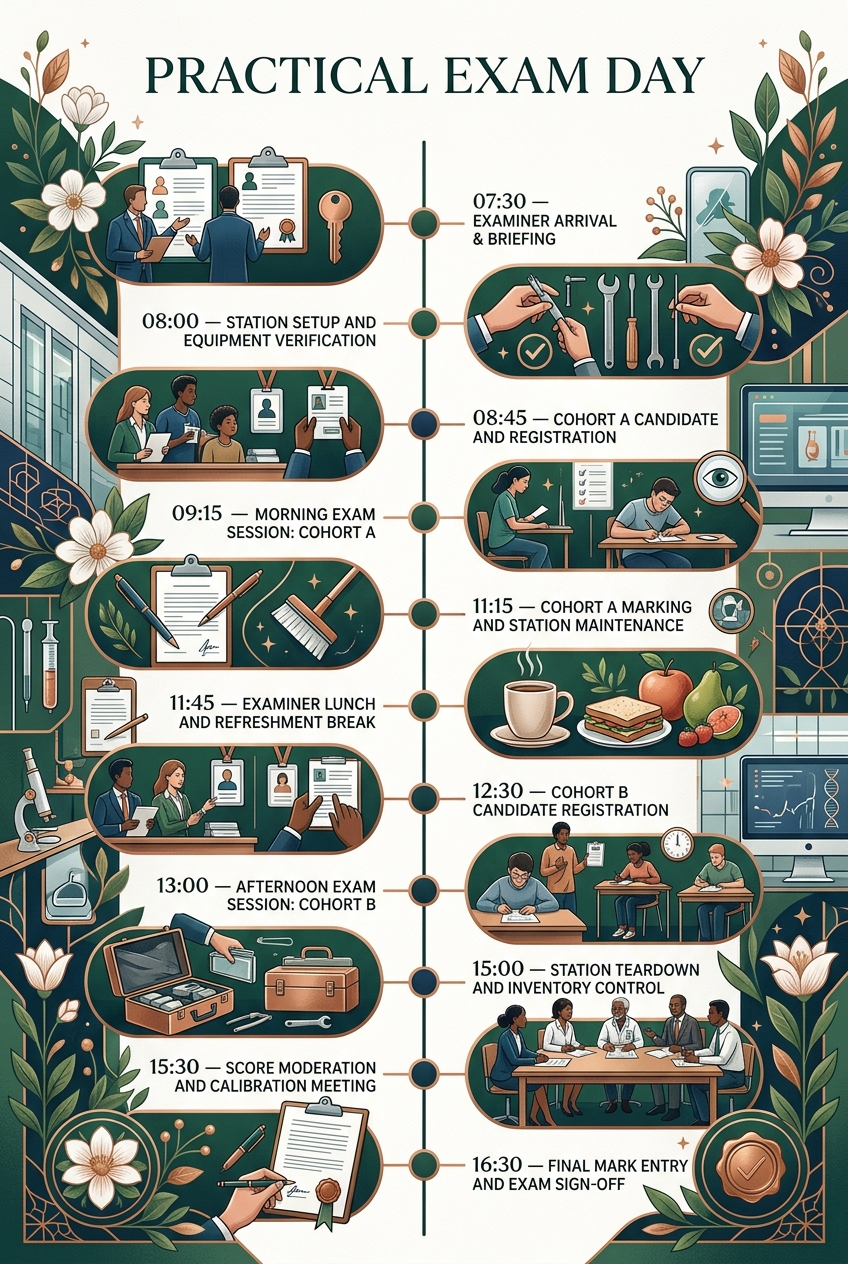
Why Practical Exam Days Need a Timeline
Practical examinations involve a fast-moving web of physical assets, strict compliance protocols, and human variables. Without a centralized timetable, even minor hiccups—like a missing diagnostic tool or a misplaced scorecard—can derail the entire testing schedule.
- Guarantees Equal Testing Conditions: Every candidate deserves the exact same duration at each station. A enforced master schedule ensures strict time equity across all cohorts, protecting the assessment from appeal challenges.
- Synchronizes Multi-Disciplinary Staff: Technical staff, invigilators, role-play actors, and senior examiners must move in lockstep. Clear timing ensures seamless handoffs between technical setup and live testing.
- Protects Evaluator Focus and Scoring Integrity: Evaluating candidates continuously is mentally taxing. Building explicit breaks and dedicated marking windows into the schedule prevents assessor fatigue and grading drift.
- Streamlines Score Calibration: Allocating fixed time for moderation immediately after testing guarantees that borderline cases and scoring anomalies are resolved while performances remain fresh in examiners' minds.
Much like a corporate governance board requires a disciplined sequence of events using a board meeting timeline, a practical testing facility demands precise scheduling to uphold institutional authority and operational rigrum.
What to Include in a Practical Exam Day Timeline
To maintain order across busy testing halls, your master schedule must incorporate several distinct operational windows:
- Assessor and Invigilator Briefings: Mandatory alignment meetings to review rubrics, safety procedures, and scoring policies.
- Technical Station Calibration: Hands-on setup, software verification, and tool distribution by technical staff before candidate arrival.
- Secure Candidate Registration: Identity checks, personal item storage, orientation, and station badge distribution in holding areas.
- Timed Exam Rotations: Active testing windows governed by synchronized bells, buzzers, or automated countdown timers.
- Station Reset & Consumables Maintenance: Rapid cleaning, equipment recalibration, and paper restocking between active testing sessions.
- Examiner Rest and Refreshment Windows: Protected breaks designed to reduce cognitive strain on grading staff.
- Score Moderation and Sign-Off: Rigorous post-exam statistical review, scorecard reconciliation, and official administrative sign-off.
Morning Setup & Candidate Registration
Morning Setup & Candidate Registration
| Time | Event |
|---|---|
| 07:30 | Examiner Arrival & Briefing |
| 08:00 | Station Setup and Equipment Verification |
| 08:45 | Cohort A Candidate Registration |
The success of a practical exam day is decided before the first candidate ever steps into the assessment hall. Starting at 07:30 in the Examiner Lounge (Room 101), examiners gather for coffee and a mandatory briefing. This initial half-hour allows chief invigilators to reiterate standardized marking rubrics, clarify candidate prompt guidelines, review emergency protocols, and confirm that all evaluators are matched with their assigned testing stations.
At 08:00, technical staff move into Practical Assessment Hall B for equipment verification and station setup. During this 45-minute window, technicians calibrate diagnostic machinery, lay out physical examination scorecards, check power connections, and position station props or anatomical models. Meanwhile, at 08:45, Cohort A Candidate Registration opens in the Main Reception & Holding Area. Invigilators verify photo identification, lock away mobile phones and smart devices, and assign colored station badges so candidates know exactly where to report when the rotation horn sounds.
+-------------------------------------------------------------------+ | PRACTICAL EXAM DAY FLOW | | | | [ 07:30 Briefing ] --> [ 08:00 Tech Setup ] --> [ 08:45 Check-in ]| | | | | [ 11:15 Marking ] <-- [ 09:15 Cohort A Exam ] <---------+ | | | | | v | | [ 11:45 Lunch ] --> [ 12:30 Cohort B ] --> [ 13:00 Exam B ] | | | | | [ 16:30 Sign-Off ] <-- [ 15:30 Moderation ] <-- [ 15:00 Teardown ]| +-------------------------------------------------------------------+
Morning Assessment Phase
Morning Assessment Phase
| Time | Event |
|---|---|
| 09:15 | Morning Exam Session: Cohort A |
| 11:15 | Cohort A Marking and Station Maintenance |
At 09:15 sharp, the active testing phase begins in Practical Assessment Hall B for Cohort A. Candidates move through six timed practical skill stations, performing tasks under the close observation of stationed assessors. Whether evaluating physical physical examinations, engineering troubleshooting, or clinical communication skills, exact station timing must be enforced via central timing chimes or automated countdown displays.
By 11:15, Cohort A completes their rotation and is escorted out of the testing environment through a secure exit path to prevent candidate interaction with afternoon cohorts. The next 30 minutes are critical: examiners use this dedicated window in Practical Assessment Hall B to finalize digital or paper scorecards and write constructive performance notes. Concurrently, technical support teams disinfect machinery, replace single-use consumables, and recalibrate diagnostic tools to ensure identical conditions for the next session.
Midday Transition & Afternoon Assessment
Midday Transition & Afternoon Assessment
| Time | Event |
|---|---|
| 11:45 | Examiner Lunch and Refreshment Break |
| 12:30 | Cohort B Candidate Registration |
| 13:00 | Afternoon Exam Session: Cohort B |
Assessor fatigue is the leading cause of subjective marking variance during full-day practical exams. At 11:45, all evaluators and support staff transition to the Staff Dining Hall for a protected 45-minute lunch break. Providing quality food and quiet space allows examiners to step away from high-density grading decisions and mentally reset before the afternoon session.
While assessors are dining, the administrative team opens Cohort B Candidate Registration at 12:30 in Auditorium A. Holding afternoon candidates in a separate facility eliminates cross-talk between incoming and outgoing cohorts, safeguarding exam security. At 13:00, Cohort B enters Practical Assessment Hall B to begin their two-hour practical examination across the freshly prepared testing stations.
Teardown, Moderation & Final Sign-Off
Teardown, Moderation & Final Sign-Off
| Time | Event |
|---|---|
| 15:00 | Station Teardown and Inventory Control |
| 15:30 | Score Moderation and Calibration Meeting |
| 16:30 | Final Mark Entry and Exam Sign-Off |
With candidate testing concluded at 15:00, technical staff perform station teardown and inventory control in Practical Assessment Hall B. Sensitive equipment, expensive diagnostic tools, and confidential scenario prompts are accounted for, packed into secure cases, and returned to locked storage rooms.
At 15:30, senior leadership, chief invigilators, and assessors assemble in Conference Room 202 for the score moderation and calibration meeting. Following established assessment frameworks, such as those published by the Association for Medical Education in Europe (AMEE), the panel reviews borderline candidates, evaluates potential station anomalies, and standardizes scoring distributions across both morning and afternoon cohorts. Finally, at 16:30, chief invigilators enter verified scores into the central academic database inside the Examiner Lounge (Room 101), sign off on official completion logs, and officially close the examination day.
Practical Exam Day Timeline vs Written Exam Schedule
It is common for administrative teams to confuse practical exam day schedules with standard written exam timetables. However, the operational demands of practical testing are far more complex.
| Operational Feature | Practical Exam Day Schedule | Written Exam Timetable |
|---|---|---|
| Primary Focus | Active candidate rotation & station setup | Static desk seating & quiet supervision |
| Resource Needs | Diagnostic tools, equipment calibration, role-players | Desk allocation, paper test booklets, answer sheets |
| Grading Mechanics | Live real-time scoring & post-session moderation | Post-exam batch marking by external graders |
| Staffing Roles | Technicians, station assessors, chief invigilators | Hall proctors, chief invigilators, door usher |
| Schedule Buffers | Mandatory gaps for station resets & sanitization | Minimal gaps required between exam papers |
While a written exam schedule simply manages arrival and paper collection, a practical exam day timeline acts as an engine that coordinates active equipment maintenance, multi-room candidate routing, live performance scoring, and institutional moderation protocols.
Who Should Use This Template?
This detailed template is built for assessment professionals who manage multi-station skill evaluations across diverse technical, scientific, and professional domains:
- Medical and Nursing Schools: Ideal for organizing complex Objective Structured Clinical Examinations (OSCEs) and patient interaction modules.
- Engineering and Technical Institutes: Perfect for practical laboratory tests, machine operating evaluations, and trade certifications.
- Culinary Arts & Hospitality Academies: Tailored for practical cooking exams, station resets, and multi-course timed judging panels.
- Emergency Services & Law Enforcement Academies: Built for tactical scenario testing, physical fitness stations, and field skills evaluations.
- Vocational & Trade Certification Boards: Designed to handle standardized skills assessments for electrical, plumbing, and automotive certifications.
Chronolio offers specialized features for various organizational roles, allowing chief invigilators, lead technicians, and academic coordinators to collaborate seamlessly on master event operational timelines.
How to Use This Template
- Download or Duplicate the Master Timetable: Access the online interactive template above or download our offline copies in /downloads/practical-exam-day.docx or /downloads/practical-exam-day.pdf.
- Configure Candidate Cohort Sizes: Adjust station durations and rotation counts based on total candidate enrollment and hall capacity.
- Customize Station Setup Times: Extend technical setup windows if your exam uses complex electronic diagnostic gear or heavy machinery.
- Assign Dedicated Room Numbers: Clearly denote physical spaces (e.g., Holding Rooms, Assessment Halls, Moderation Rooms) to prevent corridor confusion.
- Distribute Custom Views to Staff: Provide technicians with setup-focused views while giving examiners schedule views focused on briefings, testing blocks, and moderation meetings.
Tips for a Successful Practical Exam Day
- Run a Dry-Run Call Time: Have technical staff test all electronic timing bells, audio speakers, and station diagnostic machinery at least 24 hours prior to exam day.
- Enforce Strict Isolation Routes: Ensure incoming afternoon cohorts cannot cross paths with exiting morning candidates to prevent station details from leaking.
- Maintain Spare Equipment at Every Station: Keep backup diagnostic tools, extra paper mark sheets, and fresh batteries directly inside testing halls to resolve equipment failures instantly.
- Standardize Time Signal Warnings: Use clear, automated auditory signals (e.g., single chime for 1-minute warning, double chime for station rotation) across all testing halls.
- Keep Examiners Nourished and Hydrated: Place water bottles and light snacks at assessor stations so evaluators remain focused throughout multi-hour testing blocks.
- Over-Communicate Holding Area Instructions: Brief holding room invigilators to clearly explain mobile phone bans and badge numbering to reduce candidate anxiety before entry.
Common Mistakes to Avoid
- Underestimating Station Maintenance Gaps: Failing to schedule at least 30 minutes between cohorts for cleaning, re-stocking, and reset leads to rushed starts and uncalibrated gear.
- Omitting Post-Exam Moderation Time: Attempting to finalize grades immediately after testing without a calibration meeting risks unfair scoring discrepancies between assessors.
- Ignoring Assessor Fatigue: Scheduling continuously without protected lunch windows causes grading leniency or harshness in late-afternoon sessions.
- Mixing Incoming and Outgoing Candidates: Poor corridor management compromises examination security and invalidates standardized testing guidelines set by bodies like the General Medical Council.
- Failing to Prepare Emergency Stations: Not having a designated "rest station" or spare rotation spot in case a candidate falls ill during testing creates severe logjams.
In Summary
- A practical exam day timeline is an operational framework that aligns technical setup, candidate rotations, and grading moderation.
- Dedicated station setup and equipment verification windows guarantee that every candidate experiences identical, fair testing conditions.
- Splitting candidates into distinct morning and afternoon cohorts maximizes hall throughput while preserving security.
- Mandatory examiner lunch breaks and rest periods maintain grading consistency and reduce evaluator burnout.
- Built-in score moderation meetings ensure all scorecards are calibrated against standardized academic rubrics before grade lock.
- Clear schedules reduce candidate stress, streamline staff communication, and protect institutions against examination appeals.
Managing assessment schedules requires precision, but so does personal life planning! Once exam season concludes, reward your team's hard work by organizing social gatherings using our birthday party timeline, planning a milestone event with an anniversary party schedule, or preparing for family milestones using a baby shower timeline.
Whether you are running university clinical exams, technical trade certifications, or vocational skills evaluations, using a structured practical exam day timeline ensures your assessment facility operates with flawless efficiency, complete security, and unquestioned integrity.
Create your practical exam day timeline