







This Template at a Glance
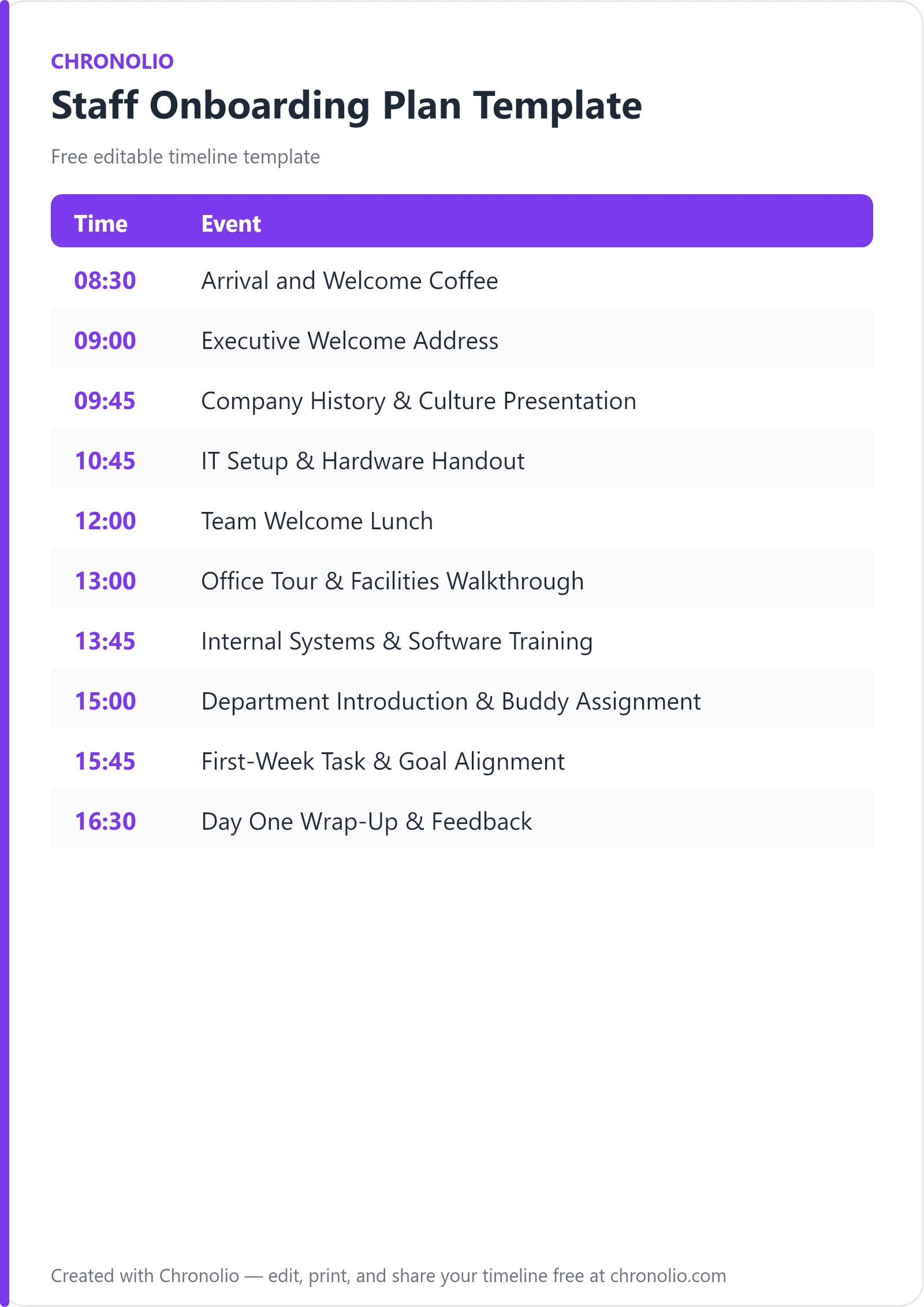
Here is the complete schedule this free template gives you — every time block, ready to edit, download, and share:
| Time | Event |
|---|---|
| 08:30 | Arrival and Welcome Coffee |
| 09:00 | Executive Welcome Address |
| 09:45 | Company History & Culture Presentation |
| 10:45 | IT Setup & Hardware Handout |
| 12:00 | Team Welcome Lunch |
| 13:00 | Office Tour & Facilities Walkthrough |
| 13:45 | Internal Systems & Software Training |
| 15:00 | Department Introduction & Buddy Assignment |
| 15:45 | First-Week Task & Goal Alignment |
| 16:30 | Day One Wrap-Up & Feedback |
What Is a Staff Onboarding Plan Timeline?
A staff onboarding plan timeline is a structured, step-by-step schedule that guides new employees through their initial orientation, hardware configuration, team introductions, and role-specific expectations. Having run corporate operations and facilitated hundreds of employee integrations, I can tell you that a smooth first day sets the trajectory for an employee's entire tenure. When new team members step into your office, they need clarity, warmth, and structured guidance—not a frantic rush to find a working laptop or an empty desk.
This template reflects proven workplace integration practices distilled from top-performing HR organizations. It balances high-level cultural immersion with practical administrative tasks, ensuring that new hires leave on their first day feeling fully prepared and genuinely welcomed. You can adapt this itinerary directly within Chronolio or export offline working copies via our downloadable Word document and printable PDF guide.
Just as formal leadership gatherings rely on a precise board meeting timeline template to keep executive discussions structured, a well-orchestrated onboarding program ensures every department—from IT to direct managers—coordinates seamlessly around the new arrival.
Customize Your Staff Onboarding Plan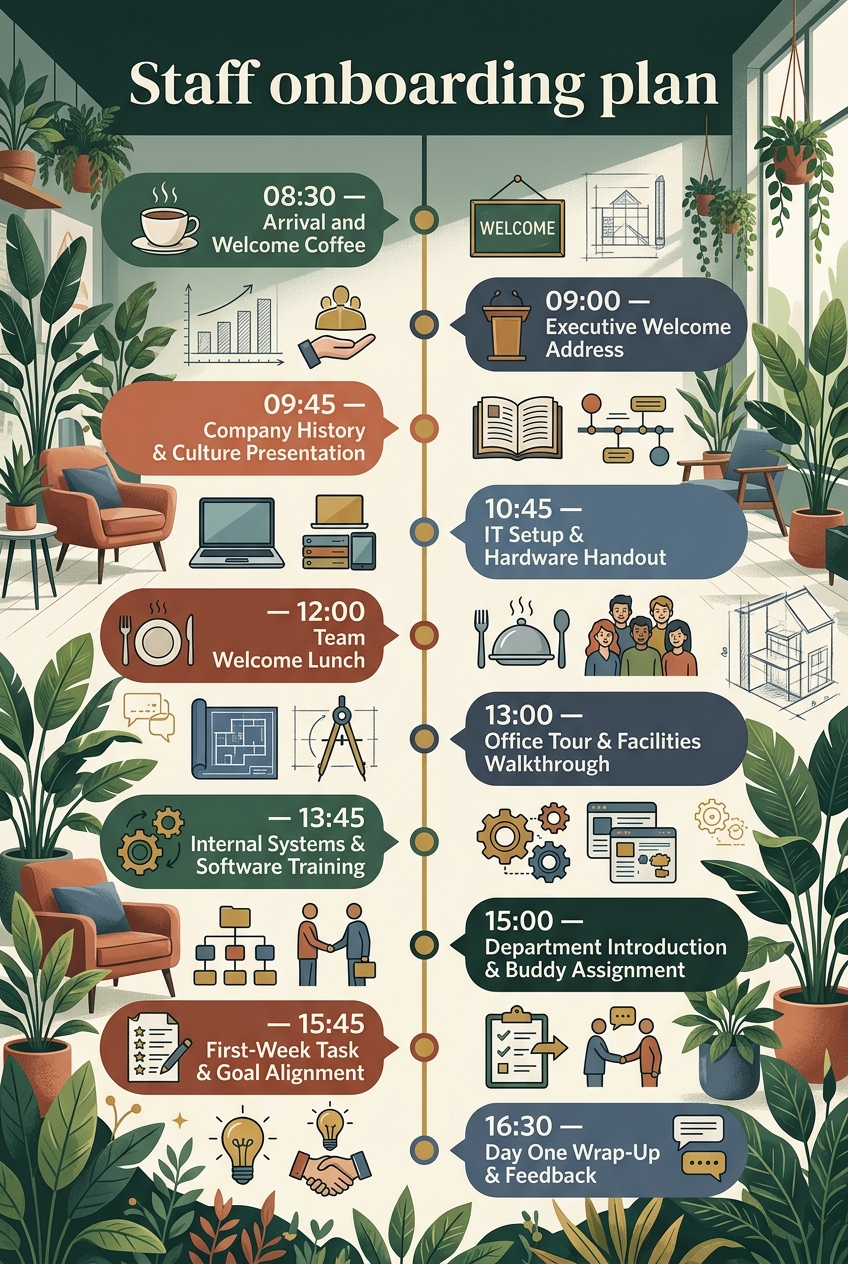
Why Staff Onboarding Plans Need a Timeline
Without a tight timeline, the first day of employment often devolves into awkward downtime, delayed IT access, and overwhelmed hiring managers. A defined schedule eliminates day-one anxiety for new hires by providing a clear map of what to expect, where to be, and who they will meet next.
Furthermore, a time-blocked plan creates operational accountability across internal departments. IT support knows exactly when hardware setup occurs, senior leaders know when to deliver their welcome address, and team leads can organize their own calendars around department introductions. According to research published by Harvard Business Review, standardized onboarding processes significantly boost employee retention and time-to-productivity.
Finally, structured schedules protect new hires from cognitive overload. Spacing out dense administrative topics like policy reviews and software training with social lunches and campus walking tours keeps energy high and information digestible throughout the day.
What to Include in a Staff Onboarding Plan
To deliver a comprehensive welcome experience, your onboarding schedule must combine administrative foundation-building with personal connection. Every high-performing plan should incorporate:
- Welcome hospitality: A dedicated arrival slot with refreshments and badge distribution to make new staff feel immediately expected and valued.
- Leadership vision: Direct access to executives or founders who communicate company mission, history, and strategic culture.
- Hardware & security configuration: Dedicated technical support for setting up company laptops, multi-factor authentication (MFA), and access keys.
- Social team integration: Structured meal times and casual gatherings where new hires meet immediate peers outside of task-oriented pressure.
- Core system navigation: Hands-on walkthroughs covering HR portals, time-tracking software, internal messaging, and document repositories.
- Peer buddy pairing: Assignment of a dedicated team buddy to mentor the new employee through unwritten workplace norms and daily routines.
- Manager goal alignment: A dedicated 1-on-1 session to establish first-week deliverables, setting up success over the initial 30-60-90 days.
Phase 1: Morning Welcome and Organizational Vision
| Time | Event |
|---|---|
| 08:30 | Arrival and Welcome Coffee |
| 09:00 | Executive Welcome Address |
| 09:45 | Company History & Culture Presentation |
The morning phase is designed to inspire and reassure new hires from the exact moment they step through the front doors. Starting at 08:30 in the Reception Lobby allows buffer time for visitors to check in, receive security badges, and settle in comfortably with breakfast pastries. Rushing new employees straight into technical training creates unnecessary stress; starting with light conversation among cohort peers builds early camaraderie.
At 09:00, transitioning into the Main Auditorium for the Executive Welcome Address grounds the cohort in the company's broader purpose. When executive leadership takes time to speak directly to incoming staff, it reinforces organizational value and mission alignment. Following this immediately with the Company History & Culture presentation deepens context, introducing new hires to core values, employee resource groups (ERGs), and community impact projects before diving into daily job functions.
Phase 2: Technical Setup and Team Integration
| Time | Event |
|---|---|
| 10:45 | IT Setup & Hardware Handout |
| 12:00 | Team Welcome Lunch |
| 13:00 | Office Tour & Facilities Walkthrough |
By mid-morning, attention naturally shifts from macro-level company vision to practical daily operations. Moving into Training Lab 1 at 10:45 for IT Setup & Hardware Handout guarantees that technical hurdles are resolved early in the day. Working side-by-side with IT specialists ensures credentials, security keys, encrypted devices, and multi-factor authentication systems are active before department managers take over.
+-------------------------------------------------------------------+ | DAY ONE ONBOARDING FOCUS | | | | [ Morning ] --> Executive Vision & Corporate History | | [ Midday ] --> IT Provisioning & Team Welcome Lunch | | [ Afternoon ] --> Software Tools, Buddy Pairing & First-Week Goals| +-------------------------------------------------------------------+
After intense technical configuration, scheduling the Team Welcome Lunch at 12:00 in the Company Cafeteria provides a vital mental break. Joining direct managers and team peers for a catered meal promotes authentic social bonding in a casual setting. Following lunch with a campus tour at 13:00 helps new staff construct a mental map of the workspace, locating essentials like print hubs, wellness rooms, break areas, and emergency exits.
Phase 3: Systems Training and Department Alignment
| Time | Event |
|---|---|
| 13:45 | Internal Systems & Software Training |
| 15:00 | Department Introduction & Buddy Assignment |
| 15:45 | First-Week Task & Goal Alignment |
| 16:30 | Day One Wrap-Up & Feedback |
The afternoon block turns attention toward practical execution within specific departments. Returning to Training Lab 1 at 13:45 for software training gives hires hands-on experience with central communication channels, task boards, and payroll portals. Guided instruction prevents employees from feeling lost when they return to their individual desks later in the week.
At 15:00, hires transition to their primary department workstations to meet their assigned onboarding buddies. Pairing a new staff member with an experienced peer provides a safe channel for operational questions and facilitates smooth integration into existing project rhythms.
At 15:45, direct managers hold a formal goal-alignment session to review expectations for the upcoming week. Finally, reconvening in the Main Auditorium at 16:30 for day-one feedback allows HR to address remaining questions and collect initial reactions. Much like hosting personal milestones using an anniversary party schedule or organizing family events with a birthday party timeline, ending a corporate orientation with structured wrap-up discussions ensures everyone departs feeling clear, celebrated, and prepared.
Staff Onboarding Plan vs Employee Orientation
A common point of confusion for hiring managers is the distinction between general orientation and an active onboarding plan. While people often use these terms interchangeably, they serve fundamentally different purposes within talent management.
| Dimension | Employee Orientation | Staff Onboarding Plan |
|---|---|---|
| Primary Scope | Classroom policy overview & paperwork | Comprehensive role and culture integration |
| Time Horizon | Day one or first few hours | First 90 to 180 days |
| Key Focus | Compliance, benefits, and workplace rules | Productivity, performance, and peer relationships |
| Ownership | HR & Facilities teams | HR, Direct Managers, Buddies, and Leadership |
| Outcome | Completed legal forms and workplace awareness | Autonomous job performance and long-term retention |
While orientation focuses on short-term administrative compliance, a staff onboarding plan outlines a multi-month development arc that helps new hires achieve operational independence. Additional guidance on structuring company policy reviews can be reviewed through resources provided by the Society for Human Resource Management (SHRM).
Who Should Use This Template?
This structured schedule suits any organization seeking to elevate talent retention and streamline operational handoffs during team growth. It is specifically built for:
- Human Resources Directors & People Ops: Designing standardized onboarding frameworks across multi-department cohorts.
- Hiring Managers & Team Leads: Structuring day-one expectations and buddy assignments for incoming team members.
- IT & Operations Managers: Coordinating batch hardware provisioning and security access credentials smoothly.
- Executive Leadership: Delivering impactful welcome addresses without disrupting daily strategic workflows.
- Corporate Office Managers: Facility operators managing room allocations, catered lunches, and campus walk-throughs.
Chronolio supports the distinct roles involved in running seamlessly coordinated corporate events, ensuring cross-departmental alignment every step of the way.
How to Use This Template
- Duplicate or Edit the Schedule: Click the editor button below to open this timeline directly within Chronolio.
- Adjust Room Locations & Times: Modify times and location tags to match your specific campus layout and building numbers.
- Assign Department Buddies: Input specific buddy and manager names into afternoon workstation blocks.
- Export and Share: Generate downloadable Word documents or PDF files for printed welcome folders.
- Send Digital Invites: Distribute calendar invites to participating managers, executives, and IT specialists well in advance.
Tips for a Successful Staff Onboarding Plan
- Pre-provision equipment before day one: Ensure laptops, passwords, email accounts, and security badges are ready before the new employee arrives.
- Notify reception and security teams: Prevent welcoming delays at the front door by giving security guards a roster of expected arrivals.
- Assign a dedicated onboarding buddy: Pick an enthusiastic, experienced team peer who can answer daily questions without judgment.
- Keep presentation decks interactive: Avoid hour-long monologue lectures; include short breakout exercises or Q&A periods.
- Protect lunch schedules: Ensure managers keep the lunch hour free of work talks so new hires can genuinely unwind.
- Schedule 1-on-1s on day one: A brief end-of-day touchpoint between the new hire and their manager reinforces security and connection.
- Gather immediate feedback: Use day-one surveys to continually refine venue logistics, presentation timing, and software setups.
Common Mistakes to Avoid
- Overloading the first day with policy reading: Forcing hires to spend six hours reading handbooks leads to mental fatigue and poor retention.
- Leaving new hires unattended at empty desks: Nothing signals poor culture faster than an employee sitting alone without instructions or functional tech.
- Forgetting to inform team leads: Ensure direct teams know exact arrival times and have cleared their calendars for afternoon introductions.
- Skipping technical setup supervision: Expecting non-technical staff to navigate complex MFA authentications without IT help creates immediate frustration.
- Failing to define first-week milestones: Leaving goal alignment open-ended creates ambiguity regarding what success looks like in week one.
- Ignoring remote or hybrid team members: Forgetting to mirror physical room sessions with dedicated video links for remote hires isolates off-site staff.
In Summary
- A staff onboarding plan is a strategic schedule bridging initial orientation and long-term workplace productivity.
- Pre-planned timelines prevent IT delays and eliminate awkward downtime during employee arrivals.
- Spacing high-level culture talks with team lunches balances dense administrative information with authentic social bonding.
- Assigning peer onboarding buddies accelerates cultural integration and provides low-pressure day-to-day support.
- Clear first-week goal setting establishes early role momentum and improves overall long-term retention.
- Templates can be exported instantly in both Word and PDF formats for immediate deployment.
Whether you are welcoming a single specialist or scaling monthly cohort intakes across enterprise departments, utilizing a structured staff onboarding plan ensures every new team member feels valued, supported, and prepared from day one.
Customize Your Staff Onboarding Plan