






This Template at a Glance
Here is the complete schedule this free template gives you — every time block, ready to edit, download, and share:
| Time | Event |
|---|---|
| 08:30 | Course Orientation & Welcome |
| 09:00 | Module 1: Fundamental Concepts Lecture |
| 10:00 | Morning Coffee & Networking Break |
| 10:15 | Module 1 Practical: Guided Lab Session |
| 11:30 | Module 2: Advanced Technical Workflows |
| 12:30 | Catered Lunch Break |
| 13:30 | Module 2 Practical: Group Workshop & Assessment Prep |
| 15:00 | Afternoon Refreshment Break |
| 15:15 | Module 3: Industry Best Practices & Compliance |
| 16:00 | Final Certification Exam |
| 17:00 | Graduation & Certificate Presentation |
Certification Course Timeline: Master Your Training Schedule
A certification course timeline is an operational schedule that organizes educational modules, practical lab exercises, and formal examinations into a precise running order. Running a professional credentialing program requires balancing demanding subject matter with human cognitive limits. Having hosted hundreds of professional training cohorts, I can tell you that keeping strictly to time is the single most important factor in maintaining student engagement and protecting exam integrity.
This template reflects real-world training schedules refined across corporate compliance seminars, technical engineering Bootcamps, and professional accreditation programs. By mapping every session down to the minute, trainers eliminate confusion, protect assessment windows, and ensure every candidate leaves with an accredited qualification. You can download this framework directly as a editable Word document or a printable PDF guide.
Customize Your Certification Course Schedule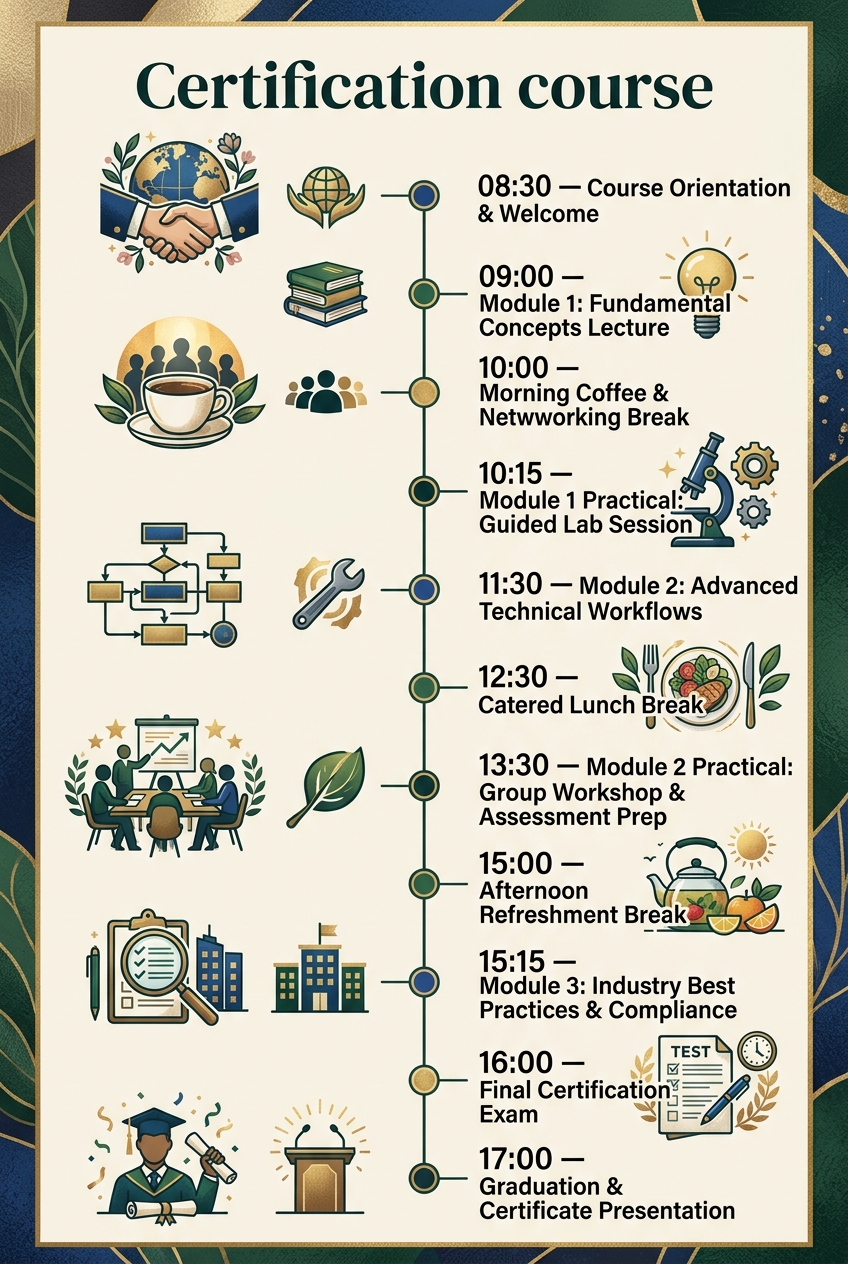
Why Certification Courses Need a Timeline
Intensive professional training demands strict time management because attendees are absorbing heavy volumes of complex information in a compressed period. Unlike standard academic lectures where reading happens over months, a single-day credentialing workshop condenses complex theoretical frameworks, software exercises, and formal evaluations into eight hours. Without a structured timeline, lectures inevitably spill over into practical labs, leaving students unprepared for their final test.
From an administrative and venue perspective, a detailed schedule coordinates multi-room movements seamlessly. Participants must shift from large lecture auditoriums into computer labs, move to dining halls for catered breaks, and return to quiet examination centers. Much like organizing structured corporate events with a board meeting timeline, a clear learning schedule sets firm expectations for both faculty and students from the moment doors open.
Finally, an established running order ensures compliance with accreditation standards. Accrediting bodies require verifiable contact hours and standardized proctored exam conditions. Keeping a transparent schedule guarantees that every candidate receives the exact instructional hours required for valid credential distribution.
What to Include in a Certification Course Timeline
To run a seamless credentialing program, your running order should account for pedagogical, logistical, and social touchpoints:
- Participant Check-In & Materials Distribution: Morning orientation, attendance tracking, and distribution of course packs and lab login credentials.
- Theoretical Core Modules: Instructor-led lectures covering foundational frameworks, legal standards, and technical terminology.
- Practical Guided Labs: Hands-on exercises in specialized spaces where students apply new skills in real time.
- Structured Networking Breaks: Refreshment intervals that encourage peer discussion and combat cognitive fatigue.
- Group Problem-Solving & Exam Prep: Collaborative scenario testing that prepares students for formal evaluation.
- Proctored Examination Window: Dedicated, distraction-free assessment time under strict monitoring rules.
- Graduation Ceremony & Credentials Presentation: Final recognition where certificates of completion are officially handed out.
Morning Foundation & Practical Application
The morning phase focuses on establishing baseline knowledge and immediately translating theoretical principles into practical skills.
| Time | Event |
|---|---|
| 08:30 | Course Orientation & Welcome |
| 09:00 | Module 1: Fundamental Concepts Lecture |
| 10:00 | Morning Coffee & Networking Break |
| 10:15 | Module 1 Practical: Guided Lab Session |
Arriving candidates gather in the Main Auditorium at 08:30 for check-in and material collection. Giving attendees thirty minutes to settle down, test Wi-Fi connections, and review syllabus objectives prevents late arrivals from disrupting the first instructional block. At 09:00, the lead instructor kicks off Module 1: Fundamental Concepts Lecture in Lecture Hall A, setting theoretical benchmarks, key vocabulary, and industry context.
By 10:00, students require a mental break after absorbing dense information. A fifteen-minute coffee break in the Lounge Area allows candidates to digest concepts and network with peers. Promptly at 10:15, participants transition to Computer Lab 2 for Module 1 Practical: Guided Lab Session. Moving straight from lecture to hands-on exercise reinforces memory retention while teaching assistants move around the room to solve technical issues before advanced content is introduced.
Midday Technical Workflows & Applied Learning
The middle of the day tackles complex system integrations, industry workflows, and team problem-solving exercises.
| Time | Event |
|---|---|
| 11:30 | Module 2: Advanced Technical Workflows |
| 12:30 | Catered Lunch Break |
| 13:30 | Module 2 Practical: Group Workshop & Assessment Prep |
At 11:30, candidates return to Lecture Hall A for Module 2: Advanced Technical Workflows. This module dives deep into complex architectures, system integrations, and operational standards. Because this material is demanding, instructors keep presentation slides focused on practical, real-world case studies that candidates will face during their afternoon assessment.
A full one-hour Catered Lunch Break at 12:30 in the Dining Hall is essential for cognitive recovery. Proper nourishment prevents the mid-afternoon energy crash that often degrades exam performance. At 13:30, students reconvene in Workshop Room B for Module 2 Practical: Group Workshop & Assessment Prep. Working in small teams allows candidates to work through scenarios, debate technical solutions, and prepare for individual proctored testing under instructor guidance.
Compliance, Final Evaluation & Graduation
The afternoon transitions from collaborative learning to formal compliance, individual evaluation, and credential award ceremonies.
| Time | Event |
|---|---|
| 15:00 | Afternoon Refreshment Break |
| 15:15 | Module 3: Industry Best Practices & Compliance |
| 16:00 | Final Certification Exam |
| 17:00 | Graduation & Certificate Presentation |
A brief 15-minute refreshment break at 15:00 in the Lounge Area gives students a chance to stretch and refocus before final testing. At 15:15, candidates return to Lecture Hall A for Module 3: Industry Best Practices & Compliance. This session highlights regulatory pitfalls, risk mitigation, and exam rules, giving candidates a clear focus before stepping into the testing room.
At 16:00, candidates enter the Examination Center for the proctored Final Certification Exam. Strict quiet policies, individual workstations, and clear countdown clocks ensure an equitable testing environment. Once exams are submitted and graded, everyone gathers at 17:00 in the Main Auditorium for Graduation & Certificate Presentation. Presenting physical credentials or digital badges celebrates candidate success and closes the event on an inspiring note.
If your training organization hosts evening celebrations or annual galas to honor graduates, you can coordinate social schedules using an anniversary party schedule or explore our birthday party timeline for informal milestone planning.
Certification Course Timeline vs Course Syllabus
Many educational coordinators confuse a operational timeline with an academic syllabus. While both support course delivery, they serve entirely different functions during execution:
| Feature | Certification Course Timeline | Course Syllabus |
|---|---|---|
| Primary Purpose | Operational schedule driving room shifts, breaks, and exam timings | Academic outline detailing learning outcomes, grading rubrics, and reading lists |
| Time Format | Minute-by-minute daily schedule (e.g., 08:30 to 17:30) | Macro structural outline (e.g., Weeks, Modules, or Topical Units) |
| Primary Audience | Facility managers, instructors, proctors, and daily attendees | Academic directors, accredited bodies, and enrolled students |
| Logistical Scope | Room locations, catering delivery, lab access, and proctoring windows | Prerequisites, reference materials, policy rules, and core competency goals |
Who Should Use This Template?
This structured training timeline is designed for professional educators and operational teams who manage accredited educational programs, including:
- Corporate Training Managers: Organizing internal employee certifications, compliance workshops, and technical onboarding.
- Professional Accreditation Bodies: Conducting standardized licensing exams, continuing education units (CEUs), and industry certifications.
- Technical Bootcamps & Vocational Schools: Managing hands-on software workshops, engineering labs, and skill bootcamps.
- Higher Education & Extension Colleges: Delivering intensive single-day professional development workshops.
- Third-Party Seminar Facilities: Coordinating venue rooms, AV equipment, and catering timelines for client workshops.
Chronolio supports the diverse internal roles involved in setting up, approving, and hosting high-impact events across commercial facilities.
How to Use This Template
- Duplicate or Download the File: Open this template in Chronolio or grab the offline Word version or PDF guide.
- Adjust Module Durations: Customize lecture times based on your specific curriculum density and accreditation hour requirements.
- Assign Specific Venues: Input exact room numbers (e.g., Computer Lab 2, Lecture Hall A) so attendees move confidently across your facility.
- Coordinate Staff & Proctors: Share the operational schedule with proctors, catering staff, and lab technicians to guarantee punctual support.
- Publish to Candidates: Send the final schedule to attendees 48 hours prior to the event so they arrive prepared.
Tips for a Successful Certification Course
- Pre-Configure Computer Labs: Ensure software licenses, lab passwords, and exercise files are loaded onto lab hardware the afternoon before class.
- Establish Clear Exam Rules: Outline proctoring standards, acceptable reference materials, and electronic device policies during morning orientation.
- Maintain Strict Break Timings: Use visible countdown timers in lecture halls to bring students back from breaks promptly.
- Provide Dedicated TAs During Labs: Keep a ratio of at least one teaching assistant for every 10 to 15 students in hands-on sessions.
- Automate Grading Systems: Utilize electronic testing platforms so final exam scores are computed immediately, enabling same-day certificate delivery.
- Coordinate Catering Arrival: Instruct caterers to set up beverages and snacks 15 minutes before scheduled breaks to avoid crowd bottlenecks.
Common Mistakes to Avoid
- Overloading Morning Lectures: Cramming too much theory into early sessions causes mental burnout long before the afternoon exam.
- Ignoring Technical Setup Time: Failing to test lab hardware prior to class leads to lost instructional time while troubleshooting logins.
- Encroaching on Lunch Breaks: Cutting lunch short to catch up on late lectures reduces student focus during critical practical exercises.
- Unclear Room Wayfinding: Neglecting to clearly signpost room changes causes tardiness as students wander between auditoriums and labs.
- Rushing the Proctored Exam: Leaving insufficient time for instructions or grading creates unnecessary stress for candidates.
- Skipping the Graduation Phase: Ending abruptly after the exam misses a key opportunity to build alumni goodwill and celebrate student effort.
In Summary
- A certification course timeline coordinates lectures, practical labs, catering, and assessments into a structured single-day schedule.
- Starting orientation at 08:30 ensures students receive login credentials and syllabus overviews before core instruction begins.
- Alternating theoretical lectures with hands-on practical labs maximizes knowledge retention and practical skill mastery.
- Providing dedicated 15-minute breaks and a 60-minute lunch prevents cognitive fatigue prior to formal testing.
- A formal proctored exam window at 16:00 preserves test integrity, followed by an immediate 17:00 graduation ceremony.
- Customizable schedules are available in DOCX format and PDF format for quick distribution.
Mastering your educational schedule guarantees high pass rates, happy attendees, and seamless facility operations. Whether you are managing corporate compliance bootcamps, technical software training, or university extension courses, adopting a proven schedule keeps your faculty synchronized and your candidates focused on success. You can also explore our baby shower timeline template and board meeting timeline template to see how Chronolio formats agendas across diverse event types.
Customize Your Certification Course Schedule