





This Template at a Glance
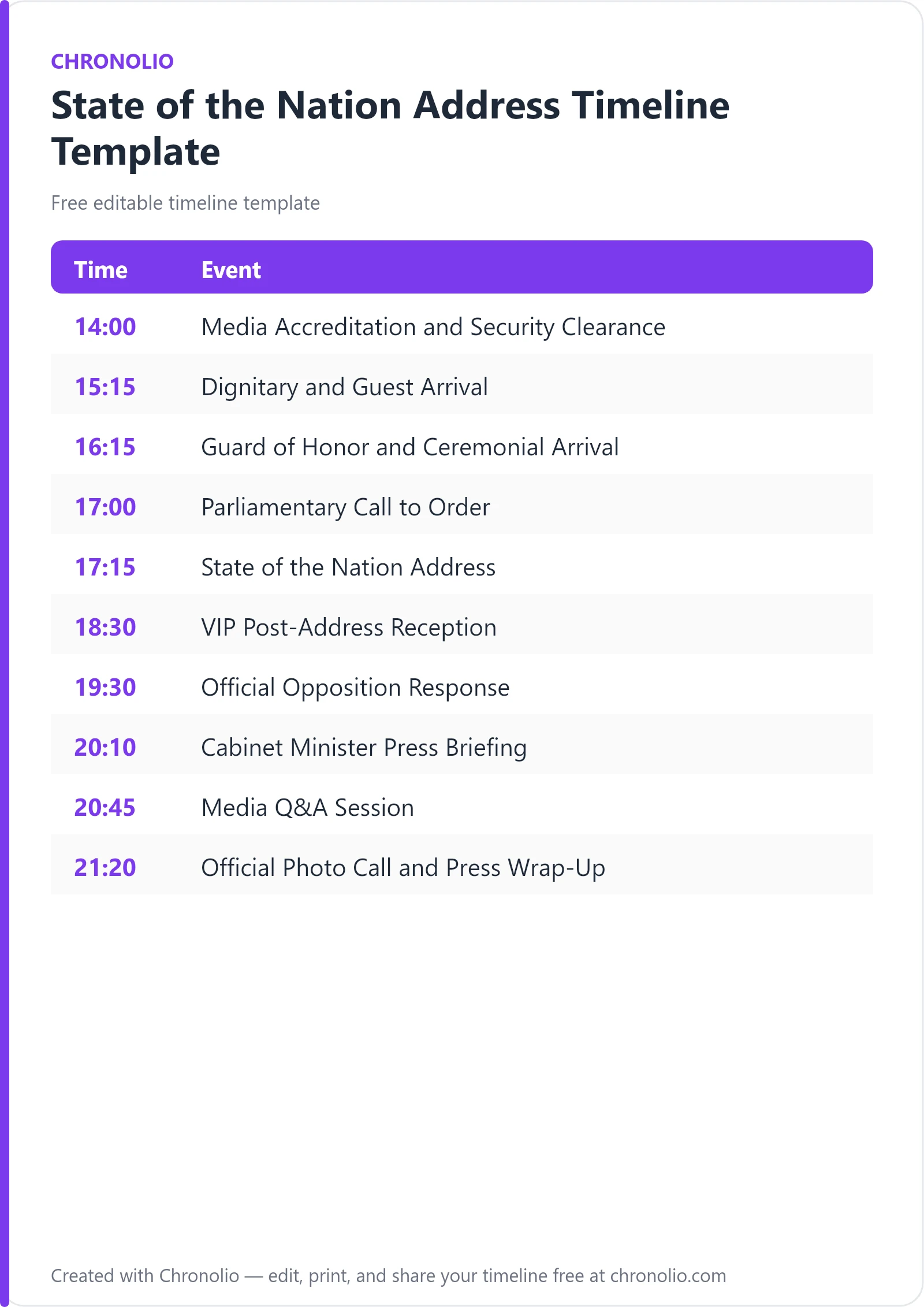
Here is the complete schedule this free template gives you — every time block, ready to edit, download, and share:
| Time | Event |
|---|---|
| 14:00 | Media Accreditation and Security Clearance |
| 15:15 | Dignitary and Guest Arrival |
| 16:15 | Guard of Honor and Ceremonial Arrival |
| 17:00 | Parliamentary Call to Order |
| 17:15 | State of the Nation Address |
| 18:30 | VIP Post-Address Reception |
| 19:30 | Official Opposition Response |
| 20:10 | Cabinet Minister Press Briefing |
| 20:45 | Media Q&A Session |
| 21:20 | Official Photo Call and Press Wrap-Up |
What Is a State of the Nation Address Timeline?
A State of the Nation Address timeline is the master operational running order that governs every minute of a head of state's annual address to the legislative assembly. Designed to bridge state ceremonial protocol with real-time broadcast requirements, this schedule coordinates parliamentary officers, presidential security teams, diplomatic corps members, and national media networks.
Executing a flawless joint parliamentary session requires balancing strict security sweeps with time-sensitive live television broadcasts. From the moment journalists clear the West Gate Security Checkpoint to the final Media Q&A Session in the press center, every transition must occur with total precision. Grounded in real-world parliamentary protocol and executive event planning best practices, this schedule ensures that lawmakers, cabinet ministers, and international dignitaries experience an uninterrupted, dignified proceedings while national news outlets receive uninterrupted feeds.
Edit This State of the Nation Address Timeline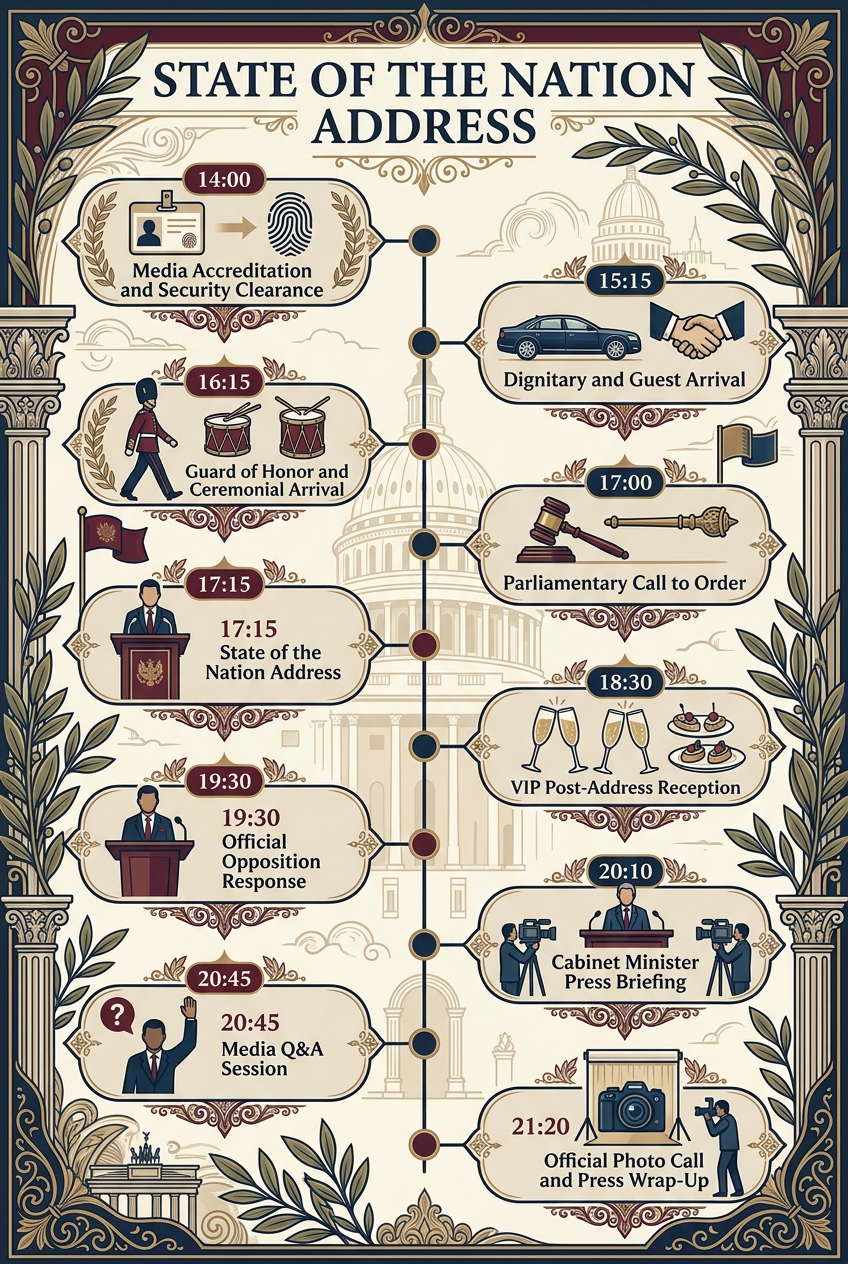
Why State of the Nation Addresses Need a Timeline
High-stakes governance events leave zero margin for error. When a country's leader steps up to the podium, national news outlets, foreign embassies, and millions of citizens are tuned in simultaneously. A centralized schedule acts as the operational single source of truth for every department involved in the production.
- Ensures Uncompromising Security and Protocol: Coordinating law enforcement, military escorts, and security personnel requires synchronized time blocks. A formal run-sheet gives security teams dedicated windows to inspect technical gear, clear the Grand Rotunda Entrance, and secure the perimeter without delaying guest arrivals.
- Synchronizes Broadcast and Media Networks: National broadcasters reserve strict, expensive satellite uplink windows and live television slots. Bumping the head of state's speech back even ten minutes disrupts national television schedules and delays post-address analysis across major news channels.
- Aligns Post-Address Press and Governance Responses: Policy rollouts rely on immediate follow-up. By sequencing the VIP Post-Address Reception, the Official Opposition Response, and technical Cabinet Minister Press Briefing sessions back-to-back, government communicators ensure policy details reach the public in an orderly, structured manner.
What to Include in a State of the Nation Address Timeline
To maintain total operational control across parliamentary grounds, your event plan should account for six crucial operational stages:
- Media Accreditation & Technical Sweeps: Early morning or mid-afternoon entry gates where journalists assemble, register credentials, and submit camera gear to explosive ordnance disposal (EOD) sweeps.
- Diplomatic & Parliamentary Arrivals: Staggered red-carpet arrivals for foreign ambassadors, supreme court justices, military brass, and lawmakers, guided by protocol officers.
- Ceremonial Arrival & Escort: The official arrival of the head of state, marked by a military guard of honor, gun salute, and ceremonial procession into the legislative concourse.
- Formal Parliamentary Proceedings: The Speaker of the House calling the joint session to order, introduction of the executive, and delivery of the core national address.
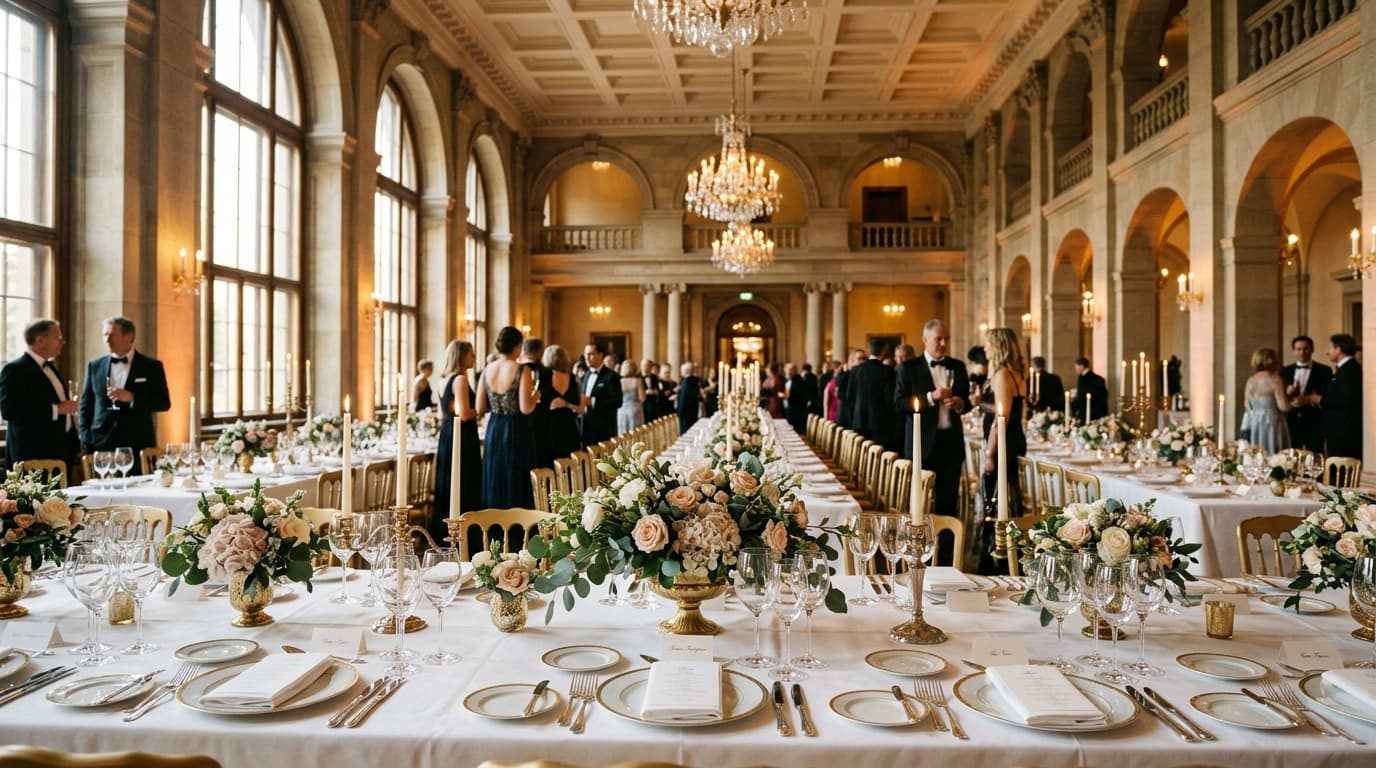
- VIP Diplomatic Reception: A private post-session gathering providing cabinet members and foreign representatives an opportunity for political networking.
- Media Briefings & Rebuttals: Structured television windows in dedicated briefing rooms for opposition leaders, ministers, and press corps Q&A.
Pre-Event Logistics and Ceremonial Arrival
| Time | Event |
|---|---|
| 14:00 | Media Accreditation and Security Clearance |
| 15:15 | Dignitary and Guest Arrival |
| 16:15 | Guard of Honor and Ceremonial Arrival |
The success of any parliamentary event hinges on early credentialing and rigid security checkpoints. At 14:00, journalists, technical engineers, and broadcast crews arrive at the West Gate Security Checkpoint. Security personnel carry out sniffer dog sweeps and technical inspections on all equipment before granting access to the press gallery. Much like managing complex access controls in executive environments—similar to the preparation outlined in our board meeting timeline template—establishing early security clearance prevents bottlenecks as dignitary traffic picks up later in the afternoon.
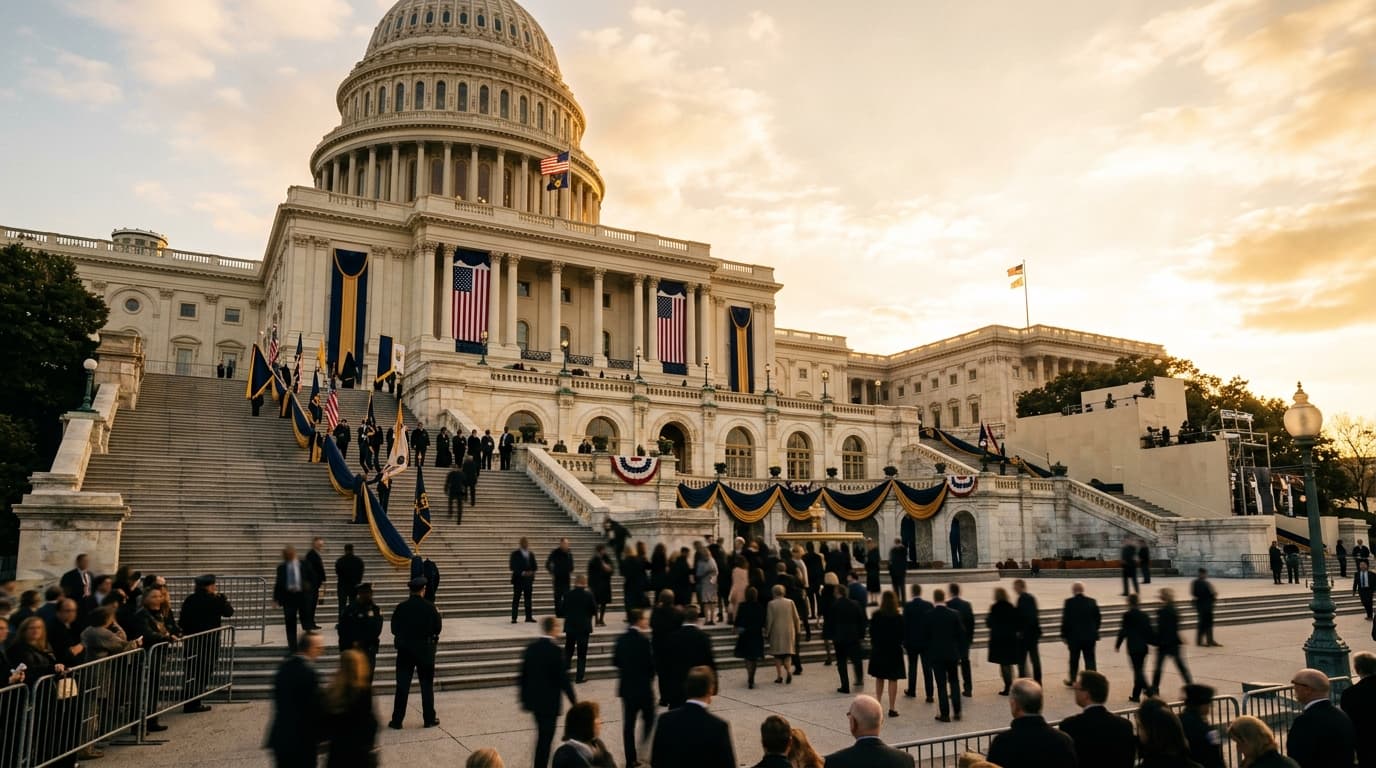
At 15:15, red-carpet protocols commence at the Grand Rotunda Entrance. Members of parliament, military commanders, and foreign ambassadors arrive according to diplomatic precedence. Protocol officers greet delegates and direct them to assigned seating within the main rotunda to ensure the chamber is fully seated well before the executive convoy arrives. At 16:15, the head of state arrives on the Parliamentary Forecourt, greeted by a formal military guard of honor and salute. The presidential party then moves through the central concourse toward the legislative chamber, building ceremonial momentum for the joint session.
Parliamentary Proceedings and Keynote Address
| Time | Event |
|---|---|
| 17:00 | Parliamentary Call to Order |
| 17:15 | State of the Nation Address |
| 18:30 | VIP Post-Address Reception |
At 17:00 sharp, the Speaker of the House calls the joint session of parliament to order inside the Main Legislative Chamber. The Speaker outlines the formal order of business and introduces the head of state to the assembled lawmakers, judicial leaders, and gallery guests. Precision timing here is vital, as national networks transition seamlessly from pre-game political commentary to live speech coverage.
At 17:15, the head of state takes the podium in the Main Chamber Podium to deliver the primary address outlining legislative priorities, economic targets, and national security strategies. When the speech concludes, guests transition at 18:30 to the Banquet Hall for the VIP post-address reception. This social interlude functions similarly to an executive dinner or formal gala, mirroring the hospitality flow found in our anniversary party schedule template by giving diplomats and lawmakers an informal space to process the announcements before official press statements begin.
Press Briefings, Response, and Media Wrap-Up
| Time | Event |
|---|---|
| 19:30 | Official Opposition Response |
| 20:10 | Cabinet Minister Press Briefing |
| 20:45 | Media Q&A Session |
| 21:20 | Official Photo Call and Press Wrap-Up |
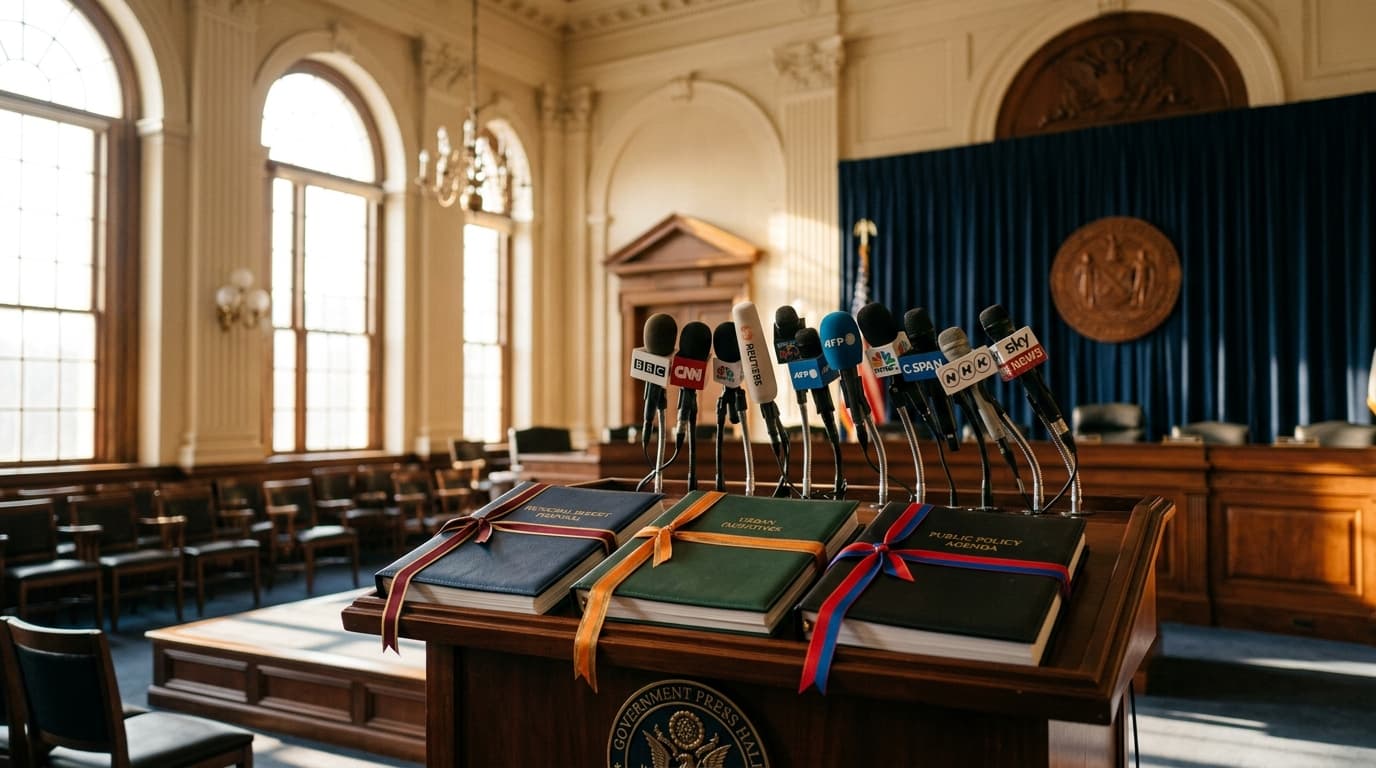
Once formal parliamentary business concludes, the event moves into its strategic media phase. At 19:30, attention shifts to Press Briefing Room A, where the Leader of the Opposition delivers a live televised response. Broadcasters depend heavily on this predictable transition to offer balanced political coverage, delivering immediate alternate policy perspectives to the nation.
Following the opposition critique, government leadership responds with granular policy details. At 20:10, senior officials gather in Press Briefing Room B for a cabinet minister press briefing to outline budgetary implications and statutory timetables. This leads directly into an interactive Media Q&A Session at 20:45, where cabinet members address inquiries from domestic and foreign journalists. Finally, at 21:20, key leaders gather outside the media center for an official photo call while broadcast crews dismantle mobile uplinks and complete late-night news edits. Managing tight evening transitions like these mirrors the rigid schedules required for large formal gatherings, such as a structured christian wedding timeline template or a multi-phase catholic wedding timeline template.
State of the Nation Address Timeline vs Parliamentary Order Paper
While both documents are essential to running a legislative assembly, they serve entirely different audiences and operational goals:
| Feature | State of the Nation Address Timeline | Parliamentary Order Paper |
|---|---|---|
| Primary Focus | Minute-by-minute operational execution and media flow | Legislative agenda, bill motions, and formal parliamentary rules |
| Target Audience | Event planners, security detail, broadcast directors, media pool | Members of parliament, legislative clerks, Speaker of the House |
| Scope | Covers pre-event arrival, security sweeps, speech, and press briefings | Limited to official chamber proceedings and legislative business |
| Flexibility | Highly dynamic; accounts for real-time security and broadcast delays | Governed strictly by parliamentary standing orders and rules |
A State of the Nation Address timeline focuses on physical logistics, media access, security clearances, and broadcast timing. Conversely, a parliamentary order paper dictates the legal mechanics of the legislative session itself. Integrating both ensures that constitutional duties and broadcast realities proceed in harmony.
Who Should Use This Template?
This timeline template is designed for professional event producers, government officials, and communications leads managing high-stakes political or executive addresses. Chronolio caters to various specialized roles across the public and private sectors, including:
- Parliamentary Protocol Officers: Managing red-carpet seating, diplomatic precedence, and chamber entry orders.
- Government Communications Teams: Overseeing presidential press pools, speech distribution, and briefing room schedules.
- Executive Security Details: Coordinating sweeping timelines, motorcade arrivals, and perimeter control points.
- Broadcast Operations Managers: Controlling camera setups, live satellite uplinks, and pool feed distribution.
- State & Municipal Event Planners: Adapting executive timing for gubernatorial State of the State speeches or mayoral addresses.
How to Use This Template
- Download or Duplicate: Access the free template directly in Chronolio, or download customizable copies in Word format or PDF format.
- Set Your Target Speech Window: Input your confirmed live broadcast time (e.g., 17:00 or 20:00) and let the timeline adjust pre-speech security arrivals and post-speech media windows automatically.
- Customize Venue Locations: Update security gates, holding rooms, and press briefing numbers to match your specific legislative complex.
- Distribute to Functional Teams: Share tailored views with security personnel, press corps leads, and broadcast crews so everyone operates off the same master schedule.
Tips for a Successful State of the Nation Address
- Run a Dedicated Technical Sweep: Schedule a complete lock-down and EOD sweep of the press gallery and legislative chamber at least two hours before guest arrivals begin.
- Enforce Strict Media Cut-off Times: Establish a hard lock-down time for press equipment setup; un-inspected broadcast gear should never enter the perimeter after security sweeps close.
- Establish Dual Press Briefing Rooms: Utilize two distinct briefing areas (Room A and Room B) so the opposition rebuttal and government ministerial briefings can set up simultaneously without technical crossover.
- Coordinate Protocol Precedence: Ensure protocol teams have printed seating charts mapping out constitutional order, foreign dignitary ranks, and cabinet positions.
- Maintain Dedicated Satellite Feed Backups: Test primary and redundant satellite uplink trucks at least three hours before the Speaker calls the chamber to order.
- Plan for Speech Duration Buffer: Always build a 15-minute buffer into post-address schedules; applause interruptions and live delivery changes frequently expand the core speech time.
Common Mistakes to Avoid
- Underestimating Press Security Clearance Windows: Allowing insufficient time for hundreds of reporters to pass through metal detectors creates major security delays at the gates.
- Overcrowded Rotunda Entrances: Failing to stagger VIP arrival windows leads to logjams on the red carpet and delays the guard of honor ceremony.
- Neglecting Post-Address Logistics: Focusing entirely on the main speech while ignoring the post-address opposition response leaves media networks without clear guidance.
- Lacking Clear VIP Escort Routes: Failing to assign protocol officers to key diplomatic groups leads to confusion when moving guests from the chamber to the banquet hall.
- Ignoring Remote Press Demands: Forgetting to schedule an official photo call and media wrap-up window forces reporters to scramble for photos in unlit corridors.
- Failing to Align Live Broadcast Cues: Commencing the Speaker’s call to order before major networks confirm live satellite feeds cuts off national viewers.
In Summary
- Master Operational Schedule: Coordinates security clearance, dignitary protocol, live broadcasting, and press briefings across an eight-hour footprint.
- Broadcast-First Design: Anchors all pre-event security and post-event briefings around a fixed live television address window.
- Structured Post-Event Flow: Sequences opposition responses, cabinet breakdowns, and press Q&As immediately following the VIP reception.
- Versatile Framework: Easily adapts to gubernatorial, mayoral, or corporate executive keynote addresses.
- Multi-Departmental Precision: Unifies security forces, parliamentary clerks, press officers, and television directors under one timeline.
Executing a flawless presidential or legislative address requires syncing constitutional protocol with real-time media demands. Designed specifically for parliamentary officers, state event planners, executive comms teams, and broadcast managers, this State of the Nation Address timeline provides the precise operational framework needed to run a secure, punctual, and highly professional national event. To get started right away, customize your schedule directly on Chronolio or download a copy in Word or PDF format today. You can also adapt these timing principles for other formal gatherings, such as a major milestone celebration using our birthday party timeline template.
Edit This State of the Nation Address TimelineFor official guidelines on parliamentary procedure and legislative session protocols, consult the U.S. House of Representatives History, Art & Archives or review constitutional sitting standards on UK Parliament.