





This Template at a Glance
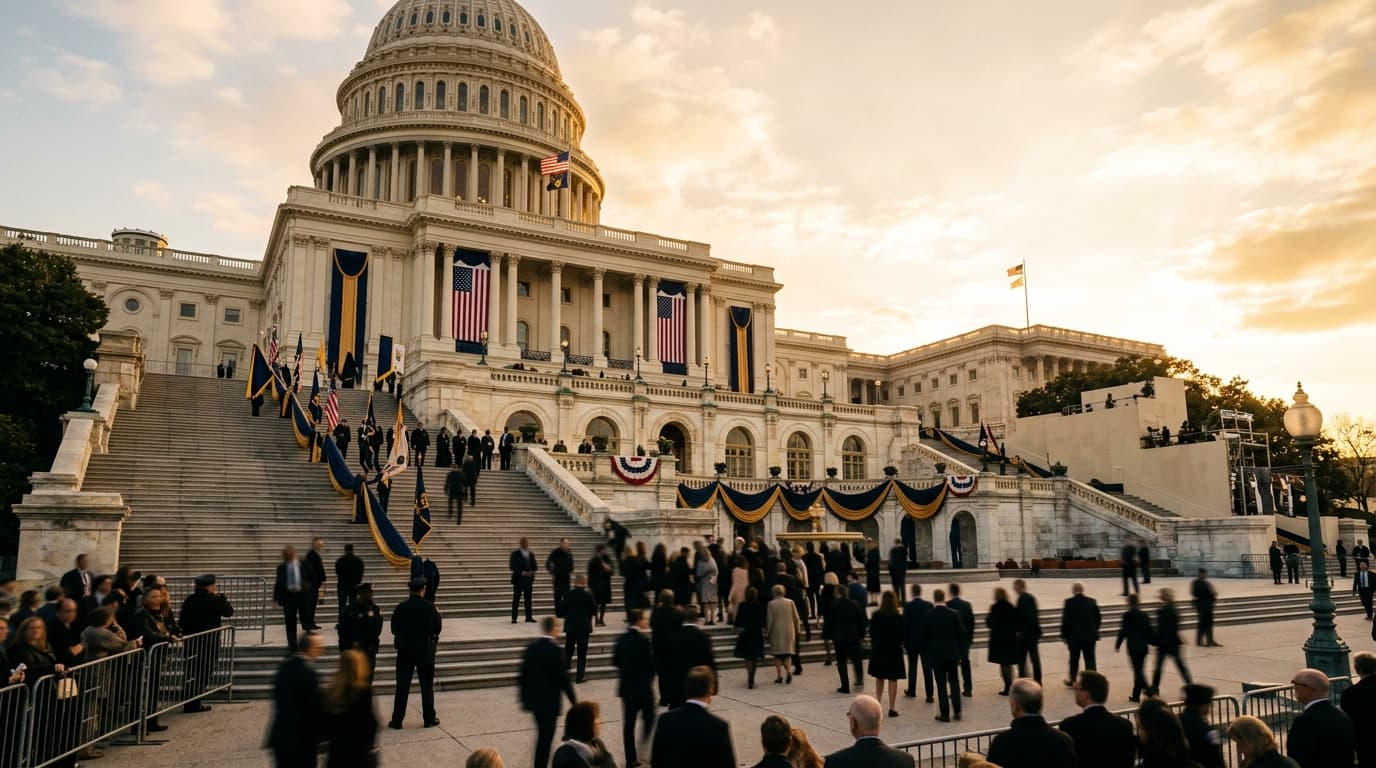
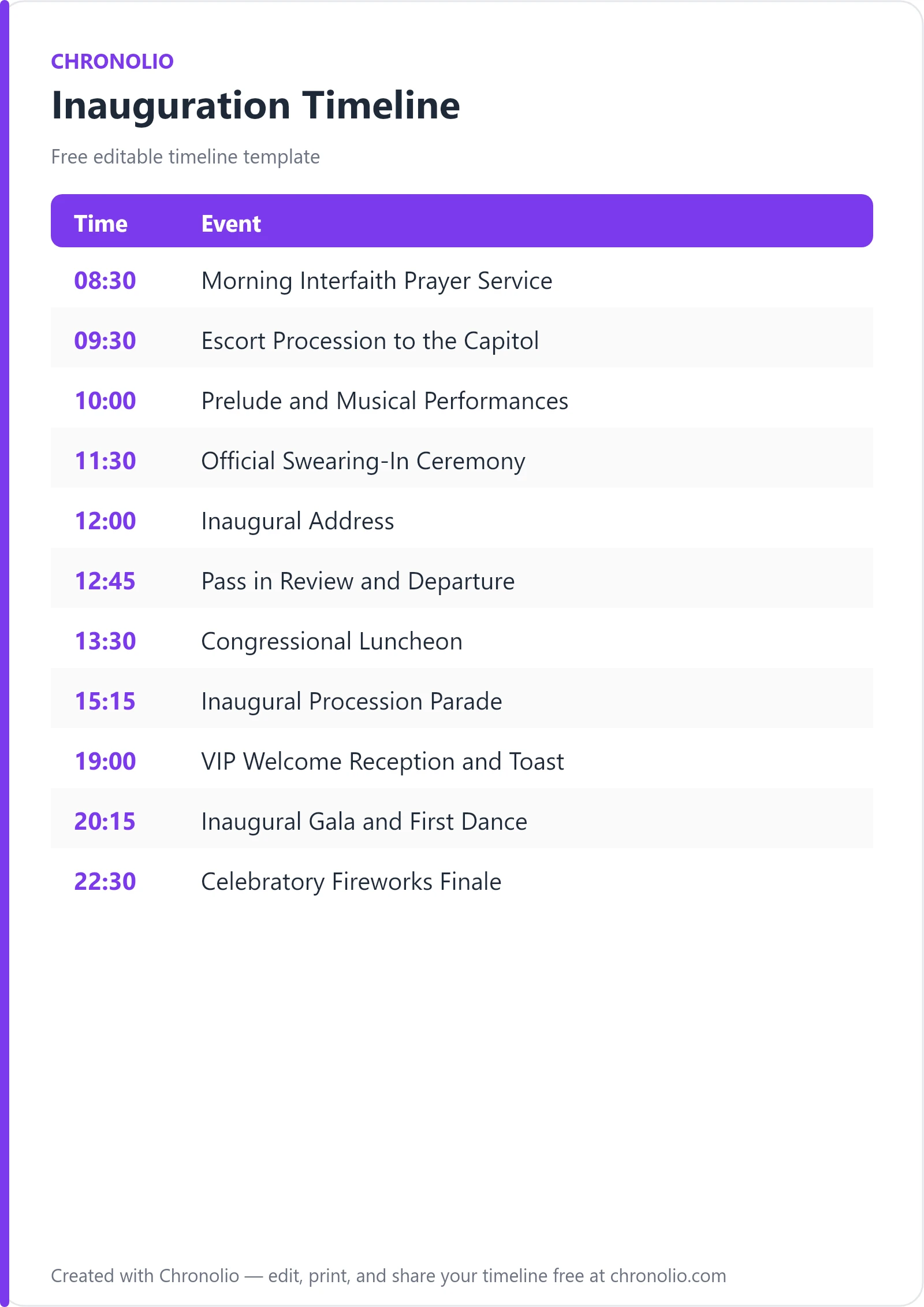
Here is the complete schedule this free template gives you — every time block, ready to edit, download, and share:
| Time | Event |
|---|---|
| 08:30 | Morning Interfaith Prayer Service |
| 09:30 | Escort Procession to the Capitol |
| 10:00 | Prelude and Musical Performances |
| 11:30 | Official Swearing-In Ceremony |
| 12:00 | Inaugural Address |
| 12:45 | Pass in Review and Departure |
| 13:30 | Congressional Luncheon |
| 15:15 | Inaugural Procession Parade |
| 19:00 | VIP Welcome Reception and Toast |
| 20:15 | Inaugural Gala and First Dance |
| 22:30 | Celebratory Fireworks Finale |
What Is an Inauguration Timeline?
An inauguration timeline is a minute-by-minute schedule that orchestrates constitutional mandates, security protocols, public processions, and formal celebrations into a unified operational plan. Managing an inaugural day is one of the most complex challenges in event planning: you are balancing strict constitutional deadliness, high-security motorcades, broadcast media cues, and foreign dignitary movements across multiple public and private venues.
Reflecting real-world civic protocols established by historical precedent and organizations like the Joint Congressional Committee on Inaugural Ceremonies, this template provides a tested structure for high-profile oath-taking ceremonies. Whether you are running a gubernatorial swearing-in, a university president investiture, or a national presidential inauguration, structure is essential. Much like executing a formal board meeting timeline template requires strict adherence to parliamentary order, an inaugural schedule ensures that constitutional requirements occur seamlessly alongside public celebrations.
Use this Inauguration Timeline Template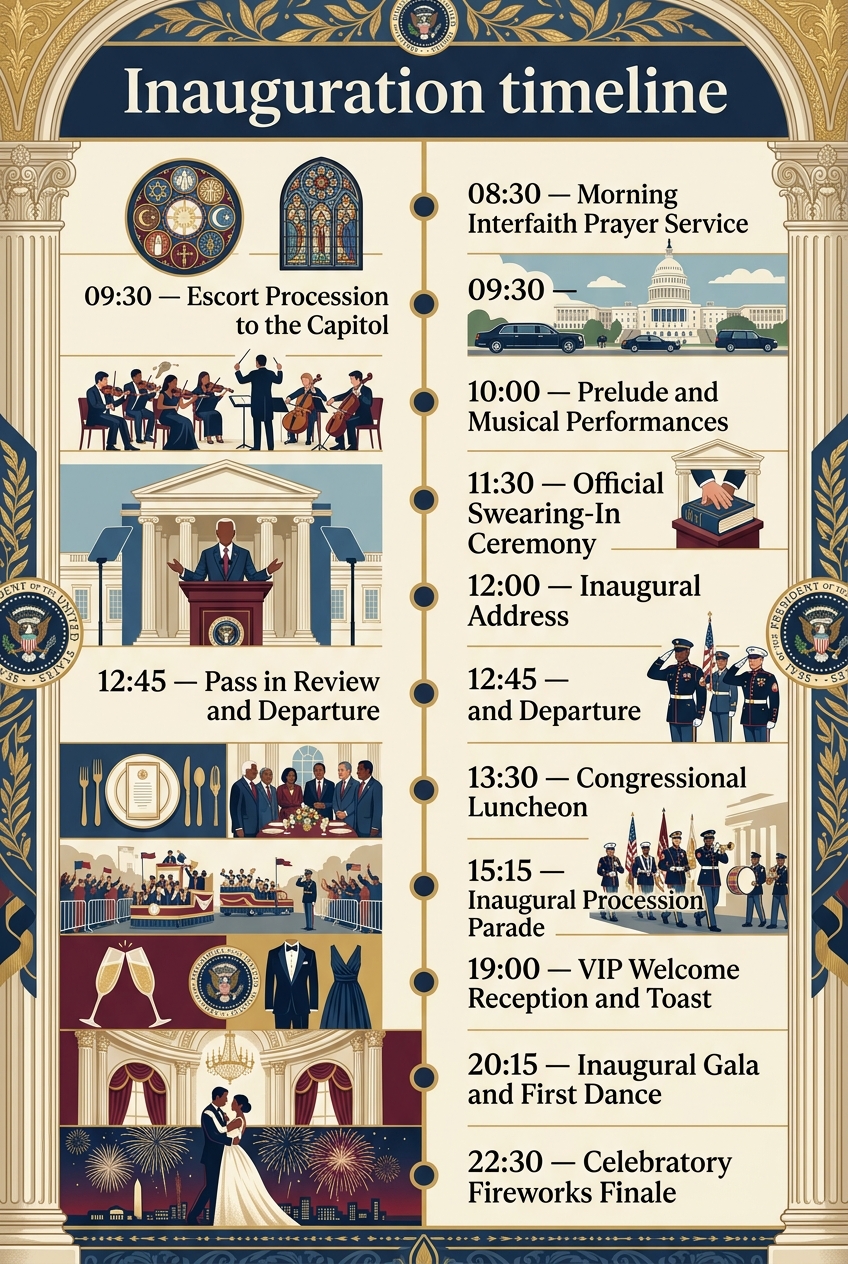
Why Inaugurations Need a Timeline
Executing an inauguration without a detailed timeline invites operational gridlock. When coordinating multi-agency security details, broadcast networks, and international diplomatic delegations, even a ten-minute delay at an early venue can disrupt the entire afternoon agenda. A well-structured schedule establishes clear milestones so security forces and motorcades know precisely when streets must be cleared and when platform doors must close.
Beyond logistics, an inaugural day carries tremendous historical and constitutional weight. The twelve-o'clock constitutional mandate requires the oath of office to occur at noon, leaving zero tolerance for timing errors during the morning platform proceedings. A shared timeline aligns platform managers, military musical ensembles, and motorcade commanders so everyone moves as a synchronized unit.
Finally, a structured schedule safeguards the attendee and dignitary experience. From elderly former leaders navigating Capitol stairs to thousands of spectators waiting along a parade route, clear pacing prevents venue bottlenecks and long, unmanaged gaps. It gives VIP guests predictability, allowing them to navigate security sweeps, formal luncheons, and wardrobe changes for evening galas without stress.
What to Include in an Inauguration Timeline
A comprehensive inauguration schedule covers every transition from early morning spiritual reflection to late-night entertainment. To keep operations seamless, your timeline should account for:
- Spiritual and Private Ceremonies: Early morning prayer services and private morning teas at executive residences.
- Dignitary Escorts and Motorcades: Scheduled departure windows for executive leadership parties moving under heavy security escort.
- Platform Preludes: Military band performances, choral selections, and guest seating on the inaugural platform before official proceedings.
- Constitutional Swearing-In Ceremonies: Invocations, oaths of office administered by judicial leaders, and musical honors (such as Hail to the Chief or 21-gun salutes).
- The Inaugural Address: The key legislative and political speech delivered by the newly sworn leader.
- Military Reviews and Departures: Formal military pass in review, honoring outgoing officials, and executive departures.
- Legislative Luncheons: Ceremonial meals hosted by legislative leaders in historic halls or chambers.
- Public Procession Parade: Street parades featuring military units, high school bands, and cultural groups along established parade routes.
- Evening Galas and Balls: Formal VIP receptions, toasts, traditional first dances, and celebratory light or fireworks displays.
Morning Services and Capitol Escort
The opening movement of the inauguration focuses on reflection, quiet transitions, and high-security movements from morning worship locations to the main ceremonial platform.
| Time | Event |
|---|---|
| 08:30 | Morning Interfaith Prayer Service |
| 09:30 | Escort Procession to the Capitol |
| 10:00 | Prelude and Musical Performances |
The morning begins at 08:30 with the Morning Interfaith Prayer Service held at St. John's Episcopal Church or a similar historic house of worship. This quiet period offers the incoming executive, vice-executive, and family members a moment of reflection before the intensity of public life takes over. Setting this service early allows attendees to finish worship, meet briefly in private, and board motorcades without rushing through security checkpoints. Incorporating structured worship into high-profile days mirrors the ceremonial discipline found in a Christian wedding timeline or a formal liturgical schedule.
At 09:30, the Escort Procession to the Capitol departs along Pennsylvania Avenue. This official motorcade transports the incoming executive leadership, departing leaders, and high-ranking dignitaries under tight law enforcement security. Coordinating this transfer requires pre-cleared traffic corridors and synchronized arrivals at the Capitol's subterranean entrances to keep public roadways open for incoming crowds.
By 10:00, the Prelude and Musical Performances begin on the West Front of the U.S. Capitol platform. While invited guests, diplomatic corps members, and former leaders take their designated seats, elite military bands and choral ensembles perform traditional classical and patriotic arrangements. This hour-long musical program fills the air with ceremonial gravity, engages early arriving crowd members, and builds anticipation leading into the formal platform program.
Swearing-In, Address, and Military Review
The mid-day phase represents the core constitutional and ceremonial heart of the inauguration day, culminating in the official transfer of executive authority.
| Time | Event |
|---|---|
| 11:30 | Official Swearing-In Ceremony |
| 12:00 | Inaugural Address |
| 12:45 | Pass in Review and Departure |
The Official Swearing-In Ceremony commences on the West Front Platform at 11:30. Platform managers follow a strict script: opening invocations, musical honors, and the administration of the oath of office to the Vice President. Precise timing is essential here so that as the clock approaches 12:00 PM (noon), the Chief Justice of the Supreme Court steps forward to administer the presidential oath of office on the traditional family Bible.
Immediately following the oath and accompanying artillery salute, the newly sworn President delivers the Inaugural Address at 12:00 PM. Lasting approximately twenty minutes, this speech sets forth the administration's vision, domestic priorities, and foreign policy goals. Keeping this address within its budgeted window ensures the high-energy momentum of the ceremony is preserved for global broadcast audiences.
At 12:45, proceedings shift to the East Front for the Pass in Review and Departure. As newly designated Commander-in-Chief, the President inspects assembled military units representing all service branches. Concurrently, outgoing officials depart the Capitol grounds via military helicopter or official vehicle, marking the formal completion of the peaceful transfer of power in accordance with archival records kept by the White House Historical Association.
Congressional Luncheon and Presidential Parade
After the public swearing-in, the schedule balances high-level legislative diplomacy with grand public celebration along city streets.
| Time | Event |
|---|---|
| 13:30 | Congressional Luncheon |
| 15:15 | Inaugural Procession Parade |
At 13:30, leadership gathers in Statuary Hall for the traditional Congressional Luncheon. Hosted by members of Senate and House leadership, this ninety-minute event gives the new administration an immediate opportunity to foster bipartisan goodwill with lawmakers. During the luncheon, ceremonial gifts, speeches, and traditional toasts are presented in an intimate, secure environment away from public cameras.
Following the luncheon, the action transitions outside at 15:15 for the Inaugural Procession Parade. Moving down Pennsylvania Avenue toward the presidential reviewing stand outside the White House, this grand street spectacle features thousands of participants. Military units, competitive high school marching bands, equestrian teams, and diverse cultural organizations parade past spectators. Organizing a street parade of this magnitude requires staging areas, marshal checkpoints, and strict interval pacing so that the parade flows continuously without long pauses in front of the presidential viewing box.
Evening Galas and Fireworks
The final phase of the inauguration shifts from public policy and street parades to formal social celebration, honoring campaign supporters, cabinet officials, and visiting leaders.
| Time | Event |
|---|---|
| 19:00 | VIP Welcome Reception and Toast |
| 20:15 | Inaugural Gala and First Dance |
| 22:30 | Celebratory Fireworks Finale |
Evening activities begin at 19:00 with the VIP Welcome Reception and Toast in the Walter E. Washington Convention Center. Key political leaders, governors, prospective cabinet nominees, and foreign ambassadors convene in private reception suites for photos and formal toasts. This controlled warm-up event helps clear security lines before the major ballroom doors open to broader ticket holders.
At 20:15, guests enter the Executive Ballroom for the Inaugural Gala and First Dance. The Commander-in-Chief and First Spouse make a grand entry, deliver brief remarks thanking supporters, and take to the ballroom floor for the traditional ceremonial first dance. Managing formal evening entertainment at this scale shares structural similarities with hosting high-end social celebrations, such as those organized using an anniversary party schedule template or a milestone birthday party timeline template, where speech timing, stage lighting, and musical cues must align effortlessly.
The inauguration day reaches its climax at 22:30 with a Celebratory Fireworks Finale over the National Mall. A fifteen-minute pyrotechnic show lights up the skyline around national monuments, providing a spectacular visual end for millions of television viewers and live attendees across the city.
Inauguration Timeline vs Inaugural Day Running Order
It is easy to confuse an overall inauguration timeline with an inaugural day running order, but they serve distinct operational roles during civic events.
| Feature | Inauguration Timeline | Inaugural Day Running Order |
|---|---|---|
| Primary Scope | Macro-level overview of the entire day's public and private events. | Micro-level, minute-by-minute technical script for a specific venue or stage. |
| Target Audience | Executive leadership, Secret Service, press corps, VIP guests, and broad logistics teams. | Stage managers, audio-visual engineers, military band directors, and broadcast directors. |
| Key Details Included | Event start times, general locations, venue transfers, and broad phase transitions. | Speaker cues, microphone assignments, camera angles, lighting changes, and script prompts. |
| Flexibility | Moderate; offers general timing windows between major public phases. | Rigid; execution is timed down to exact seconds for live television broadcasts. |
While the inauguration timeline provides the high-level roadmap for executive movements and guest arrivals across Washington, a running order dives deep into individual venues. For example, while the main timeline simply notes "11:30 Official Swearing-In Ceremony," the platform stage manager's running order breaks down exact camera cues, podium heights, and musical entry bars for every verse of the National Anthem.
Who Should Use This Template?
This master inauguration schedule is built for professionals tasked with executing flawless civic and institutional investitures. It is ideal for:
- Presidential & Gubernatorial Inaugural Committees: Planning staff coordinating multi-venue state or national inaugurations.
- Municipal Government Transitions: City clerks and mayoral transition teams organizing city hall swearing-in ceremonies and public parades.
- University Planning Offices: Higher education administrators executing university presidential investitures, academic processions, and gala dinners.
- Judicial & Legislative Protocol Officers: Court marshals and legislative sergeant-at-arms teams managing platform seating and official oaths.
- Law Enforcement & Security Liaison Teams: Secret Service, Capitol Police, and military logistics coordinators establishing security sweeps and motorcade windows.
Note that Chronolio supports the various specialized roles involved in planning high-stakes public events, from lead event coordinators to protocol officers and security liaisons.
How to Use This Template
- Download or Duplicate the Template: Select your preferred format using our editable online interface, or download the printable Inauguration timeline Word document or Inauguration timeline PDF for offline team distribution.
- Establish the Noon Anchor Point: Confirm the exact legal hour required for your official oath of office (typically 12:00 PM for state and national offices) and work backward to set morning prayer and motorcade times.
- Customize Venue Locations: Update building names, street routes, and ballroom names to match your city or campus layout.
- Insert Security and Movement Buffers: Add mandatory 15- to 30-minute security sweep buffers between venues to account for magnetometers, motorcade loading, and crowd congestion.
- Distribute Targeted Excerpts: Share full copies with executive security details while providing abbreviated venue-specific timelines to press outlets, performers, and catering staff.
Tips for a Successful Inauguration
- Build Around the Constitutional Anchor: Always build your morning timeline backward from the mandated oath time. Never allow early speeches or musical preludes to push the oath past its constitutional deadline.
- Establish Buffer Zones for Security: Require all VIPs and platform guests to be seated at least 45 minutes before public proceedings start to accommodate TSA-style screening and Secret Service sweeps.
- Coordinate Stage and Broadcast Cues: Run a full technical rehearsal on the platform the day before to calibrate podium microphones, teleprompters, and military band sightlines.
- Plan for Extreme Weather Options: Outdoor platforms in January or rain-prone months require an immediate "Code Red" indoor relocation plan with mirrored timing.
- Designate Escorts for VIP Delegations: Assign trained protocol aides to manage former leaders, diplomatic corps members, and family groups to keep platform entry streams moving quickly.
- Maintain Clear Media Sightlines: Ensure press risers and broadcast camera positions are locked down hours before platform seating begins to avoid last-minute crowd blockages.
Common Mistakes to Avoid
- Underestimating Venue Transfer Times: Motorcades move slowly through crowded streets; assuming a ten-minute transit window across a major city on inauguration day almost always causes delays.
- Overpacking the Speech Schedule: Allowing too many invocations, musical numbers, or secondary speeches on the main stage drains audience energy and risks delaying the oath.
- Ignoring Dignitary Mobility Needs: Failing to account for elderly VIPs navigating historic steps or outdoor weather can cause significant platform delays.
- Neglecting Staff Feeding Windows: Planning a 16-hour operational day without scheduling rotated meal drops for security, protocol aides, and media crews leads to afternoon execution fatigue.
- Failing to Rehearse Motorcade Staging: Allowing support vehicles to stack up at drop-off points creates traffic gridlock that delays the principal leader's arrival.
- Forgetting Post-Oath Holding Rooms: Leaving executive parties without a secure, quiet holding room between the outdoor address and the indoor legislative luncheon creates chaotic crowd swarms.
In Summary
- Master Framework: An inauguration timeline coordinates constitutional swearing-in protocols, public parades, security movements, and evening galas into one synchronized schedule.
- The Constitutional Anchor: The entire morning schedule is anchored around the 12:00 PM oath of office to satisfy legal mandates and international broadcast windows.
- Multi-Agency Alignment: It connects military escorts, law enforcement, platform managers, and broadcast teams across citywide locations.
- Balanced Structure: Integrates quiet morning reflection, solemn legal ceremonies, celebratory public parades, and high-level evening diplomacy.
- Versatile Application: Easily adapts for state governor inaugurations, mayoral swearing-in ceremonies, and university presidential investitures.
- Security-First Planning: Incorporates essential screening buffers and motorcade staging windows to maintain safety and flow.
Organizing an inaugural day requires balancing historical tradition, strict law enforcement parameters, and unforgettable public celebration. By leveraging this expert inauguration timeline, civic committees, protocol officers, and government planners can deliver an inspiring, perfectly timed event for executive leaders, distinguished guests, and millions of watching citizens.
Use this Inauguration Timeline Template