





This Template at a Glance
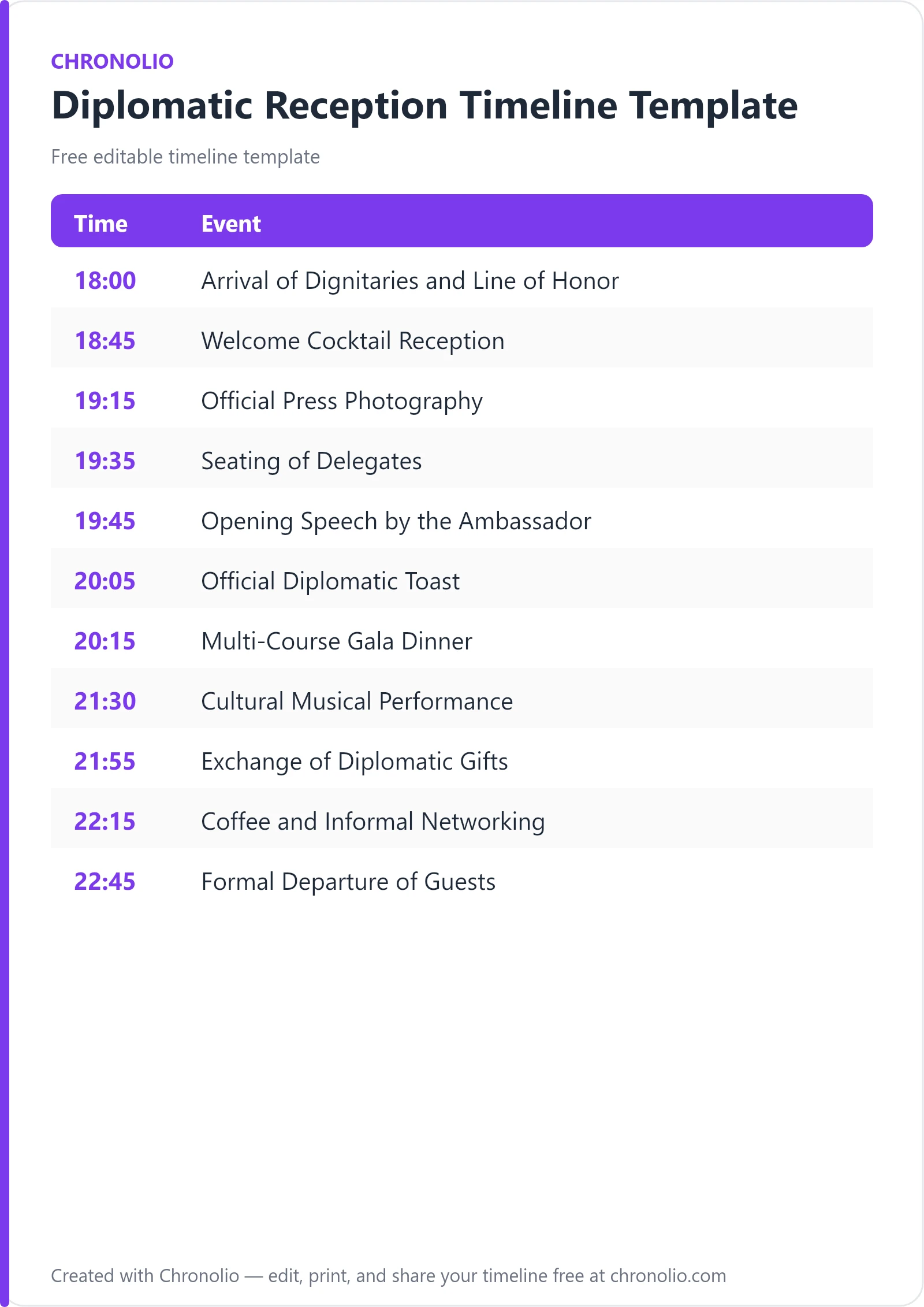
Here is the complete schedule this free template gives you — every time block, ready to edit, download, and share:
| Time | Event |
|---|---|
| 18:00 | Arrival of Dignitaries and Line of Honor |
| 18:45 | Welcome Cocktail Reception |
| 19:15 | Official Press Photography |
| 19:35 | Seating of Delegates |
| 19:45 | Opening Speech by the Ambassador |
| 20:05 | Official Diplomatic Toast |
| 20:15 | Multi-Course Gala Dinner |
| 21:30 | Cultural Musical Performance |
| 21:55 | Exchange of Diplomatic Gifts |
| 22:15 | Coffee and Informal Networking |
| 22:45 | Formal Departure of Guests |
What Is a Diplomatic Reception Timeline?
A diplomatic reception timeline is a specialized running order designed to maintain absolute decorum, security, and bilateral harmony during state functions. Whether hosted at an embassy, a consulate general, or a government hall, international diplomatic events operate under strict expectations of formality governed by diplomatic custom and international conventions such as the Vienna Convention on Diplomatic Relations. Every transition—from the moment a head of mission steps out of their official vehicle at the portico to the final exchange of state gifts—requires meticulous minute-by-minute planning.
This guide and timeline template reflect real-world diplomatic practices honed across state banquets, bilateral summits, and national day celebrations. Having run hundreds of high-stakes gatherings, protocol teams know that a well-structured timeline prevents embarrassing breaches of precedence, maintains security perimeters, and provides foreign dignitaries with a dignified environment for high-level dialogue.
Customize Your Diplomatic Reception Timeline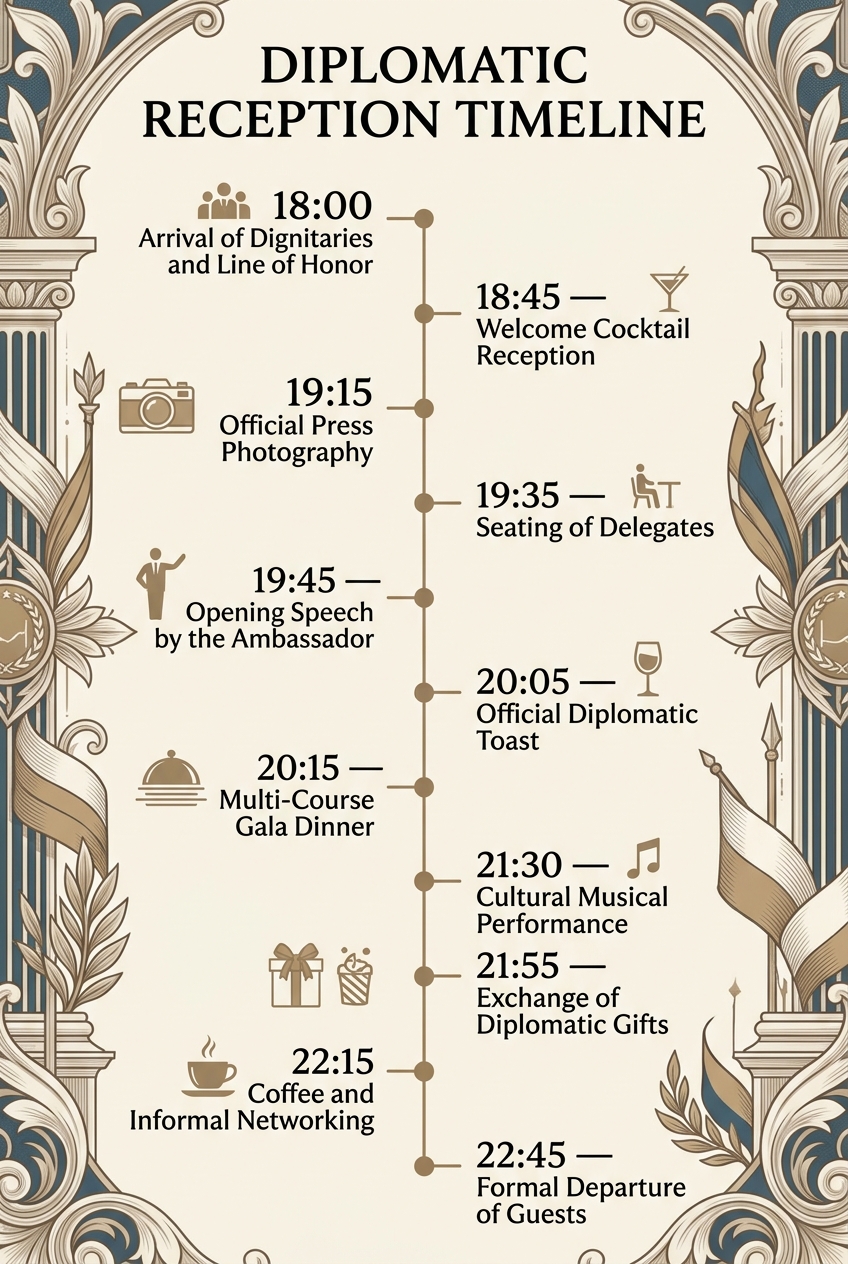
Why Diplomatic Receptions Need a Timeline
State dinners and international receptions carry zero margin for error. A failure in timing can cause diplomatic friction, disrupt high-level security motorcades, or cut short essential bilateral conversations. A rigorous diplomatic event schedule acts as the central command document for security details, protocol officers, caterers, and translation teams.
First, an explicit schedule guarantees strict adherence to diplomatic order of precedence. Foreign ministers, ambassadors extraordinary and plenipotentiary, charge d'affaires, and military attachés must be greeted, seated, and introduced in precise hierarchical order. Without a locked timeline, receiving lines stall and seating sequences become compromised.
Second, a shared running order coordinates multi-departmental teams seamlessly. Embassy security officers need exact times for motorcade arrivals and departures, while executive chefs require precise call times for every course. Much like managing complex organizational agendas—such as aligning leadership in a board meeting timeline—a diplomatic reception relies on timing synchronicity across dozens of staff members.
Finally, a structured flow balances formal state obligations with unscripted bilateral networking. By allocating distinct windows for official toasts, cultural performances, and informal lounge discussions, foreign delegates can achieve their diplomatic objectives in an environment that feels both disciplined and hospitable.
What to Include in a Diplomatic Reception Timeline
A complete diplomatic reception timeline must account for every official ritual and logistical necessity from gate security to final departures. When drafting your schedule, ensure it includes these vital operational components:
- Receiving Line & Line of Honor: Formal arrival protocols where the host Ambassador and Chief of Protocol greet arriving foreign dignitaries and verify credentials.
- Welcome Aperitifs & Networking: A designated cocktail hour allowing early arrivals to converse informally while protocol staff finalize seating arrangements.
- Official Delegation Press Photography: Structured photo opportunities for heads of delegation and international media in front of national and diplomatic flags.
- Escorted Seating & Precedence Order: Protocol ushers guiding delegates to banquet tables arranged strictly according to official state ranking.
- Formal Addresses & Bilateral Toasts: Keynote remarks from the host ambassador and responding remarks with formal toasts from visiting dignitaries, complete with simultaneous translation support.
- Multi-Course Banquet Service: A multi-course culinary service synchronized strictly with protocol cues and dietary requirements.
- Cultural Presentation: Artistic or musical performances reflecting national heritage and cross-cultural partnership.
- Exchange of Diplomatic Gifts: Formal exchange and archiving of symbolic state gifts between heads of delegation.
- Informal Diplomatic Lounge Networking: Unscripted coffee and digestif conversations in a secure, relaxed setting.
- Coordinated Motorcade Departures: Staggered, protocol-compliant departures managed in direct coordination with protective security details.
Guest Arrival and Protocol Greetings
| Time | Event |
|---|---|
| 18:00 | Arrival of Dignitaries and Line of Honor |
| 18:45 | Welcome Cocktail Reception |
| 19:15 | Official Press Photography |
The opening phase sets the tone for the entire diplomatic gathering. Beginning at 18:00 in the Grand Foyer of the Embassy State Hall, guests and foreign dignitaries arrive under the direction of security and protocol officers. The host Ambassador and Chief of Protocol extend official greetings in the formal Line of Honor, verifying guest credentials and ensuring each delegate is acknowledged according to rank.
At 18:45, guests transition into the Garden Terrace for the Welcome Cocktail Reception. This 30-minute window serves a dual purpose: it gives early arrivals a comfortable space to network over light aperitifs while background music plays, and it allows protocol staff to verify seating cards and ensure every delegate understands the movement path into the main hall.
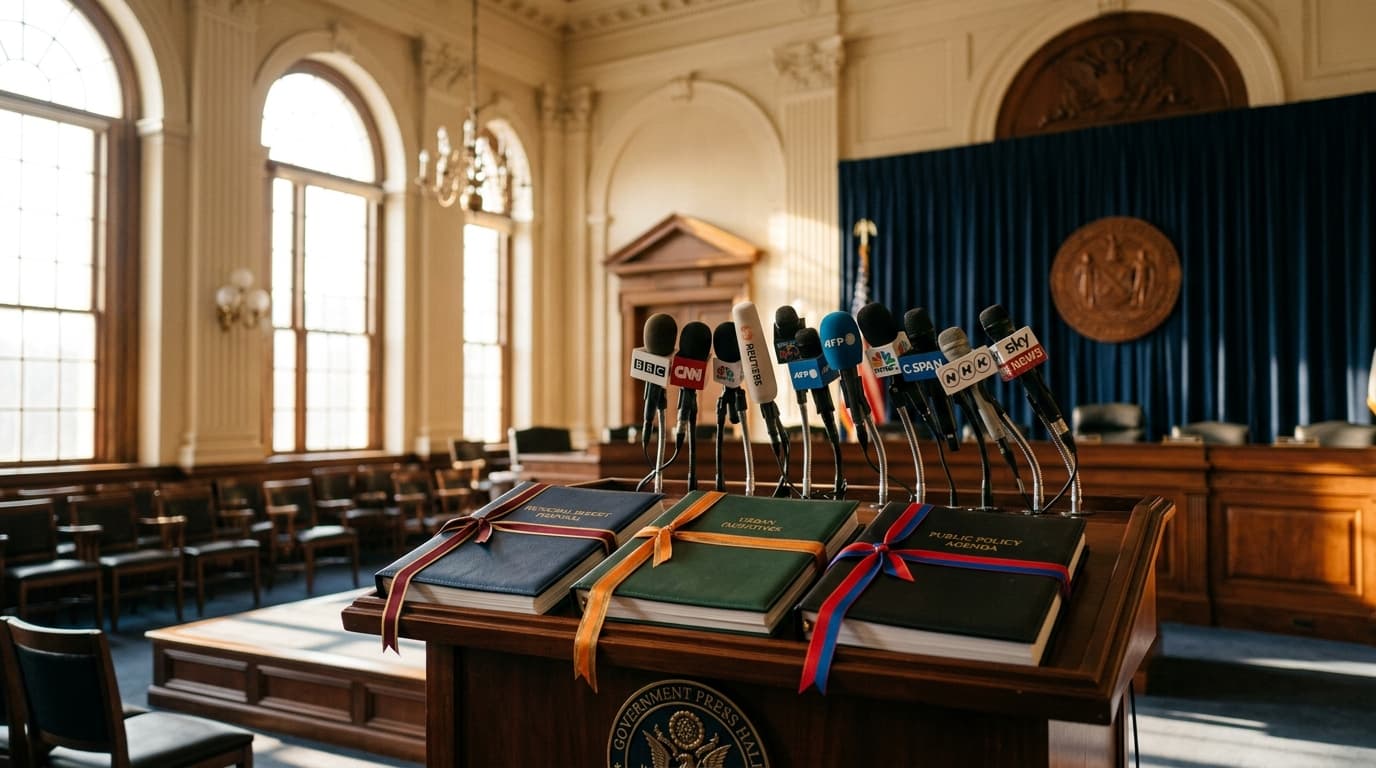
At 19:15, heads of delegation move to the State Hall Press Area for Official Press Photography. Positioning leaders in front of official diplomatic flags requires precise coordination; international press photographers operate within strict time limits to capture bilateral delegations before formal proceedings begin.
Formal Proceedings and Speeches
| Time | Event |
|---|---|
| 19:35 | Seating of Delegates |
| 19:45 | Opening Speech by the Ambassador |
| 20:05 | Official Diplomatic Toast |
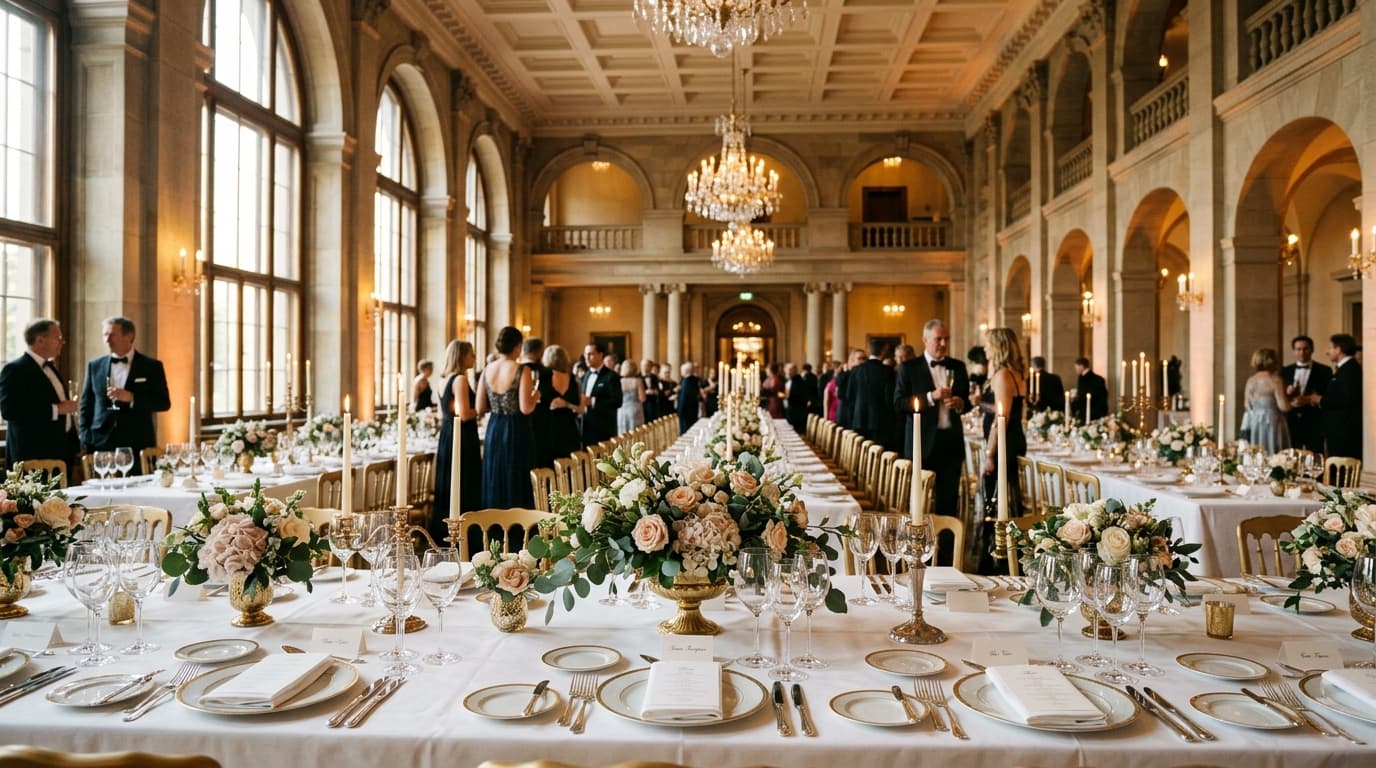
Once press photography concludes, the focus shifts to the formal program inside the Main Banquet Hall. At 19:35, ushering officers assist dignitaries and delegation members to their precise places at the banquet tables while soft classical music plays. Proper table placement is one of the most critical elements of protocol; place cards are arranged strictly by diplomatic precedence to foster balanced cross-delegation dialogue.
At 19:45, the host country Ambassador takes the Main Banquet Hall Stage to deliver opening remarks. Over twenty minutes, the Ambassador outlines bilateral relations, celebrates economic and cultural achievements, and articulates shared diplomatic objectives. Simultaneous translation earpieces are active across all channels to ensure non-native delegates follow every word without delay.
Immediately following at 20:05, the visiting Foreign Minister delivers a brief ten-minute response. This address culminates in the Official Diplomatic Toast to international cooperation. All attendees stand, raise their glasses, and share in a moment of state solidarity before dinner service begins.
Gala Banquet and Cultural Presentation
| Time | Event |
|---|---|
| 20:15 | Multi-Course Gala Dinner |
| 21:30 | Cultural Musical Performance |
| 21:55 | Exchange of Diplomatic Gifts |
The central portion of the evening balances gastronomy, artistic exchange, and state ritual. At 20:15, banquet staff commence the Multi-Course Gala Dinner in the Main Banquet Hall. Serving a four-course meal paired with selected regional wines requires absolute coordination between kitchen executive chefs and protocol directors. Plates are served simultaneously at principal tables so no high-ranking delegate waits for service.
At 21:30, as dinner plates are cleared, attention returns to the stage for a Cultural Musical Performance. A celebrated national string ensemble performs classical pieces showcasing national heritage and artistic unity. Similar to the curated entertainment timings seen in milestone celebrations like an anniversary party schedule or a milestone birthday party timeline, this performance offers guests a shared aesthetic experience that eases tension and bridges cultural divides.
At 21:55, delegation heads gather on the reception stage for the Exchange of Diplomatic Gifts. Symbolic items representing state history, national craftsmanship, or bilateral achievements are formally presented. Official archival photographers record each exchange for public records and diplomatic archives.
Bilateral Lounge Networking and Departure
| Time | Event |
|---|---|
| 22:15 | Coffee and Informal Networking |
| 22:45 | Formal Departure of Guests |
Following formal gift presentations, the energy of the reception transitions into quiet, practical diplomacy. At 22:15, guests move from the banquet room into the Diplomatic Lounge for Coffee and Informal Networking. Here, over espresso, fine tea, and digestifs, delegates engage in unscripted, direct conversations away from cameras and podiums. Many of the most productive bilateral agreements trace their origins to these informal lounge discussions.
At 22:45, protocol officers initiate the Formal Departure of Guests at the Portico Entrance. Departing dignitaries are escorted down to waiting vehicles in strict reverse order of precedence or coordinated according to motorcade readiness. The host Ambassador and chief delegation members stand at the main portico to bid farewell, concluding an evening of refined international hospitality precisely at 23:00.
Diplomatic Reception Timeline vs State Visit Itinerary
It is common for planning teams to confuse a diplomatic reception timeline with broader diplomatic documents, such as a state visit itinerary or a general event checklist.
| Dimension | Diplomatic Reception Timeline | State Visit Itinerary |
|---|---|---|
| Primary Scope | A minute-by-minute schedule for a single evening reception or gala dinner. | A multi-day overview covering bilateral summits, policy meetings, press briefings, and accommodation schedules. |
| Primary User | Embassy protocol officers, venue managers, caterers, security details, and event ushers. | Chiefs of staff, diplomatic attachés, national security advisers, and delegation heads. |
| Level of Detail | Minute-level precision covering speeches, course service, toasts, and gift exchanges. | Hour-by-hour or block schedule covering travel legs, bilateral meetings, and official rest periods. |
| Focus Area | Guest hospitality, protocol order of precedence, dining synchronicity, and event logistics. | Policy objectives, treaty signings, public appearances, and diplomatic transport logistics. |
While a state visit itinerary guides an entire foreign delegation across several days, the diplomatic reception running order focuses intensely on the execution of one high-stakes evening event.
Who Should Use This Template?
This timeline template is designed for diplomatic professionals, civil servants, and specialized hospitality teams who demand absolute precision during official state functions. It is engineered to accommodate diverse organizational roles involved in executing international events:
- Embassies and Consulates General: Chief protocol officers and embassy attachés managing national day receptions, ambassadorial welcomes, and diplomatic corps banquets.
- Ministries of Foreign Affairs: Departmental event coordinators organizing ministerial dinners, ambassadorial appointments, and international summit galas.
- State Protocol Offices: Government protocol specialists coordinating visits for foreign heads of state, vice presidents, and parliamentary delegations.
- International Organizations & UN Missions: Event directors hosting intergovernmental galas, multilateral working dinners, and treaty commemoration receptions.
- Specialized Protocol Venues: Historic venues, luxury hotel banquet directors, and diplomatic club managers executing high-security government receptions.
How to Use This Template
Using Chronolio's flexible scheduling tools, you can adapt this diplomatic timeline to match your exact venue layout, security directives, and delegation requirements:
- Download or Duplicate the Template: Access the pre-built structure directly in Chronolio or download a local copy in Microsoft Word (.docx) or Printable PDF format.
- Adjust Arrival and Departure Times: Set your official start time based on motorcade arrival permits and local traffic regulations, letting Chronolio recalculate subsequent phase timings automatically.
- Customize Speeches and Protocol Elements: Insert specific delegate names, titles, speech durations, and translation requirements into the event notes.
- Coordinate with Security and Catering: Share dedicated views of the schedule with embassy protective details, transport dispatchers, and executive banquet chefs.
- Distribute to Delegation Aides: Provide finalized, time-stamped run sheets to foreign delegation ushers and press officers prior to guest arrival.
Tips for a Successful Diplomatic Reception
Executing a flawless diplomatic reception requires balancing rigid state protocol with warm international hospitality. Keep these operational guidelines in mind:
- Confirm Precedence Orders Early: Verify the exact official ranking of all attending dignitaries against guidelines from the U.S. Department of State Office of the Chief of Protocol or your host nation's foreign ministry at least 48 hours prior to the event.
- Brief Ushers on Room Layouts: Ensure protocol ushers memorize table locations and guest name pronunciations to prevent hesitation in the main hall.
- Test Translation Equipment: Conduct audio checks on all simultaneous translation headsets and channels before opening the foyer to guests.
- Maintain Open Lines with Security: Ensure the Chief of Protocol has direct radio contact with the head of the motorcade security detail to manage early or delayed dignitary arrivals.
- Synchronize Kitchen Call Times: Lock in course serving times with the catering team so that hot dishes land immediately following speeches and toasts.
- Prepare Secondary Photo Areas: Set up a secondary backdrop in case the primary press area becomes overcrowded during high-profile delegation arrivals.
Common Mistakes to Avoid
Even seasoned event organizers can encounter friction if certain diplomatic logistics are overlooked. Avoid these frequent pitfalls:
- Ignoring Precedence Rules: Placing a higher-ranking minister further down the head table than a lower-ranking ambassador creates severe diplomatic offense.
- Overcrowded Speeches: Allowing opening remarks to extend past allocated times delays dinner service and compresses valuable networking windows.
- Mismanaging Motorcade Flow: Failing to stagger arrival and departure slots causes vehicle congestion at the portico and compromised delegate security.
- Unclear Dietary Tracking: Serving restricted foods to foreign dignitaries due to uncollected dietary requirements causes embarrassment for host teams.
- Inadequate Press Control: Allowing photojournalists to stray outside designated press boxes disrupts delegate movements into the banquet hall.
- Abrupt Program Transitions: Moving guests between rooms without clear protocol ushering creates confusion and destroys event pacing—a challenge equally critical in sacred ceremonies like a Catholic wedding timeline or formal religious functions.
In Summary
- Purpose: A structured schedule designed to manage arrivals, speeches, dining, gift exchanges, and departures at official diplomatic events.
- Key Focus: Maintaining strict order of precedence, multi-departmental coordination, and secure, dignified environments for foreign dignitaries.
- Primary Locations: Grand Foyer, Garden Terrace, State Hall Press Area, Main Banquet Hall, and Diplomatic Lounge.
- Core Participants: Ambassadors, foreign ministers, heads of delegation, protocol officers, and security details.
- Flexibility: Fully customizable in Chronolio and downloadable in Word and PDF formats for immediate operational deployment.
A successful diplomatic event depends on absolute clarity, disciplined timing, and flawless hospitality execution. By using this diplomatic reception timeline, embassy protocol officers, state planners, and venue directors can deliver a distinguished experience that reinforces bilateral relationships and upholds international decorum.
Customize Your Diplomatic Reception Timeline