




This Template at a Glance
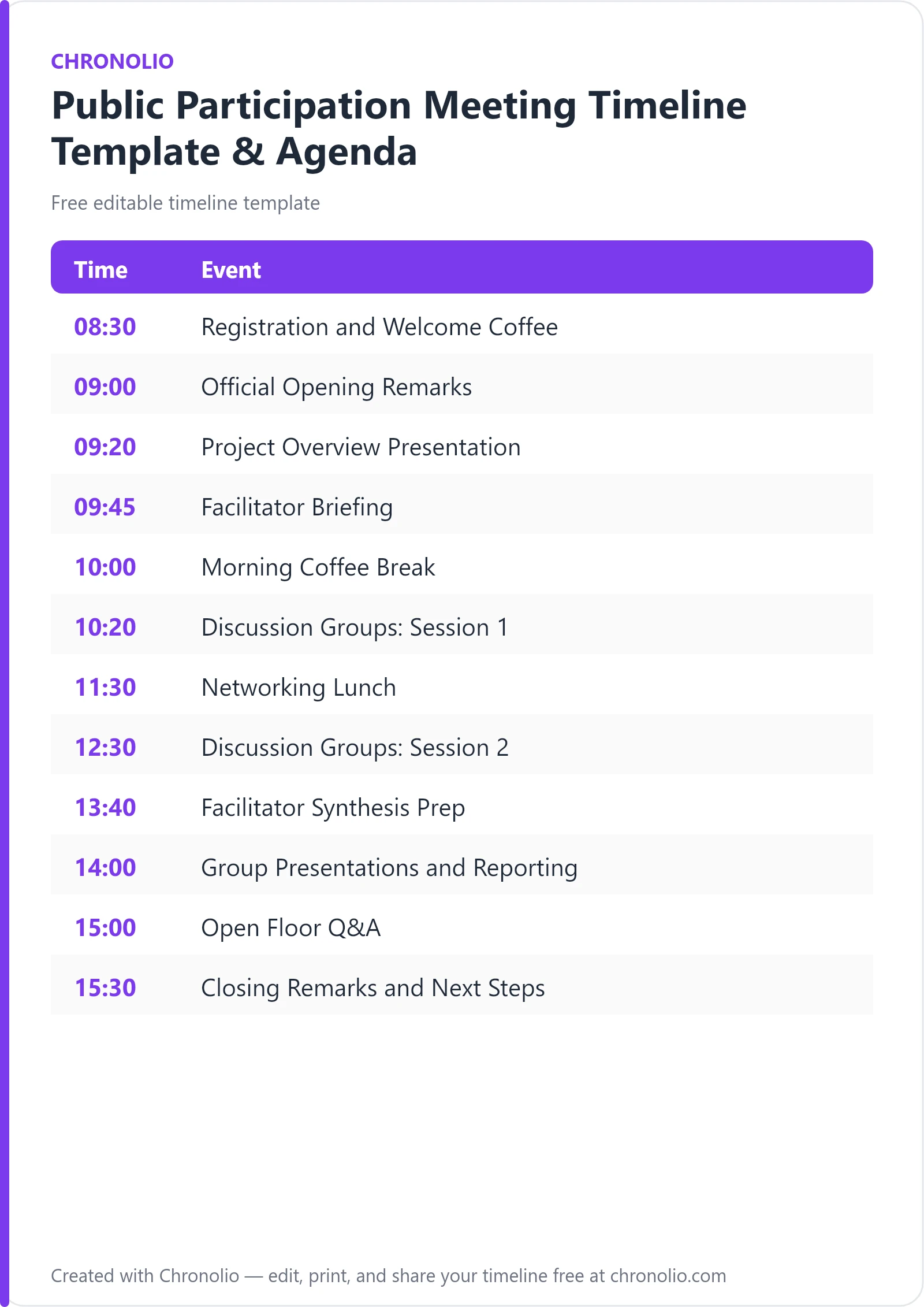
Here is the complete schedule this free template gives you — every time block, ready to edit, download, and share:
| Time | Event |
|---|---|
| 08:30 | Registration and Welcome Coffee |
| 09:00 | Official Opening Remarks |
| 09:20 | Project Overview Presentation |
| 09:45 | Facilitator Briefing |
| 10:00 | Morning Coffee Break |
| 10:20 | Discussion Groups: Session 1 |
| 11:30 | Networking Lunch |
| 12:30 | Discussion Groups: Session 2 |
| 13:40 | Facilitator Synthesis Prep |
| 14:00 | Group Presentations and Reporting |
| 15:00 | Open Floor Q&A |
| 15:30 | Closing Remarks and Next Steps |
What Is a Public Participation Meeting Timeline?
A public participation meeting timeline is an end-to-end operational agenda that structures direct civic engagement between public sector leaders, project stakeholders, and community residents. Running a transparent, productive public consultation requires far more than handing out a project brochure and passing around a microphone.
Having managed dozens of town halls and municipal workshops, I know that managing floor dynamics and group energy depends entirely on clear, predictable timing. This battle-tested template reflects real-world public engagement frameworks used by urban planners, municipal councils, and facilitation teams. By establishing explicit windows for contextual briefings, small-group collaboration, and plenary reporting, your engagement process remains constructive and accountable. You can also download this template as a customizable Word document or a printable PDF schedule for offline team coordination.
Customize Your Public Participation Schedule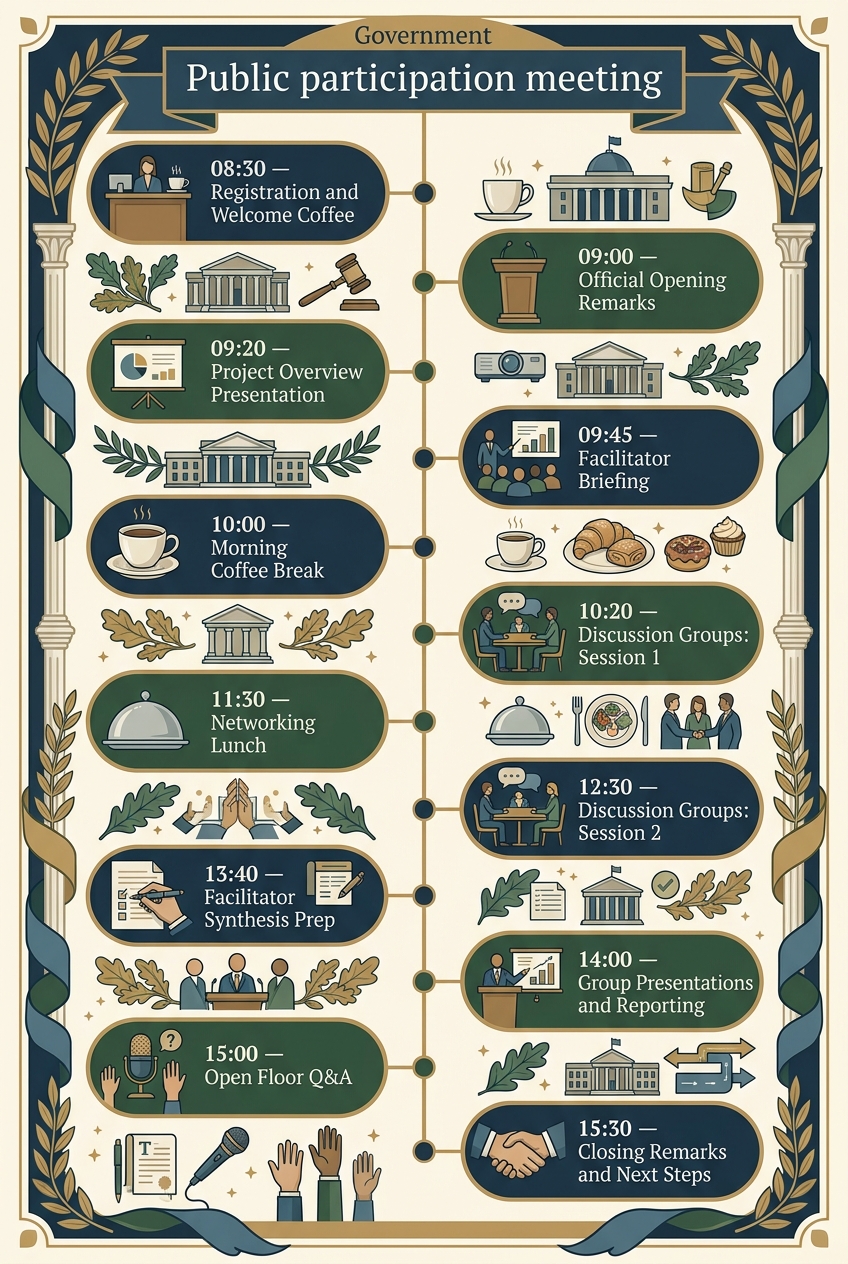
Why Public Participation Meetings Need a Timeline
Public consultations carry high expectations, diverse opinions, and occasionally contentious community debates. Without a rigorous running order, a simple presentation can easily expand into an uncontrolled open mic, leaving insufficient time for collaborative breakout work. A detailed timeline serves as a neutral framework that keeps stakeholders focused on specific consultative objectives.
Structuring your session gives participants confidence that their time and personal contributions are respected. Knowing exactly when group discussions begin and when the open floor Q&A takes place prevents attendees from interrupting presentation phases with early objections.
Finally, explicit timing aligns multi-person event teams—including lead facilitators, audio-visual technicians, scribes, and catering staff. When everyone works from a synchronized agenda, room transitions between the main auditorium and breakout areas occur seamlessly without losing participant momentum.
What to Include in a Public Participation Meeting Timeline
To deliver a transparent, high-impact public consultation, your schedule should incorporate the following essential phases:
- Welcome and Registration Period: A welcoming check-in area with light refreshments to encourage informal community arrival and material distribution.
- Context Setting & Technical Briefing: Clear presentations outlining project background, legal or planning parameters, and key decision areas.
- Facilitator Ground Rules Briefing: Instructions explaining group expectations, discussion table mechanics, and equity of voice.
- Structured Breakout Sessions: Small working group discussions targeting specific operational themes, such as zoning, traffic, or public amenities.
- Catered Networking Lunch: An informal interval that encourages participants and facilitators to build rapport.
- Synthesis and Scribe Prep: Dedicated preparation time for facilitators to consolidate table notes into clear reporting bullet points.
- Plenary Group Reporting: Public presentations delivered by table spokespersons to share breakout recommendations with the broader assembly.
- Open Floor Q&A: A facilitated dialogue session where attendees can address questions directly to project sponsors.
- Closing Commitments & Next Steps: Official summary statement outlining how community input will influence project decisions.
Phase 1: Welcome, Context, and Facilitation Prep
| Time | Event |
|---|---|
| 08:30 | Registration and Welcome Coffee |
| 09:00 | Official Opening Remarks |
| 09:20 | Project Overview Presentation |
| 09:45 | Facilitator Briefing |
The morning phase establishes the tone, authority, and factual foundation for the entire consultation. Setting aside thirty minutes for registration and welcome coffee allows community members to collect background packets, check in at the Community Center Main Foyer, and settle down comfortably without delaying the formal opening.
+-------------------------------------------------------------------+ | PHASE 1: WELCOME & CONTEXT | | 08:30 Registration --> 09:00 Opening --> 09:20 Presentation | +-------------------------------------------------------------------+
Promptly at 09:00, local officials deliver official opening remarks in the Main Auditorium to contextualize the civic importance of the meeting. This flows directly into the project overview presentation, where urban planners detail technical scope, site maps, and governance boundaries. Before splitting into small groups, the lead facilitator conducts a fifteen-minute facilitator briefing, establishing clear ground rules for respectful dialogue, timekeeping, and equity of voice across all tables.
Phase 2: Collaborative Breakout Workshops and Synthesis
| Time | Event |
|---|---|
| 10:00 | Morning Coffee Break |
| 10:20 | Discussion Groups: Session 1 |
| 11:30 | Networking Lunch |
| 12:30 | Discussion Groups: Session 2 |
| 13:40 | Facilitator Synthesis Prep |
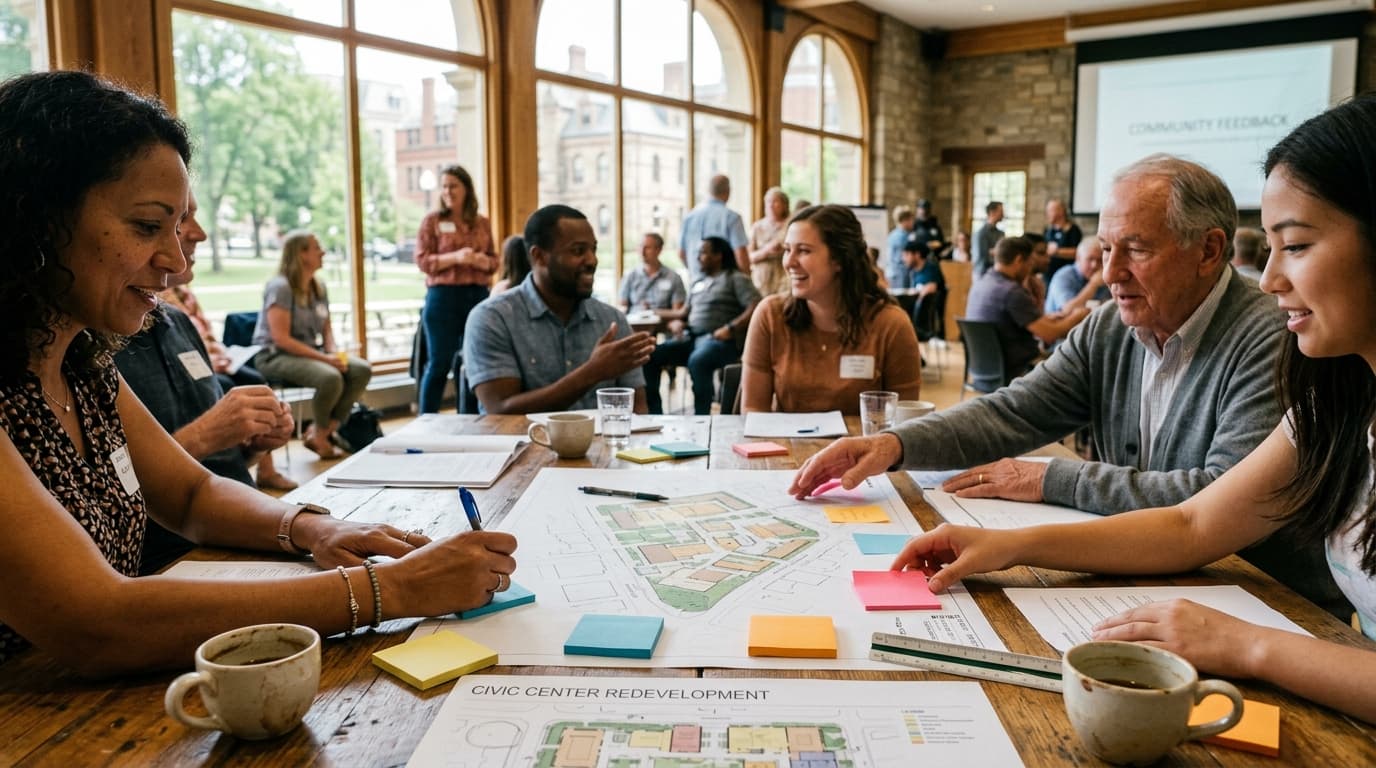
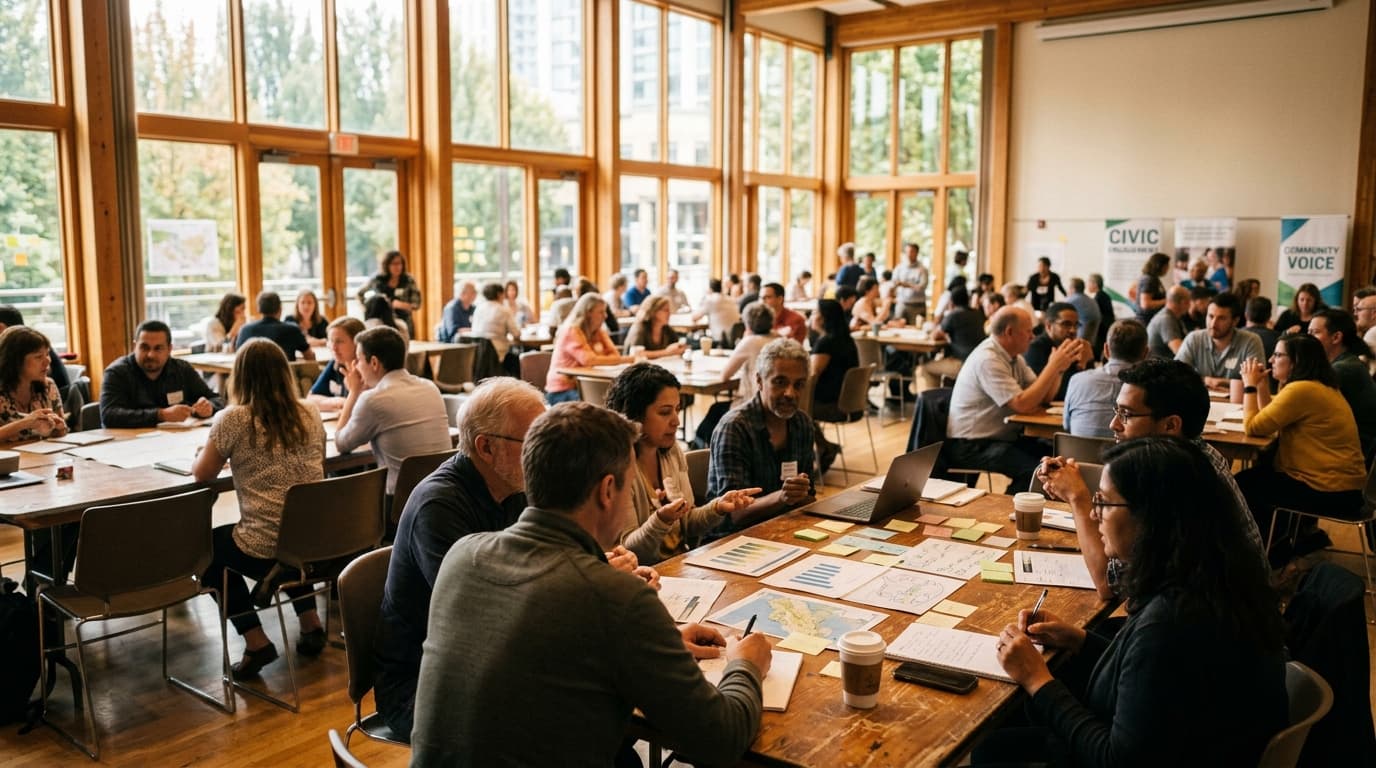
Following a brief transition break in the Catering Hall, participants disperse to designated Breakout Rooms A through D. Dividing a large crowd into focused working groups of 8 to 12 people prevents dominant voices from monopolizing the conversation and gives quiet attendees space to participate.
+-------------------------------------------------------------------+ | PHASE 2: BREAKOUTS & SYNTHESIS | | 10:20 Session 1 --> 11:30 Lunch --> 12:30 Session 2 | +-------------------------------------------------------------------+
During Session 1, groups dive into foundational topic areas like local infrastructure and environmental impacts. After a catered networking lunch, participants resume in Session 2 to refine specific proposal recommendations. Once discussions close at 13:40, group facilitators retire to the Facilitators Lounge for a twenty-minute synthesis preparation window. This quiet period is critical: facilitators filter raw flipchart notes into structured summary points before standing in front of the full auditorium. While governance meetings follow formal parliamentary motions like a board meeting timeline, public participation relies on this rapid qualitative analysis to capture genuine community sentiment.
Phase 3: Plenary Reporting and Open Q&A
| Time | Event |
|---|---|
| 14:00 | Group Presentations and Reporting |
| 15:00 | Open Floor Q&A |
| 15:30 | Closing Remarks and Next Steps |
The final phase brings all attendees back to the Main Auditorium for public accountability. Designated spokespersons from each breakout group deliver succinct five-minute table presentations, sharing top recommendations and key points of consensus with local leadership.
+-------------------------------------------------------------------+ | PHASE 3: REPORTING & CLOSING | | 14:00 Reporting --> 15:00 Open Q&A --> 15:30 Next Steps | +-------------------------------------------------------------------+
At 15:00, the meeting transitions into a thirty-minute open floor Q&A, permitting community members to question panel members directly regarding overall findings. By placing open floor questions after collaborative breakout sessions, participants ask far more informed, constructive questions. Organizers conclude at 15:30 with explicit closing remarks detailing next steps, explaining exactly how meeting outcomes will feed into municipal decision-making before adjourning on time.
Unlike social events such as a celebratory birthday party timeline, an formal anniversary party schedule, or a structured baby shower timeline, civic consultations require strict adherence to announced times to maintain public trust.
Public Participation Meeting Timeline vs Meeting Agenda
Organizers often confuse a high-level public agenda with an operational event timeline. While an agenda outlines what topics will be discussed for the public, an operational timeline specifies the precise internal execution mechanics.
| Public Agenda | Operational Event Timeline |
|---|---|
| Broad time blocks published for attendees | Minute-by-minute execution times for event staff |
| Lists presentation titles and public discussion topics | Details technician, facilitator, and scribe cues |
| Focused on high-level participant expectations | Incorporates buffer times, room transitions, and synthesis windows |
| Shared on public notices and event registration pages | Distributed internally to venue staff, moderators, and audio-visual teams |
An agenda tells residents what will happen; the operational timeline controls venue logistics behind the scenes so the event runs smoothly.
Who Should Use This Template?
This consultative timeline is engineered for project leaders, civic coordinators, and facilitators who manage public stakeholder engagement across various domains:
- Municipal Planning Departments: Conducting official public hearings or urban development masterplan consultations.
- Civil Society Organizations: Facilitating community advocacy workshops, public policy roundtables, and town halls.
- Environmental & Infrastructure Agencies: Running environmental impact assessment consultations with regional communities.
- School Boards & University Councils: Gathering input from parents, students, and local residents on major institutional policy changes.
- Housing Authorities & Community Trusts: Engaging residents on estate regeneration or local housing allocation strategies.
Depending on your specific role within these organizations, Chronolio provides customized schedule views tailored to distinct team roles across management, facilitation, and technical production.
How to Use This Template
- Duplicate or Import the Schedule: Load this template into Chronolio or download the editable Word template or printable PDF template.
- Set Your Event Date & Start Time: Adjust the morning start time to reflect your local venue access and registration schedule.
- Customize Discussion Topics: Update breakout session descriptions to match your specific consultative themes (e.g., transit networks, park allocation, or zoning rules).
- Assign Room Numbers and Lead Facilitators: Add specific hall names and facilitator assignments directly to individual event items.
- Publish and Distribute: Share the public schedule with participants while providing the detailed execution timeline to facilitators and venue staff.
Tips for a Successful Public Participation Meeting
- Establish Neutral Ground Rules Early: Post rules regarding speaking limits, mutual respect, and constructive critique in every room before starting.
- Cap Discussion Table Sizes: Keep working groups to 8 to 12 participants per room to ensure everyone has a fair opportunity to speak.
- Enforce Strict Timekeeping: Provide facilitators with quiet hand signs (e.g., 2 minutes remaining, 30 seconds remaining) to keep table discussions moving.
- Provide Dedicated Scribes: Assign an impartial note-taker to each breakout table so participants see their points recorded accurately on flipcharts or digital screens.
- Incorporate Synthesis Buffer Windows: Never skip the facilitator prep period between breakouts and plenary reporting; synthesis prevents repetitive, disorganized table presentations.
- Document All Physical Materials: Photograph flipcharts, gather worksheet printouts, and collect written feedback slips immediately following the event.
- Follow Up Promptly: Publish a consolidated summary report within 7 to 10 days to demonstrate how community contributions impact final decisions.
Common Mistakes to Avoid
- Overloading Presentation Time: Expending two hours on staff presentations leaves insufficient time for community input, turning a consultation into a lecture.
- Skipping Facilitator Preparation: Assuming table facilitators know how to guide conversations without a dedicated 15-minute briefing leads to inconsistent breakout quality.
- Allowing Early Open Mic Dominance: Opening the general microphone before small group work allows vocal participants to hijack the agenda early on.
- Neglecting Room Transition Times: Forgetting to schedule move-time between the main hall and breakout areas creates chaotic schedule drift.
- Failing to Publish Next Steps: Leaving participants without clear follow-up dates erodes civic trust and undermines future engagement efforts.
- Ignoring Audio-Visual Checks: Failing to test microphones, slide clickers, and projector resolution prior to 08:30 causes embarrassing morning delays.
In Summary
- A public participation meeting schedule balances public presentation, collaborative breakout dialogue, and transparent reporting.
- The 08:30 to 15:45 schedule ensures adequate time for context setting, two working group sessions, and open-floor Q&A.
- Small working groups capped at 8 to 12 participants yield higher-quality feedback than large open-floor discussions.
- Dedicating a 20-minute synthesis window allows facilitators to organize flipchart feedback into clear plenary summary points.
- Transparent timekeeping and clear follow-up commitments build public trust and enhance project outcomes.
Mastering public consultation requires balancing structured discipline with open, inclusive dialogue. By grounding your community meeting in this battle-tested timeline, you ensure every resident is heard, public sector objectives are addressed, and your team stays on track from registration to closing remarks. For formal religious ceremonies or nuptial schedules, view our specialized guides like the Catholic wedding timeline or the Christian wedding timeline.
Customize Your Public Participation ScheduleFor additional international standards on civic engagement design, refer to the International Association for Public Participation (IAP2) Core Values and the US EPA Public Participation Guide.