






This Template at a Glance
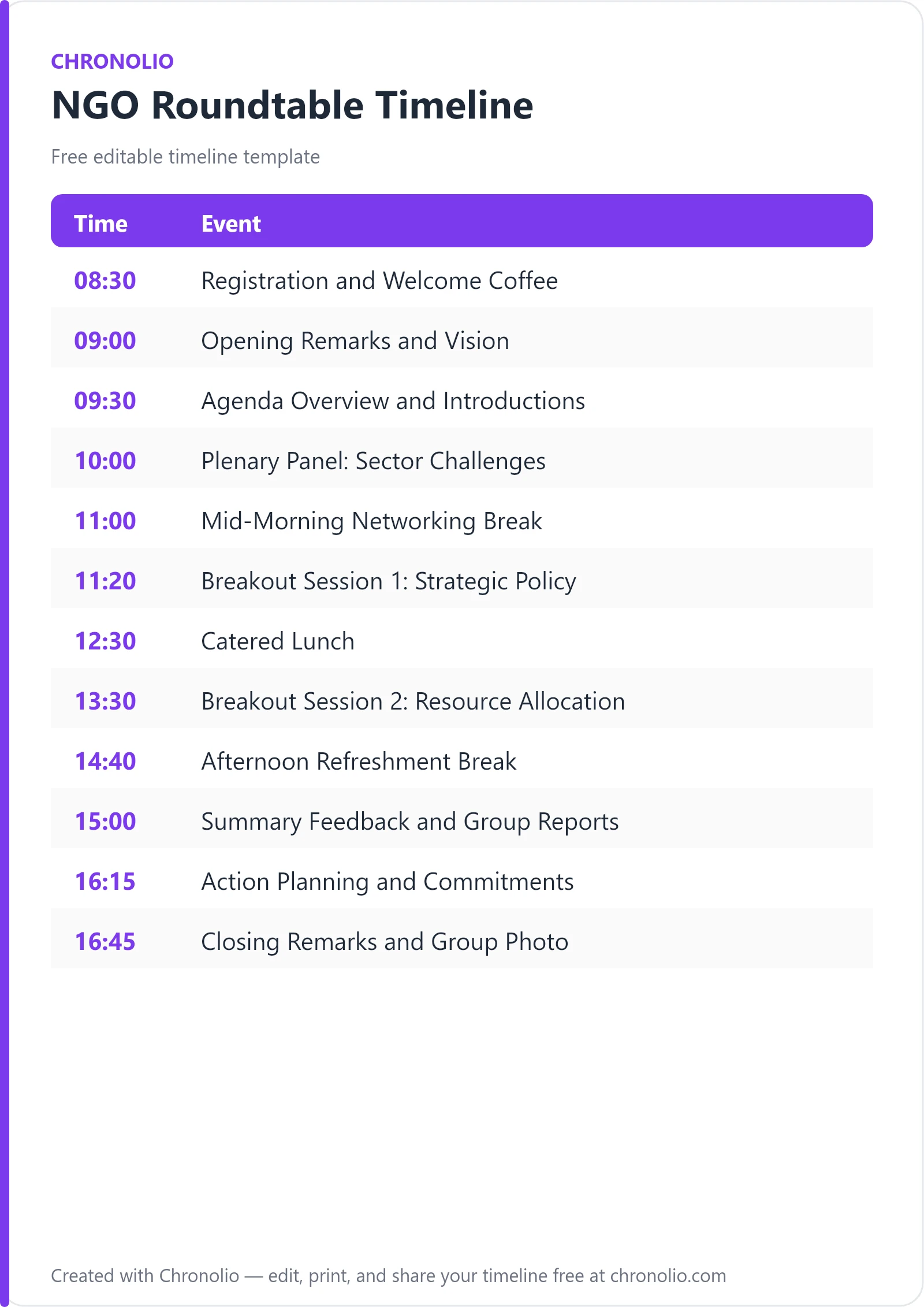
Here is the complete schedule this free template gives you — every time block, ready to edit, download, and share:
| Time | Event |
|---|---|
| 08:30 | Registration and Welcome Coffee |
| 09:00 | Opening Remarks and Vision |
| 09:30 | Agenda Overview and Introductions |
| 10:00 | Plenary Panel: Sector Challenges |
| 11:00 | Mid-Morning Networking Break |
| 11:20 | Breakout Session 1: Strategic Policy |
| 12:30 | Catered Lunch |
| 13:30 | Breakout Session 2: Resource Allocation |
| 14:40 | Afternoon Refreshment Break |
| 15:00 | Summary Feedback and Group Reports |
| 16:15 | Action Planning and Commitments |
| 16:45 | Closing Remarks and Group Photo |
What Is an NGO Roundtable Timeline?
An NGO roundtable timeline is a structured, chronologically mapped running order designed to guide non-governmental organizations, civil society groups, and international donor agencies through collaborative working meetings. Unlike standard corporate presentations or academic symposiums, multi-stakeholder non-profit roundtables require deliberate pacing between high-level plenary discussions and focused small-group working sessions. Having organized convenings across international humanitarian forums and policy working groups, we know that non-profit leaders rarely lack passion—they lack time. A well-designed timetable acts as a neutral governor, ensuring that key delegates, technical advisors, and rapporteurs remain focused on consensus building rather than getting bogged down in procedural debates.
This template incorporates tested sector practices, ensuring your delegation transitions smoothly from registration and contextual briefing through thematic breakout rooms to concrete joint commitments and strategic consensus. Whether you are coordinating emergency relief networks or regional policy coalitions, keeping your agenda disciplined ensures every organizational voice is heard without running past your venue rental window.
Use This NGO Roundtable Timeline Template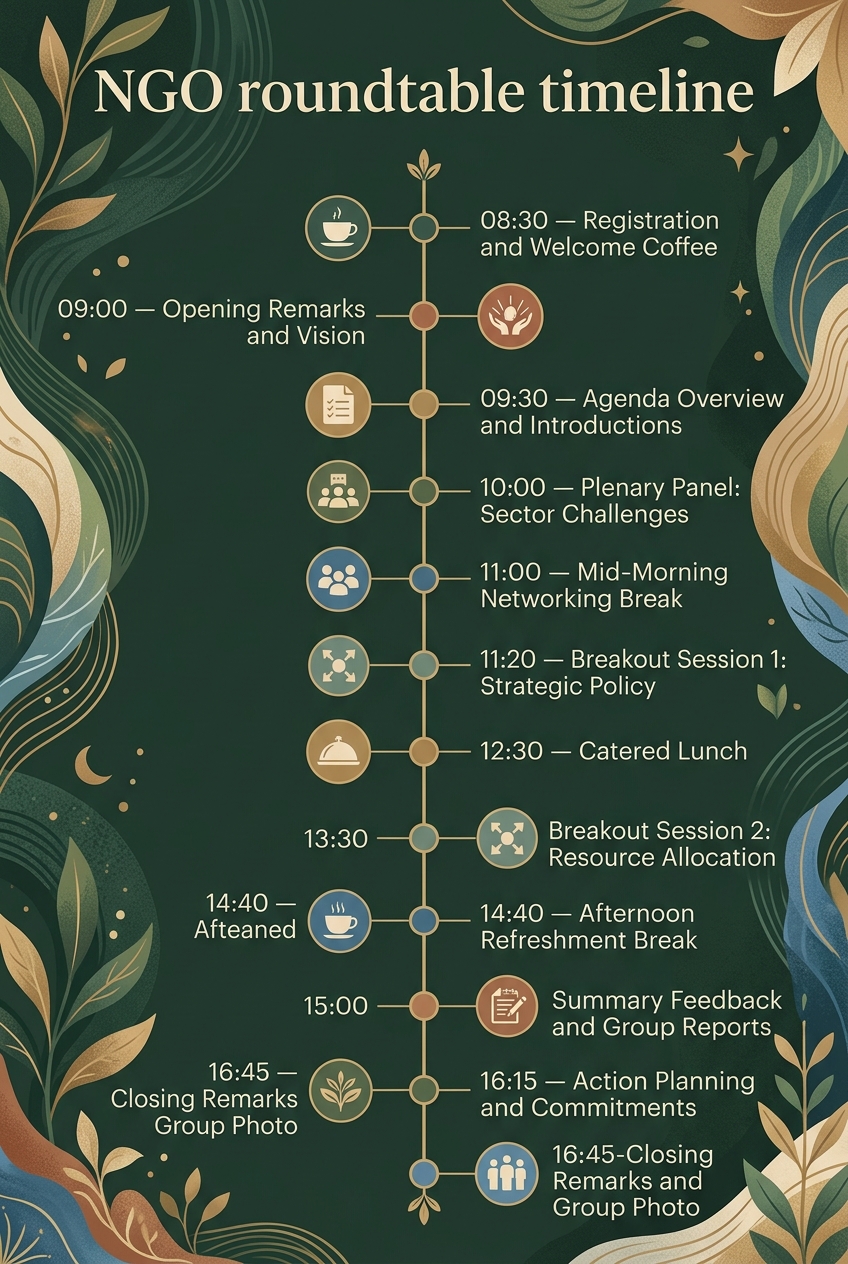
Why NGOs Need a Timeline
Multi-stakeholder convenings bring together passionate advocates, donor representatives, and field experts who often have competing priorities. Without a firm schedule, plenary discussions routinely spill into working group hours, leaving delegates with insufficient time to draft policy resolutions or allocate joint resources. A clear running order sets ground rules from the outset, establishing predictable boundaries for speaking times, networking breaks, and feedback reporting.
Furthermore, running an international or regional roundtable involves complex logistical coordination across venue spaces. Facilitators must coordinate breakout room transitions, catered meal windows, and technical audiovisual resets seamlessly. When delegates know precisely where they need to be—whether in the main ballroom or designated breakout suites— session transitions run smoothly without losing valuable working minutes.
Finally, an explicit timeline drives accountability. When delegates see a dedicated block for action planning and follow-up assignments at the end of the day, conversations naturally orient toward actionable outputs. It transforms what could be a passive talk-shop into an outcome-oriented working session that produces white papers, shared advocacy campaigns, and resource-sharing commitments.
What to Include in an NGO Roundtable Timeline
To maintain momentum throughout an intensive full-day convening, an NGO roundtable agenda should include the following core phases:
- Welcome and Delegate Registration: Dedicated time in the foyer for check-in, badge collection, and informal morning networking over coffee.
- Framing & Vision Statements: Opening remarks by steering committee leads to set boundaries, review safety protocols, and outline expected outputs.
- Contextual Plenary Panels: High-level thematic panel discussions addressing macro sector challenges, regulatory hurdles, or funding landscapes.
- Structured Breakout Sessions: Concurrent small-group working sessions focused on specific thematic policy tracks, resource sharing, or operational joint ventures.
- Dedicated Networking & Catered Breaks: Ample time for delegates to step away from formal working groups, connect informally, and review documentation.
- Rapporteur Feedback & Synthesis: A main-room session where group representatives present key findings, draft recommendations, and consensus points.
- Action Planning & Follow-Up Commitments: A facilitated closing exercise to assign working group leads, outline deadlines, and establish concrete next steps.
Morning Plenary & Sector Framing
| Time | Event | | 08:30 | Registration and Welcome Coffee | | 09:00 | Opening Remarks and Vision | | 09:30 | Agenda Overview and Introductions | | 10:00 | Plenary Panel: Sector Challenges | | 11:00 | Mid-Morning Networking Break |
The opening hours of an NGO roundtable set the professional tone and contextual framework for the entire day. Beginning at 08:30 in the Main Foyer at Global Civic Center, delegates complete check-in procedures, collect meeting packs, and engage in informal peer introductions over morning refreshments. Starting with a half-hour registration buffer prevents late arrivals from disrupting the critical framing remarks.
At 09:00, delegates gather in the Grand Ballroom at Global Civic Center where the Steering Committee lead delivers opening remarks to articulate the core objectives of the gathering. This leads directly into the agenda overview and participant introductions at 09:30, allowing facilitators to establish working rules and explain how breakout rapporteurs will synthesize findings. The morning reaches its analytical peak during the 10:00 Plenary Panel, where invited sector experts highlight regulatory, financial, and logistical hurdles facing civil society organizations. After an intensive hour of diagnostic presentation, delegates step back out to the main foyer at 11:00 for a 20-minute mid-morning break to absorb the panel insights before dividing into working groups.
If your non-profit also manages governance assemblies alongside programmatic roundtables, consider pairing this layout with our board meeting timeline template to keep executive director reporting equally tight.
Interactive Breakout Working Sessions
| Time | Event | | 11:20 | Breakout Session 1: Strategic Policy | | 12:30 | Catered Lunch | | 13:30 | Breakout Session 2: Resource Allocation | | 14:40 | Afternoon Refreshment Break |
Mid-day is reserved for intensive, interactive working groups where real policy work and resource coordination occur. At 11:20, delegates disperse from the main ballroom into Breakout Rooms A through D at Global Civic Center. In this first session, focused on Strategic Policy, delegates break into thematic tracks to debate policy frameworks, collaborative advocacy messages, and legislative reform targets. Structuring small groups of 8 to 12 participants ensures every delegate contributes actively.
At 12:30, the convening shifts to the Dining Hall at Global Civic Center for a hot buffet lunch. This hour provides necessary mental relief while encouraging informal cross-organizational networking across different breakout tracks. Following lunch at 13:30, participants reassemble in their assigned breakout rooms for Breakout Session 2, focusing on Resource Allocation. Here, the focus turns from high-level advocacy to operational mechanics—discussing joint fundraising initiatives, pooled emergency relief funds, and shared supply chain infrastructure. At 14:40, delegates transition back to the main foyer for an afternoon refreshment break, allowing facilitators and session rapporteurs time to organize their notes before returning to the plenary hall.
For broader organizational milestones or celebratory non-profit galas, explore our anniversary party schedule template or birthday party timeline template for structuring celebratory evening agendas.
Synthesis, Commitments & Closing
| Time | Event | | 15:00 | Summary Feedback and Group Reports | | 16:15 | Action Planning and Commitments | | 16:45 | Closing Remarks and Group Photo |
The final block of the roundtable translates multi-hour breakout discussions into cohesive institutional outcomes. Reconvening in the Grand Ballroom at Global Civic Center at 15:00, rapporteurs from each breakout room present key findings, highlighted consensus points, and controversial policy options to the full assembly. Allowing 75 minutes for this summary feedback stage ensures that every breakout track receives equal visibility and delegates can cross-examine proposed recommendations.
At 16:15, the lead facilitator transitions the room into active Action Planning. Rather than leaving agreements abstract, the lead synthesizer logs commitments on live visual monitors, assigns working group chairs, and sets firm publication dates for the resulting summit white paper. The day concludes at 16:45 on the Main Hall Steps at Global Civic Center with closing expressions of gratitude from organizers and a commemorative group photo.
When managing faith-based civil society gatherings or charity summits with complex ceremonial protocols, event coordinators can also adapt structures from our Christian wedding timeline or Catholic wedding timeline to manage multi-phase group movements with grace.
NGO Roundtable Timeline vs Conference Agenda
Understanding the functional difference between a collaborative roundtable schedule and a traditional conference agenda is vital for event planners and steering committees:
| Event Feature | NGO Roundtable Timeline | Standard Conference Agenda |
|---|---|---|
| Primary Objective | Multi-stakeholder consensus, working policy outputs, and shared commitments. | Knowledge dissemination, keynotes, and passive audience learning. |
| Participant Role | Active delegates, breakout discussants, and appointed rapporteurs. | Attendees, listeners, and Q&A participants. |
| Session Structure | Small working groups, roundtables, and joint synthesis blocks. | Sequential keynote speeches, panel tracks, and vendor exhibitions. |
| Output Type | Joint declarations, white papers, pooled funding arrangements. | Individual learning, networking contacts, downloaded slidedecks. |
| Time Allocation | High ratio of working group discussion to presentation time (60/40). | High ratio of speaker presentations to audience Q&A (80/20). |
While a conference agenda schedules back-to-back presentations across large halls, an NGO roundtable timeline focuses on interactive dialog, intentionally reserving majority blocks of time for small-group problem-solving and immediate plenary reporting.
Who Should Use This Template?
This structured schedule template serves civil society leaders, international coalition directors, and event facilitators managing multi-organizational gatherings. Chronolio supports various non-profit roles involved in leading, coordinating, and documenting complex events.
- International NGO Coalitions: Federations coordinating joint advocacy and regional humanitarian policy.
- Civil Society Organizations (CSOs): Local grassroots networks aligning community development strategies.
- Grantmaking Foundations & Donors: Philanthropic organizations hosting grantee convenings and strategic funding reviews.
- Governmental Policy Working Groups: Public-private partnerships aligning civil protection and development strategies.
- Think Tanks & Research Institutes: Policy experts convening cross-sector specialists to draft strategic white papers.
- Emergency Response Coordination Committees: Disaster relief networks standardizing rapid response protocols across agencies.
How to Use This Template
- Download or Duplicate: Access this agenda framework directly on Chronolio or download our ready-to-use versions as a customizable Word document or a formatted PDF document.
- Set Your Convening Date and Venue Details: Update the top header with your specific summit date, host organization, and venue location details.
- Adjust Breakout Timings for Your Delegation: Scale the length of Breakout Sessions 1 and 2 based on whether your working groups are drafting detailed resolutions or conducting high-level brainstorming.
- Assign Facilitators and Rapporteurs: Name session leads and rapporteurs next to each agenda block early so they understand their reporting duties.
- Distribute Pre-Summit Packets: Send the finalized timeline to delegates at least five days prior alongside background policy briefs and venue maps.
Tips for a Successful NGO Roundtable
- Appoint Dedicated Rapporteurs Early: Designate a capable note-taker and presenter for each breakout room prior to event day so group reporting is structured and quick.
- Enforce Strict Timekeeping in Plenary: Use visual timekeepers or countdown timers during panel speeches to ensure breakout groups start exactly on schedule.
- Provide Clear Breakout Prompts: Give each working group room a printed one-page prompt listing exact questions to answer and outputs required.
- Incorporate Live Synthesis Technology: Use shared digital whiteboards during the summary feedback session so delegates see live edits to action plans.
- Build in Substantial Buffer Space: Leave 15 to 20 minutes between major breakout sessions and lunch to handle room transitions and technical AV setups.
- Keep Refreshments Close to Working Areas: Position coffee stations near breakout rooms to prevent delegates from wandering away during quick breaks.
- Follow Up with Action Minutes Within 48 Hours: Circulate the live action planning commitments to all participating delegations while momentum remains high.
Common Mistakes to Avoid
- Overloading the Opening Plenary: Spending half the day on long opening speeches, which starves afternoon breakout groups of critical discussion time.
- Neglecting Rapporteur Prep Time: Failing to give breakout rapporteurs 15 minutes to organize their notes before presenting in plenary.
- Unclear Breakout Group Objectives: Sending delegates into small rooms without specific discussion prompts or expected output formats.
- Skipping the Action Planning Phase: Concluding the roundtable after summary reports without logging explicit commitments, owners, and deadlines.
- Inadequate Venue Signage: Leaving breakout room assignments unclear, causing delegates to wander around corridors during session changes.
- Ignoring Hybrid Delegate Needs: Failing to designate virtual moderators for remote delegates attending online breakout channels.
In Summary
- An NGO roundtable timeline is an outcome-oriented event schedule designed to guide non-profit convenings, policy summits, and multi-stakeholder working groups.
- It balances contextual expert panels, deep-dive thematic breakout sessions, catered networking breaks, and joint action planning.
- Structuring 60 to 75 minutes for rapporteur feedback ensures that small-group discussions translate into consensus policy outputs.
- Clear time allocation prevents long opening speeches from delaying interactive working groups.
- Downloadable formats are available as a customizable Word document and a formatted PDF document.
- Using a dedicated template guarantees smooth venue room transitions and clear accountability for post-summit follow-up commitments.
Designing an effective agenda is the foundation of any successful civil society summit. By utilizing an optimized NGO roundtable timeline, organizers can keep international delegates, policy advisors, steering committees, and advocacy groups aligned from the morning coffee to the final commitments. Start customizing your roundtable agenda today to turn policy discussions into actionable impact.
Use This NGO Roundtable Timeline Template