






This Template at a Glance
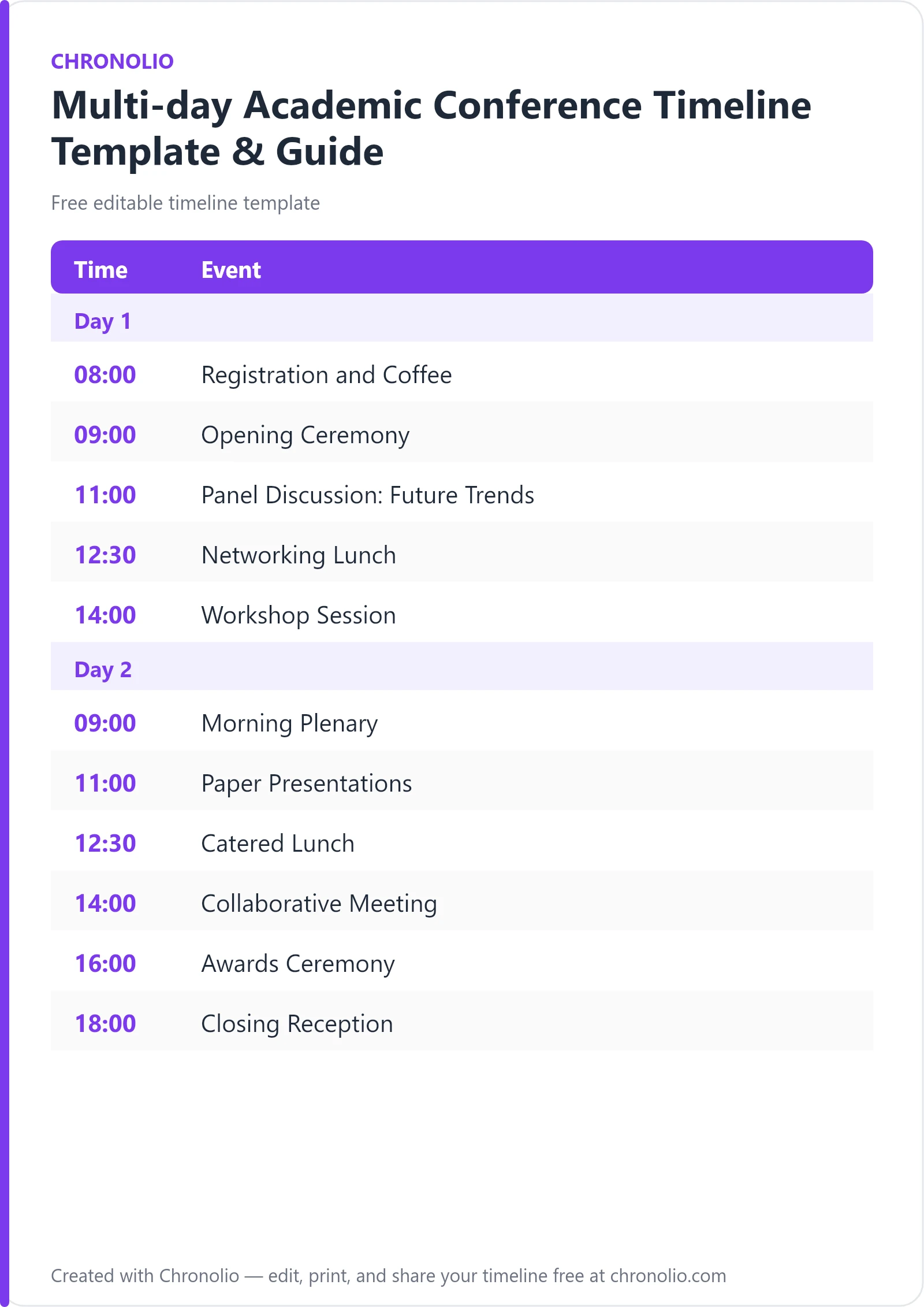
Here is the complete schedule this free template gives you — every time block, ready to edit, download, and share:
| Day | Time | Event |
|---|---|---|
| 1 | 08:00 | Registration and Coffee |
| 1 | 09:00 | Opening Ceremony |
| 1 | 11:00 | Panel Discussion: Future Trends |
| 1 | 12:30 | Networking Lunch |
| 1 | 14:00 | Workshop Session |
| 2 | 09:00 | Morning Plenary |
| 2 | 11:00 | Paper Presentations |
| 2 | 12:30 | Catered Lunch |
| 2 | 14:00 | Collaborative Meeting |
| 2 | 16:00 | Awards Ceremony |
| 2 | 18:00 | Closing Reception |
What Is a Multi-day Academic Conference Timeline?
A multi-day academic conference timeline is an operational master plan that structures scholarly presentations, panel discussions, breakout workshops, and social functions across a multi-day gathering. Higher education institutions, research bodies, and professional associations rely on a synchronized running order to move hundreds of delegates through crowded auditoriums, paper sessions, and poster grounds.
Having managed academic gatherings for over fifteen years, I have seen firsthand how easily a morning keynote overrunning by fifteen minutes can derail an entire afternoon of peer-reviewed presentations. This comprehensive template reflects real-world academic conference structures, incorporating realistic movement buffers, Q&A blocks, and catered networking sessions tested across major campus venues and university convention centers.
Use This Multi-Day Academic Conference Schedule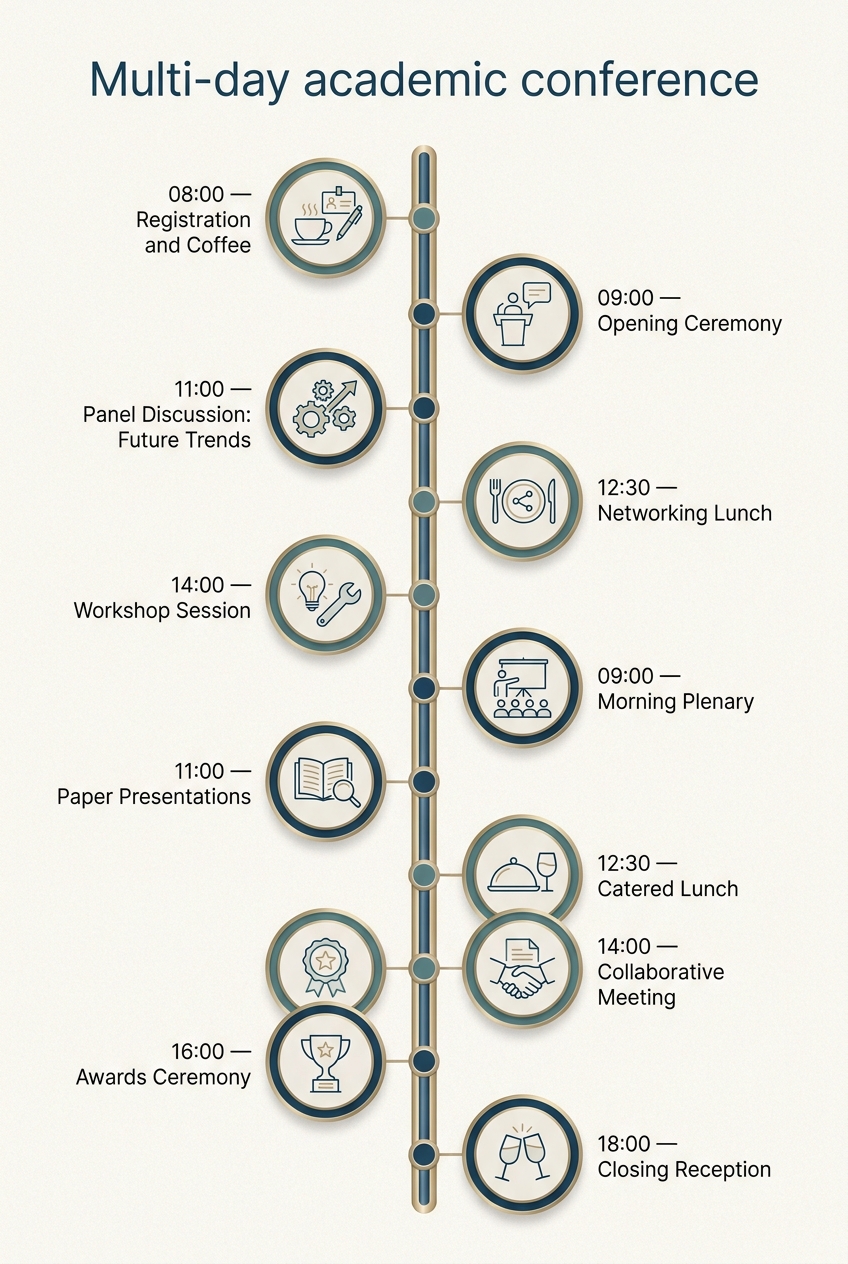
Why Multi-day Academic Conferences Need a Timeline
Scholarly gatherings involve a delicate balance between intellectual rigour and physical endurance. Without a clear schedule, delegates experience session fatigue, concurrent track overlaps run past their limits, and venue catering staff struggle to serve meals efficiently.
A well-structured master schedule provides direct benefits across three core areas:
- Punctuality across parallel sessions: When paper presentations run in multiple breakout rooms simultaneously, synchronized start and end times allow attendees to move between talks without missing critical research findings.
- Seamless vendor and venue coordination: Venue staff, AV technicians, and catering contractors require precise target times to set up buffet lines, adjust microphone levels, and transition rooms from plenary setups to interactive workshops.
- Optimized delegate networking: Research shows that informal connections are often as valuable as formal papers; dedicated networking lunch blocks and evening receptions give scholars guaranteed space to forge institutional partnerships.
What to Include in a Multi-day Academic Conference Timeline
To build an exhaustive program agenda, your planning team should account for both high-profile ceremonies and smaller collaborative sessions:
- Registration and welcome refreshments to check in delegates, hand out badges, and distribute conference proceedings.
- Opening ceremonies and keynotes featuring department chairs, keynote speakers, or visiting university dignitaries.
- Panel discussions and Q&A blocks where multi-disciplinary experts debate emerging field trends.
- Methodology and hands-on workshops offering practical technical training or collaborative problem-solving.
- Plenary lectures highlighting major breakthroughs, statistical datasets, and field-wide findings.
- Peer-reviewed paper presentation tracks where researchers share findings before an audience of peers.
- Dedicated catering breaks including catered lunches, morning coffee runs, and afternoon tea breaks.
- Institutional partnership meetings to encourage joint research proposals and inter-university grants.
- Formal recognition ceremonies such as annual research excellence awards.
- Social receptions including informal mixers, closing drinks, and poster session discussions.
Day 1: Registration, Keynotes, and Collaborative Workshops
| Time | Event | | 08:00 | Registration and Coffee | | 09:00 | Opening Ceremony | | 11:00 | Panel Discussion: Future Trends | | 12:30 | Networking Lunch | | 14:00 | Workshop Session |
Day 1 sets the scholarly direction and operational rhythm for the rest of the conference. Gathering attendees at the Grand Hall Entrance starting at 08:00 ensures that badging, registration pack pick-ups, and early morning coffee run smoothly without bottlenecking the main lobby. Giving delegates a full hour to check in guarantees that the opening session starts promptly.
At 09:00, attendees gather in the Main Auditorium for the opening address. The department chair outlines the overarching theme of this year's research focus, inspiring the audience before moving into specialized technical content. After a brief transition, the 11:00 panel session in Room A brings together panel experts to debate broad sector trends, leaving ample time for audience Q&A.
Midday transitions to the Garden Patio for a catered networking lunch. Staggered buffet stations prevent long lines, giving delegates time to eat and speak casually. Day 1 concludes in Workshop Lab 1 with an intensive, two-hour hands-on workshop focused on practical research methodologies. Grouping scholars at round tables encourages immediate collaboration on practical problem sets.
Day 2: Plenaries, Paper Presentations, and Awards
| Time | Event | | 09:00 | Morning Plenary | | 11:00 | Paper Presentations | | 12:30 | Catered Lunch | | 14:00 | Collaborative Meeting | | 16:00 | Awards Ceremony | | 18:00 | Closing Reception |
The second day shifts focus toward specific academic research findings, peer feedback, and formal institutional recognition. We open directly in the Main Auditorium at 09:00 with a high-impact morning plenary covering recent breakthrough data. Commencing without an early registration block assumes delegates are already badged, maximizing morning lecture time.
At 11:00, attendees divide into specialized tracks, such as the paper presentations held in Room B. Selected scholars present peer-reviewed abstracts to their colleagues, with strict timekeeping enforced so each speaker receives constructive peer critique. A swift boxed lunch served in the Grand Hall Foyer at 12:30 keeps delegates energized while allowing them to move easily toward early afternoon sessions.
After lunch, formal inter-institutional dialogues commence at 14:00 in Conference Room 3, where institutional leaders exchange project proposals and sign research agreements. The academic program culminates at 16:00 back in the Main Auditorium with the annual research excellence awards. To end the multi-day gathering on a celebratory note, delegates head to the Sky Lounge at 18:00 for the closing reception—a final chance to unwind over appetizers and exchange contact details.
Multi-day Academic Conference Timeline vs One-Day Research Symposium Agenda
Planning a multi-day conference requires a different strategic approach than single-day academic gatherings. The chart below highlights how these formats differ in scope, venue logistics, and session pacing:
| Feature | Multi-Day Academic Conference | One-Day Research Symposium |
|---|---|---|
| Program Scope | Broad scholarly themes, multi-track papers, and diverse sub-disciplines. | Highly focused research topic or single departmental update. |
| Networking Structure | Multiple catered lunches, evening receptions, and formal partnership blocks. | Brief coffee breaks and a single networking lunch. |
| Session Variety | Mix of keynotes, workshops, paper sessions, panels, and award galas. | Primarily sequential paper talks, poster viewings, and a keynote. |
| Venue Utilization | Multiple breakout rooms, main auditoriums, and dedicated dining areas. | Single lecture hall paired with an adjacent foyer or lobby. |
| Pacing & Fatigue | Paced over 2–4 days with strategic break buffers to manage delegate fatigue. | Dense, fast-paced agenda compressed into a single 8-hour day. |
If you are organizing a shorter, single-track gathering instead of a multi-day event, compare this structure with our one-day conference agenda or review our guide on the research symposium schedule to find the right format for your event.
Who Should Use This Template?
This master timeline template is designed for academic planners, institutional administrators, and committee chairs running multi-day research gatherings. It is tailored for:
- University departments organizing annual regional or international academic conferences.
- Scholarly societies and associations managing multi-track scientific meetings.
- Research institutes showcasing grant-funded findings across multi-disciplinary teams.
- Medical and healthcare faculties structuring clinical research presentations—similar to our specialized medical conference timeline template.
- Cross-institutional consortiums hosting collaborative research panels and grant workshops.
- Corporate R&D departments hosting professional leadership and innovation summits, which can also be paired with a leadership conference schedule template.
Chronolio offers tailored views for various roles involved in event coordination—ensuring venue managers, session chairs, and technical staff view the exact timeline detail they need.
How to Use This Template
- Download or duplicate the template: Choose your preferred format using our direct downloads, available as a Word document schedule or a printable PDF guide.
- Adjust dates and session tracks: Set your event start dates and adapt session titles to match your conference proceedings and sub-discipline tracks.
- Assign rooms and moderators: Enter specific campus locations (e.g., Main Auditorium, Room A, Workshop Lab 1) and designate session moderators for each block.
- Share with your steering committee: Distribute the live timeline to track managers, venue AV technicians, and catering coordinators so every team stays synchronized.
Tips for a Successful Multi-Day Academic Conference
- Enforce strict presentation timing: Provide moderators with clear visual timers (such as green, yellow, and red cards) to keep presenters within their allotted 15- to 20-minute windows.
- Preload presentation slide decks: Collect digital presentations from scholars prior to Day 1 to avoid time-consuming laptop swaps between speakers.
- Build in robust movement buffers: University campuses often require long walks between halls. Always leave 15 to 30 minutes between major sessions to accommodate movement.
- Centralize catering stations: Avoid long lines by dividing coffee and lunch stations across multiple foyer points near main breakout areas.
- Designate quiet working zones: Academic delegates often need space to review papers or answer university emails between sessions; set aside a designated lounge with charging stations.
- Provide clear venue signage: Use directional floor signs or digital monitors outside every lecture room indicating current and upcoming paper presentations.
- Liaise with publisher reps early: If academic journals are exhibiting or offering publishing workshops, schedule these sessions away from competing plenary lectures. For tips on managing sponsor pitch slots, see our guide on the startup pitch event timeline.
Common Mistakes to Avoid
- Overcrowded daily schedules: Packing paper sessions back-to-back without adequate breaks leads to delegate fatigue and low afternoon attendance.
- Neglecting session Q&A time: Failing to reserve at least five to ten minutes for questions undermines the peer review process and diminishes attendee engagement.
- Ignoring AV and microphone testing: Skipping pre-conference technical checks frequently results in mic feedback, missing adapter cables, and display failures.
- Inadequate dietary labelling during meals: Academic conferences attract global delegates with diverse dietary requirements; clearly mark vegan, gluten-free, and allergen-friendly options.
- Unclear room capacity planning: Scheduling high-profile panel topics in small breakout rooms leads to overcrowded doorways and safety hazards.
- Publishing rigid printed schedules too early: Last-minute paper withdrawals happen; ensure your visual digital schedules can be updated in real time.
In Summary
- A multi-day academic conference schedule coordinates keynotes, paper sessions, collaborative workshops, and meals across several days.
- Structuring Day 1 around broad themes and Day 2 around specialized papers balances broad context with granular research.
- Dedicated 15- to 30-minute break buffers prevent session delays from cascading through parallel presentation tracks.
- Clear venue locations (such as auditoriums, foyer labs, and outdoor patios) help guide attendees through complex campus layouts.
- This schedule template is fully customizable for academic departments, scientific bodies, and higher education event committees.
Planning a multi-day conference requires a balance of scholarly rigor, technical reliability, and efficient venue navigation. By structuring your program with tested time buffers, clear room assignments, and balanced networking blocks, you ensure a successful event for presenters and attendees alike.
Use This Multi-Day Academic Conference Schedule