






This Template at a Glance
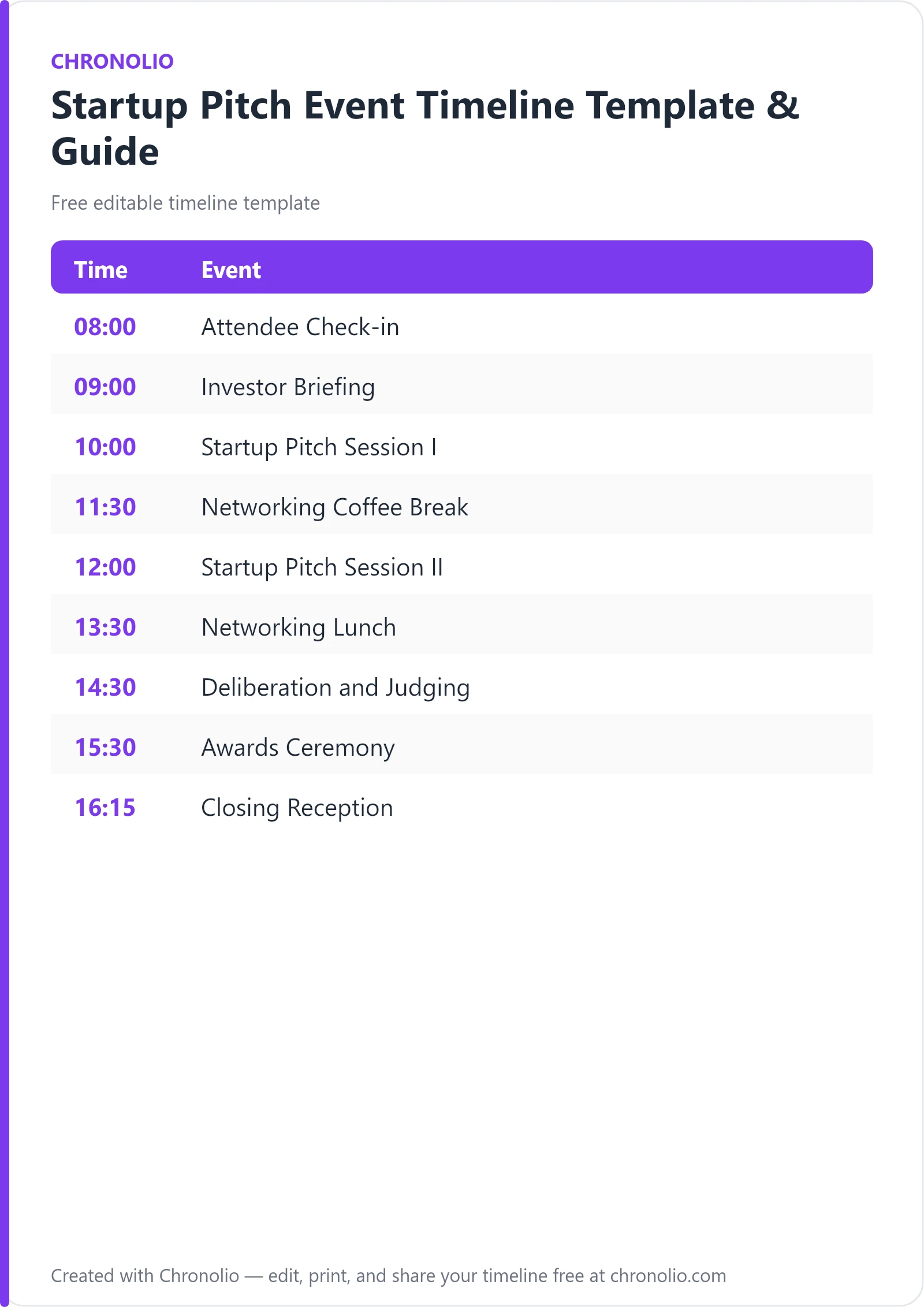
Here is the complete schedule this free template gives you — every time block, ready to edit, download, and share:
| Time | Event |
|---|---|
| 08:00 | Attendee Check-in |
| 09:00 | Investor Briefing |
| 10:00 | Startup Pitch Session I |
| 11:30 | Networking Coffee Break |
| 12:00 | Startup Pitch Session II |
| 13:30 | Networking Lunch |
| 14:30 | Deliberation and Judging |
| 15:30 | Awards Ceremony |
| 16:15 | Closing Reception |
Startup Pitch Event Timeline: What Is It?
A startup pitch event timeline is an operational master plan that structures every stage of a pitch competition, demo day, or venture showcase from morning check-in through the final networking reception. Running a high-stakes pitch competition requires balancing tight presentation windows, anxious founders, demanding venture capitalists, and strict venue schedules. Without a synchronized master plan, technical glitches, lingering Q&A sessions, and extended judge debates can easily push your event off course.
Having operated dozens of demo days and pitch competitions, I can tell you that time is your most critical asset. Investors expect crisp execution, while founders deserve an equal and fair stage window to present their pitch decks. This template reflects real-world startup pitch event structures and industry best practices, giving event managers, accelerator directors, and corporate innovation teams a turnkey schedule that keeps judges, presenters, and production teams perfectly aligned.
Build Your Startup Pitch Event Timeline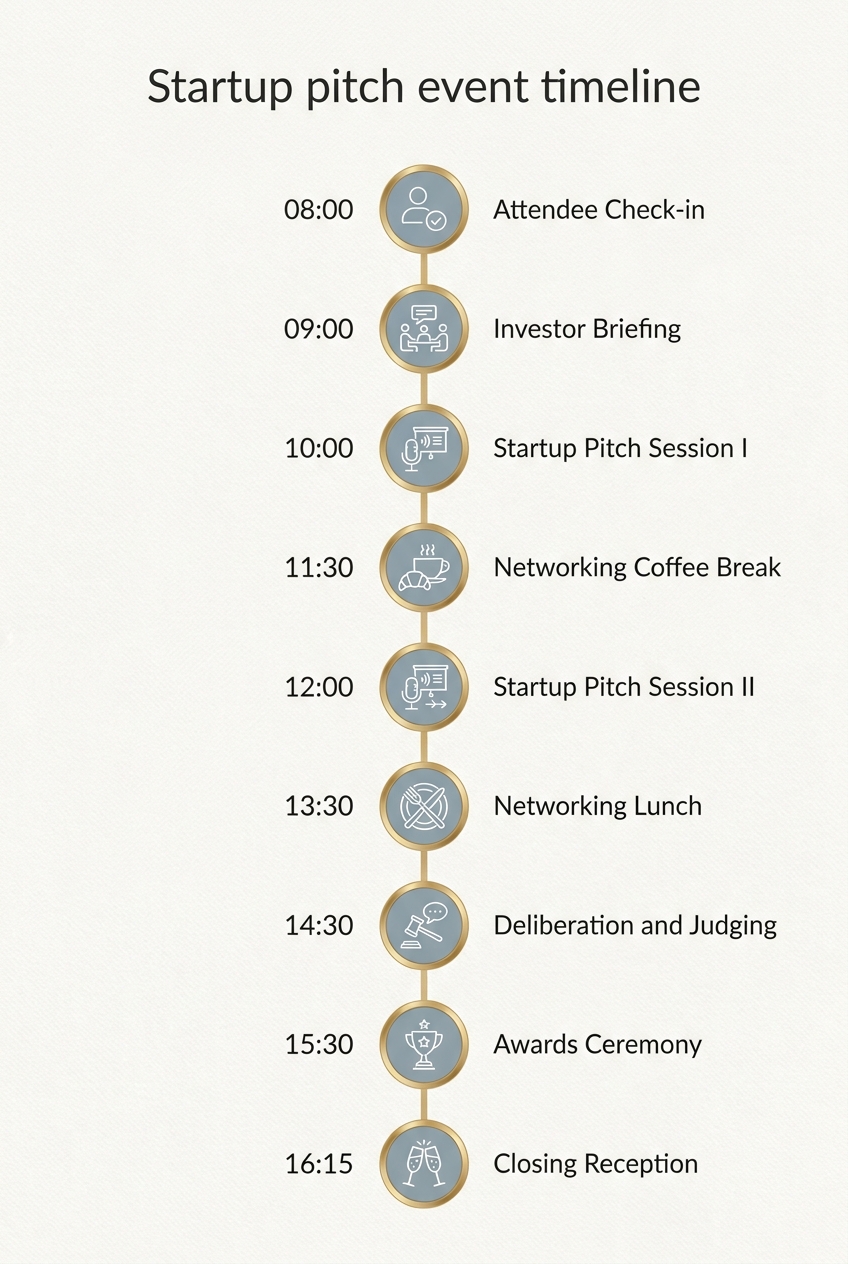
Why Pitch Events Need a Rigorous Timeline
When dealing with high-profile angel investors, venture capital partners, and early-stage entrepreneurs, maintaining precise schedule discipline directly impacts the perceived professional quality of your organization. Nothing frustrates busy investors faster than an event running an hour behind schedule, forcing them to slip out before the winning startups are announced.
Furthermore, pitch competitions depend on strict fairness across all team presentations. If the first startup receives fifteen minutes of presentation time and seven minutes of panel Q&A, every subsequent founder expects that same allocation. Enforcing an explicit schedule ensures that pitch decks, stage entrances, and judging rubrics remain uniform from the first elevator pitch to the final candidate.
Finally, an detailed operational schedule serves as the central alignment sheet for technical crews. Your AV team needs to know exactly when audio transitions occur, when stage microphones shift to the judging panel, and when lighting cues change for award announcements. By pairing this master schedule with a comprehensive one-day conference agenda template, you ensure both front-of-house guests and back-of-house production staff operate in complete harmony.
What to Include in a Startup Pitch Event Timeline
A comprehensive startup showcase schedule must account for both public audience interactions and private backroom operations. To build an end-to-end framework, ensure your schedule incorporates:
- Guest and Investor Registration: A dedicated window for badge pickup, welcome kits, and informal morning coffee.
- Closed-Door Investor Briefing: A private session to walk judges through scoring rubrics, evaluation criteria, and investment expectations.
- Structured Pitch Blocks: Batches of founder presentations formatted with strict presentation and live Q&A time allocations.
- Networking Breaks & Catered Meals: Dedicated windows for founders to meet prospective mentors, angel syndicate leads, and venture partners.
- Isolated Deliberation Windows: A quiet room and set timeframe for the judging panel to tally scores, discuss deal terms, and select winners.
- Awards Ceremony & Keynotes: A structured stage announcement revealing top winners, grants, or seed funding allocations.
- Post-Event Social Reception: An informal gathering area where participants can network, exchange contact information, and discuss term sheets.
Phase 1: Registration and Investor Alignment
| Time | Event |
|---|---|
| 08:00 | Attendee Check-in |
| 09:00 | Investor Briefing |
The morning kick-off sets the tone for your entire pitch showcase. Doors open at 08:00 AM in the main lobby for attendee check-in and coffee gathering, allowing founders, general attendees, and media representatives to collect badges, programs, and welcome bags. Allowing a full hour for registration prevents bottlenecks at the front desk and gives technical staff time for final slide deck pre-loads and microphone checks.
At 09:00 AM, while general attendees gather in the atrium, judges and active investors move into Boardroom A for a private investor and judge briefing. During this private hour, the event director walks the evaluation panel through the judging rubric, scoring software, evaluation weights (e.g., team execution, market viability, traction, scalability), and non-disclosure rules. Conducting this briefing behind closed doors ensures every judge evaluates candidates against identical standards before the first founder takes the main stage.
Phase 2: Live Pitching Blocks and Networking Breaks
| Time | Event |
|---|---|
| 10:00 | Startup Pitch Session I |
| 11:30 | Networking Coffee Break |
| 12:00 | Startup Pitch Session II |
The core presentation showcase begins promptly at 10:00 AM in the Main Auditorium with Startup Pitch Session I. In this initial 90-minute block, six to eight startups deliver their business models and technology solutions. Each pitch team gets exactly ten minutes for presentation slides followed immediately by five minutes of direct Q&A from the panel. A visible stage-facing digital countdown clock keeps founders disciplined, while a designated floor coordinator manages roaming microphones for the judging panel.
By 11:30 AM, attendees and presenters require a mental break. The networking coffee break in the lounge gives founders a quick opportunity to debrief with their team, while investors discuss morning highlights over refreshments. Pitching events that require structured executive sessions can also adapt frameworks from our leadership conference schedule template to manage high-level executive discussions during these intermediate breaks.
At 12:00 PM, Startup Pitch Session II launches in the Main Auditorium. The second cohort of startups takes the stage under the same 10-minute pitch and 5-minute Q&A standard. Judges continue entering real-time scores into their digital evaluation rubrics, scoring teams on market traction, unit economics, and team competence.
Phase 3: Deliberations, Awards, and Closing Reception
| Time | Event |
|---|---|
| 13:30 | Networking Lunch |
| 14:30 | Deliberation and Judging |
| 15:30 | Awards Ceremony |
| 16:15 | Closing Reception |
At 13:30 PM, the focus transitions to the Dining Hall for a catered networking lunch service. This hour offers critical unstructured face time where investors can approach early-stage founders whose morning pitches caught their attention. Catering staff should be fully prepared to handle dietary restrictions quickly so conversations remain uninterrupted.
At 14:30 PM, while attendees participate in informal roundtable discussions, the judging panel retires to Boardroom B for closed-door deliberations and judging. Over sixty minutes, judges resolve tied scores, review financial projections, debate market potential, and choose the top three prize winners. For events incorporating academic or research-heavy technology pitches, incorporating structured scoring methodology from our research symposium schedule template helps keep complex technical evaluations objective.
The event reaches its peak at 15:30 PM back in the Main Auditorium with the official awards ceremony and closing announcements. Organizers announce non-equity grant winners, incubator seats, or seed funding allocations, presenting trophies and checks to the top three startups. Finally, at 16:15 PM, everyone transitions to the Terrace Area for a celebratory closing networking reception with appetizers, providing a relaxed setting for founders and venture capitalists to initiate preliminary term sheet conversations before venue doors close at 17:30 PM.
Startup Pitch Event Timeline vs Event Agenda
It is common for first-time pitch managers to confuse a pitch event timeline with a guest-facing pitch agenda. While both documents detail the flow of the day, they serve distinct operational purposes and audiences.
| Feature | Pitch Event Timeline | Pitch Event Agenda |
|---|---|---|
| Primary Audience | Event directors, AV team, emcee, pitch callers, judges | Attendees, general public, visiting media, participants |
| Level of Detail | Precise operational cues, AV switches, room changes | High-level session times, company names, speaker titles |
| Internal Cues | Includes slide pre-loads, mic tests, judge scoring windows | Focuses on public start times and break locations |
| Flexibility | Rigid execution document managed by production team | General programmatic outline provided to guests |
While the public pitch agenda tells guests what is happening in the auditorium, the pitch event timeline outlines how the back-of-house team makes it happen seamlessly behind the scenes. If your pitch showcase is part of a broader multi-track event, review our creative industry conference timeline guide to effectively manage parallel track programming.
Who Should Use This Template?
This master pitch showcase template is engineered for organizations that host competitive business presentations, founder showcases, and investment pitch days. It is specifically tailored for:
- Venture Capital & Angel Networks: Hosting annual portfolio showcases, pitch days, or syndicate investment events.
- Tech Accelerators & Incubators: Managing cohort completion demo days and pitch competitions for seed funding.
- University Innovation Centers: Organizing campus business plan competitions, student pitch challenges, and grant award showcases.
- Corporate Innovation Labs: Running internal intrapreneurship pitches and startup partnership selection challenges.
- Economic Development Agencies: Hosting regional business grant competitions and startup economic development showcases.
Chronolio offers specialized workflow support tailored to the distinct roles involved in event planning—from venue managers and technical directors to judging panel chairs and pitch timekeepers.
How to Use This Template
Setting up your demo day schedule using Chronolio takes only a few minutes. Follow these practical steps to prepare your master pitch schedule:
- Download or Duplicate the Template: Select your preferred export format using our Word document template or printable PDF guide, or click the edit button to open this schedule directly in Chronolio.
- Set Your Event Date & Start Time: Adjust the baseline start time. If your event begins at 09:00 AM instead of 08:00 AM, Chronolio automatically shifts all downstream pitch blocks accordingly.
- Customize Startup Pitch Durations: Modify pitch session slots based on your specific founder count. If you offer 5-minute pitches with 3-minute Q&A instead of 10+5 minutes, adjust session blocks to match.
- Assign Stage & Room Locations: Tailor venue locations (Auditorium, Boardroom, Dining Hall) to reflect your actual facility layout.
- Share with Key Stakeholders: Export customized schedule views for your emcee, floor managers, AV crew, and judging panel chair.
Tips for a Successful Pitch Event
Having managed numerous demo days, I have learned that great pitch events depend on rigorous timing and flawless technical preparation. Consider these proven strategies:
- Enforce a Stage Countdown Clock: Place a large digital countdown timer directly in the founder's line of sight on stage. Set visual warning lights at 2 minutes (yellow) and 0 minutes (red).
- Mandate a Stage Slide Pre-Load: Never allow founders to plug their personal laptops into stage projectors during live sessions. Require all final pitch decks (PDF or PowerPoint) to be uploaded to a master AV presentation laptop 24 hours in advance, as recommended by venture event guidelines on TechCrunch.
- Assign a Dedicated Judge Handler: Designate a staff member whose sole responsibility is guiding judges from the auditorium to Boardroom B and collecting evaluation sheets on time.
- Implement Roaming Q&A Microphones: Assign two floor managers equipped with catch-box or handheld wireless mics to walk between judges during the 5-minute Q&A windows.
- Build Buffer Times Between Pitch Blocks: Always preserve 5 to 10 minutes of operational buffer between pitch blocks to absorb minor technical or schedule overruns.
- Provide a Founder Green Room: Maintain a quiet room offstage equipped with drinks, power strips, and video feeds so upcoming presenters can warm up without distraction.
Common Mistakes to Avoid
Avoid these frequent operational mistakes when scheduling your startup competition:
- Overcrowding Pitch Schedules: Squeezing twenty startups into a single morning session leads to audience fatigue and rushed judging. Limit pitch blocks to 60–90 minutes maximum.
- Skipping the Investor Briefing: Assuming judges know how to use digital scoring rubrics leads to missing scores and delayed deliberations. Always keep the 09:00 AM orientation intact.
- Allowing Founders to Exceed Q&A Limits: Letting popular startups answer questions past their allocated time creates unfair advantages and delays downstream pitches. Empower your emcee to step in firmly.
- Underestimating Deliberation Time: Pitch score debates among venture partners almost always take longer than expected. Never schedule judging deliberation for less than 45 to 60 minutes.
- Neglecting AV Dry Runs: Failing to test audio levels, lapel mics, and pitch deck video embeds before 08:00 AM check-in is a recipe for on-stage technical failure.
In Summary
- What it is: An operational master schedule covering setup, pitches, judging, awards, and networking for startup showcases.
- Who it’s for: Venture capital funds, startup accelerators, university incubators, and innovation managers.
- Key phases: Morning check-in & investor briefing, dual pitch sessions with coffee breaks, catered lunch, judge deliberations, awards, and closing social hour.
- Primary benefit: Maintains schedule discipline, ensures pitch fairness, and provides seamless coordination between stage production and judges.
- Format options: Available for direct online editing, or downloadable in Word (.docx) and PDF (.pdf) formats.
A well-planned startup pitch event timeline is the backbone of a high-impact demo day. By establishing clear presentation windows, dedicated investor briefing periods, and realistic judge deliberation blocks, you create a professional environment where early-stage founders can shine and investors can make confident funding decisions. Whether you are running a university business competition, an accelerator showcase, or a corporate venture summit, this customizable template guarantees your pitch event stays punctual, fair, and successful.
Build Your Startup Pitch Event Timeline