






This Template at a Glance
Here is the complete schedule this free template gives you — every time block, ready to edit, download, and share:
| Time | Event |
|---|---|
| 08:00 | Registration and Breakfast |
| 09:00 | Opening Plenary |
| 10:15 | Panel Discussion: Breaking Barriers |
| 11:45 | Mentorship Roundtables |
| 12:45 | Networking Lunch |
| 14:00 | Technical Workshops |
| 15:45 | Leadership Awards |
| 17:00 | Closing Reception |
What Is a Women in STEM Conference Timeline?
A Women in STEM conference timeline is the operational master schedule used by event directors, venue operators, and committee leads to coordinate every phase of a specialized diversity and technology conference. Running an impactful conference for women across science, technology, engineering, and mathematics requires a delicate balance between professional development, high-level networking, and technical skill-building. Unlike general industry trade shows, STEM diversity events must offer psychologically safe spaces for honest discussion around workplace equity while maintaining rigorous, technical programming.
Having run dozens of full-scale conventions in venue spaces ranging from academic halls to corporate convention centers, I have seen firsthand how easy it is for an ambitious program to fall off schedule. Whether you are adapting a broader one-day conference agenda template or tailoring a specialized corporate summit, your timeline serves as the operational contract between venue staff, stage managers, track moderators, and catering teams. This template reflects proven industry run-of-show standards, ensuring your attendees leave feeling inspired and energized rather than rushed and exhausted.
Build Your Women in STEM Conference Timeline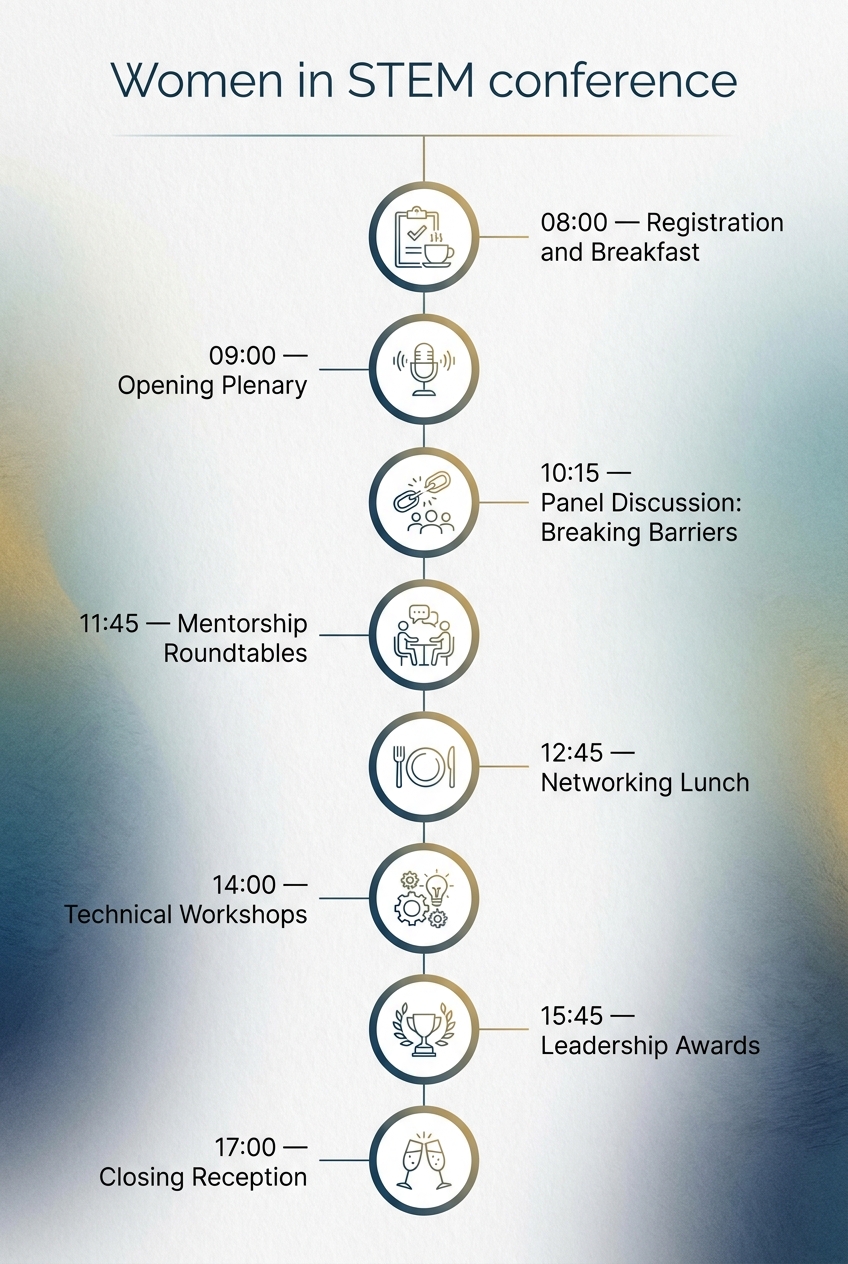
Why Women in STEM Conferences Need a Timeline
Planning an event in the STEM sector comes with unique multi-track challenges. Attendees often move back and forth between broad career development tracks and intensive coding or laboratory workshops. Without a clear master timeline, sessions spill over, breakout rooms become congested, and critical networking sessions end up squeezed out.
A dedicated operational schedule keeps every team aligned behind the scenes:
- A seamless guest experience: Attendees know precisely where to go, whether they are attending an executive panel or participating in small-group career mentorship.
- Precision AV and venue transitions: Technical speakers frequently rely on specialized software demos, live coding environments, or interactive presentation displays that require strict setup windows between sessions.
- Optimized sponsor and speaker coordination: Keynotes, corporate sponsors, and award recipients often operate on packed executive schedules; exact timing ensures their sessions start and finish on time.
- Balanced energy throughout the day: Interspersing heavy technical learning with interactive mentorship roundtables and social breaks keeps participant engagement consistently high.
When running multi-track events, event organizers often reference a multi-day academic conference timeline template to understand how multi-room transitions scale across longer programs.
What to Include in a Women in STEM Conference Timeline
To build an engaging program that caters to students, early-career researchers, and seasoned executives alike, your timeline should incorporate these core components:
- Welcome and morning hospitality: Registration check-in paired with light catering to encourage early morning networking.
- Inspirational keynote plenary: A central gathering designed to set the theme and establish a collective vision for the day.
- Strategic panel discussions: Moderated panel sessions covering career advancement, workplace equity, and navigating male-dominated technical fields.
- Structured mentorship roundtables: Guided small-group interactions connecting junior talent with experienced industry leaders.
- Interactive technical workshops: Applied skill-building tracks focusing on data science, programming languages, or engineering frameworks.
- Formal award recognition: A dedicated segment celebrating top achievements and field-defining contributions.
- Informal social reception: Evening food and beverage service allowing guests to solidify new professional connections.
Morning Plenary and Panel Discussions
| Time | Event |
|---|---|
| 08:00 | Registration and Breakfast |
| 09:00 | Opening Plenary |
| 10:15 | Panel Discussion: Breaking Barriers |
The opening movement of the day sets the emotional and intellectual tone for the entire conference. Commencing at 08:00 in the Main Lobby, morning registration and coffee allow early arrivals to settle in, collect their credentials, and initiate informal conversations. Starting registration an hour before the keynote prevents long check-in queues from delaying the opening presentation, while giving catering staff plenty of room to refresh coffee stations.
At 09:00, the crowd moves into the Grand Ballroom for the Opening Plenary. Keynote presentations at diversity-focused technology events should be bold, inspiring, and forward-looking. Following a brief 15-minute transition pause to clear stage setups and allow guests to move across the facility, the program shifts to Conference Room A at 10:15 for the panel discussion Breaking Barriers. Panelists from various engineering and technical sectors discuss institutional challenges, policy changes, and individual strategies for dismantling gender bias in corporate tech environments.
08:00 AM - Check-in & Coffee 09:00 AM - Opening Keynote 10:15 AM - Panel Discussion
Midday Mentorship and Networking
| Time | Event |
|---|---|
| 11:45 | Mentorship Roundtables |
| 12:45 | Networking Lunch |
Late morning and midday are dedicated to building deep, direct interpersonal connections. At 11:45, attendees gather in the Networking Hall for Mentorship Roundtables. Mentorship is universally cited by organizations like the Society of Women Engineers as a primary factor in retention across STEM careers. Organizing mentorship into focused 60-minute roundtables gives junior attendees direct access to executive mentors without the awkwardness of unstructured cold networking.
At 12:45, the group transitions into the Dining Hall for a structured 75-minute Networking Lunch. Providing a full hour and fifteen minutes ensures that attendees do not feel rushed through food lines and leaves ample opportunity to exchange contact information, discuss morning topics, or catch up on urgent work emails before the afternoon technical tracks begin.
Many organizers running similar professional summits cross-reference their schedule with a leadership conference schedule template to evaluate how executive networking segments are best positioned around meal breaks.
Afternoon Technical Tracks, Recognition, and Social Hour
| Time | Event |
|---|---|
| 14:00 | Technical Workshops |
| 15:45 | Leadership Awards |
| 17:00 | Closing Reception |
The afternoon block shifts focus from broad career discussions to deep technical skill enhancement and formal celebration. At 14:00, participants move into the Lab Wing for hands-on Technical Workshops. Allocating a dedicated 90-minute workshop block gives participants sufficient time to set up software environments, run code tutorials, and participate in practical data science challenges without feeling pushed for time.
At 15:45, the event returns to the Grand Ballroom for the Leadership Awards segment. Highlighting local pioneers, corporate sponsors, and emerging student leaders provides a celebratory high point late in the day when afternoon fatigue might otherwise set in. Finally, at 17:00, the conference wraps up on the Garden Terrace with an informal Closing Reception. Serving light refreshments in an open-air or casual space creates a relaxed setting where participants can finalize partnerships, join professional networks, and solidify mentorship agreements made earlier in the day.
If your conference features significant scientific paper presentations or peer reviews alongside workshops, you might also compare this flow to a research symposium schedule template.
Women in STEM Conference Timeline vs General Tech Conference Schedule
While both types of events require robust venue logistics and speaker timing, a Women in STEM conference timeline prioritizes personal connection and structured professional advocacy alongside technical content.
| Aspect | Women in STEM Conference Timeline | General Tech Conference Schedule |
|---|---|---|
| Core Focus | Technical advancement, advocacy, and equity | Product reveals, feature updates, and vendor sales |
| Networking Format | Curated mentorship roundtables and speed-mentoring | General trade show floor walking and expo booths |
| Session Structure | Mixed technical tracks and leadership panels | Heavy emphasis on product demos and developer tracks |
| Recognition Segment | Focused diversity awards and scholarship honors | Product launch announcements and company keynotes |
| Target Audience | Female scientists, engineers, students, and allies | Broad developers, IT buyers, executives, and press |
Unlike standard commercial expos that prioritize product announcements, a Women in STEM gathering places equal weight on building sustainable peer support networks and career growth mechanisms.
Who Should Use This Template?
This timeline framework is designed for event leaders across corporate, academic, and non-profit environments who need a battle-tested schedule structure. It is ideal for:
- Corporate Employee Resource Groups (ERGs): Internal women-in-tech committees hosting annual summits or regional gathering days.
- University STEM Departments: Academic faculties running cross-disciplinary symposia for female undergraduate, graduate, and faculty researchers.
- Professional Associations: Regional chapters of organizations like IEEE Women in Engineering, SWE, or Association for Women in Mathematics.
- Tech Incubators and Non-Profits: Foundations hosting coding bootcamps, career expos, and founder pitch showcases.
Chronolio offers specialized workflow features tailored for various professional roles, helping committee chairs, venue managers, and AV directors stay synchronized on a single live schedule.
How to Use This Template
- Duplicate or import the master schedule: Open the interactive timeline directly in Chronolio or download offline versions available in standard formats such as the editable Word document format or printable PDF agenda document.
- Adjust for your venue layout: Calculate transition times based on your physical building. If your technical labs are far from your main auditorium, increase the break windows from 15 minutes to 20 minutes.
- Assign track leads and moderators: Insert designated stage managers, panel moderators, and room hosts into each timeline segment.
- Share tailored views with stakeholders: Export custom views for speakers (showing green-room call times), catering leads (showing meal service times), and attendees (showing public room assignments).
Tips for a Successful Women in STEM Conference
- Pre-assign mentorship topics: Collect attendee interest data during online registration so mentorship tables can be themed by domain (e.g., Navigating Management, AI & Machine Learning, Work-Life Integration).
- Provide dedicated quiet rooms: Conferences can be overwhelming. Designate a small lounge room with Wi-Fi and power outlets for attendees who need to check in on work or take a quiet break.
- Streamline AV checks: Schedule all technical speaker presentation checks during the morning registration window or lunch hour to prevent mid-afternoon laptop adapter delays.
- Offer digital takeaway packets: Ensure slide decks, speaker contact details, and mentorship resource guides are uploaded to a central portal before the closing awards.
- Leverage experienced panel moderators: Select moderators who can confidently steer audience Q&A sessions, ensuring questions remain concise and relevant to the entire room.
- Incorporate inclusive catering options: Clearly label gluten-free, vegan, and halal options at breakfast and lunch to keep meal service lines moving smoothly.
Common Mistakes to Avoid
- Overcrowding the schedule: Scheduling back-to-back sessions without buffer time leads to cascading delays, missed lunch schedules, and frustrated attendees.
- Neglecting Q&A moderation: Failing to hold dedicated Q&A microphones or run digital submission tools can allow individual audience members to monopolize short panel times.
- Underestimating technical requirements: Technical workshops often require robust Wi-Fi bandwidth and specific power outlets; test venue infrastructure days in advance.
- Treating networking as an afterthought: Leaving all networking to an optional evening hour robs introverted or commuting attendees of meaningful connection opportunities.
- Skipping sponsor logistics checks: Corporate sponsors supporting awards sessions need exact timing on when executives should present on stage.
In Summary
- A Women in STEM conference timeline balances technical skill-building with structured career mentorship and awards.
- Morning schedules prioritize broad keynote inspiration and panel discussions on career advancement.
- Midday sessions center on structured mentor roundtables and networking lunches.
- Afternoon programming shifts into hands-on computer workshops and formal industry leadership awards.
- Evening social receptions provide low-pressure spaces for attendees to exchange contact details and solidify mentorship connections.
- Including 15-minute buffer periods between room switches keeps multi-track events running strictly on schedule.
Running a multi-track diversity summit requires coordination between key speakers, venue coordinators, and track leads. By basing your operational run-of-show on this customizable framework, you ensure that every panel, workshop, and networking session delivers maximum value to your attendees.
Build Your Women in STEM Conference Timeline