






This Template at a Glance
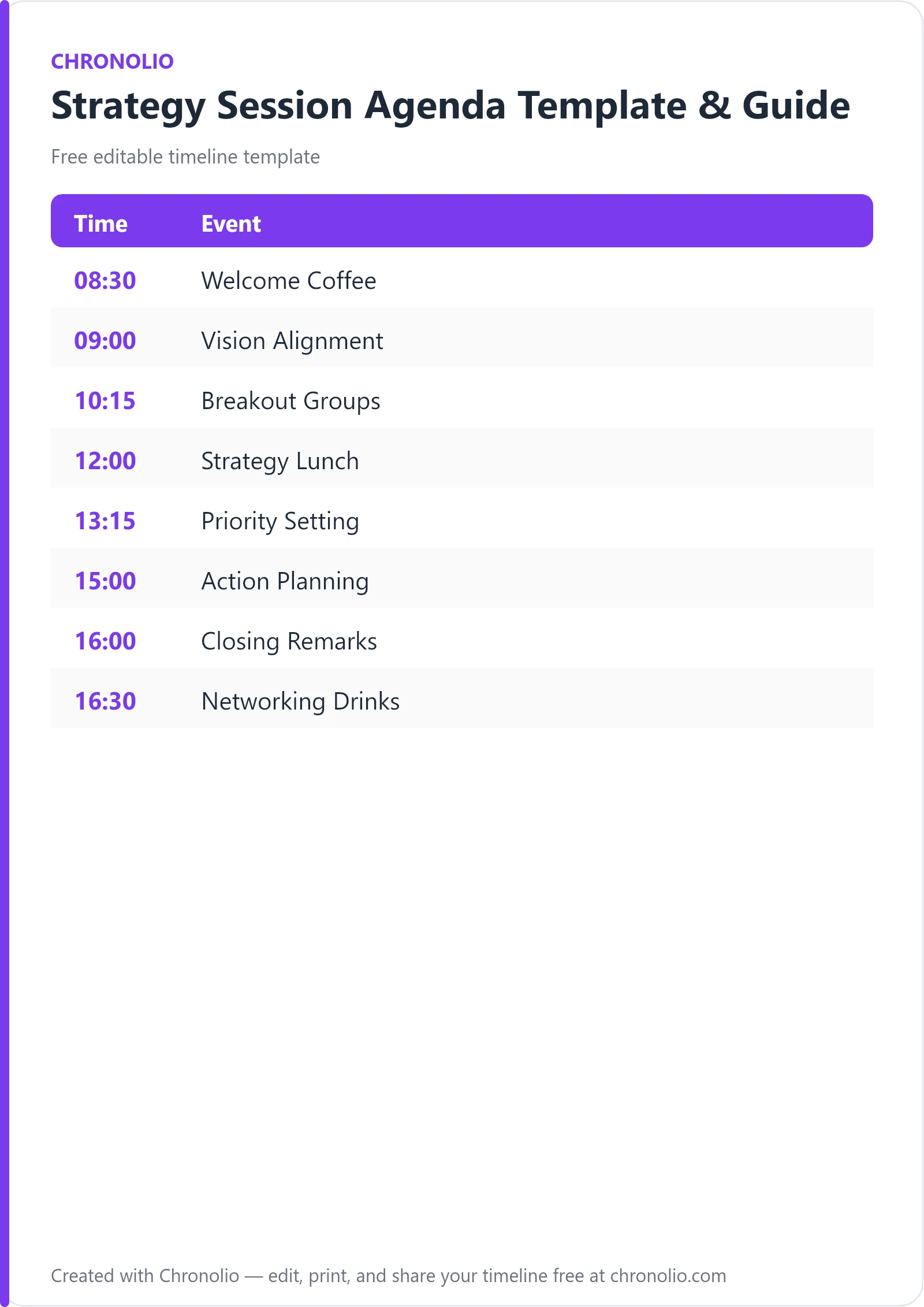
Here is the complete schedule this free template gives you — every time block, ready to edit, download, and share:
| Time | Event |
|---|---|
| 08:30 | Welcome Coffee |
| 09:00 | Vision Alignment |
| 10:15 | Breakout Groups |
| 12:00 | Strategy Lunch |
| 13:15 | Priority Setting |
| 15:00 | Action Planning |
| 16:00 | Closing Remarks |
| 16:30 | Networking Drinks |
What Is a Strategy Session Agenda?
A strategy session agenda is an actionable roadmap designed to align executive leadership around corporate goals, evaluate market opportunities, and establish measurable priorities for the upcoming quarter or year. Unlike routine status meetings, an offsite strategy day demands a careful balance of broad macroeconomic vision, tactical departmental problem-solving, and decisive consensus-building.
Having facilitated dozens of corporate retreats in venue settings, I have found that unscripted planning days quickly devolve into venting sessions or endless debates. This schedule reflects proven facilitation frameworks and real-world executive workshops, giving your team the ideal mix of structured focus time and unstructured strategic banter. By clearly defining time slots for vision alignment, cross-functional breakout groups, and priority ranking, you ensure every participant leaves with complete clarity on organizational direction and personal accountability.
Customize Your Strategy Session Agenda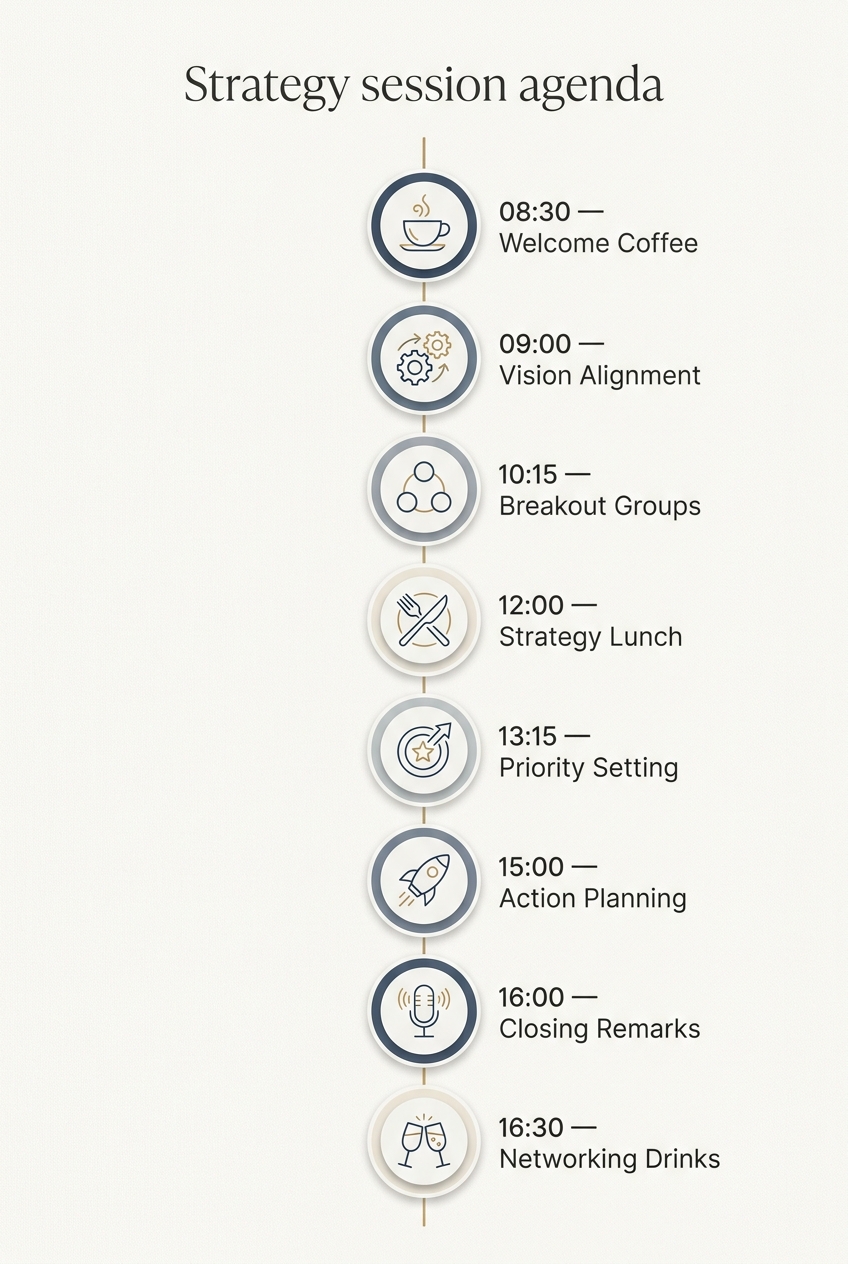
Why Strategy Sessions Need a Timeline
Strategic planning consumes valuable executive hours and venue resources. Without a rigorous timeline, teams spend hours deliberating early agenda items only to rush through crucial budget allocations and action planning in the final hour. A pre-planned schedule creates the discipline required to transition from abstract ideas to concrete quarterly deliverables.
A strict timeline also protects attendee energy. High-stakes strategic discussions cause genuine cognitive fatigue. By embedding strategic coffee breaks and a relaxed midday meal into the agenda, you maintain sharp executive focus throughout eight hours of intense decision-making.
Finally, a structured schedule gives facilitators leverage to enforce meeting discipline. When discussions wander off-topic, an explicit agenda allows the leader to park tangential ideas and keep cross-functional initiatives moving forward on schedule. If your strategic offsite coincides with major corporate milestones, you can also pair it with a board meeting timeline template to streamline governance reporting ahead of the retreat.
What to Include in a Strategy Session Agenda
A comprehensive strategy day schedule must incorporate several core planning phases to ensure seamless progression from high-level ideals to practical tasks:
- Informal arrival networking to encourage informal social rapport before formal sessions.
- Executive vision alignment to contextualize market conditions, core mission, and annual revenue targets.
- Cross-functional breakout groups for small-group problem solving around specific departmental friction points.
- Catered strategy lunch to allow informal cross-pollination between teams.
- Impact vs. feasibility priority setting to distill broad ideas down to key strategic pillars.
- Resource allocation and action planning to assign task ownership, deadlines, and tracking KPIs.
- Executive closing remarks to summarize agreement and reveal the final strategic roadmap.
- Post-session drinks to celebrate collaborative effort and build executive unity.
Morning Alignment & Discovery
The morning hours represent your team's highest cognitive energy. Begin with light networking over coffee, then immediately dive into executive vision before moving into focused departmental breakout groups.
| Time | Event |
|---|---|
| 08:30 | Welcome Coffee |
| 09:00 | Vision Alignment |
| 10:15 | Breakout Groups |
Starting at 08:30, welcome coffee in the main lobby provides an informal window for participants to get settled, catch up, and set aside operational distractions before entering the formal session. Moving promptly to Conference Hall A at 09:00, leadership presents the overall long-term corporate vision, contextualizing recent market shifts and establishing overarching targets.
At 10:15, transition the room into small departmental breakout groups across Breakout Rooms 1 through 4. Splitting into focused teams of four to six individuals encourages candid discussions on operational hurdles and growth opportunities. Group facilitators record key insights on whiteboards, preparing raw findings for the afternoon consolidation exercises.
Midday Refuel & Priority Setting
After an intensive morning of discovery, your executive team needs time to digest ideas before making critical trade-offs and selecting core initiatives.
| Time | Event |
|---|---|
| 12:00 | Strategy Lunch |
| 13:15 | Priority Setting |
At 12:00, transition all participants to the Dining Pavilion for a catered strategy lunch. A designated meal break away from main presentation screens offers a mental reset and prompts organic cross-departmental dialogue. Facilitators should actively encourage executives to sit with peers outside their daily reporting lines to break down organizational silos.
Reconvening in Conference Hall A at 13:15, the afternoon session shifts from broad brainstorming to rigorous priority setting. Using structured evaluation frameworks like an Impact vs. Effort matrix, department heads present their morning findings while the broader executive group votes on the top three to five strategic initiatives for the coming quarters.
Execution Planning & Closing
An inspiring strategy day is useless without operational accountability. The final block transforms high-level strategy into concrete assignments before concluding with team recognition.
| Time | Event |
|---|---|
| 15:00 | Action Planning |
| 16:00 | Closing Remarks |
| 16:30 | Networking Drinks |
Beginning at 15:00, action planning maps concrete deliverables to every chosen priority. Department heads define resource requirements, outline critical path milestones, and assign single-point accountability owners to each strategic initiative. Establishing clear accountability before leaving the room ensures immediate post-event momentum.
At 16:00, executive leadership delivers concise closing remarks, summarizing key consensus points and unveiling a visual roadmap overview. Finally, at 16:30, transition everyone to the Outdoor Terrace for casual networking drinks. Celebrating the team's hard work reinforces executive cohesion and ending on a warm social note. If your strategy session serves as a precursor to broader company rollouts or corporate announcements, you can align your timing with our M&A announcement event schedule or integrate product milestones using a product launch timeline template.
Strategy Session Agenda vs Strategy Session Workshop Itinerary
It is easy to confuse a strategy session agenda with a workshop itinerary or retreat schedule. While both serve offsite events, they differ significantly in scope, primary audience, and operational outcome.
| Strategic Dimension | Strategy Session Agenda | Strategy Session Workshop Itinerary |
|---|---|---|
| Primary Focus | Executive alignment, goal setting, and resource allocation. | Team training, skill development, and creative exploration. |
| Target Audience | C-suite leaders, department heads, and key board directors. | Broader team members, functional departments, or all-hands. |
| Key Output | Prioritized quarterly OKRs, action plans, and budget shifts. | Shared understanding, upgraded skills, and team alignment. |
| Pacing | Strict time blocks for evaluation, voting, and decision-making. | Flexible blocks for interactive exercises and open discussion. |
While a workshop itinerary emphasizes broad participation and skill acquisition, a strategy session agenda maintains strict decision discipline. Every agenda segment is built to drive consensus and force trade-offs between competing corporate goals.
Who Should Use This Template?
This timeline structure is tailored for executive facilitators, internal event planners, and business leaders who need to drive focused outcomes from complex multi-stakeholder meetings. Chronolio offers specialized layout views tailored for various executive roles involved in hosting strategic events:
- Executive Leadership Teams (C-Suite) setting annual corporate direction and fiscal targets.
- Department Heads and VPs aligning cross-functional teams around product, marketing, and revenue initiatives.
- Management Consultants and Workshop Facilitators running structured offsite retreats for enterprise clients.
- Private Equity and Venture Partners guiding portfolio company management teams through strategic growth planning.
- Non-Profit Boards and Executive Directors refining organizational mission strategies and fundraising targets.
If your strategy session coincides with major corporate milestones, you can adapt this agenda alongside a corporate year-end function timeline or coordinate public messaging with a media press briefing agenda guide.
How to Use This Template
Implementing this strategy agenda for your organization requires minimal preparation when using our dynamic digital tools or static print files:
- Customize or duplicate this template directly inside Chronolio to establish your base schedule.
- Download your preferred offline format using our Strategy Session Agenda Word Document or Strategy Session Agenda PDF Guide for easy printing and offline review.
- Adjust start times and breakout durations based on your team's size and venue layout constraints.
- Assign break room locations and facilitators to each breakout row so attendees know exactly where to go.
- Share the digital link with your executive team at least five days prior to the retreat alongside pre-reading decks.
Tips for a Successful Strategy Session
To ensure your strategic offsite delivers maximum return on executive time, follow these field-tested event planning strategies:
- Enforce strict pre-work requirements: Mandate that all financial reviews, market analysis, and SWOT reports are read prior to arrival so meeting time isn't spent presenting slides.
- Hire an impartial facilitator: Using a third-party facilitator allows internal executives to participate fully in discussions without having to manage meeting dynamics or keep time.
- Establish a strict "Parking Lot": Capture tangential but important ideas on a dedicated whiteboard so core strategic discussions remain focused on primary objectives.
- Cap breakout room sizes at 6 people: Small groups ensure that quiet team members contribute equal perspective during discovery exercises.
- Incorporate physical movement: Shift participants between different physical environments—such as moving from presentation halls to breakout rooms and outdoor terraces—to maintain high energy levels.
- Secure executive commitment before leaving: Ensure that every major priority item has a named executive owner who agrees to ownership before the closing remarks.
- Reference established research: Design your decision-making frameworks around proven strategic planning literature, such as Harvard Business Review's guide to strategic execution, to keep discussions grounded in best practice.
Common Mistakes to Avoid
Even well-funded executive offsites can fail due to poor agenda design and weak facilitation. Watch out for these common planning mistakes:
- Overloading the schedule with presentations: Spending three hours watching slides leaves zero time for deep strategic debate and cross-functional alignment.
- Skipping hard priority trade-offs: Leaving the session with fifteen "top priorities" means you actually have zero priorities; enforce forced ranking exercises.
- Failing to assign single-point accountability: Assigning ownership to entire departments instead of named individuals guarantees slow implementation post-event.
- Ignoring venue physical logistics: Setting breakout rooms too far from the main hall wastes valuable agenda time during transitions.
- Neglecting post-event follow-up: Allowing post-retreat momentum to die by failing to publish finalized action plans within 48 hours.
In Summary
- What it is: A structured 8-hour executive framework designed to turn long-term vision into actionable quarterly priorities.
- Who it is for: C-suite leaders, department heads, board directors, and executive workshop facilitators.
- Core benefits: Balances strategic alignment with operational task ownership while protecting executive energy.
- Key milestones: Vision presentation, cross-functional breakouts, catered refuel, priority ranking, and action planning.
- Critical success factor: Assigning single accountability owners for every priority before ending the session.
Planning an impactful offsite strategy day requires balancing high-level visionary discussions with practical accountability. By leveraging this adaptable schedule, executive leadership teams, management consultants, and enterprise department heads can easily run focused, output-driven planning sessions that generate clear operational results.
Customize Your Strategy Session Agenda