






This Template at a Glance
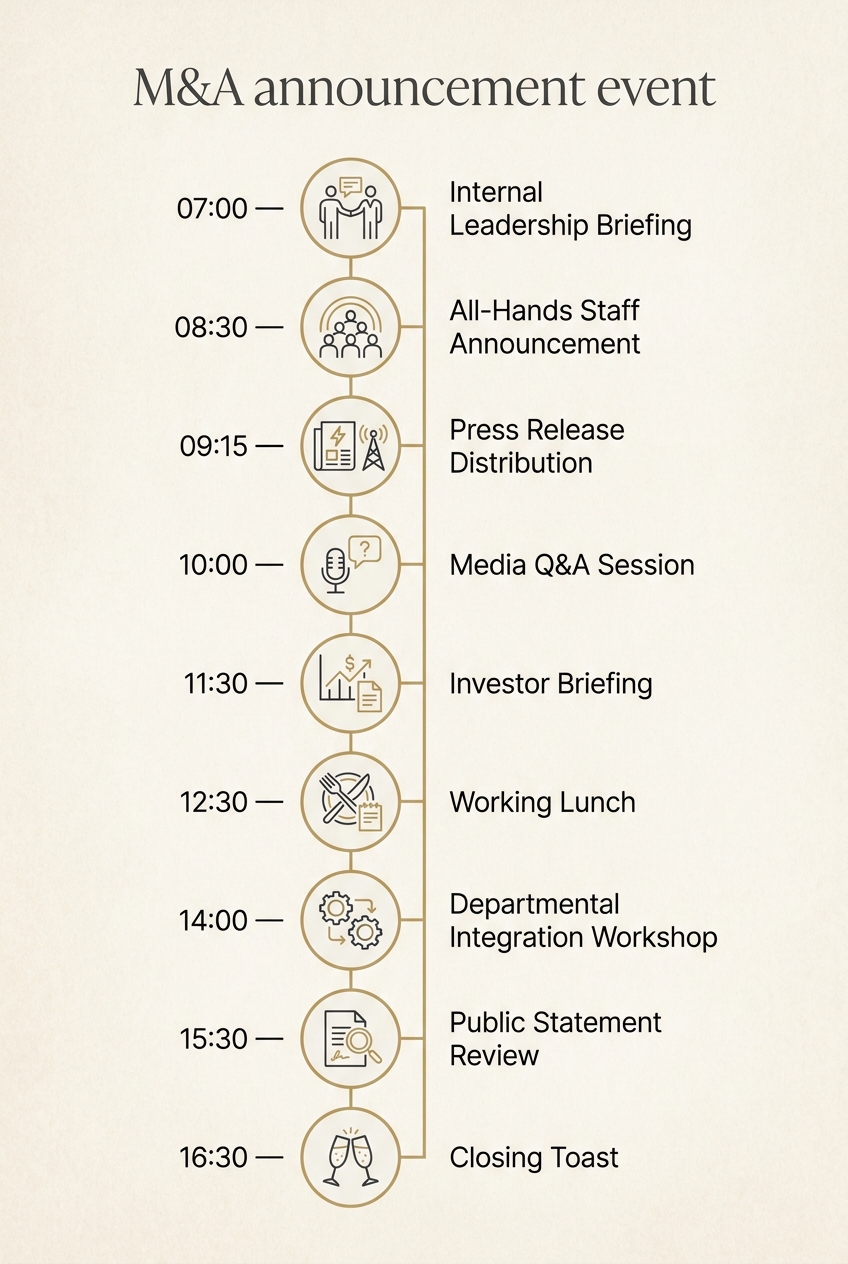
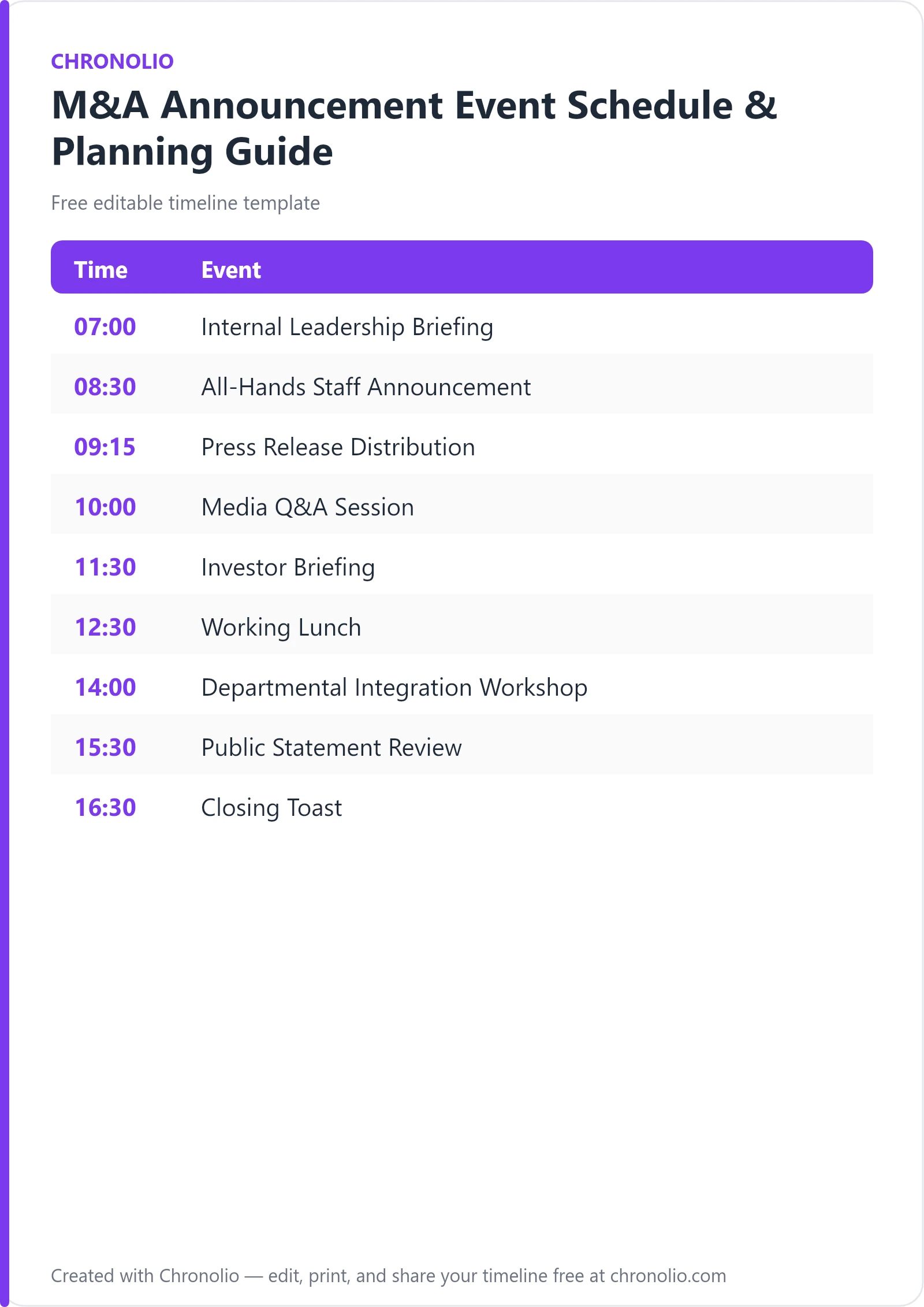
Here is the complete schedule this free template gives you — every time block, ready to edit, download, and share:
| Time | Event |
|---|---|
| 07:00 | Internal Leadership Briefing |
| 08:30 | All-Hands Staff Announcement |
| 09:15 | Press Release Distribution |
| 10:00 | Media Q&A Session |
| 11:30 | Investor Briefing |
| 12:30 | Working Lunch |
| 14:00 | Departmental Integration Workshop |
| 15:30 | Public Statement Review |
| 16:30 | Closing Toast |
What Is an M&A Announcement Event Timeline?
An M&A announcement event timeline is the definitive operational blueprint used by corporate executives, communications teams, and deal advisors to orchestrate the public and internal disclosure of a merger or acquisition. Executing a transaction disclosure requires absolute precision: regulatory agencies require immediate transparency, financial markets demand accurate valuation metrics, and staff need reassurance regarding organizational stability.
Having managed dozens of corporate transaction rollouts from behind the scenes, I can tell you that timing is the ultimate risk mitigation tool. A single leaked detail prior to market open or an uncoordinated press release can destabilize stock performance and erode employee trust overnight. This template reflects real-world M&A announcement event structures and corporate best practices honed across high-stakes corporate disclosures, ensuring your leadership team hits every critical milestone with composure and authority.
Customize Your M&A Announcement Timeline
Why M&A Announcement Events Need a Timeline
When two corporate entities merge, the sheer volume of competing stakeholders—investors, regulators, journalists, and thousands of employees—creates an intense, high-pressure environment. A master schedule keeps all parties aligned across multiple venues, virtual streaming rooms, and media wires, ensuring that key executives know precisely where they need to be at every minute of the morning.
Furthermore, a disciplined timeline enforces strict coordination between internal and external channels. If you broadcast news to news outlets before your internal staff briefing, employee morale drops instantly. By embedding sequential buffer windows into your schedule, you maintain complete control over the narrative and ensure consistent messaging across every touchpoint.
Finally, an established schedule gives your legal counsel and investor relations specialists clear operational checkpoints. You can easily cross-reference this schedule alongside a board meeting timeline template when securing final sign-offs, keeping the transition team synchronized from the pre-dawn briefing to the afternoon integration workshop.
What to Include in an M&A Announcement Event Timeline
A battle-tested transaction disclosure schedule must account for both public disclosure obligations and internal change management. Every successful M&A run of show includes:
- Pre-market leadership alignment to confirm executive messaging points, review deal parameters, and complete legal check-ins.
- Company-wide internal briefing to deliver authentic, top-down context directly from executive leadership before rumors spread.
- Wire press release distribution strategically timed for global market disclosure and trade publication coverage.
- Virtual or in-person media Q&A allowing financial journalists to press leadership on transaction rationale, debt loads, and operational synergies.
- Dedicated investor and analyst call detailing shareholder value, balance sheet impacts, and future growth trajectories.
- Cross-functional integration sessions to immediately jumpstart operational planning among key departmental heads.
- Social sentiment debrief and leadership toast to evaluate initial market reaction and acknowledge the deal team's hard work.
Phase 1: Internal Alignment & Staff Disclosure
| Time | Event |
|---|---|
| 07:00 | Internal Leadership Briefing |
| 08:30 | All-Hands Staff Announcement |
The early morning hours set the tone for the entire transaction disclosure. At 07:00, the C-suite, legal counsel, and public relations leads gather in Boardroom A for the Internal Leadership Briefing. This hour serves as the final reality check before wire services go live. Leaders review talking points, anticipate tough media inquiries, and double-check regulatory filing status. Getting leadership aligned early eliminates contradictory statements later in the day.
At 08:30, focus shifts directly to internal staff during the All-Hands Staff Announcement hosted in the Main Auditorium and broadcast via secure livestream. Employees must hear about the acquisition directly from their CEO before reading headlines on financial news portals. Explaining the deal structure, strategic vision, and immediate integration expectations builds trust and stabilizes workforce sentiment right out of the gate. For future media-focused gatherings, you can adapt this structure with a specialized media press briefing schedule.
Phase 2: Market Disclosure & External Communications
| Time | Event |
|---|---|
| 09:15 | Press Release Distribution |
| 10:00 | Media Q&A Session |
| 11:30 | Investor Briefing |
Once internal teams are informed, market disclosure takes priority. At 09:15, the Communications Office executes the Press Release Distribution, launching the official regulatory announcements and sending multi-wire press releases globally. This precise timing satisfies public reporting mandates while giving financial analysts time to digest the core financial metrics as morning markets digest the transaction.
At 10:00, executive leaders step into the Media Studio for the live Media Q&A Session. Financial reporters and industry correspondents grill executives on deal rationale, expected cost synergies, and potential regulatory hurdles. Giving journalists a structured, direct line to key executives prevents speculation and shapes fair news coverage.
By 11:30, attention moves to Conference Hall B for the Investor Briefing. Shareholders and equity analysts expect granular detail on long-term value creation, earnings per share impact, and debt profiling. Pair this disclosure effort with a structured strategy session agenda to maintain clear strategic continuity throughout executive presentations.
Phase 3: Integration Strategy & Debrief
| Time | Event |
|---|---|
| 12:30 | Working Lunch |
| 14:00 | Departmental Integration Workshop |
| 15:30 | Public Statement Review |
| 16:30 | Closing Toast |
After the heavy external communications wrap up, attention pivots toward operational execution. At 12:30, the core transition team convenes in the Executive Dining Room for a Working Lunch. Away from cameras and microphones, leaders map out immediate 30-day priorities and define integration milestones while discussing early market reactions.
At 14:00, functional leaders gather in Breakout Room 4 for the Departmental Integration Workshop. Operational leaders from both merging entities review software stacks, reporting hierarchies, and culture alignment plans. Transitioning quickly from public messaging to hands-on collaboration signals stability to both internal teams and external stakeholders.
As the market day closes at 15:30, the PR and communications teams conduct a Public Statement Review in the Communications Office. They analyze broadcast coverage, financial news headlines, and social sentiment to refine follow-up communications for day two. Finally, at 16:30, everyone gathers in the Lobby Lounge for a Closing Toast. Celebrating this milestone acknowledges months of grueling deal preparation—much like celebrating major company milestones using a corporate year-end function template.
M&A Announcement Event Timeline vs Integration Roadmap
It is critical not to confuse an M&A announcement event timeline with a long-term integration roadmap. While both are essential components of corporate M&A strategy, they operate on completely different time horizons and serve distinct tactical purposes:
| M&A Announcement Event Timeline | Long-Term Integration Roadmap |
|---|---|
| Focus: Hour-by-hour operational run of show for public disclosure day. | Focus: Multi-month or multi-year strategic operational consolidation. |
| Primary Audience: PR team, executive leadership, journalists, employees, investors. | Primary Audience: Department heads, HR managers, IT teams, transition officers. |
| Key Deliverables: Press release distribution, live all-hands, analyst webcast, media Q&A. | Key Deliverables: Systems migration, cultural alignment, head count adjustments, operational cost savings. |
| Time Horizon: 24 to 48 hours centered on deal disclosure. | Time Horizon: 100 days to 2 years post-close. |
While an integration roadmap maps the marathon journey of bringing two enterprise organizations together under one roof, the announcement timeline is a sprint designed to control public perception, satisfy legal disclosure rules, and inspire organizational confidence on day one.
Who Should Use This Template?
This event structure is designed specifically for corporate teams managing high-stakes organizational disclosures and major transaction events:
- Chief Executive Officers & C-Suite Executives seeking a clear, stress-free agenda for announcement day.
- Corporate Communications & Public Relations Directors managing press distribution wires, media studios, and crisis control.
- Investor Relations Specialists coordinating shareholder calls, SEC compliance disclosures, and equity analyst decks.
- Human Resources & Internal Communications Lead ensuring smooth employee messaging and all-hands streaming.
- M&A Advisory & Legal Consultants guiding enterprise clients through regulatory and press protocols.
Chronolio offers specialized features tailored to various organizational roles, helping deal leads, communication specialists, and event managers coordinate complex schedules smoothly without miscommunication.
How to Use This Template
Executing a seamless transaction disclosure is simple when you leverage digital timeline software:
- Duplicate or download the schedule: Access the digital template directly on Chronolio or download offline copies via our Word template or PDF template.
- Adjust times for market hours: Align your press distribution (09:15) and investor briefings with regional stock exchange opening bells and regulatory filing constraints.
- Assign speaker and location roles: Add specific executive names, room numbers, and virtual meeting links to every line item so attendees know exactly where to report.
- Distribute under NDA prior to deal day: Share the finalized run of show with core executive assistants, agency partners, and legal advisors ahead of time to confirm technical readiness.
Tips for a Successful M&A Announcement Event
- Establish strict embargoes: Ensure all external PR agencies, web designers, and stream operators sign non-disclosure agreements with clear embargo dates prior to asset preparation.
- Set up a dedicated media holding room: Keep journalists and camera crews contained in a dedicated studio away from executive prep suites and employee meeting spaces.
- Prepare robust FAQ documents: Equip executive spokespersons with comprehensive Q&A briefs addressing potential job overlaps, facility closures, and leadership changes according to expert guidelines from organizations like Harvard Business Review.
- Test virtual streaming tech in advance: Run dry runs of all-hands streams and analyst phone bridges 24 hours prior to prevent audio dropouts or broadcast delays.
- Monitor market regulatory bodies: Confirm that regulatory disclosures, such as those governed by the U.S. Securities and Exchange Commission, are cleared before firing off wire press releases.
- Maintain central command control: Establish a single point of contact in the Communications Office to make quick timing calls if a session runs over.
Common Mistakes to Avoid
- Telling employees after the press release: Letting staff learn about an acquisition from trade publications destroys organizational trust and triggers immediate attrition risk.
- Omitting buffer windows between sessions: Running back-to-back live webcasts without 15-to-30-minute buffers leaves executives flustered if media Q&A runs long.
- Failing to prep for tough media inquiries: Assuming journalists will focus solely on positive synergies often leaves executives unprepared for questions on layoffs or restructuring costs.
- Ignoring social sentiment monitoring: Forgetting to track online commentary immediately following release distribution leaves public relations teams reactive rather than proactive.
- Overcomplicating Day One messages: Overloading staff and external media with dense 3-year integration tactics during the initial announcement confuses the core strategic narrative.
In Summary
- An M&A announcement event timeline orchestrates the complex hour-by-hour disclosure sequence across internal employees, financial markets, and media outlets.
- Sequencing internal all-hands meetings before wire releases preserves workforce trust and minimizes internal speculation.
- Timing regulatory press announcements to align with financial market schedules ensures compliance and reduces volatility.
- Structured media Q&As and investor webcasts build external market confidence by delivering transparent, authoritative deal messaging.
- Post-announcement integration workshops capitalize on immediate momentum to start cross-company operational alignment on day one.
Mastering an M&A disclosure requires strict discipline, absolute privacy control, and seamless execution. Whether you are leading a middle-market consolidation or a multi-billion-dollar enterprise merger, structuring your day around this battle-tested run of show guarantees that your leadership team speaks with clarity, authority, and confidence.
Customize Your M&A Announcement Timeline