





This Template at a Glance
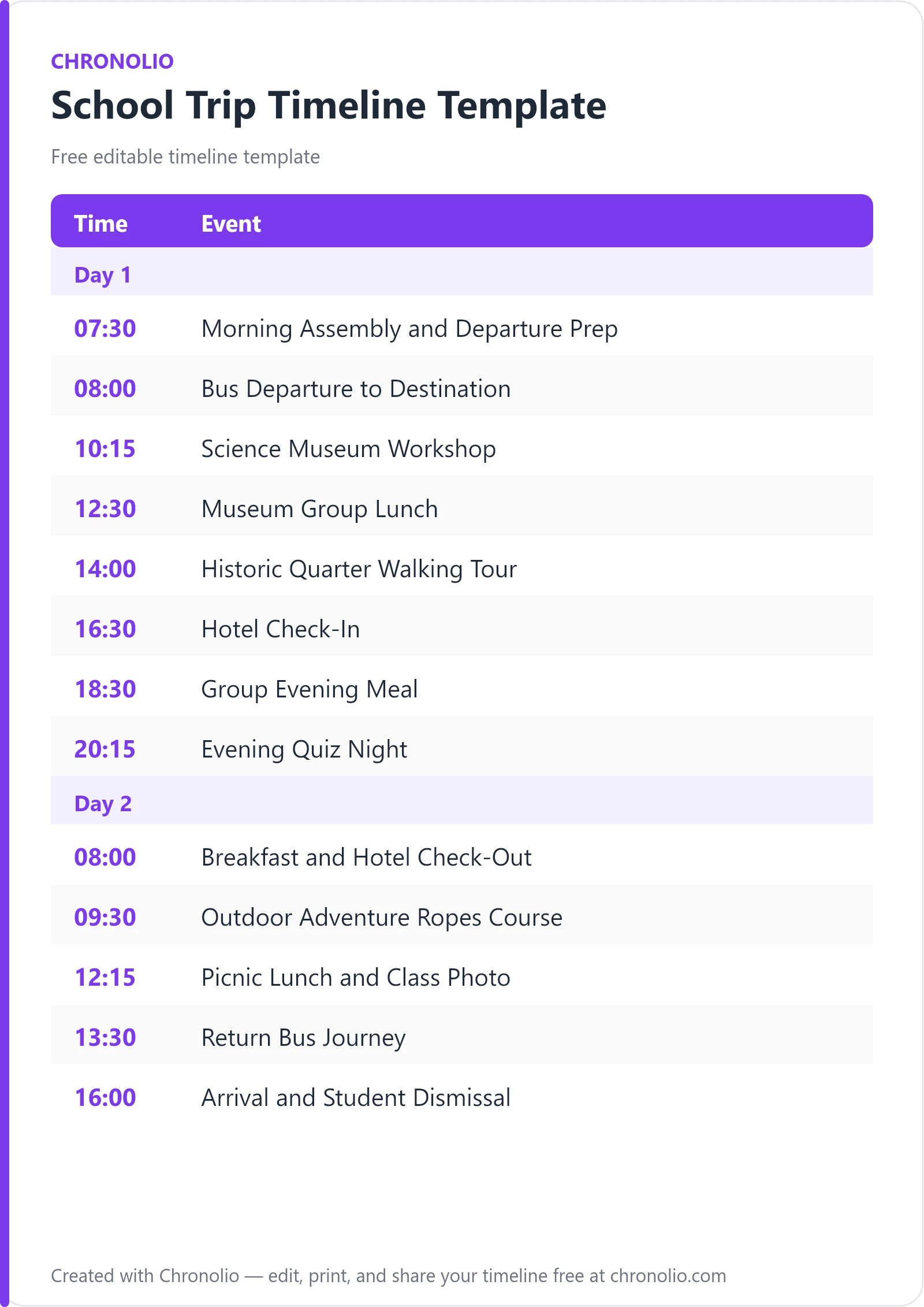
Here is the complete schedule this free template gives you — every time block, ready to edit, download, and share:
| Day | Time | Event |
|---|---|---|
| 1 | 07:30 | Morning Assembly and Departure Prep |
| 1 | 08:00 | Bus Departure to Destination |
| 1 | 10:15 | Science Museum Workshop |
| 1 | 12:30 | Museum Group Lunch |
| 1 | 14:00 | Historic Quarter Walking Tour |
| 1 | 16:30 | Hotel Check-In |
| 1 | 18:30 | Group Evening Meal |
| 1 | 20:15 | Evening Quiz Night |
| 2 | 08:00 | Breakfast and Hotel Check-Out |
| 2 | 09:30 | Outdoor Adventure Ropes Course |
| 2 | 12:15 | Picnic Lunch and Class Photo |
| 2 | 13:30 | Return Bus Journey |
| 2 | 16:00 | Arrival and Student Dismissal |
What Is a School Trip Timeline?
A school trip timeline is an operational master schedule that maps out every travel movement, educational activity, meal service, and chaperone check-in across an educational excursion. Far beyond a basic summary given to parents, an operational timeline provides teachers, school administrators, charter drivers, and venue hosts with precise chronological milestones from initial morning assembly to final student dismissal.
Having coordinated dozens of multi-day student travel itineraries, I can tell you that successful off-campus excursions rely entirely on predictable structure. Unexpected traffic jams, delayed headcounts, and crowded dining halls can quickly derail a morning program if your timing isn't tightly planned. This master schedule reflects real-world educational tour practices, incorporating realistic transit buffers and dedicated head-count windows. Whether you need an offline version as a Word document or a printable PDF guide, having a clear timeline keeps your staff aligned and your students safe.
Edit Your School Trip Timeline Template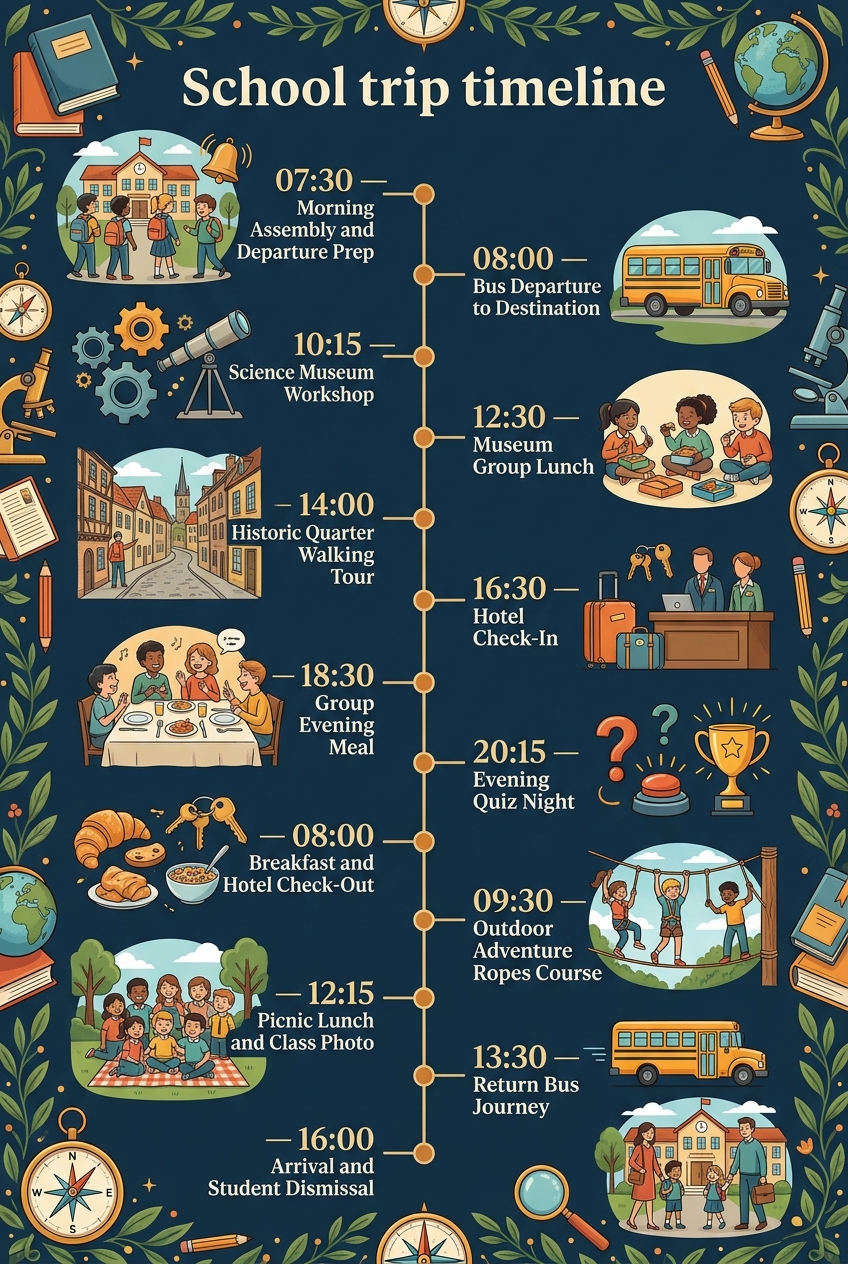
Why School Trips Need a Timeline
Managing forty to one hundred students away from campus requires strict group management and clear accountability. A detailed timeline serves as the central operational playbook for chaperones, ensuring every staff member knows exactly where their assigned group should be, who is leading each session, and when headcounts must occur.
Furthermore, partner venues and transport providers operate on strict schedules. Museum educators set aside specific lab windows, restaurants prepare group buffets to order, and charter bus drivers are bound by legally enforced driving limits. A well-constructed schedule eliminates friction with external vendors and prevents costly overages or missed reservations.
Finally, structured timing significantly reduces student fatigue and behavioral issues. When students have predictable meal breaks, defined downtime, and structured evening programs, they stay engaged and energized throughout the trip. Much like organizing a structured corporate event using our board meeting timeline template, clear boundaries and predictable pacing create a smoother experience for everyone involved.
What to Include in a School Trip Timeline
To ensure your multi-day excursion runs without a hitch, your trip timeline should account for the following critical operational phases:
- Pre-departure administration: Roll call, luggage tagging, medication collection, and chaperone group assignments.
- Transit and buffer blocks: Travel times calculated with traffic padding, driver breaks, and rest-stop headcounts.
- Structured venue activities: Guided museum workshops, hands-on exhibits, and historical walking tours tied to curriculum standards.
- Meal logistics: Dedicated windows for pre-arranged dining halls, boxed lunches, and dietary accommodation verification.
- Accommodation workflows: Room key distribution, luggage unloading, hotel guidelines briefings, and night-duty rotations.
- Evening engagement: Controlled social or educational activities like trivia nights to keep students contained and entertained before lights-out.
- Return and dismissal protocol: Checkout inspections, final photo opportunities, transit updates sent to parents, and baggage collection.
Day 1: Departure Prep, Science Workshop, and Historic District
| Time | Event |
|---|---|
| 07:30 | Morning Assembly and Departure Prep |
| 08:00 | Bus Departure to Destination |
| 10:15 | Science Museum Workshop |
| 12:30 | Museum Group Lunch |
| 14:00 | Historic Quarter Walking Tour |
The trip begins bright and early in the Oakridge High School Courtyard, where students gather for mandatory roll call, luggage tagging, and medication hand-off to designated first-aid chaperones. Taking thirty minutes for thorough pre-departure checks ensures no permission slips or essential gear are left behind before boarding the charter buses at 08:00.
The two-hour drive to the state capital science hub incorporates a small travel buffer for morning traffic. Upon arriving at the Metropolitan Science Museum, students move straight into an interactive, educator-led physics demonstration. Following the workshop, the group transitions directly to the Science Museum Dining Hall for a pre-arranged buffet lunch. Staggering your arrival right at the start of the lunch hour avoids peak venue crowds and ensures students are fed before heading back out for the afternoon walking tour through the Old Town Historic District.
Day 1: Hotel Check-In and Evening Programming
| Time | Event |
|---|---|
| 16:30 | Hotel Check-In |
| 18:30 | Group Evening Meal |
| 20:15 | Evening Quiz Night |
Following two hours of exploring local architecture and historic landmarks, the charter buses transport the group to the Grand Plaza Youth Hotel. Checking in at 16:30 allows a generous hour-and-a-half window for room assignments, luggage handling, and chaperone room checks. Allowing students dedicated downtime before dinner helps them recharge after an active afternoon on their feet.
Dinner is served in the hotel's Grand Plaza Ballroom at 18:30, providing a controlled environment where teachers can make announcements about the upcoming day. At 20:15, students gather in the hotel activity room for an organized quiz night. Running a structured trivia game reinforces the day's educational lessons while keeping students active in a supervised area prior to room night-checks and lights-out.
Day 2: Outdoor Adventure, Return Travel, and Dismissal
| Time | Event |
|---|---|
| 08:00 | Breakfast and Hotel Check-Out |
| 09:30 | Outdoor Adventure Ropes Course |
| 12:15 | Picnic Lunch and Class Photo |
| 13:30 | Return Bus Journey |
| 16:00 | Arrival and Student Dismissal |
Day 2 starts with a hot breakfast in the hotel ballroom while chaperones conduct room inspections to ensure no personal items are left behind. Luggage is loaded back onto the charter buses before departing for the Pine Ridge Outdoor Center. Getting on the road by 09:00 guarantees arrival for the 09:30 ropes course, where students participate in outdoor team-building challenges under the instruction of certified guides.
At 12:15, the group gathers at the Pine Ridge Park Pavilion for a picnic lunch and a commemorative photo session. Setting aside dedicated time for a group photo before boarding the buses ensures you capture memorable moments without rushing. The return bus journey leaves at 13:30, arriving back at the Oakridge High School Parking Lot at 16:00 for baggage collection and parent pick-up.
School Trip Timeline vs Field Trip Itinerary
It is easy to confuse a school trip timeline with a standard trip itinerary, but they serve distinct purposes during trip planning:
| Feature | School Trip Timeline | Field Trip Itinerary |
|---|---|---|
| Primary Audience | Trip Leaders, Chaperones, Drivers | Parents, Students, School Board |
| Level of Detail | Minute-by-minute operational shifts | Overview of main stops and daily themes |
| Logistical Focus | Duty rosters, headcounts, buffer times | Highlights, packing lists, general locations |
| Usage Context | Used active-on-site during the trip | Used for pre-trip approval and planning |
| Vendor Information | Driver contact, confirmation numbers | Public venue addresses and general names |
While a student itinerary summarizes where the group will be each afternoon, the operational timeline dictates who manages roll calls and how staff respond if travel transitions slip behind schedule. Just as you would separate guest schedules from vendor running orders when planning personal events using a birthday party timeline template or an anniversary party schedule template, keeping detailed operational procedures on a dedicated timeline prevents communication confusion.
Who Should Use This Template?
This customizable timeline is designed for anyone responsible for student safety, group travel, and educational event management. It is ideal for:
- High school and middle school teachers coordinating grade-level field trips or subject-specific excursions.
- Department heads and athletic directors organizing multi-day academic competitions or sports tournaments.
- School administrative assistants drafting safety compliance schedules and travel packs for school board approval.
- Youth group leaders and non-profit coordinators running overnight retreats or educational camps.
- Educational tour operators building standardized master schedules for client schools.
Chronolio features customized workflow options tailored for various organizational roles, making it simple to share distinct views of the schedule with teachers, drivers, and parents.
How to Use This Template
- Customize your master schedule: Click the template button below to open the schedule in Chronolio. Adjust arrival hours, venue choices, and activity lengths to match your destination.
- Assign chaperone responsibilities: Add specific lead staff names to each time block for headcounts, medication management, and duty rotations.
- Verify venue time slots: Confirm your museum workshop hours, restaurant reservations, and activity sessions with external providers, aligning them with your timeline.
- Distribute offline copies: Export finalized schedules as a Word document or a printable PDF guide to distribute in chaperone binders.
- Share high-level schedules with parents: Provide families with key departure, return, and hotel emergency contact details extracted from your main schedule.
Tips for a Successful School Trip
- Implement the "buddy system" alongside chaperone groups: Assign every student a specific peer buddy and place them in chaperone groups of 6 to 10. Require headcounts before leaving any location.
- Pad your transit schedules: Always add a 15- to 20-minute safety buffer to transit times predicted by GPS apps to account for bus loading, parking delays, and group bathroom stops.
- Pre-assign hotel rooms and bus seats: Draft seating charts and rooming lists at least two weeks before departure to avoid delays during hotel check-in and morning boarding.
- Pack emergency travel kits: Provide each chaperone with a binder containing student medical forms, dietary restriction lists, venue confirmation codes, and emergency contact numbers. According to safety guidance from the Council for Learning Outside the Classroom, comprehensive pre-trip planning and clear group oversight are essential for mitigating outdoor activity risks.
- Schedule explicit quiet hours: Establish clear lights-out rules (e.g., 22:00) during evening announcements so students get adequate rest for Day 2 activities.
Common Mistakes to Avoid
- Over-scheduling the daily agenda: Cramming too many venues into a single day leads to exhausted students and missed reservations. Build in downtime at the hotel.
- Forgetting driver rest compliance: Federal safety regulations strictly govern commercial driver hours. Ensure your schedule accords with required driver rest periods.
- Neglecting dietary requirement checks: Always confirm allergen and dietary lists with venues and catering services at least seven days prior to arrival.
- Failing to hold a chaperone briefing: Never start a trip without running a 15-minute alignment meeting with all chaperones to review safety protocols, duty rosters, and mobile contact trees.
- Lacking a designated central rendezvous point: When visiting open spaces like historical quarters or park pavilions, establish a clear, fixed meeting point for lost students or mid-tour check-ins.
In Summary
- A school trip timeline is an operational schedule ensuring safety, educational value, and timely execution across multi-day trips.
- This free two-day template covers morning assembly, educational workshops, walking tours, team building, and safe parent dismissal.
- Dedicated buffer periods between travel and activity blocks prevent unforeseen traffic jams from ruining venue bookings.
- Operational timelines provide chaperone rosters and emergency procedures that go beyond basic student itineraries.
- You can fully edit this timeline online or export it directly as a Word document or PDF guide.
Planning an excursion requires careful oversight, clear group management, and seamless vendor coordination. Whether you are leading high school students on an urban historical tour or managing younger children during a science retreat, using a structured schedule guarantees a safe and memorable experience for everyone involved. For other event planning needs, you might also enjoy exploring our baby shower timeline template or our library of specialized event agendas.
Edit Your School Trip Timeline Template