





This Template at a Glance
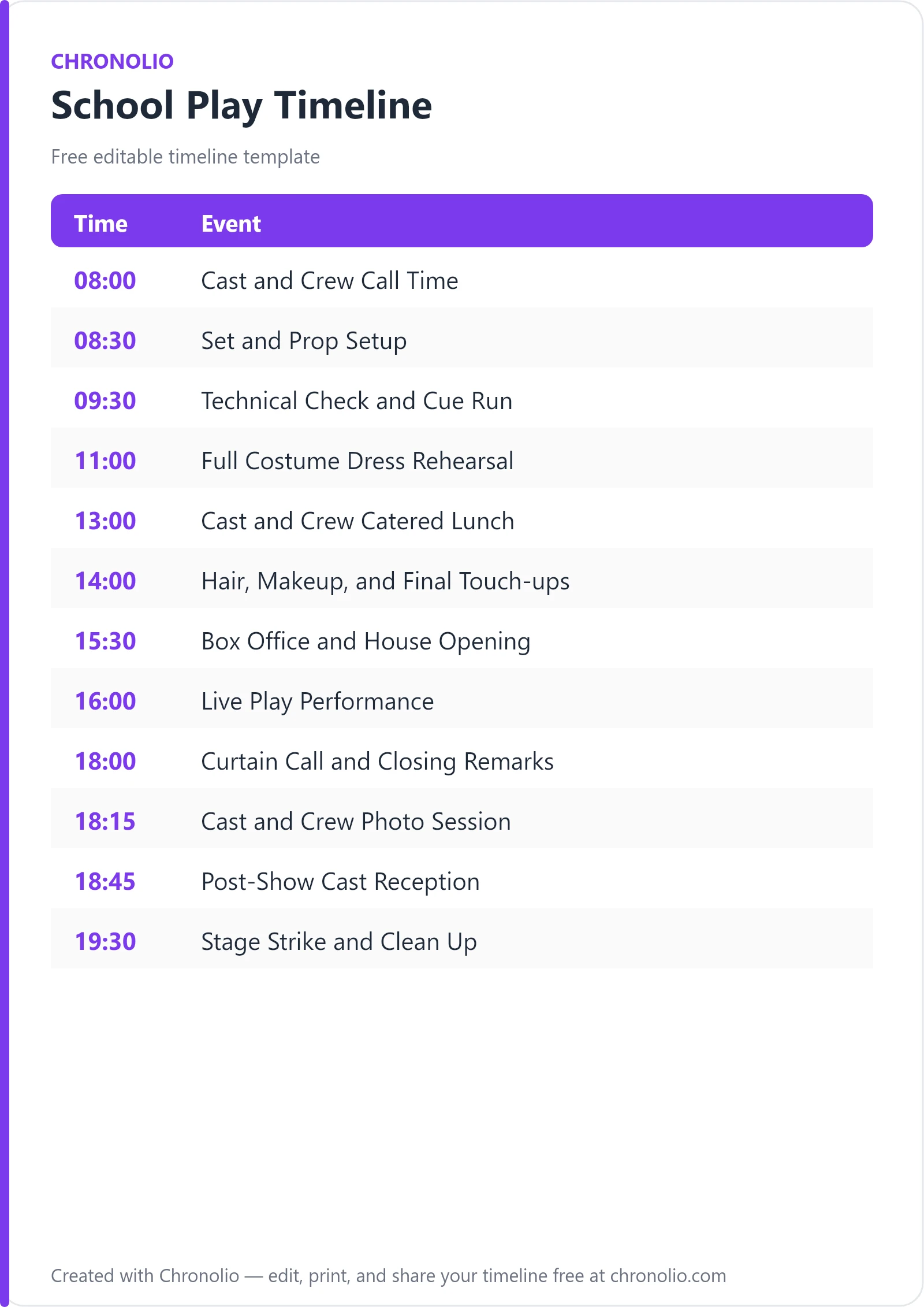
Here is the complete schedule this free template gives you — every time block, ready to edit, download, and share:
| Time | Event |
|---|---|
| 08:00 | Cast and Crew Call Time |
| 08:30 | Set and Prop Setup |
| 09:30 | Technical Check and Cue Run |
| 11:00 | Full Costume Dress Rehearsal |
| 13:00 | Cast and Crew Catered Lunch |
| 14:00 | Hair, Makeup, and Final Touch-ups |
| 15:30 | Box Office and House Opening |
| 16:00 | Live Play Performance |
| 18:00 | Curtain Call and Closing Remarks |
| 18:15 | Cast and Crew Photo Session |
| 18:45 | Post-Show Cast Reception |
| 19:30 | Stage Strike and Clean Up |
What Is a School Play Timeline?
A school play timeline is the operational master blueprint that guides student actors, technical stage crews, drama directors, and parent volunteers through every phase of production day. From early morning call times in the auditorium backstage to the final sweep during post-show stage strike, a structured timeline ensures that technical cues, wardrobe adjustments, front-of-house operations, and live performance segments happen without chaos.
Running a successful educational theatre production requires balancing multiple moving parts simultaneously. Lighting technicians need quiet time in the booth to test dimmer cues; sound engineers must ring out body microphones across the stage; and actors need adequate time for wardrobe fittings and vocal warm-ups. Built from proven educational theatre best practices and real-world stage management standards, this master schedule eliminates backstage confusion, protects student well-being with scheduled rest breaks, and guarantees that doors open on time for your audience.
Edit your school play timeline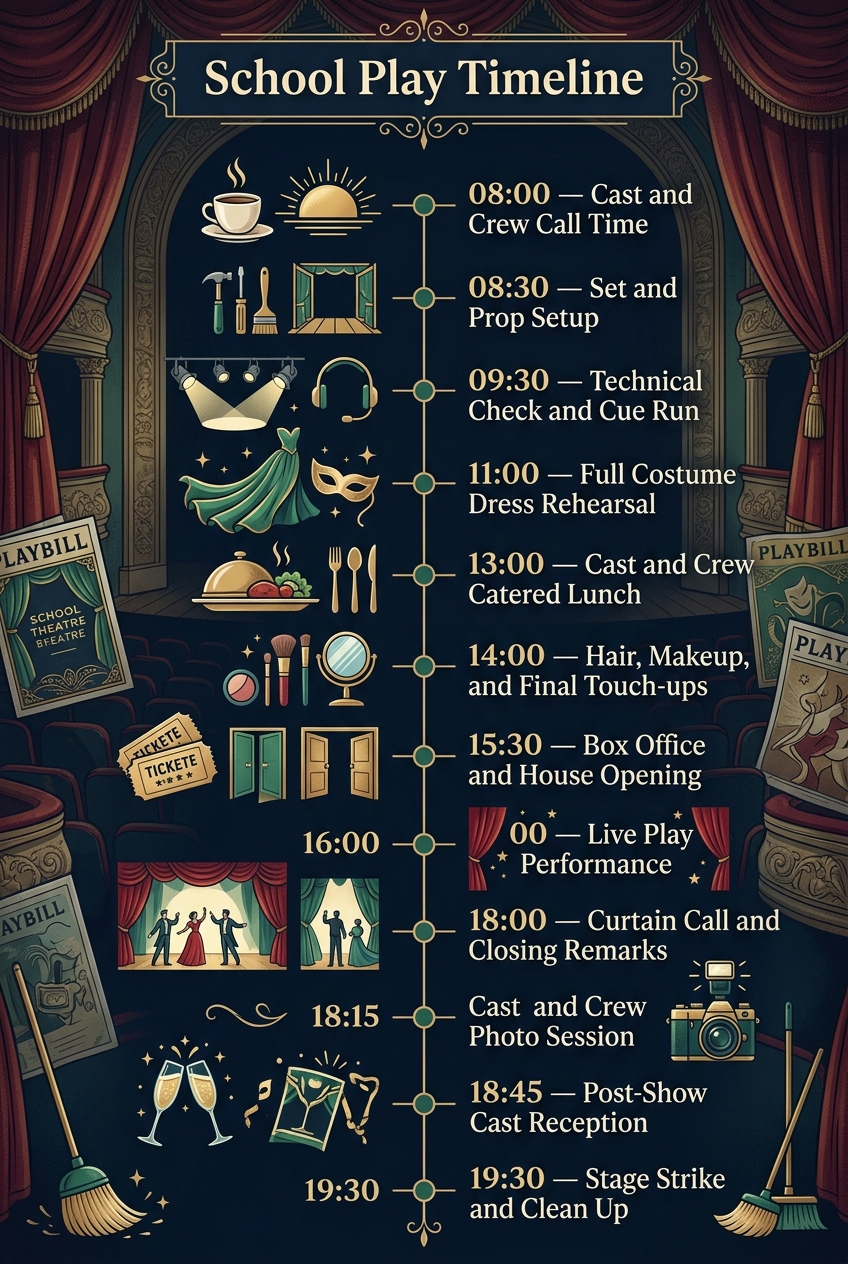
Why School Plays Need a Timeline
In educational theatre, timing is the key to safety and performance confidence. Unlike professional adult theatre where union rules enforce rigid breaks and specialized union crews handle set pieces, school plays rely on student performers and volunteer crew members who are learning stagecraft in real time. Without a clear hour-by-hour schedule, morning setup stretches into late afternoon, technical rehearsals get rushed, and actors end up performing on stage physically exhausted and mentally drained.
A well-structured production day schedule serves as a shared communication bridge across all school departments. It gives the facilities manager precise hours for heating or air conditioning, informs catering volunteers when to serve meals in the cafeteria, and notifies front-of-house ushers when the lobby doors should open. Just as a corporate leader relies on a board meeting timeline to keep executive sessions structured, a drama director relies on a master schedule to keep students focused and safe.
Furthermore, a published schedule instills professional discipline in student artists. When student actors and stage managers see a clear sequence of events—from sound check to curtain call—they learn time management, accountability, and stage etiquette that stay with them long after the final applause. You can also download this schedule as a Word Document (.docx) or a Printable PDF for easy posting on call boards and distribution to families.
What to Include in a School Play Timeline
A comprehensive show day schedule must account for both backstage technical operations and front-of-house public management. To ensure your production flows seamlessly, your master plan should always include these core milestones:
- Cast and Crew Call Time: Official arrival and sign-in time for all actors, stage managers, and technical operators in the auditorium backstage area.
- Set, Prop, and Rigging Setup: Unpacking scenic pieces, checking stage furniture placement, inspecting hand props, and conducting rigging safety inspections on the main stage.
- Technical Check and Sound Cue Run: Testing light board presets, ringing out body wireless microphones, and testing audio sound effects from the control booth.
- Full Costume Dress Rehearsal: An uninterrupted complete run-through of the play on stage with full lighting, sound cues, costumes, and theatrical makeup.
- Catered Meal and Rest Break: A mandatory off-stage break in the cafeteria for students to eat, hydrate, and clear their minds before live audience arrival.
- Hair, Makeup, and Mic Fitting: Final physical preparations in the dressing rooms, microphone taping, and quick audio check-ins before call.
- Box Office and House Opening: Opening lobby ticket counters, assigning ushers, and opening auditorium doors to seat incoming guests.
- Live Play Performance and Intermission: Running the full show on stage under live conditions with a planned intermission for audience comfort.
- Curtain Call and Director Remarks: Cast bows, acknowledgement of student stage crew, and brief closing gratitude from the drama director.
- Cast Photography and Post-Show Reception: Commemorative group photos on stage followed by light refreshments and family meet-and-greets in the green room.
- Stage Strike and Clean Up: Complete teardown of set structures, costume inventory storage, equipment packing, and auditorium cleanup.
Morning Setup and Technical Cue Run
| Time | Event |
|---|---|
| 08:00 | Cast and Crew Call Time |
| 08:30 | Set and Prop Setup |
| 09:30 | Technical Check and Cue Run |
The early morning hours set the tone for the entire production day. Beginning with Cast and Crew Call Time at 08:00, all student actors, stage managers, board operators, and parent volunteers gather in the school auditorium backstage for initial sign-in and safety briefings. Attendance is taken immediately to ensure all critical roles are filled, while the drama director reviews safety guidelines, emergency exits, and the day's milestones before assigning specific morning duties.
At 08:30, focus shifts to Set and Prop Setup on the main stage. Under the guidance of the stage manager, the run crew unloads set flats, positions stage furniture, and organizes the stage left and stage right prop tables. Every prop must be inspected for damage and inventoried on prop sheets, while adult supervisors perform thorough safety inspections on overhead fly lines, battens, and curtain riggings.
Beginning at 09:30, the technical team conducts the Technical Check and Cue Run from the control booth and stage deck. Sound engineers turn on wireless receivers, check individual body microphones for frequency interference, and set master volume gain levels. Concurrently, lighting technicians cycle through every programmed lighting scene—from warm wash lighting to isolated spots—ensuring that light board channels, gel filters, and cue numbers match the stage manager's prompt book perfectly.
Dress Rehearsal and Backstage Prep
| Time | Event |
|---|---|
| 11:00 | Full Costume Dress Rehearsal |
| 13:00 | Cast and Crew Catered Lunch |
| 14:00 | Hair, Makeup, and Final Touch-ups |
With technical equipment fully calibrated, the entire company transitions into the Full Costume Dress Rehearsal at 11:00. This rehearsal simulates exact show conditions without stopping. Performers wear full stage costumes, quick-change dressers practice tight wardrobe changes in the wings, and technical operators execute light, sound, and scene change cues in real time. The drama director sits in the auditorium middle seats taking notes on line delivery, scene pacing, and lighting balance to share during post-rehearsal notes.
At 13:00, all activities pause for Cast and Crew Catered Lunch in the school cafeteria. Providing a healthy, balanced catered meal is vital for maintaining student energy and concentration through an intense show day. Stepping away from the dim lighting and high pressure of the auditorium allows actors and crew members to bond, rest their voices, and recharge. Water stations and light fruit snacks remain accessible throughout the day to keep performers hydrated.
At 14:00, actors report to designated dressing rooms for Hair, Makeup, and Final Touch-ups. Makeup crew volunteers apply stage foundation, eye accents, and hair styling tailored to each character's era and lighting exposure. Audio technicians re-fit body pack transmitters and secure lavalier microphone elements behind hair lines using theatrical tape, running quick whisper-and-projection mic checks before actors head to backstage call locations.
House Opening and Live Performance
| Time | Event |
|---|---|
| 15:30 | Box Office and House Opening |
| 16:00 | Live Play Performance |
| 18:00 | Curtain Call and Closing Remarks |
At 15:30, front-of-house operations commence with Box Office and House Opening. Parent volunteer ushers prepare playbills in the auditorium lobby, unlock public main entrances, and start ticket sales at the box office. Background instrumental music plays softly over the house speakers to welcome families, alumni, and faculty members as ushers guide guests to their assigned seating sections.
The main event begins at 16:00 with the Live Play Performance. House lights fade down as the stage manager calls cue 1, signaling the opening sequence of the play on the main stage. Student actors deliver their lines, stage crew members manage stealthy scene transitions in blackouts, and booth technicians execute dynamic lighting and sound effects. Midway through the production, a scheduled 15-minute intermission allows audience members to visit restrooms and concessions while actors catch their breath backstage.
At 18:00, the show culminates in Curtain Call and Closing Remarks. Cast members take orchestrated bows by ensemble, supporting, and lead groups, followed by stage management and running crew coming on stage to receive applause for their backstage work. The drama director takes the stage microphone to acknowledge school administrators, parent boosters, and facilities staff who made the production possible.
Photography, Reception, and Stage Strike
| Time | Event |
|---|---|
| 18:15 | Cast and Crew Photo Session |
| 18:45 | Post-Show Cast Reception |
| 19:30 | Stage Strike and Clean Up |
Immediately following curtain call, the Cast and Crew Photo Session begins at 18:15 on the main stage. Organized group portraits capture the full cast in costume, followed by technical crew pictures, department photos, and individual headshots with directors. Having a dedicated photographer run through a structured shot list ensures pictures are finished quickly before students change out of costumes.
At 18:45, the production team moves to the green room for the Post-Show Cast Reception. Student actors, stage crew members, and families gather for light refreshments, dessert platters, and photo opportunities. Similar to celebrating milestones in a family environment like an anniversary party schedule or a birthday party timeline, this casual gathering allows students to celebrate their hard work with loved ones in a joyful, relaxed setting.
The day concludes with Stage Strike and Clean Up starting at 19:30. All capable cast and crew members return to the main stage and backstage facilities to dismantle set flats, disconnect sound cables, store lighting instruments, fold costumes into wardrobe bins, and sweep stage floors. Following guidance from resources like the Educational Theatre Association, maintaining strict safety protocols during strike prevents injuries and returns the school auditorium to its standard school assembly setup by 21:00.
School Play Timeline vs Stage Manager Call Sheet
While both tools are critical for theatrical production management, they fulfill distinct operational purposes during a show run:
| Feature | School Play Timeline | Stage Manager Call Sheet |
|---|---|---|
| Primary Audience | Cast, crew, parents, school admin, front-of-house | Stage crew, booth technicians, actors, dressers |
| Primary Purpose | High-level schedule of full show day events | Minute-by-minute execution call sheet for specific scenes |
| Time Scale | Hourly blocks (e.g., 08:00 to 21:00) | Exact cue timings (e.g., 16:14:05 Cue 22 Light Fade) |
| Detail Included | Setup, rehearsals, meals, doors, showtime, strike | Cue numbers, deck tracks, entrance calls, mic swaps |
| Distribution | Printed on call board, emailed to families, website | Kept in stage manager prompt binder and booth |
A school play timeline establishes the overarching macro schedule for show day, keeping everyone from catering parents to front-of-house ushers synchronized. In contrast, a stage manager call sheet (or prompt book script) dictates the precise micro execution of cues, actor entrances, and mechanical scene shifts during the performance itself.
Who Should Use This Template?
This master production schedule is tailored for educational environments and community theatre productions, supporting diverse roles involved in live theatre management:
- Drama Directors & Theatre Teachers: Who need a structured, reliable timetable to manage show day without missing critical technical steps.
- Student Stage Managers & Assistant Directors: Who need a clear operational roadmap to run backstage calls and manage deck crew assignments.
- Technical Theatre Instructors & Crew Leads: Who manage lighting design, sound engineering, set construction, and fly rail operations.
- High School & Middle School Drama Clubs: Planning annual fall plays, spring musicals, one-act competition pieces, or student-directed showcases.
- Elementary School Arts Coordinators: Organizing school-wide theatrical pageants and grade-level holiday performances.
- Parent Teacher Associations & Booster Clubs: Coordinating catered meals, box office ticketing, intermission concessions, and cast receptions.
- Community Youth Theatre Organizations: Running weekend youth theatre productions in shared civic venues or school auditoriums.
How to Use This Template
- Customize Your Show Parameters: Click the Edit Button above to load this schedule into Chronolio. Adjust arrival times based on whether your performance is a matinee or evening show.
- Assign Specific Department Duties: Add departmental notes for set crew, costume dressers, booth operators, and front-of-house ushers under each timeframe.
- Incorporate Venue-Specific Requirements: Adjust meal break windows and facility usage hours according to your school district's custodial and scheduling policies.
- Export and Distribute Print Versions: Generate clean, print-ready PDF schedules using the Printable PDF format or edit offline using the Word Document (.docx) template.
- Post Backstage and Share Digitally: Post large printed copies on the backstage call board, attach them to dressing room doors, and email PDF copies to cast parents one week prior to opening night.
Tips for a Successful School Play
- Schedule Buffer Time Between Events: Always build 10 to 15 minutes of flex time between the technical cue run and dress rehearsal to handle unexpected technical hiccups without pushing back lunch.
- Conduct Mic Checks Before Hair and Makeup Finishes: Perform wireless body microphone sound checks before applying hairspray or pinning elaborate wigs to prevent audio crackle and tape failure during the show.
- Designate Quiet Backstage Zones: Assign specific holding areas for non-performing cast members during dress rehearsals and live shows to keep wing spaces clear for prop movements and emergency changes.
- Feed Your Cast and Crew Early: Ensure student performers eat lunch at least two hours before full-dress performance so they digest properly and maintain energy on stage without discomfort.
- Assign Clear Strike Duty Lists: Divide post-show strike responsibilities into clear station assignments (costumes, lighting cables, set disassembly, dressing room cleanup) so teardown moves efficiently and safely.
- Coordinate Front-of-House Volunteers: Hold a 10-minute briefing with parent ushers at box office opening to review ticketing policies, aisle etiquette, emergency exits, and handicap seating.
- Emphasize Backstage Safety Gear: Enforce safety protocols during set construction and stage strike, requiring closed-toe shoes, work gloves, and supervised ladder usage at all times.
Common Mistakes to Avoid
- Skipping the Full Dress Rehearsal: Attempting a live show without performing a complete, uninterrupted dress rehearsal in costume often leads to backstage panics, lighting miscue traps, and wardrobe malfunctions.
- Overlooking Sound Cue Testing: Failing to ring out body microphones in an empty hall and with a full house causes audio feedback screeching and lost vocal clarity during lead solos.
- Shortchanging Cast Rest Breaks: Rushing through lunch or skipping downtime leaves student actors exhausted, causing forgotten lines and diminished stage presence during the live performance.
- Neglecting Safety Equipment Checks: Forgetting to inspect overhead rigging lines, fire curtains, or scenic bracing puts student actors and crew members at physical risk on stage.
- Unclear Box Office Guidelines: Opening auditorium doors late without trained ushers creates lobby congestion, delayed start times, and frustrated audience members.
- Leaving Strike to a Small Crew: Letting actors leave immediately after the cast reception leaves set strike to a tired handful of crew members; make strike a mandatory whole-company activity.
- Forgetting Stage Management Communication: Operating without clear radio headset communication between stage right, stage left, and the control booth leads to premature scene changes and lighting mishaps.
In Summary
- A school play timeline organizes call times, technical cue runs, full costume dress rehearsals, live showtime, and post-show strike into a unified schedule.
- Proper morning scheduling guarantees sound and lighting equipment are fully calibrated before actors step onto the main stage for dress rehearsals.
- Dedicated meal and rest breaks protect student health and ensure high energy throughout live performances.
- Coordinating front-of-house lobby setup with backstage readiness prevents show delays and delivers a professional audience experience.
- Post-show stage strike involves the entire cast and crew to safely dismantle scenery and return venue equipment to standard storage.
- Chronolio provides fully editable online templates alongside downloadable Word and PDF versions for easy call board posting.
Executing a flawless educational drama production requires balancing artistic passion with structured, disciplined timing. By adopting a comprehensive school play timeline, drama directors, student stage managers, and technical crews ensure that every lighting cue, actor entrance, and set change happens safely and punctually. Whether you are staging a middle school musical, a high school drama, or an elementary holiday production, this timeline template provides the structural foundation needed for a memorable standing ovation.
Edit your school play timeline