





This Template at a Glance
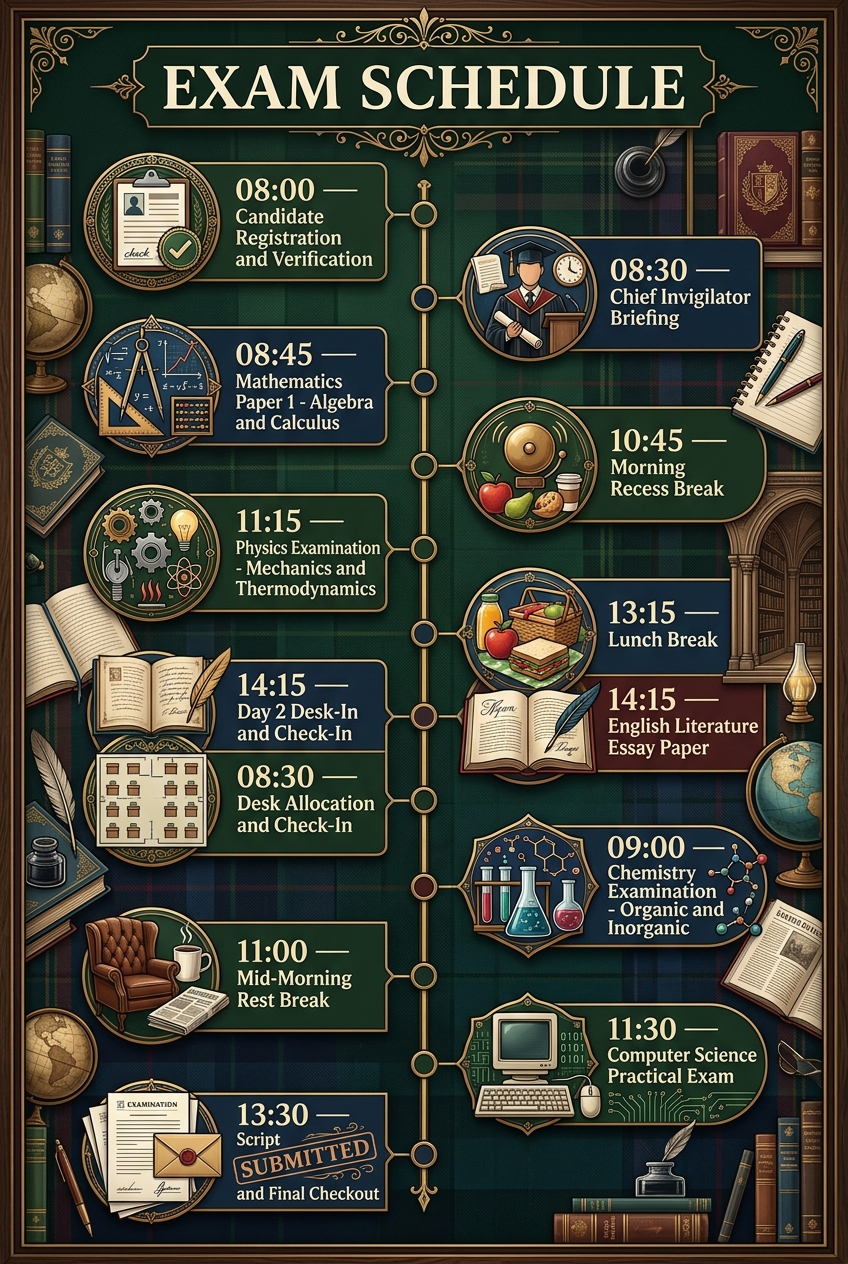
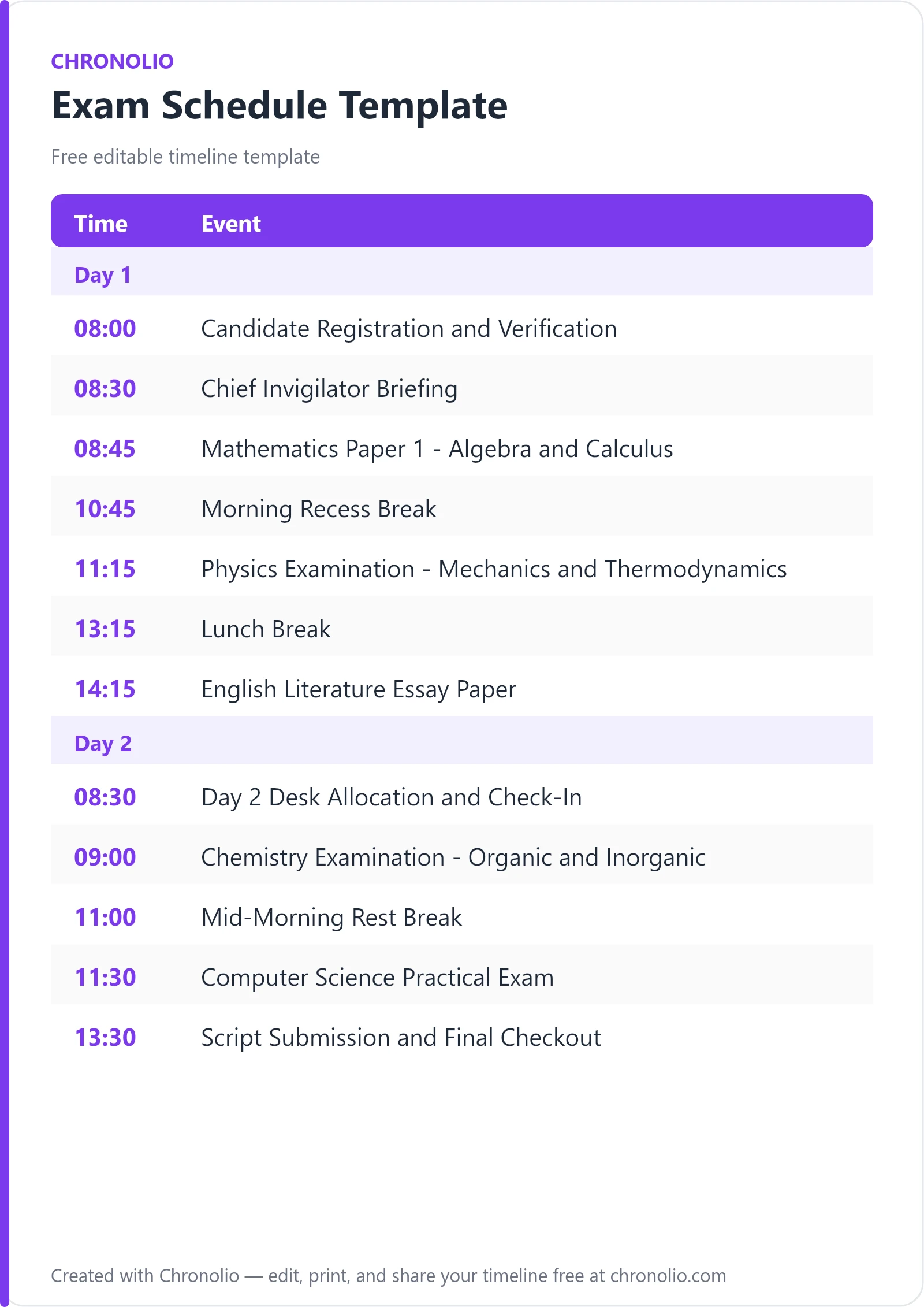
Here is the complete schedule this free template gives you — every time block, ready to edit, download, and share:
| Day | Time | Event |
|---|---|---|
| 1 | 08:00 | Candidate Registration and Verification |
| 1 | 08:30 | Chief Invigilator Briefing |
| 1 | 08:45 | Mathematics Paper 1 - Algebra and Calculus |
| 1 | 10:45 | Morning Recess Break |
| 1 | 11:15 | Physics Examination - Mechanics and Thermodynamics |
| 1 | 13:15 | Lunch Break |
| 1 | 14:15 | English Literature Essay Paper |
| 2 | 08:30 | Day 2 Desk Allocation and Check-In |
| 2 | 09:00 | Chemistry Examination - Organic and Inorganic |
| 2 | 11:00 | Mid-Morning Rest Break |
| 2 | 11:30 | Computer Science Practical Exam |
| 2 | 13:30 | Script Submission and Final Checkout |
Exam Schedule: What It Is and How It Works
An exam schedule is an operational timetable designed to streamline candidate registration, invigilator briefings, written testing, and script collection across multiple academic venues. Running a multi-room testing center requires strict timekeeping to prevent administrative chaos, maintain security protocols, and protect student performance from unnecessary stress.
Having managed university examination halls and regional testing facilities for over a decade, I built this master structure around real-world academic testing standards, such as those recommended by Cambridge Assessment. It accounts for candidate check-in queues, chief invigilator announcements, rest breaks, and controlled script hand-ins. Whether you are running university finals or high school midterms, this layout keeps every building wing operating smoothly.
Download Free Exam Schedule Template
Why Exams Need a Timeline
A detailed timeline is the backbone of fair and secure test administration. Without a firm schedule, registration desks experience bottlenecking, examination papers start late, and candidates face elevated anxiety before turning a single page. Setting hard start and end times guarantees that all students receive their full allotted writing time without compromising subsequent sessions.
Invigilators and facility staff rely heavily on precise timing to execute security handovers. Coordinating paper distribution, answer booklet collection, and room clearance takes predictable blocks of time. Much like coordinating strict executive events with a board meeting timeline or managing complex guest flows with a birthday party timeline, academic testing requires clear boundaries so that staff can transition between testing modules without misplacing sensitive candidate scripts.
Finally, structured rest periods protect candidate well-being. Sprinting from a demanding STEM paper directly into a heavy essay paper without a break leads to mental exhaustion. A published schedule ensures students have dedicated windows to hydrate, stretch, and reset before entering the next testing environment.
What to Include in an Exam Schedule
To run a compliant testing venue, your master schedule must incorporate several core operational elements:
- Candidate Registration and Verification: Dedicated check-in windows to confirm identity cards, desk numbers, and permitted equipment.
- Chief Invigilator Briefings: Standardized announcements regarding silence, paper rules, and emergency procedures.
- Subject Module Blocks: Clearly specified writing durations for each subject paper or lab assessment.
- Rest and Recess Breaks: Scheduled breaks for light snacks, hydration, and mental recovery between papers.
- Lunch Intermissions: A mid-day break long enough for students to eat and reach their next venue.
- Script Collection and Checkout: Controlled hand-ins of answer booklets and digital practical files.
Day 1: Core Written Examinations
| Time | Event |
|---|---|
| 08:00 | Candidate Registration and Verification |
| 08:30 | Chief Invigilator Briefing |
| 08:45 | Mathematics Paper 1 - Algebra and Calculus |
| 10:45 | Morning Recess Break |
| 11:15 | Physics Examination - Mechanics and Thermodynamics |
| 13:15 | Lunch Break |
| 14:15 | English Literature Essay Paper |
The first morning begins in the Main Examination Center Foyer, where candidate registration and verification opens at 08:00. Allocating a full 30-minute buffer allows invigilators to inspect student identification cards, verify desk assignments, and clear prohibited items before candidates enter the testing floor. At 08:30, everyone gathers in Grand Examination Hall A for the chief invigilator briefing, where silence requirements, header details on answer booklets, and emergency exit routes are reviewed.
At 08:45, the two-hour Mathematics Paper 1 - Algebra and Calculus begins. Non-programmable calculators are checked upon entry, and candidates work through core written problems until 10:45. Immediately following the paper, students transition to the Campus Courtyard Cafe for a 30-minute morning recess break. This short interlude gives candidates time to step away from intense analytical tasks, grab coffee, and refresh.
Testing resumes at 11:15 in the Science Wing Auditorium with the Physics Examination - Mechanics and Thermodynamics. Standardized formula sheets are distributed inside the test booklets to eliminate external materials. Following this heavy two-hour module, a full one-hour lunch break is held at the Student Union Dining Hall at 13:15. This extended rest is critical before the afternoon session, offering a quiet zone for light review. The day concludes back in Grand Examination Hall A with the 90-minute English Literature Essay Paper starting at 14:15, where dictionaries are strictly prohibited to ensure equal assessment conditions.
Day 2: Science and Practical Testing
| Time | Event |
|---|---|
| 08:30 | Day 2 Desk Allocation and Check-In |
| 09:00 | Chemistry Examination - Organic and Inorganic |
| 11:00 | Mid-Morning Rest Break |
| 11:30 | Computer Science Practical Exam |
| 13:30 | Script Submission and Final Checkout |
Day two opens with a streamlined 30-minute check-in at 08:30 in the Main Examination Center Foyer. Because candidates are familiar with floor layouts from the previous day, desk allocation moves quickly, allowing staff to clear personal belongings and seat everyone promptly. Promptly at 09:00, the two-hour Chemistry Examination - Organic and Inorganic gets underway in the Science Wing Auditorium, complete with official periodic tables distributed alongside test papers.
A 30-minute mid-morning rest break at 11:00 in the Campus Courtyard Cafe offers water stations and hot drinks, helping candidates decompress before shifting gears from written theory to practical computer testing. At 11:30, candidates transfer to Computer Lab 3B for the two-hour Computer Science Practical Exam. Workstations are isolated, and network access is restricted entirely to the internal testing environment so candidates can program and debug independently under secure conditions.
The testing sequence concludes at 13:30 back at the Main Examination Center Foyer with script submission and final checkout. Invigilators account for every physical booklet and collect practical code outputs before candidates retrieve their personal items and leave the building.
Exam Schedule vs Study Timetable
| Feature | Exam Schedule | Study Timetable |
|---|---|---|
| Primary Purpose | Coordinates official test logistics, venue rooms, and invigilation | Guides candidate revision and subject preparation routines |
| Managed By | Exam boards, test coordinators, and chief invigilators | Individual students, tutors, or study groups |
| Structure | Strict, non-negotiable start/end times and hall rules | Flexible time blocks adaptable to personal learning pace |
| Compliance | Mandates security, ID verification, and formal script collection | Informal self-assessment and topic revision |
While a study timetable helps students organize their personal revision weeks in advance, an official exam schedule governs facility operations on test day. Managing a test center requires strict operational enforcement akin to structured guest management in a baby shower timeline or an anniversary party schedule, where timing directly dictates participant movement and hall utilization.
Who Should Use This Template?
This versatile scheduling model fits a broad range of educational and professional evaluation settings. Chronolio provides built-in tools for various administrative roles involved in setting up and overseeing academic schedules.
- University Examination Boards: Standardize multi-hall finals across various academic faculties.
- High School Test Coordinators: Organize state or national midterm and AP testing schedules.
- Professional Certification Bodies: Manage multi-module licensing exams with strict security needs.
- Language Assessment Centers: Coordinate listening, writing, and practical speaking evaluations.
- Corporate Training Academies: Schedule formal employee compliance and technical tests.
To tailor this framework to your institution, download our fully editable exam schedule DOCX download or the print-ready exam schedule PDF download.
How to Use This Template
- Duplicate or Download: Load this timeline into your Chronolio workspace, or download the Word/PDF file.
- Adjust Date and Subject Times: Update subject titles, test durations, and building rooms to reflect your academic curriculum.
- Assign Staff and Halls: Input chief invigilator names and hall monitor assignments for each testing block.
- Publish to Candidates: Print physical posters for hall foyers and upload digital copies to your student portal at least three weeks prior to exams.
Tips for a Successful Exam Schedule
- Stagger Hall Arrivals: If running concurrent exams across multiple wings, stagger check-in times by 15 minutes to avoid main foyer crowding.
- Enforce Clear Desk Rules: State acceptable equipment (e.g., clear pencil cases, non-programmable calculators) directly on the schedule to avoid delays at desk check-in.
- Buffer Script Collections: Always allow at least 15 minutes post-exam to count and bundle answer booklets before opening doors for student exit.
- Designate Quiet Review Zones: Provide designated quiet seating areas in dining areas so reviewing students do not disturb ongoing sessions in adjacent halls.
- Prepare Emergency Stations: Position extra stationery, approved calculators, and water bottles near registration desks to resolve student panics quickly.
- Coordinate Technical IT Support: Have network technicians on standby in computer labs 30 minutes before practical testing starts.
Common Mistakes to Avoid
- Underestimating Check-In Queues: Scheduling candidate verification for only 10 minutes leads to late exam starts and elevated panic.
- Omitting Invigilator Briefings: Skipping standardized rule readings causes inconsistent enforcement across separate rooms.
- Cutting Break Durations Short: Rest periods under 20 minutes leave candidates insufficient time to use restrooms and clear their minds.
- Vague Venue Directions: Failing to print specific lab and auditorium numbers on candidate schedules creates confusion in corridors.
- Overcrowded Practical Labs: Booking lab terminals without leaving buffer stations for hardware glitches can halt an entire practical paper.
- Rushing Script Hand-Ins: Dismissing candidates before verifying booklet counts can result in lost papers and severe compliance audits.
In Summary
- An exam schedule coordinates candidate arrival, verification, paper administration, and script collection across multi-day testing sessions.
- Structured rest breaks prevent cognitive exhaustion and keep written papers running strictly on time.
- Clear room and building locations eliminate corridor congestion and late candidate arrivals.
- Dedicated submission buffers guarantee complete script accountability before students leave the facility.
- Templates can be customized for high schools, universities, professional bodies, and language centers.
- The layout is available in editable digital, Word (.docx), and PDF formats for immediate deployment.
Planning a seamless, secure examination period requires clear communication, realistic buffers, and dependable operational templates. Download this master timetable today to keep your candidates focused, your invigilators coordinated, and your examination halls running smoothly.
Download Free Exam Schedule Template