




This Template at a Glance
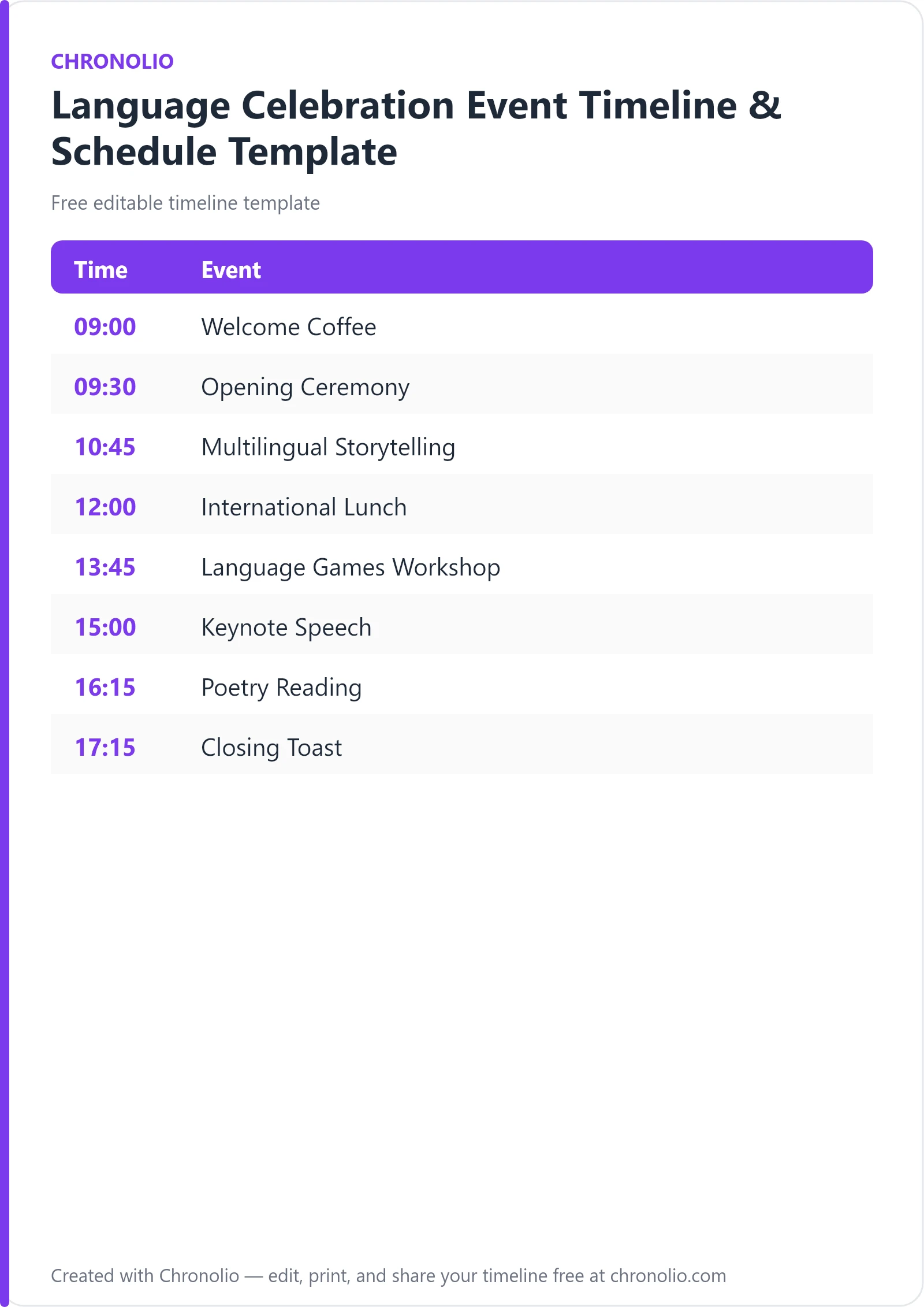
Here is the complete schedule this free template gives you — every time block, ready to edit, download, and share:
| Time | Event |
|---|---|
| 09:00 | Welcome Coffee |
| 09:30 | Opening Ceremony |
| 10:45 | Multilingual Storytelling |
| 12:00 | International Lunch |
| 13:45 | Language Games Workshop |
| 15:00 | Keynote Speech |
| 16:15 | Poetry Reading |
| 17:15 | Closing Toast |
What Is a Language Celebration Event Timeline?
A language celebration event timeline is a comprehensive operational schedule that organizes every stage of a festival or gathering dedicated to linguistic diversity. It coordinates guest speakers, stage performers, interactive facilitators, and venue technicians while providing attendees with a clear order of events.
Having managed dozens of cultural gatherings at our host venue, I know that events celebrating global dialects and native speakers require careful pacing so that guest artists do not run over their allotted stage time. This template reflects real-world language festival structures and common best practices, providing a reliable foundation to align audio-visual cues, room transitions, and live translations.
Using a pre-tested schedule allows your event planning committee to assign specific responsibilities to volunteers and staff across multiple rooms. Whether you are featuring traditional spoken-word artists or academic discussions on linguistic preservation, a structured timeline ensures every voice receives the spotlight it deserves without leaving guests feeling rushed or exhausted.
Customize Your Language Celebration Event Schedule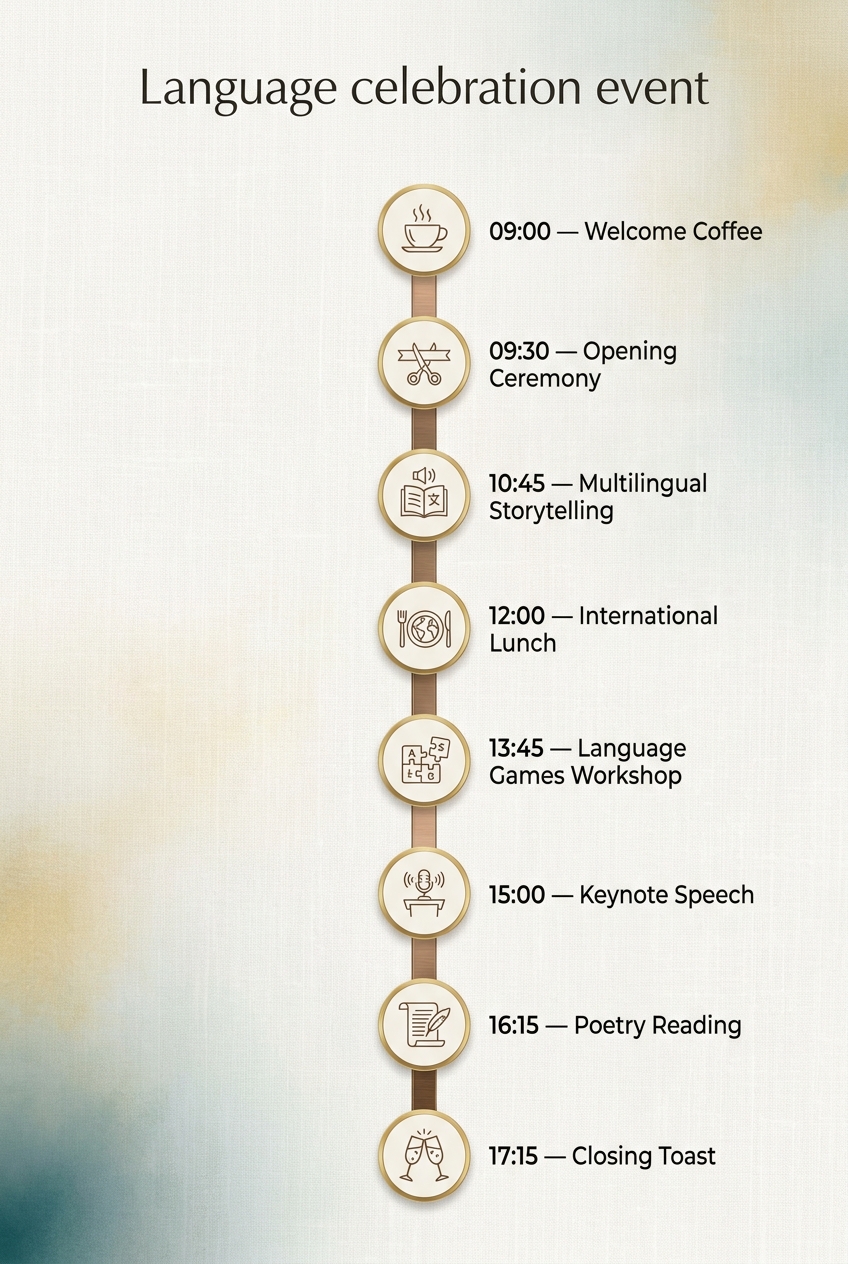
Why Language Celebration Events Need a Timeline
Managing an event centered on linguistic diversity and cultural exchange requires balancing high-energy interactive sessions with focused listening. Without a precise running order, oral storytelling sessions can easily overflow, throwing off catering setups and compressing downstream keynote lectures into hurried talks.
Clear timelines give presenters, performers, and interpreters the structure they need to deliver engaging content confidently. Knowing exactly when each session begins and ends allows storytellers and poets to calibrate their recitations, while workshop facilitators can pace their group games to conclude neatly before the next transition.
Furthermore, a strict timeline ensures seamless venue operations across multiple rooms and outdoor spaces. Moving hundreds of attendees from an auditorium to workshop labs or dining halls requires designated buffer times, clear directional signage, and precise coordination between stage managers and catering teams.
What to Include in a Language Celebration Event Timeline
To keep your attendees engaged and your operations running smoothly, a comprehensive festival schedule should incorporate these key stages:
- Guest Arrival & Registration: A dedicated welcoming window with light refreshments to allow attendees to gather and collect event schedules.
- Formal Opening Ceremony: Introductory remarks that outline the event's core mission, introduce organizing bodies, and set a respectful, inclusive tone.
- Cultural Storytelling & Oral Traditions: Live recitations of traditional folk tales by native speakers, supported by translated summaries for universal comprehension.
- Communal International Dining: A multi-station lunch that encourages informal networking and spontaneous language exchange among attendees.
- Interactive Language Workshops: Hands-on group activities, grammar games, and conversational practice led by qualified instructors.
- Featured Academic Keynote: An educational lecture by a guest scholar or linguist addressing contemporary issues like language revitalization.
- Artistic Recitations & Poetry: Spoken-word performances that showcase the musicality, rhythm, and artistic depth of diverse tongues.
- Closing Remarks & Toast: A final gathering to acknowledge sponsors, thank performers and volunteers, and celebrate the day's achievements.
Morning Opening & Oral Traditions
| Time | Event |
|---|---|
| 09:00 | Welcome Coffee |
| 09:30 | Opening Ceremony |
| 10:45 | Multilingual Storytelling |
The morning phase opens in the Main Lobby with Welcome Coffee, giving attendees time to register, collect print materials, and settle into the space. Starting with an informal thirty-minute window accounts for morning transit delays and creates immediate opportunities for participants to greet one another.
At 09:30, guests move into the Grand Auditorium for the Opening Ceremony. Organizers establish the day's goals, highlight featured languages, and go over logistics. If your festival incorporates cultural music or traditional dances during the opening, consider pairing this guide with our cultural heritage day schedule to coordinate stage cues and artist check-ins smoothly.
Following the ceremony, the crowd transitions to the Heritage Room at 10:45 for Multilingual Storytelling. Native speakers share ancient folk tales and modern narratives in their mother tongues, accompanied by brief English context summaries. Setting aside a full hour for oral traditions ensures performers do not feel pressured to rush their delivery.
Midday Gastronomy & Interactive Learning
| Time | Event |
|---|---|
| 12:00 | International Lunch |
| 13:45 | Language Games Workshop |
At 12:00, attendees gather in the Banquet Hall for an International Lunch. Food stations organized by region offer diverse culinary options, serving as a natural conversation starter for global language enthusiasts. Providing a generous ninety-minute block gives guests sufficient time to dine, rest, and engage in spontaneous conversations without rushing to the next session.
Promptly at 13:45, the momentum shifts to active participation in the Workshop Lab with the Language Games Workshop. Participants break into small groups to complete phrase matching, vocabulary trivia, and pronunciation challenges under the guidance of multi-lingual facilitators. Interactive elements keep energy levels high immediately following lunch, preventing the typical afternoon mid-day slump.
Afternoon Keynote, Arts, and Closing
| Time | Event |
|---|---|
| 15:00 | Keynote Speech |
| 16:15 | Poetry Reading |
| 17:15 | Closing Toast |
The afternoon transitions back to intellectual exploration at 15:00 in the Grand Auditorium for the Keynote Speech. A guest linguist discusses global language preservation strategies, endangered dialects, and modern translation tech. Incorporating academic perspectives adds educational depth to community celebrations; according to insights from organizations like UNESCO, preserving linguistic diversity is essential for protecting global heritage and indigenous knowledge systems.
At 16:15, attendees head outside to the Garden Pavilion for an open-air Poetry Reading. Local writers and students recite classical and contemporary poems in various dialects, letting audience members appreciate the natural cadences of each language. If you want to organize standalone literary events, review our poetry reading night timeline for specialized stage pacing tips.
The day concludes at 17:15 on the Main Terrace with a celebratory Closing Toast. Organizers express gratitude to volunteers, venue staff, and guest speakers while inviting attendees to enjoy final networking opportunities over light refreshments.
Language Celebration Event Timeline vs Event Program
It is common for planning committees to confuse an operational timeline with a public event program, but they serve distinctly different purposes during festival execution.
| Feature | Operational Timeline | Event Program |
|---|---|---|
| Primary Audience | Organizers, venue staff, speakers, and AV tech crew | Event attendees, general guests, and ticket holders |
| Level of Detail | Includes room setups, speaker load-in times, and tech cues | Shows public session start times, room locations, and titles |
| Focus Area | Logistics, timing buffer enforcement, and staff duties | Session descriptions, speaker bios, and venue maps |
| Document Format | Internal spreadsheet or real-world master schedule | Printed booklet, mobile app schedule, or digital PDF |
While the event program gives your guests a high-level summary of what to attend, your internal operational timeline contains technical notes, presenter contact details, and precise room clear times needed behind the scenes.
Who Should Use This Template?
This versatile schedule is engineered for educational institutions, civic organizations, and community groups hosting multicultural programs.
- Academic Departments: University linguistics, modern language, and anthropology faculties planning campus-wide heritage showcases.
- Community Cultural Centers: Non-profit organizations hosting multicultural days to engage diverse local neighborhoods.
- Municipal Diversity Councils: City planners celebrating international heritage weeks and promoting social integration.
- International Schools: Educational administrators organizing student cultural exchanges, storytelling fairs, and language bowls.
- Corporate ERGs: Employee Resource Groups running internal diversity, equity, and inclusion (DEI) events for global teams.
Our flexible tool supports the various roles involved in executing multi-room cultural gatherings, from lead event directors to stage managers and volunteer leads.
How to Use This Template
- Duplicate or Customize: Click the edit button on this page to load this timeline directly into your free Chronolio dashboard.
- Set Your Event Date: Choose your event date to automatically sync timestamps, countdowns, and operational reminders across your team.
- Adjust Room Locations & Times: Tailor session start times, room names, and transition buffers to match your venue’s specific floor plan.
- Share with Stakeholders: Export print-ready documents in format options like a custom Word document or a formatted PDF file for staff, presenters, and stage managers.
Tips for a Successful Language Celebration Event
- Provide Visual Context: Display English or primary-language summaries on screens during foreign-language presentations so non-native speakers stay engaged.
- Designate Room Managers: Assign a trained volunteer to every room to monitor audio levels, assist speakers, and keep timing on track.
- Build In Buffer Time: Schedule 15-minute buffers between sessions to accommodate room clearing, AV adjustments, and bio breaks.
- Label Dietary Options clearly: At the international food stalls, mark all ingredients and potential allergens clearly to accommodate all dietary needs safely.
- Offer Printed Guides: While digital schedules are convenient, physical printed pocket programs ensure older guests and non-tech users navigate easily.
- Set Up Quiet Zones: Dedicate a small room or outdoor area as a low-sensory space where guests can rest between loud interactive sessions.
Common Mistakes to Avoid
- Overpacking the Schedule: Squeezing too many presentations into a single afternoon leaves no time for guest Q&A or venue movement.
- Ignoring AV Testing Requirements: Skipping early morning microphone checks and display tests often leads to mid-event technical delays.
- Underestimating Room Transitions: Forgetting that moving a large crowd between auditorium floors takes at least ten minutes creates cascading delays.
- Failing to Brief Presenters: Not reminding guest storytellers of strict time limits can result in early speakers accidentally consuming subsequent time slots.
- Neglecting Accessibility: Forgetting to check wheelchair ramps, sign language interpretation, or stage access limits participation for guests with physical needs.
In Summary
- A language celebration event timeline is an essential operational tool for managing multi-room cultural and educational programs.
- It coordinates speakers, workshop leaders, oral storytellers, and venue staff into a single synchronized schedule.
- Alternating passive lectures with hands-on games maintains crowd engagement from morning arrival to evening departure.
- Dedicated buffer times between sessions protect the event from cascading delays caused by overrunning talks.
- Tailored schedules can be exported to offline formats like Word and PDF documents for easy distribution to stage managers.
Planning a rich, multilingual gathering requires balancing creative cultural showcases with rigorous operational discipline. By organizing your speakers, venue logistics, and attendee movements around this tested schedule, you create an inviting atmosphere where every culture and dialect can be celebrated seamlessly.
Customize Your Language Celebration Event Schedule