







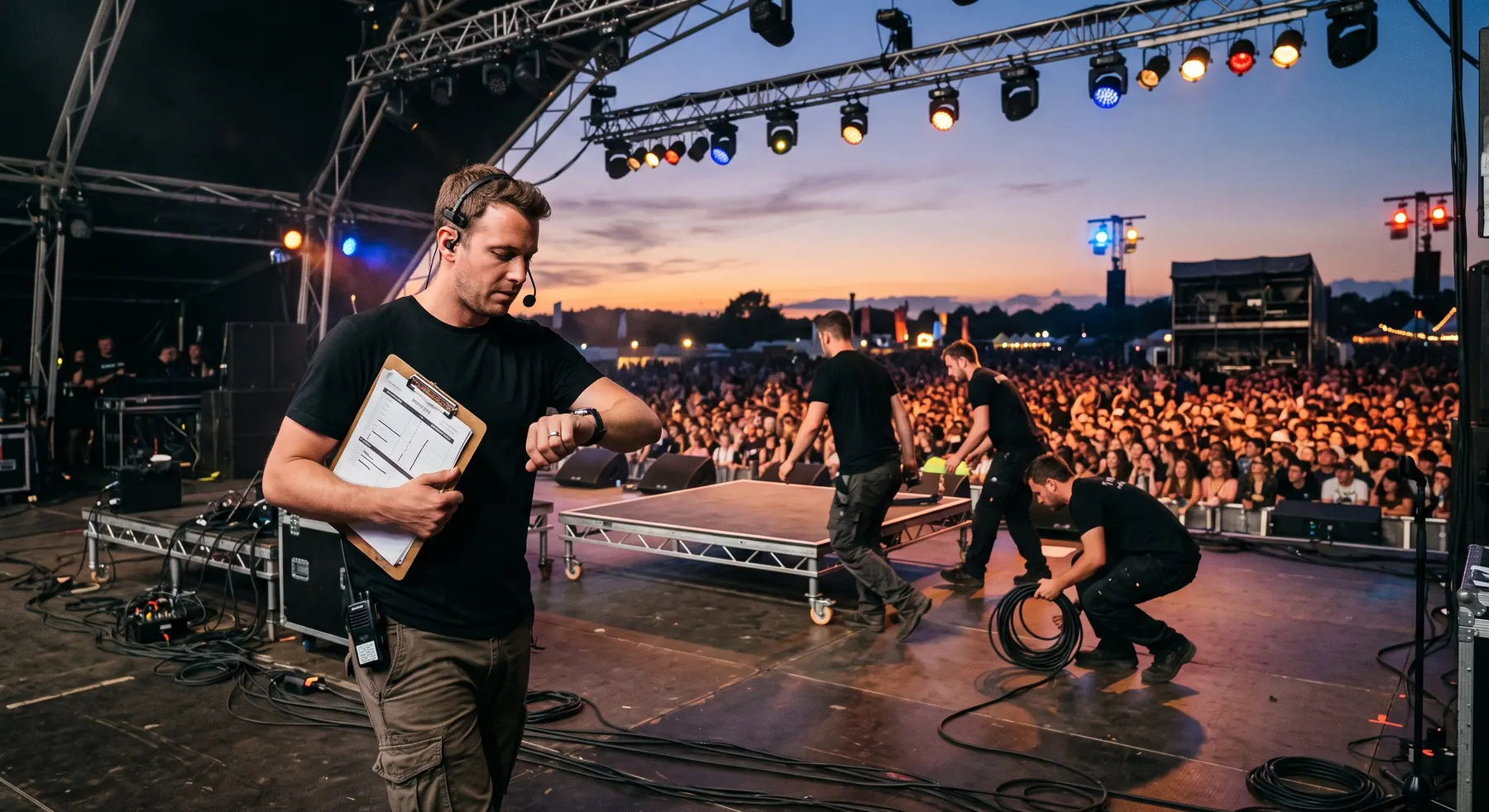
The curfew is the only fixed time
A festival day has one time nobody can move: the curfew. It is set by the event licence or the local authority, and the consequences of overrunning it range from a fine to the power being cut mid-song to conditions on next year's licence.
So the schedule is built backwards. The headliner finishes at curfew. Their changeover sits before them. The act before that finishes before the changeover starts. By the time you reach the first act of the day, every set time has been derived from the one at the end.
The mistake is building it forwards — first act at noon, forty-five-minute sets, see where it lands — and discovering at 22:40 that the headliner's set runs twenty minutes past curfew. At that point the only lever left is cutting the set the whole crowd came for.
Changeovers are the real schedule
Set lengths are the part everyone discusses. Changeovers are the part that determines whether the day works.
| Changeover | Realistic time | What drives it |
|---|---|---|
| DJ to DJ, shared setup | 10–15 min | USB swap, monitor check |
| Solo or acoustic act | 15–20 min | Few inputs |
| Band to band, shared backline | 30–45 min | Drum kit and amps stay; line check only |
| Band bringing own backline | 45–60 min | Physical kit swap on stage |
| Headliner with own production | 60–90 min | Lighting, video, set pieces |
Two things about that table matter more than the numbers.
Most acts get a line check, not a soundcheck. A soundcheck is a full check and balance of an act's sound, and on a busy stage there is rarely time to give one to anyone except the headliner, usually before doors. Everyone else gets a line check during the changeover: a quick pass confirming each input is live. Tell acts which they are getting when you advance them, because a band expecting a soundcheck and receiving a line check will spend the changeover arguing about it.
Changeovers compound. A changeover that runs ten minutes over pushes every later act by ten minutes, and there is no mechanism to recover it later — sets do not get shorter on their own. Build five to ten minutes of genuine slack into the middle of the day, and give the stage manager the authority, written into artist contracts, to finish a set on its scheduled end time even if it started late.
Stagger the stages
On a multi-stage site, the relationship between stages matters as much as the schedule on each one.
The principle is the same one that governs a multi-track conference — covered in detail in building a multi-track conference schedule — but a festival adds crowd movement on a much larger scale:
- Offset main and second stage start times by 15–30 minutes, so the end of one set feeds people toward the start of another rather than releasing everyone at once.
- Never end two large sets at the same moment. Thousands of people leaving two arenas simultaneously all head for the same bars, toilets, and pathways. That is a crowd-safety question, not only a comfort one.
- Put the site's walking time into the schedule. If it takes eight minutes to walk from the main stage to the tent, a set that starts four minutes after the main stage ends is a set played to an empty tent for its first song.
Which clashes actually matter
Every multi-stage festival has clashes. Fans will publish clash-finder grids within an hour of your set times going out, and they will complain about some of them.
The only clashes worth losing sleep over are between acts that share an audience. Two acts in the same genre, with overlapping fans, should not play against each other — the crowd is split and both sets feel half-empty.
A headliner clashing with a very different act on another stage is often deliberate and useful: it gives people who are not there for the headliner somewhere to go, and it spreads the crowd across the site at the busiest moment of the night.
Lay out a multi-stage schedule freeThe builder handles parallel tracks with changeover time applied between slots — the same structure as a multi-stage bill — and shows you what one overrunning changeover pushes down the rest of the day.
Two schedules: the public one and the crew one
Attendees need set times. Your crew needs something very different: changeovers, line check windows, artist arrival and load-in times, backline notes, the curfew, and who calls each cue on each stage.
That second document is a run of show, one per stage, and it is a genuinely different artefact from the public schedule — there is more on what goes in one in what a run of show is. The two must be generated from the same source, because the moment the public set times and the stage manager's run sheet disagree, one of them is wrong and nobody on site knows which.
Publish once, change as little as possible
Most festivals publish set times one to four weeks out. Publish earlier and you will be making changes afterwards; publish later and attendees who need to plan travel get frustrated.
Whenever you publish, treat every later change as expensive. Set times get screenshotted, printed, and shared, and a stale screenshot of a moved set is the most common complaint on the day. A live schedule that always shows the current times — on the website and the app, not as a PDF — is the only format that survives changes.
Festival and community event organizers running an annual event gain most by starting from last year's stage structure rather than a blank grid: the lineup changes completely, the changeover pattern and the curfew barely change at all. The same holds for community festivals, markets, and food events, where the "stages" might be a demonstration kitchen and a band tent but the arithmetic is identical. Event planners brought in to run a festival day, and venue managers hosting one on their site, will recognise the pattern from any multi-room event — the difference is scale, and the fact that the curfew is enforced by someone outside the event.
Worked examples sit in the music festival timeline, the food and drink festival, and the wider festival template collection. For how other organisers run theirs, see festivals and concerts.