




The document your audience never sees
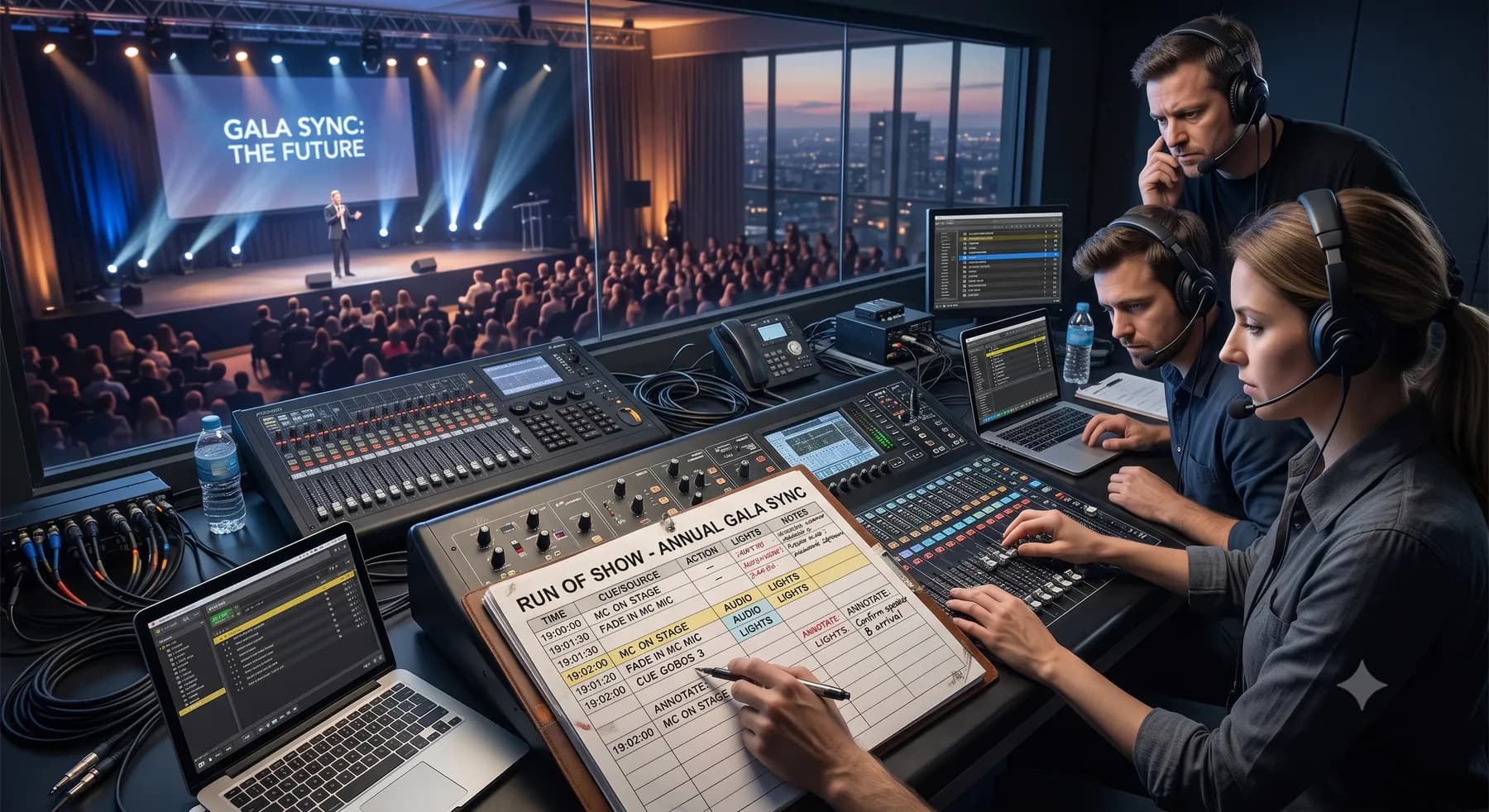
Every smooth event has two documents. The agenda is the one the audience gets: "7:00 — Dinner. 8:00 — Awards." The run of show is the one taped to the AV desk: "19:58 — walk-in music fades. 20:00 — house to half. 20:02 — roll opening video, MC to position stage left."
I've coordinated hundreds of events, and I can tell you the difference between a gala that flows and one that lurches is almost never the content — it's whether that second document existed, and whether everyone with a job was working from the same copy of it.
What actually goes in a run of show
Each line of a run of show is a cue: a time, an action, and an owner. The strongest ones also carry the technical state — what the lights, sound, and screens are doing at that moment.
| Element | Example |
|---|---|
| Cue number | CUE 5 |
| Time | 20:15 |
| Action | First award presentation — walk-up music |
| Owner | MC intro → AV plays sting → presenter from table 2 |
| Technical state | House at half, follow spot on lectern |
Numbering matters more than it looks. When something slips mid-event — and something always slips — "we're jumping to cue 9" instantly re-synchronizes the MC, the sound desk, and the stage manager. "Skip the thing after the speeches" does not.
Run of show vs. agenda vs. timeline
These get conflated constantly, so here's the practical split (there's a full breakdown of the vocabulary here):
- The agenda is audience-facing and rounded to friendly times.
- The event timeline is the planner's working document for the whole day, including setup and vendor logistics.
- The run of show zooms into the performance portion at cue-level precision — usually the two or three hours between doors and close, at a granularity of minutes and transitions.
For a conference, you'll often have all three: the published program, the organizer's master timeline, and a run of show per stage.
Where events actually break: the transitions
Here's the thing fifteen years of event days have taught me: segments don't fail — transitions do. A speech is a speech; a video plays. What goes wrong is the seam between them: the microphone that wasn't handed over, the presenter walking to a dark lectern, the four silent seconds of the wrong slide while three hundred people watch.
That's why a good run of show is obsessive about the moments between the program items. The walk-up music is a cue. The lighting change is a cue. The MC returning to position is a cue. If your run of show only lists the segments, it's an agenda in a costume.
Two numbers worth stealing:
- Eight minutes per award. Intro, walk-up, acceptance, photo. It only holds if walk-up music is cued and winners were told their speech limit in writing. Twelve awards is ninety-six minutes — knowing that before you promise "a short ceremony" is the whole game.
- One full technical run-through before doors. Walk every cue with the actual operators. It's an hour that predicts the entire evening.
Build yours in five minutes
You can absolutely build a run of show in a spreadsheet — planners have for decades — but you'll rebuild the times by hand every time a segment moves. Our free run of show builder generates a numbered cue sheet from your doors time and segments, recalculates every cue when something changes, and prints clean for the AV desk. No signup.
For a full conference with parallel stages, pair it with the conference agenda builder — and when you need the crew seeing live updates on the night instead of a printout, that's exactly what live share links in Chronolio are for.