







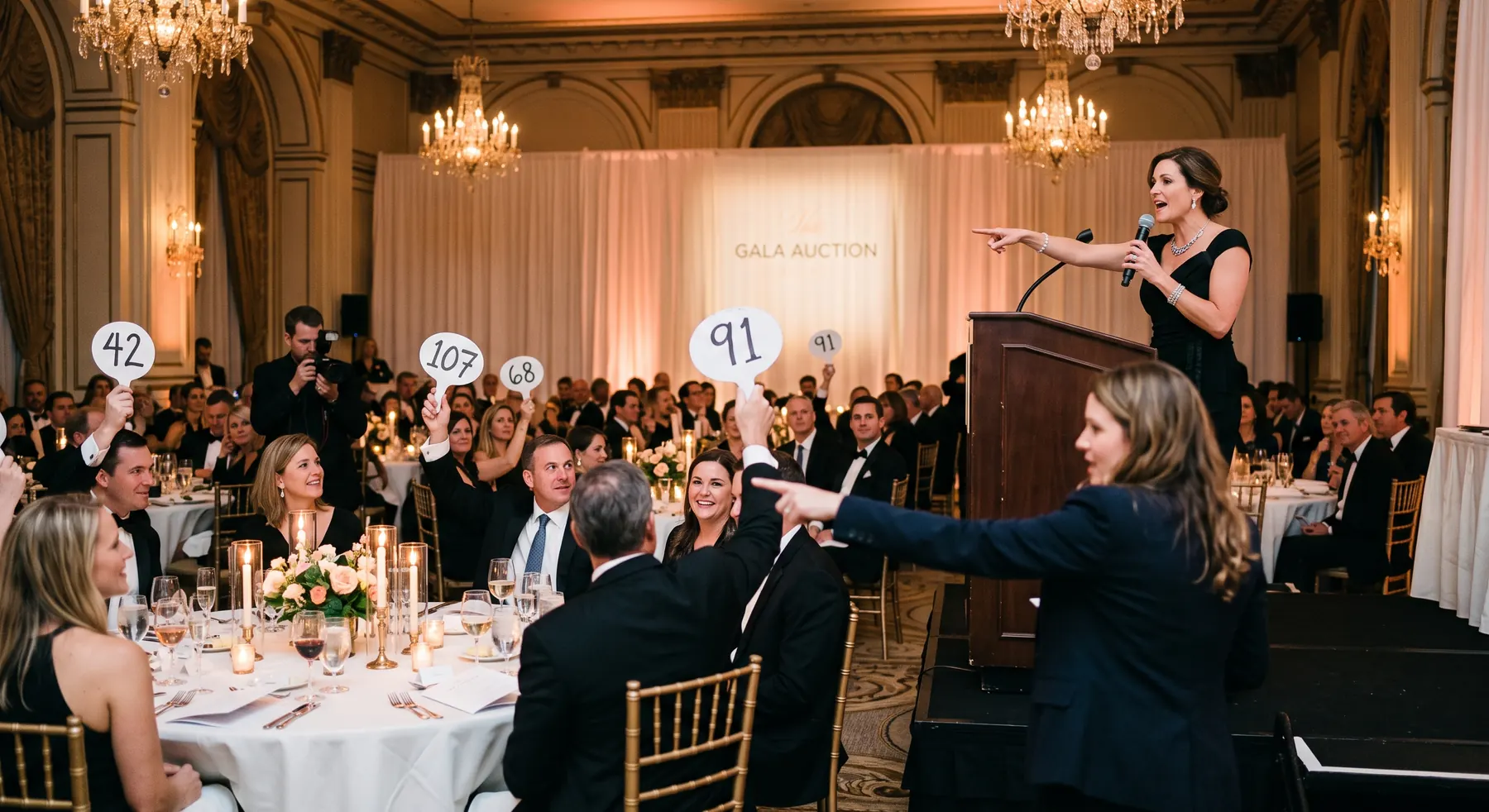
One sequence pays for the night
A gala has a lot of moving parts: a reception, a silent auction, a plated dinner, an honoree, an auctioneer, a video, a band. It is tempting to treat them as equally important and give each its moment.
They are not equally important. For most fundraising galas, the bulk of what is raised on the night comes from two things — the live auction and the paddle raise — and the paddle raise depends almost entirely on what happens in the ninety seconds before it.
That sequence is simple: the room hears a story about why the money matters, and then it is asked for money. When the ask follows the story immediately, people give while they are still moved. When there is a gap — the lights come up, the MC fumbles for a card, someone thanks the table-linen sponsor — the feeling fades, conversation restarts, and the ask lands on a room that has moved on.
Everything else in the run of show is either warming the room up for that sequence or getting out of its way.
The run of show
This is the order that protects the ask, with durations that hold up for a plated gala of 200–300 guests:
| Item | Duration | Why it sits here |
|---|---|---|
| Doors, reception & silent auction | 60 min | Guests browse with a drink in hand |
| Silent auction closes | 5 min | Before seating, with 15- and 5-min warnings |
| Guests seated | 15 min | Always longer than planned |
| Welcome from the MC & chair | 8 min | One welcome, not three |
| Dinner service | 75 min (plated) | Buffet 60, stations 50 |
| Honoree or award | 15 min | Before the money, never between the story and the ask |
| Live auction | 5 min + ~4 min per lot | Open strong; best lot second-to-last |
| Mission video or beneficiary story | 8 min | The emotional peak of the night |
| Paddle raise | 15 min | Seconds after the story |
| Thank-yous & the night's total | 7 min | Announce the number before anyone leaves |
| Band or DJ | 60 min | Only after the ask |
| Auction checkout | 30 min | Let winners pay at the table |
The live auction before the paddle raise is deliberate. The auction warms the room and gets paddles in the air; the paddle raise then catches everyone who didn't win a lot but still wants to give. Reversing them asks people to give generously and then asks them to bid, which is the wrong order for both.
What crowds out the ask
The programme almost never runs long because of the auction or the paddle raise. It runs long because of the things in front of them.
Sponsor thank-yous. Each one is short. Five of them are ten minutes, delivered at the point where the room's attention is at its best. Sponsors genuinely deserve recognition, but they get it far more effectively on screens during dinner, in the printed programme, on table signage, and in one line of the MC's welcome — none of which spend the room's attention.
Stacked welcomes. The chair, the executive director, and a board member each "saying a few words" is three welcomes. One, at eight minutes, does the job.
The honoree running long. An award presentation is lovely and completely unpredictable — honorees rarely keep to time, and nobody can cut them off. Put it before the live auction, never between the story and the ask, and give it a hard slot so its overrun eats the auction's buffer rather than the paddle raise.
Dessert service. Plates being cleared during a beneficiary story is a room full of clattering while someone describes the hardest year of their life. That is a catering conversation, and it needs to happen in advance — the catering timeline guide covers why the kitchen needs the programme cues. Caterers will hold service happily if they know exactly when to hold it and who will signal them.
The auctions
Close the silent auction before dinner. Announce warnings at fifteen and five minutes, then close before guests sit. Volunteers tally the winners during dinner, and nobody wanders off to the auction tables in the middle of the programme. A silent auction left open "until dessert" competes with the ask for exactly the guests you most need in their seats.
Cap the live auction at about ten lots. Around four minutes a lot, including the auctioneer's build-up. Past ten, the room's attention drops faster than the bids rise, and every extra lot is time borrowed from the paddle raise. Open with a strong lot to set the pace, and keep the best for second-to-last so the auction ends high.
Brief the bid spotters. Volunteers who spot bids for the auctioneer need to know the room layout, the lot order, and how to record winning paddles. A twenty-minute briefing before doors is the difference between a clean auction and a disputed one.
Build your gala run of show freeThe run of show builder sets these durations from your dinner format and lot count, and moves everything downstream when one item changes — so you can see what one extra sponsor speech actually costs the paddle raise.
Rehearse the three cues that raise the money
If the budget allows only one rehearsal, rehearse three cues back to back: the video, the auctioneer's walk-on, and the paddle raise. These are the moments where a technical stumble costs the most. A video that won't play, a microphone that isn't live for the auctioneer, or a gap while someone finds the pledge cards is exactly the kind of pause that lets the room's attention drain.
One person should call those cues from a written, numbered running order, and that person should not also be the MC. There is more on how that document differs from the guest-facing programme in what a run of show is.
Announce the total, then let people leave easily
Announce what the room raised before the band starts in earnest. Guests who hear the total feel part of it, and they are far more likely to come back next year.
Then make the exit painless. The auction checkout queue is the last impression of the night. Let winners pay at their tables during dessert or by phone, so nobody spends the end of a generous evening standing in a line.
Nonprofit and fundraising event organizers usually run one or two galas a year, which means the structure is easy to forget between them. Keeping last year's run of show as the starting point for this year's saves the rediscovery — the lots change, the honoree changes, the shape barely does. Event planners brought in to run a gala for a charity client get the most value from pushing back early on the programme order, because by the week of the event every speech in front of the ask has an owner who wants it.
Worked examples sit in the fundraising gala timeline and the charity auction event, and more structures in the nonprofit template collection. For how other organisations run theirs, see fundraisers and galas.