







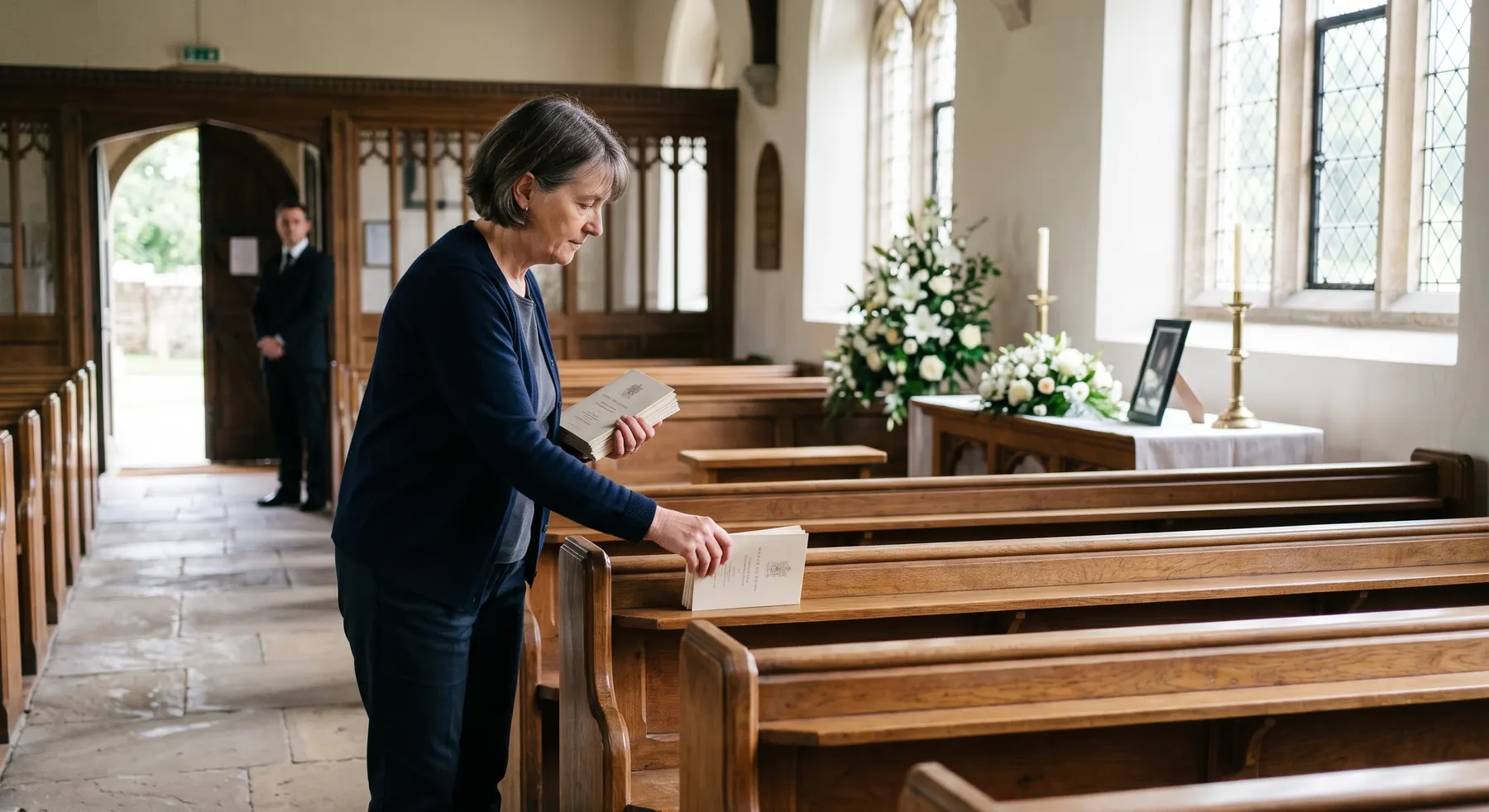
Planned in days, run by many hands
Most events are planned over months. A funeral is usually planned in a handful of days, and in some traditions within a day or two, by a family who are grieving and exhausted.
On the day it is run by a surprising number of people, each of whom needs a different piece of the plan: the minister or celebrant, the funeral director, whoever is on the organ or the sound desk, the ushers, the speakers, the people setting up the hall for afterwards. If each of them is working from a different conversation, the service will still happen — but the small things will go wrong in front of people who have no capacity left to absorb them.
A clear, written order of service with timings is not bureaucracy. It is one of the kindest things anyone can do for a grieving family, because it means nobody has to ask them what happens next.
The order of service, with realistic timings
| Part | Typical time | Notes |
|---|---|---|
| Family arrives and gathers privately | 30 min before | A quiet room, and the last calm moment of the day |
| Viewing or visitation (if held) | 60 min | Close it before guests are seated |
| Guests arrive and are seated | 20 min | Reserve front rows; two ushers |
| Entrance of the coffin and family | 5 min | Everything is timed from here |
| Welcome and opening words | 5–8 min | Slightly longer in a religious service |
| Readings and music | 12–15 min | Choose music with its length in mind |
| Eulogies and tributes | 7 min per speaker | Ask for five |
| Photo tribute or slideshow | 4–6 min | One song; test it on the venue's screen |
| Prayers or a moment of reflection | ~6 min | |
| Closing words | 5 min | |
| Recessional | 5 min | |
| Procession to graveside or crematorium | travel + 15 min | Cars take time to form up behind the hearse |
| Committal | ~20 min | |
| Gathering and refreshments | ~90 min | Often the part people remember most warmly |
The service itself — entrance to recessional — lands between forty minutes and an hour for most families. A full funeral Mass, or a service with four or five speakers, runs longer, and that is completely fine as long as everyone downstream knows.
Eulogies: ask for five, plan for seven
Five minutes is about 600 to 700 words, read slowly. It is long enough to say something true and short enough that the speaker can get through it.
Plan seven minutes per speaker in the timing anyway. Speakers pause, they stop to steady themselves, and sometimes a line lands and the room needs a moment. None of that should feel rushed, and building the time in means nobody has to hurry.
The one arrangement every service should have: a backup for every speaker. Before the day, ask each speaker to name someone who will sit near the front with a printed copy of their words. If the speaker cannot continue, the backup simply steps up and reads the rest. It happens often, there is nothing to be ashamed of in it, and knowing the arrangement exists makes it much less likely to be needed — because the speaker no longer carries the fear of freezing alone.
Agree the order of speakers in advance, and tell each person who speaks before them. It removes one small uncertainty from people who have enough of them.
The details that go wrong
The slideshow. Test it on the venue's actual screen, with the actual file, before the day. A tribute that stalls in a silent room is hard on everyone, and it is almost always a format or cable problem that a five-minute test would have caught.
The entrance music. The procession is slower than people expect. Choose the entrance music knowing roughly how long it runs, and tell whoever is playing it to keep going until the family is seated rather than stopping at the end of the track.
The printed order of service. Print more than you think you need. Attendance at funerals is genuinely hard to predict — people who knew the person decades ago often come — and running out at the door is far worse than taking spares home.
The front rows. Reserve them clearly, with ushers who know which family members are expected. It spares close family the small indignity of looking for a seat.
Plan the order of service — free, no signupThe planner lays out the service from the parts you choose — religious or non-religious, number of tributes, burial or cremation, a gathering afterward — and gives you a timed running order you can print or share with the celebrant, speakers, and funeral director.
Religious and non-religious services
The shape is remarkably consistent across traditions: an entrance, words of welcome, readings or music, remembrance, reflection, and a farewell. What changes is the content, and sometimes the length — a liturgy may have required elements, and a celebration of life is often a little longer and more informal.
Whoever is leading the service will know what their tradition requires. Ask them for a real duration for the parts they lead rather than estimating it, and build everything else around that.
After the service
The service is only part of the day, and the transitions are where things tend to fray.
If there is a burial, the journey to the graveside takes longer than the map suggests: cars need time to form up behind the hearse, and the cortege moves slowly. Allow the travel time plus fifteen minutes. If the committal is at a separate crematorium, twenty minutes covers most journeys; if it happens in the same chapel, there is no gap at all.
The gathering afterward needs to be ready when people arrive, not being set up as they walk in. If it is in a church hall or at a venue, the tea, the food, and the chairs are being prepared while the service is happening, which means whoever is doing it needs the same timings as everyone else. Venue managers and caterers who host these regularly will tell you that the one thing they need is an honest estimate of when the first guests will walk through the door.
One order of service, shared with everyone
The most useful thing a coordinator can do is make sure there is exactly one version of the plan, and that everyone involved is reading it: family, celebrant, funeral director, musicians, sound, ushers, and whoever is preparing the gathering. When a speaker is added the night before — and one often is — that change needs to reach all of them, not just the person who took the phone call.
Worship and church event coordinators often carry funerals alongside the weekly rhythm of services, weddings, and events, with very little notice. Keeping a well-timed structure to start from, rather than building each service from a blank page, is what makes that sustainable — the family's choices change everything that matters, and the practical shape underneath barely changes at all.
For the regular rhythm of a congregation, the weekly church service timeline and the wider religious template collection may help, and there is more on how churches and faith communities plan in religious services.