





This Template at a Glance
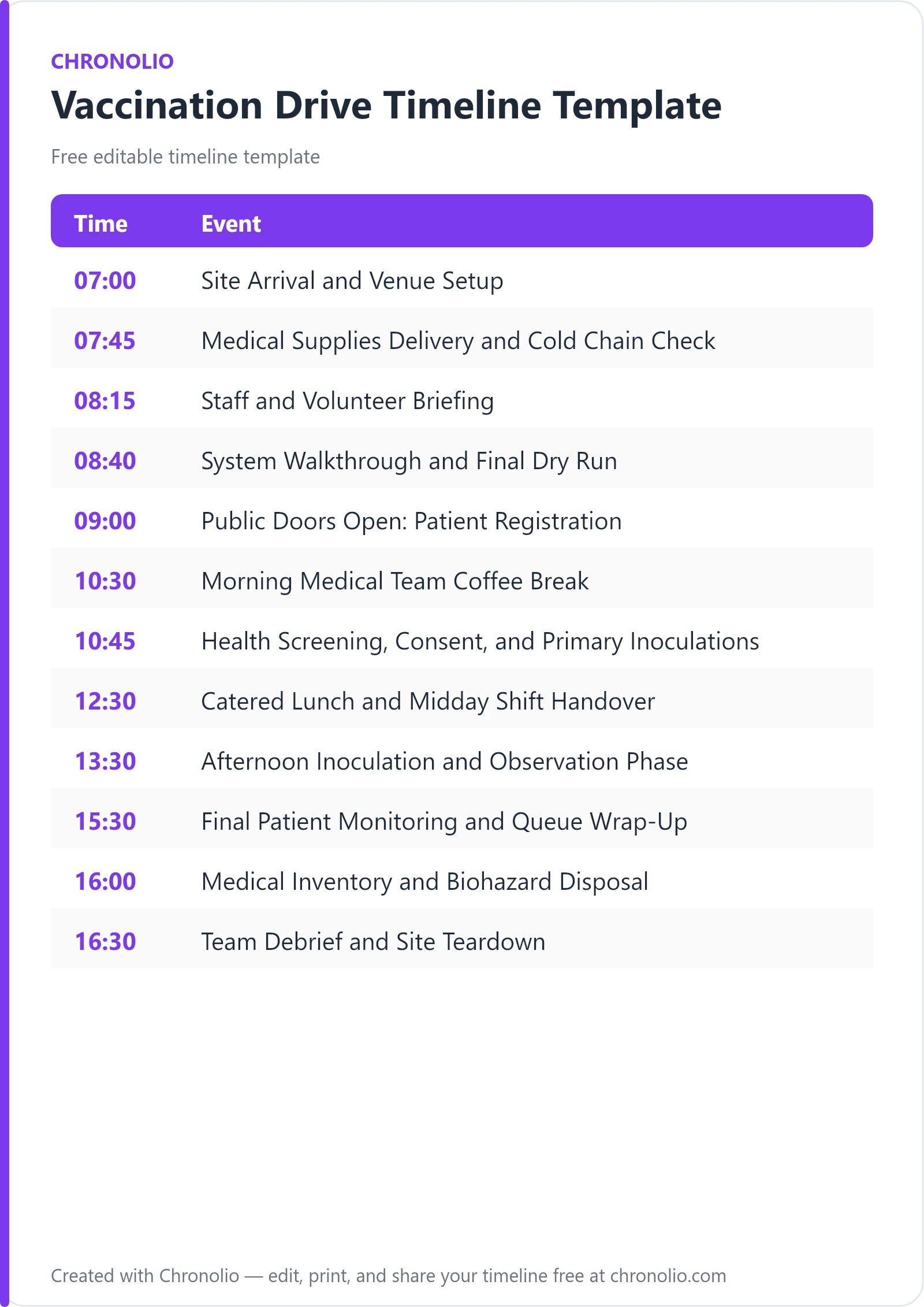
Here is the complete schedule this free template gives you — every time block, ready to edit, download, and share:
| Time | Event |
|---|---|
| 07:00 | Site Arrival and Venue Setup |
| 07:45 | Medical Supplies Delivery and Cold Chain Check |
| 08:15 | Staff and Volunteer Briefing |
| 08:40 | System Walkthrough and Final Dry Run |
| 09:00 | Public Doors Open: Patient Registration |
| 10:30 | Morning Medical Team Coffee Break |
| 10:45 | Health Screening, Consent, and Primary Inoculations |
| 12:30 | Catered Lunch and Midday Shift Handover |
| 13:30 | Afternoon Inoculation and Observation Phase |
| 15:30 | Final Patient Monitoring and Queue Wrap-Up |
| 16:00 | Medical Inventory and Biohazard Disposal |
| 16:30 | Team Debrief and Site Teardown |
What Is a Vaccination Drive Timeline?
A vaccination drive timeline is an operational master plan that coordinates clinical logistics, facility setup, patient queue management, and medical compliance across a community immunization event. Operating a pop-up clinical clinic requires balancing intense operational efficiency with zero-tolerance patient safety standards. Unlike traditional corporate gatherings where minor delays are merely inconvenient, a health clinic schedule governs cold chain integrity, rapid emergency response, and biohazard safety.
This proven schedule reflects real-world clinical site management and industry standard protocols developed by public health coordinators. By establishing clear operational phases—from morning power hookups for refrigeration units to afternoon waste management—the running order keeps medical staff, administrative volunteers, and site security completely synchronized. You can also download print-ready copies in Microsoft Word format or as a PDF reference guide for on-site clipboard distribution.
Customize Your Vaccination Drive Timeline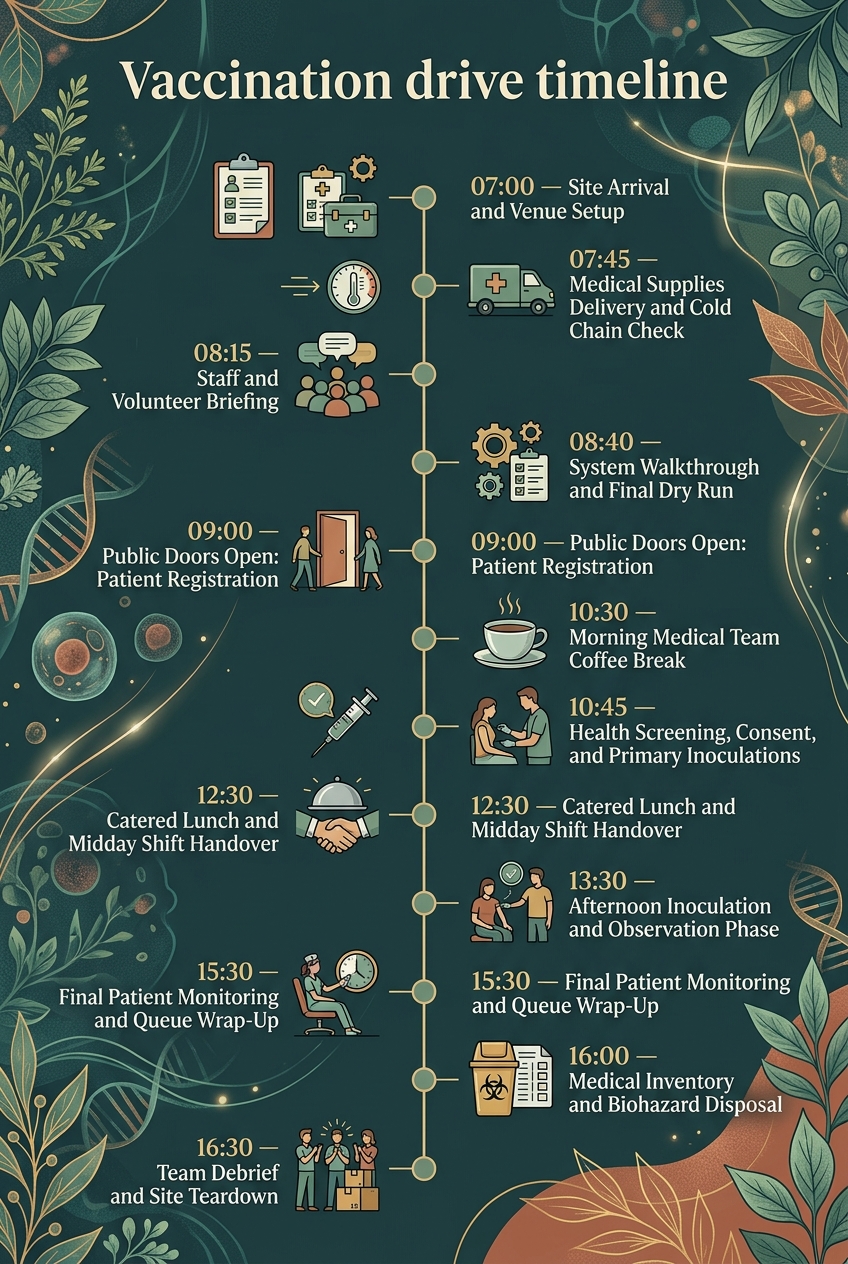
Why Vaccination Drives Need a Timeline
Public health operations thrive on predictable, calm structure. When hundreds of community members arrive for immunizations, a disciplined timeline prevents bottlenecking at registration desks and ensures that clinical screeners have adequate time to review patient histories without rushing. Clear schedules protect staff from fatigue and keep patient lines moving systematically through every checkpoint.
Behind the scenes, timing is directly tied to medical safety and regulatory compliance. Vaccines require strict cold chain monitoring from the moment supply trucks arrive to the final dose drawn. Scheduling dedicated checks for temperature logs, midday shift handovers, and biohazard containment ensures that no clinical step is overlooked, minimizing vaccine wastage and protecting patient wellbeing.
Finally, an established schedule gives every team member operational confidence. Volunteers know exactly when shifts rotate, security personnel anticipate peak queue volumes, and paramedic support teams remain primed during active observation windows. Just as structured governance demands a strict agenda in a board meeting timeline, a community health initiative relies on a rigid, minute-by-minute structure to run safely and ethically.
What to Include in a Vaccination Drive Timeline
To execute a flawless public health initiative, your master running order should incorporate these essential operational phases:
- Facility and Equipment Setup: Establishing physical queue barriers, private injection booths, and dedicated electrical connections for refrigeration.
- Cold Chain and Supply Delivery: Verifying drug temperature logs, logging serial/lot numbers, and stocking clinical consumables.
- Staff and Volunteer Briefings: Aligning clinical staff, administrative aides, and safety marshals on station assignments and emergency response protocols.
- Dry Runs and Software Checks: Testing digital check-in systems, intake tablets, and physical flow pathways before public doors open.
- Registration and Triage Flow: Greeting patients, verifying eligibility, issuing queue numbers, and guiding individuals to screening bays.
- Health Screening and Informed Consent: Reviewing medical history, checking contraindications, and securing signed consent forms.
- Vaccine Administration: Delivering precise dosage, recording lot numbers in health registry databases, and providing post-care instructions.
- Mandatory Post-Inoculation Observation: Monitoring patients in a designated lounge for 15 to 30 minutes to detect and treat acute allergic reactions.
- Shift Handovers and Break Rotation: Managing staff lunches and breaks seamlessly to maintain baseline station throughput.
- Biohazard Disposal and Site Strike: Safely sealing sharps containers, accounting for unused inventory, and returning the venue to its original state.
Pre-Drive Logistics and Facility Preparation
| Time | Event | | 07:00 | Site Arrival and Venue Setup | | 07:45 | Medical Supplies Delivery and Cold Chain Check | | 08:15 | Staff and Volunteer Briefing | | 08:40 | System Walkthrough and Final Dry Run |
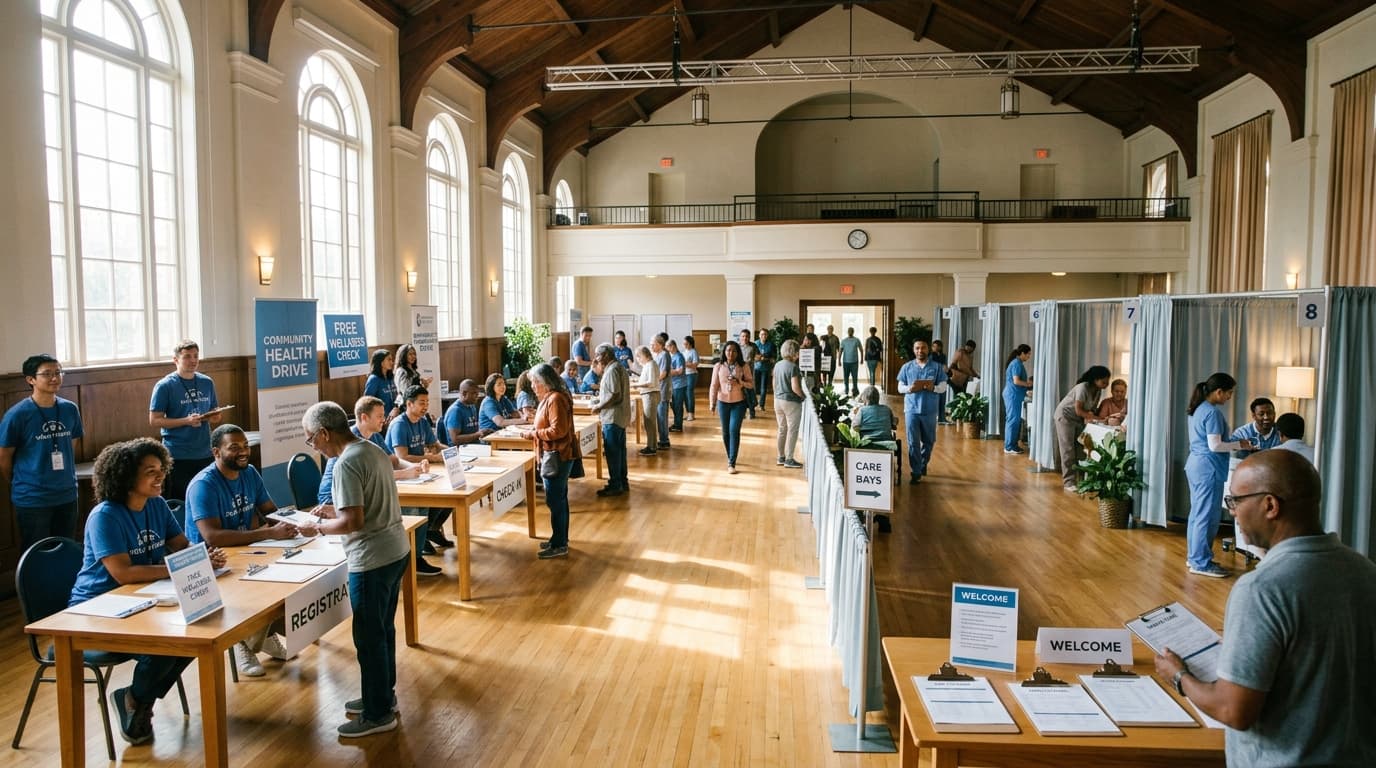
The success of any pop-up clinical operation is determined long before the first patient walks through the doors. Early site access allows logistics teams to build directional pathways using stanchions and privacy screens, separating intake queues from confidential medical bays. Establishing uninterrupted power hookups for portable medical refrigeration units at the top of the hour is critical to prevent thermal excursions.
Once facility infrastructure is in place, vaccine shipments arrive under strict transport monitoring. Nurses must immediately check temperature data loggers to verify that cold chain integrity was maintained during transit according to guidelines set by official bodies like the Centers for Disease Control and Prevention (CDC). Following supply verification, the lead coordinator hosts an all-hands briefing to distribute radios and clarify emergency protocols, followed by a full digital dry run across all check-in terminals.
Morning Public Operations and Initial Dose Rollout
| Time | Event | | 09:00 | Public Doors Open: Patient Registration | | 10:30 | Morning Medical Team Coffee Break | | 10:45 | Health Screening, Consent, and Primary Inoculations |
Opening doors precisely on schedule establishes public confidence and prevents overcrowding in exterior waiting areas. Queue managers guide incoming patients through initial registration, confirming identity credentials and issuing sequential physical or digital queue tickets. Much like managing guests in a baby shower timeline, greeting visitors warmly and giving clear directional cues eliminates anxiety and prevents logjams at the entrance lobby.
To maintain continuous operational throughput throughout the morning, administrative and nursing staff operate on a staggered break schedule. A rotational coffee break preserves baseline desk coverage while giving front-line intake personnel a chance to recharge. Following intake, patients move to individual screening booths where clinical staff review health histories, obtain informed consent signatures, administer shots, and record vaccine lot numbers into public health databases.
Midday Shift Rotation and Peak Inoculation Flow
| Time | Event | | 12:30 | Catered Lunch and Midday Shift Handover | | 13:30 | Afternoon Inoculation and Observation Phase |
Midday marks the transition between operational teams and requires rigorous administrative discipline. A structured lunch and shift handover ensures complete continuity across all clinical bays. During this hour, outgoing shift leaders reconcile dose logs against registered patient counts and brief incoming nurses on current queue speeds and inventory levels.
The early afternoon period typically brings a second major wave of patient arrivals, including local workers taking advantage of lunch or early dismissal hours. Sustaining high throughput across active stations depends on disciplined queue management and prompt routing into the observation area. While planning social celebrations like a birthday party schedule allows for fluid timing, medical pop-ups require zero lag between screening, administration, and post-shot monitoring.
Post-Clinical Monitoring, Biohazard Disposal, and Site Strike
| Time | Event | | 15:30 | Final Patient Monitoring and Queue Wrap-Up | | 16:00 | Medical Inventory and Biohazard Disposal | | 16:30 | Team Debrief and Site Teardown |
As public registration doors close, operations shift entirely toward patient discharge, clinical auditing, and site decontamination. The mandatory fifteen-minute observation period must never be shortened, even during the final wrap-up phase. On-site paramedics remain active in the recovery lounge until the final registered patient is cleared and departs the venue safely.
Once all members of the public have exited, clinical personnel initiate biohazard protocols. Unused vaccine vials are accounted for and secured back into cold-chain transport units, while used needles and syringes are locked in rigid sharps containers. For full health department compliance, review standard waste handling frameworks established by the World Health Organization (WHO). Finally, volunteer teams disassemble temporary partitions, clean surfaces, and conduct a brief operational debrief to capture key metrics before returning the facility.
Vaccination Drive Timeline vs Clinical Patient Flow Chart
It is common for project managers to confuse an event schedule with a clinical flow chart. While both serve the health initiative, they cover different operational perspectives:
| Feature | Vaccination Drive Timeline | Clinical Patient Flow Chart |
|---|---|---|
| Primary Focus | Master schedule for overall site operations and logistics | Individual patient movement step-by-step through stations |
| Time Orientation | Clock-based schedule (07:00 to 17:00) | Elapsed duration per patient (e.g., 2 mins registration, 15 mins observation) |
| Target Audience | Event directors, shift leads, venue managers, volunteers | Patients, clinical screeners, post-shot observation staff |
| Core Deliverable | Timed facility activation, breaks, handovers, and teardown | Physical route, intake logic, and safety station layout |
Where the clinical flow chart details how an individual moves from registration to inoculation, the vaccination drive timeline manages site synchronization, ensuring staff briefings, delivery drop-offs, catering, and facility breakdown occur at precise times.
Who Should Use This Template?
This master schedule is engineered for organizers managing multi-station health initiatives across various public and private sectors:
- Public Health Authorities: Municipal health departments coordinating regional mass-vaccination pop-ups.
- Community Healthcare Centers: Local clinics extending reach through mobile neighbourhood events.
- Corporate HR & EHS Teams: Workplace coordinators hosting employee flu shot clinics and wellness fairs.
- School Boards & Universities: Educational administrators organizing campus-wide immunization drives.
- Non-Profit Organizations & Disaster Relief Teams: Humanitarian agencies delivering emergency medical aid in temporary facilities.
Note that Chronolio provides tailored tools for various operational roles, helping site supervisors, safety officers, and volunteer leads stay fully aligned throughout event day.
How to Use This Template
- Download or Duplicate: Access this template on Chronolio or download a copy in Word or PDF.
- Set Your Operating Hours: Adjust the master start and end times to align with your facility access agreement and public clinic hours.
- Scale Inoculation Capacity: Adjust station throughput and volunteer shift schedules based on expected patient counts and available nurse prescribers.
- Assign Dedicated Shift Leads: Designate specific personnel responsible for cold chain logging, queue control, and biohazard disposal.
- Distribute to Stakeholders: Share the final running order with venue operators, security, medical transport drivers, and emergency medical services.
Tips for a Successful Vaccination Drive
- Separate Entrance and Exit Flows: Design a strict one-way foot traffic path to eliminate congestion between incoming registrants and departing patients.
- Establish a Cold Chain Redundancy: Keep backup power generators or battery packs on site to protect medical freezers against unexpected power grid failure.
- Pre-Print Paper Screening Forms: Always maintain physical paper copies of health questionnaires in case digital check-in tablets lose Wi-Fi connectivity.
- Designate a Dedicated Paramedic Bay: Position emergency resuscitation kits and rapid-response paramedics directly adjacent to the post-vaccination observation zone.
- Implement Staggered Staff Meals: Whether managing public foot traffic at a municipal clinic or hosting large crowds for an anniversary party schedule, bottleneck prevention requires staggered team breaks to keep operations active.
- Utilize Clear Color-Coded Signage: Use high-contrast, multi-lingual signs to guide patients seamlessly through registration, screening, and observation.
Common Mistakes to Avoid
- Underestimating Setup Time: Failing to allow two full hours for physical setup and cold chain verification before doors open leads to stressed staff and public queue delays.
- Creating Bottlenecks at Screening: Assigning too few qualified medical screeners relative to check-in desks causes severe backlogs early in the morning.
- Shortening Observation Times: Allowing patients to leave early during busy periods creates unacceptable medical liability and safety risks.
- Neglecting Midday Inventory Audits: Skipping inventory reconciliation during shift handovers leads to unrecorded doses or misallocated lot numbers.
- Poor Communication Equipment: Relying on mobile phones rather than dedicated two-way radios causes breakdown in rapid site communications.
- Inadequate Biohazard Storage: Leaving medical waste or sharps containers exposed in public areas during peak hours breaks safety compliance.
In Summary
- A vaccination drive timeline coordinates site setup, cold chain delivery, public registration, screening, inoculation, observation, and teardown.
- Pre-drive setup requires establishing power for medical refrigeration, conducting cold chain checks, and executing a complete system dry run.
- Staggered staff breaks keep clinical stations fully operational throughout peak morning and afternoon traffic.
- Post-vaccination observation requires a mandatory 15-to-30-minute waiting period supervised by qualified emergency medical staff.
- Strict biohazard disposal and inventory auditing must take place immediately after public clinic closure.
Executing a flawless health event requires balancing high patient throughput with rigorous clinical protocols. Designed for public health directors, corporate wellness managers, municipal emergency response teams, and healthcare volunteers, this vaccination drive timeline guarantees a safe, orderly, and fully compliant operation from morning setup to final site release.
Customize Your Vaccination Drive Timeline