






This Template at a Glance
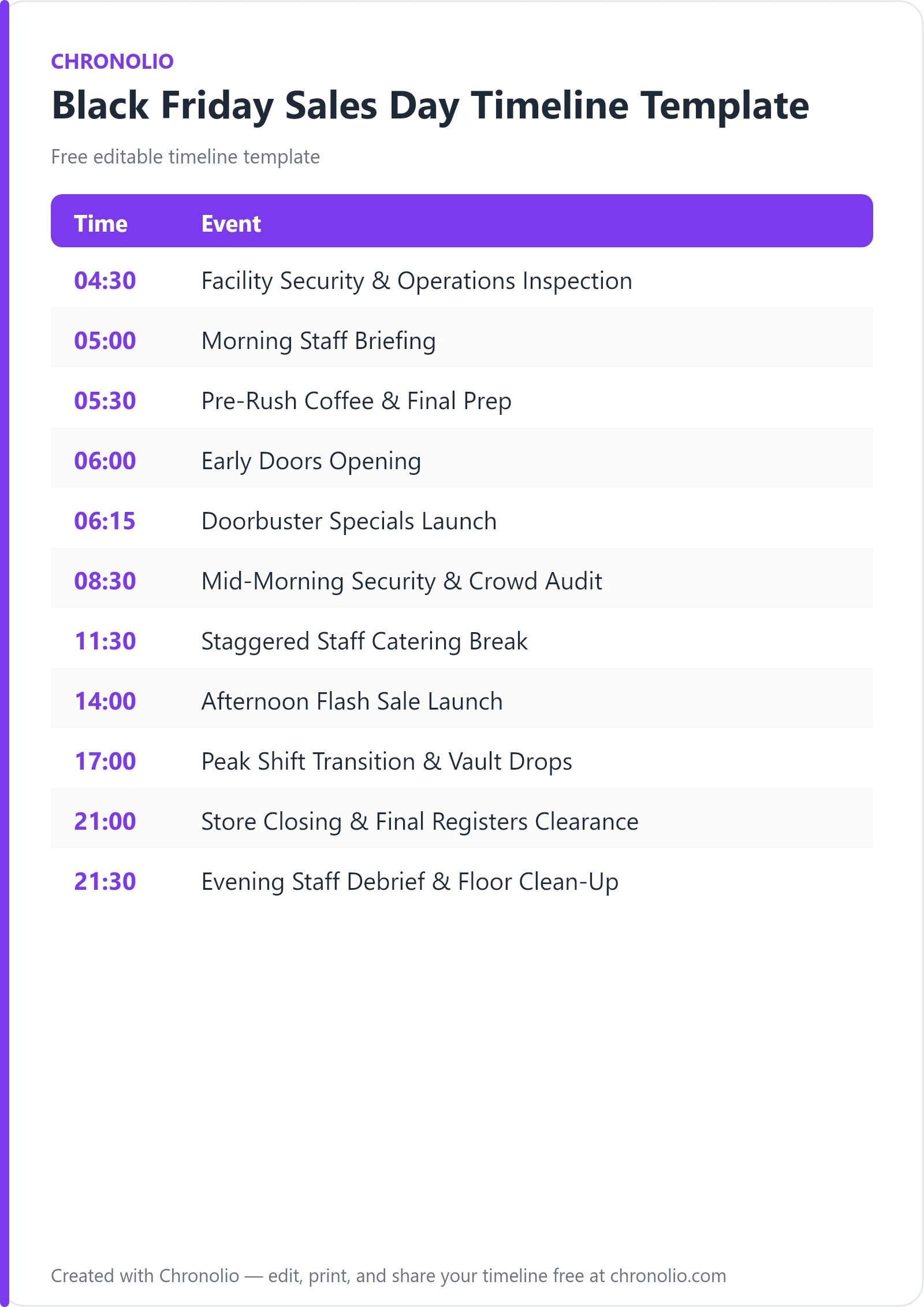
Here is the complete schedule this free template gives you — every time block, ready to edit, download, and share:
| Time | Event |
|---|---|
| 04:30 | Facility Security & Operations Inspection |
| 05:00 | Morning Staff Briefing |
| 05:30 | Pre-Rush Coffee & Final Prep |
| 06:00 | Early Doors Opening |
| 06:15 | Doorbuster Specials Launch |
| 08:30 | Mid-Morning Security & Crowd Audit |
| 11:30 | Staggered Staff Catering Break |
| 14:00 | Afternoon Flash Sale Launch |
| 17:00 | Peak Shift Transition & Vault Drops |
| 21:00 | Store Closing & Final Registers Clearance |
| 21:30 | Evening Staff Debrief & Floor Clean-Up |
What Is a Black Friday Sales Day Timeline?
A Black Friday sales day timeline is the strategic operational roadmap that orchestrates every minute of retail operations during peak promotional trading. Having managed multi-level retail operations through dozens of high-stakes promotional days, I can tell you that success on peak shopping days is won or lost before the first customer steps through the door. This schedule integrates building security checks, point-of-sale (POS) terminal prep, staff briefings, crowd management, and shift handovers into a unified sequence.
This template reflects real-world retail industry best practices refined across high-traffic outlets and department stores. Rather than treating Black Friday as an unstructured rush, a structured running order gives department heads, loss prevention officers, and cashiers clear expectations for doorbuster launches, vault drops, and floor restocking. You can also download our free downloadable Word template or printable PDF version to post in employee breakrooms and manager hubs.
Edit This Black Friday Sales Day Schedule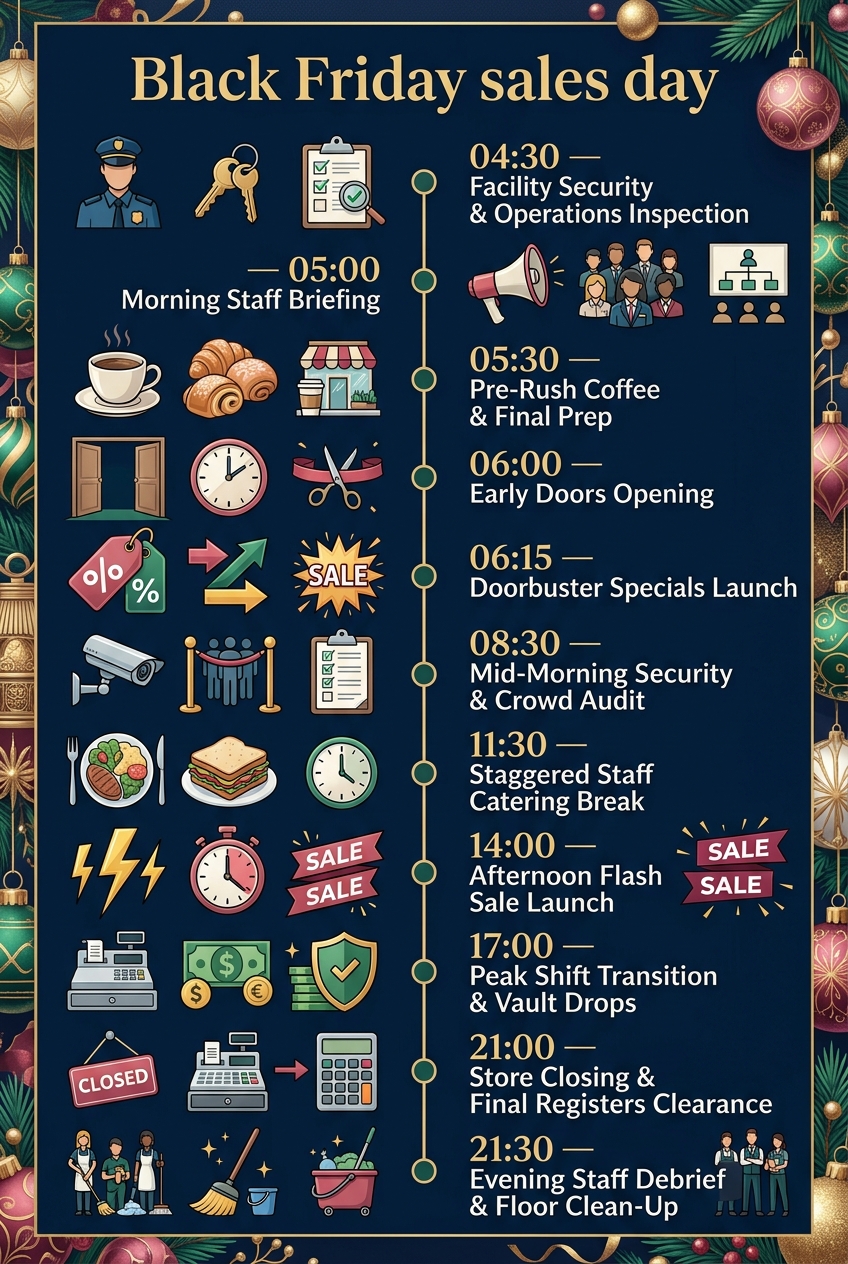
Why Black Friday Sales Days Need a Timeline
Without a central master schedule, peak shopping days quickly descend into operational friction, register bottlenecks, and security hazards. A well-constructed schedule acts as the nervous system of your store, ensuring that loss prevention controls and revenue targets move in sync.
When every team member knows precisely when doorbusters launch and when their relief shifts arrive, operational fatigue drops dramatically. Maintaining clear timing helps store managers balance aggressive promotional goals with strict compliance standards set by organizations like the National Retail Federation.
- Protects store security and customer safety: Scheduled facility walks prevent aisle congestion and ensure emergency exits remain unobstructed under heavy foot traffic.
- Eliminates checkout bottlenecks: Aligning register till assignments with predicted peak traffic hours keeps transaction queues moving smoothly.
- Sustains workforce energy: Staggered meal breaks and catered dining keep floor personnel rested and motivated across marathon 16-hour operating days.
- Maximizes promotional revenue: Timed flash sale announcements drive continuous movement between department displays and central atrium promotions.
What to Include in a Black Friday Sales Day Timeline
A comprehensive commercial retail plan must account for back-of-house logistics alongside front-of-house customer interactions. To keep operations running seamlessly, ensure your schedule incorporates these essential building blocks:
- Pre-opening security audits: Comprehensive perimeter, alarm, barrier, and POS system checks prior to customer arrival.
- Shift briefings & cheat sheets: Aligning register staff and floor teams on promotional codes, top doorbuster locations, and security codes.
- Controlled door opening procedure: Staggered entry protocols to manage waiting crowds safely at main entrances.
- Doorbuster & flash sale launches: Specific time slots for high-demand, limited-stock item releases and public address announcements.
- Midday crowd & safety inspections: Dedicated aisle walks by security supervisors to audit line flow and exit access.
- Cash handling & vault drops: Scheduled transfers of cash reserves during shift transitions to maintain till safety.
- Post-closing debrief & recovery: Final floor reorganization, till balancing, and team recognition before weekend trading resumes.
Phase 1: Building Preparation & Pre-Rush Briefings
| Time | Event |
|---|---|
| 04:30 | Facility Security & Operations Inspection |
| 05:00 | Morning Staff Briefing |
| 05:30 | Pre-Rush Coffee & Final Prep |
The early morning hours set the foundation for the entire operational footprint. At 04:30, security personnel and store management gather at the Main Entrance and Security Hub to execute a comprehensive facility security inspection, checking alarm systems, panic hardware, queue barriers, and emergency exit routes before any floor staff step foot in the building.
Once the facility is cleared, the team moves to the Employee Breakroom for the 05:00 Morning Staff Briefing. Here, management sets the tone for the day, issuing sales targets, distributing promotional cheat sheets, reviewing crowd control protocols, and confirming register assignments. Staff then transition into the Employee Lounge and Checkout Lanes for a short prep period, enjoying complimentary coffee while running test transactions across all scanners and payment terminals.
Phase 2: Doorbusters & Morning Traffic
| Time | Event |
|---|---|
| 06:00 | Early Doors Opening |
| 06:15 | Doorbuster Specials Launch |
| 08:30 | Mid-Morning Security & Crowd Audit |
Opening doors to a large waiting crowd requires absolute discipline. At 06:00, security officers unlock the Main Store Entrance, managing controlled customer line flow into the central concourse to prevent surges.
Fifteen minutes later, the main promotional push begins across the Retail Floor and Electronics Section. Department leads manage high-demand merchandise by distributing voucher tickets for limited-quantity electronics, avoiding chaotic floor rushes. By 08:30, as early doorbuster crowds stabilize, security leads carry out a formal audit across escalators and department aisles, verifying that main pathways remain clear and register queues are processing efficiently.
Phase 3: Midday Sales & Shift Transitions
| Time | Event |
|---|---|
| 11:30 | Staggered Staff Catering Break |
| 14:00 | Afternoon Flash Sale Launch |
| 17:00 | Peak Shift Transition & Vault Drops |
Maintaining momentum through midday requires careful coordination of personnel and promotions. Starting at 11:30, the first rotation of floor staff heads to the Catering Dining Room for a staggered catered break, ensuring that relief workers step seamlessly into cashier lanes to keep all registers fully operational during the peak lunch rush.
At 14:00, public address announcements herald the Afternoon Flash Sale in the Center Atrium and Display Promenades. Floor teams execute rapid merchandise restocks on depleted display units to capture impulse buys. As the evening crowd begins to surge around 17:00, management coordinates scheduled cash vault drops at register stations under security escort, while incoming evening shift workers log in to maintain peak capacity.
Phase 4: Closing Operations & Floor Recovery
| Time | Event |
|---|---|
| 21:00 | Store Closing & Final Registers Clearance |
| 21:30 | Evening Staff Debrief & Floor Clean-Up |
The closing phase transitions the retail space from high-speed sales back to structured inventory control. At 21:00, courtesy announcements inform remaining shoppers that main store entrances are locked, guiding customer traffic toward the front register lanes for final transaction processing.
Once the last customer exits and tills are locked down, the entire workforce gathers in the Central Atrium at 21:30. Management shares initial daily sales totals, acknowledges top-performing team members, and directs night crew personnel as they begin restocking display tables and reorganizing floor merchandise for weekend operations.
Black Friday Sales Day Timeline vs General Retail Shift Schedule
Store operators often confuse a master event timeline with a standard employee shift roster. While a shift roster tracks individual working hours, an event timeline manages the synchronized physical, security, and promotional flow of the entire facility.
| Planning Aspect | Black Friday Sales Day Timeline | General Retail Shift Schedule |
|---|---|---|
| Primary Scope | Whole-store operational synchronization, crowd safety, & promotional triggers | Individual worker start times, meal break windows, & department coverage |
| Security Focus | Integrated facility audits, line management, & vault drops | Standard end-of-day register closing checks |
| Promotional Integration | Real-time flash sale launches & doorbuster voucher distributions | Passive shelf maintenance & routine restocking |
| Adaptability | Reactive to floor traffic, queue volume, & line bottlenecks | Fixed daily schedules set days or weeks in advance |
Just as corporate event planners use a board meeting timeline template to keep executive agendas punctual, retail operators depend on structured master timelines to ensure every department operates in complete harmony.
Who Should Use This Template?
This master schedule is engineered for retail decision-makers who manage complex, high-volume retail environments where timing directly influences revenue and safety.
- Big-box store managers: Streamline doorbuster releases and manage expansive multi-register checkout plazas.
- Department store directors: Coordinate multi-floor promotions, escalator crowd flows, and loss prevention teams.
- Shopping outlet center leads: Align concourse security, shared facility accesses, and tenant door-opening times.
- Boutique owners & specialty retailers: Scale down doorbuster timing while keeping cash controls and customer flow tight.
- Pop-up retail event operators: Maintain strict schedules for short-duration, high-impact promotional events.
Our platform supports the diverse operational roles required to run flawless retail events, giving floor managers and security chiefs access to real-time schedule updates.
How to Use This Template
- Download or duplicate the template: Save your copy in Word, PDF, or directly inside Chronolio.
- Adjust opening hours: Align start times with your local municipal trading laws and store licensing rules.
- Assign department leads: Add staff names to specific responsibilities like vault drops, PA announcements, and line control.
- Print and post physically: Hang printed copies in the breakroom, manager hub, and cash office.
- Sync with security teams: Conduct a brief walk-through with your loss prevention chief 24 hours prior to launch.
Tips for a Successful Black Friday Sales Day
- Implement a voucher system early: Issue numbered tickets for top electronics and doorbusters to customers in line outside, eliminating floor rushes when doors unlock.
- Pre-stage cash register supplies: Ensure every checkout lane is pre-stocked with receipt paper rolls, shopping bags, and spare till trays before 05:00.
- Establish a dedicated runner team: Assign fast-moving staff members to transport go-backs and misplaced items from checkout lanes back to floor displays.
- Over-communicate via public address: Broadcast clear, friendly public address reminders about register locations and flash sale start times every 30 minutes.
- Provide high-protein catered meals: Keep staff energy stable by offering hot, accessible meals inside the breakroom so personnel do not leave the facility during breaks.
- Keep loss prevention visible: Station uniform security personnel near high-value displays and main entrances to deter shoplifting during peak rushes.
Common Mistakes to Avoid
- Uncoordinated door openings: Opening store doors without queue barriers or security positioning leads to hazardous customer surges.
- Neglecting vault drops: Allowing excessive cash to accumulate in register drawers during high-volume periods creates severe loss risks.
- Ignoring employee break schedules: Delaying catered breaks causes staff burnout and register slip-ups during peak afternoon volume.
- Underestimating restocking speed: Failing to pre-stage backroom inventory causes popular promotional displays to sit empty during peak buying hours.
- Lacking a contingency line protocol: Failing to prepare overflow register lines leads to concourse gridlock that blocks emergency exits.
- Skipping the morning briefing: Skipping the 05:00 team huddle leaves cashiers unaware of promotional discount codes and cheat sheet details.
In Summary
- Master coordination: Integrates security inspections, doorbuster releases, catered breaks, and cash vault drops into one master operational schedule.
- Built for high traffic: Designed specifically for big-box retailers, department store directors, and outlet center management.
- Enforces store safety: Prioritizes crowd control, clear exit corridors, and active security walks throughout trading hours.
- Optimizes revenue: Synchronizes floor restocking and public address flash sale announcements to maximize consumer spending.
- Fully customizable: Easily adapt times and department assignments using Chronolio’s interactive editing tools.
Running a high-stakes retail promotional event demands the same precision as managing complex live venues or milestone celebrations. Just as event coordinators rely on a birthday party timeline template or an anniversary party schedule template to keep distinct phases flowing smoothly, retail leaders depend on structured timelines to protect profits and customer safety. Furthermore, just as ceremonial planners organize formal movements using a Christian wedding timeline, retail store managers use this framework to keep thousand-person store rushes orderly from 04:30 inspections to final 21:30 floor recovery.
Edit This Black Friday Sales Day Schedule