





This Template at a Glance
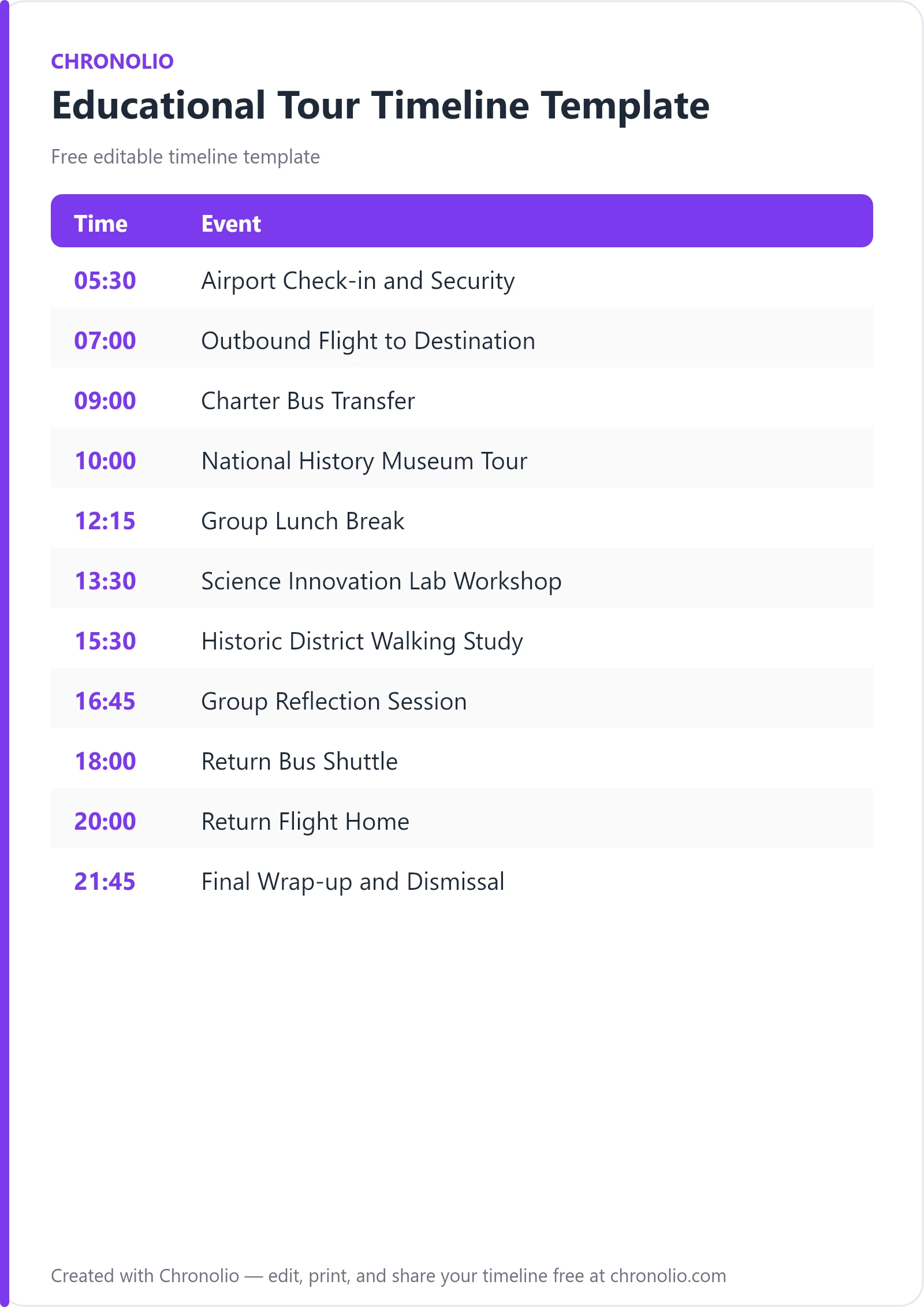
Here is the complete schedule this free template gives you — every time block, ready to edit, download, and share:
| Time | Event |
|---|---|
| 05:30 | Airport Check-in and Security |
| 07:00 | Outbound Flight to Destination |
| 09:00 | Charter Bus Transfer |
| 10:00 | National History Museum Tour |
| 12:15 | Group Lunch Break |
| 13:30 | Science Innovation Lab Workshop |
| 15:30 | Historic District Walking Study |
| 16:45 | Group Reflection Session |
| 18:00 | Return Bus Shuttle |
| 20:00 | Return Flight Home |
| 21:45 | Final Wrap-up and Dismissal |
What Is an Educational Tour Timeline?
An educational tour timeline is an operational master schedule designed to coordinate complex group logistics, academic activities, and safety protocols during a student field excursion. Managing a group of young learners across public transit hubs, busy museum galleries, and interactive workshops requires precise synchronization between lead educators, chaperones, tour guides, and transport operators.
This template reflects real-world educational tour structures refined across hundreds of successful school field trips and academic excursions, incorporating essential safety buffers and structured debriefing periods. By establishing a explicit sequence of events, tour leaders can eliminate transit anxiety, maintain clear attendance accounting, and keep the primary focus on experiential learning. Whether you are organizing an out-of-state STEM trip or an intra-city cultural study, a unified schedule provides the blueprint for a safe, educational, and memorable journey.
Customize Your Educational Tour Timeline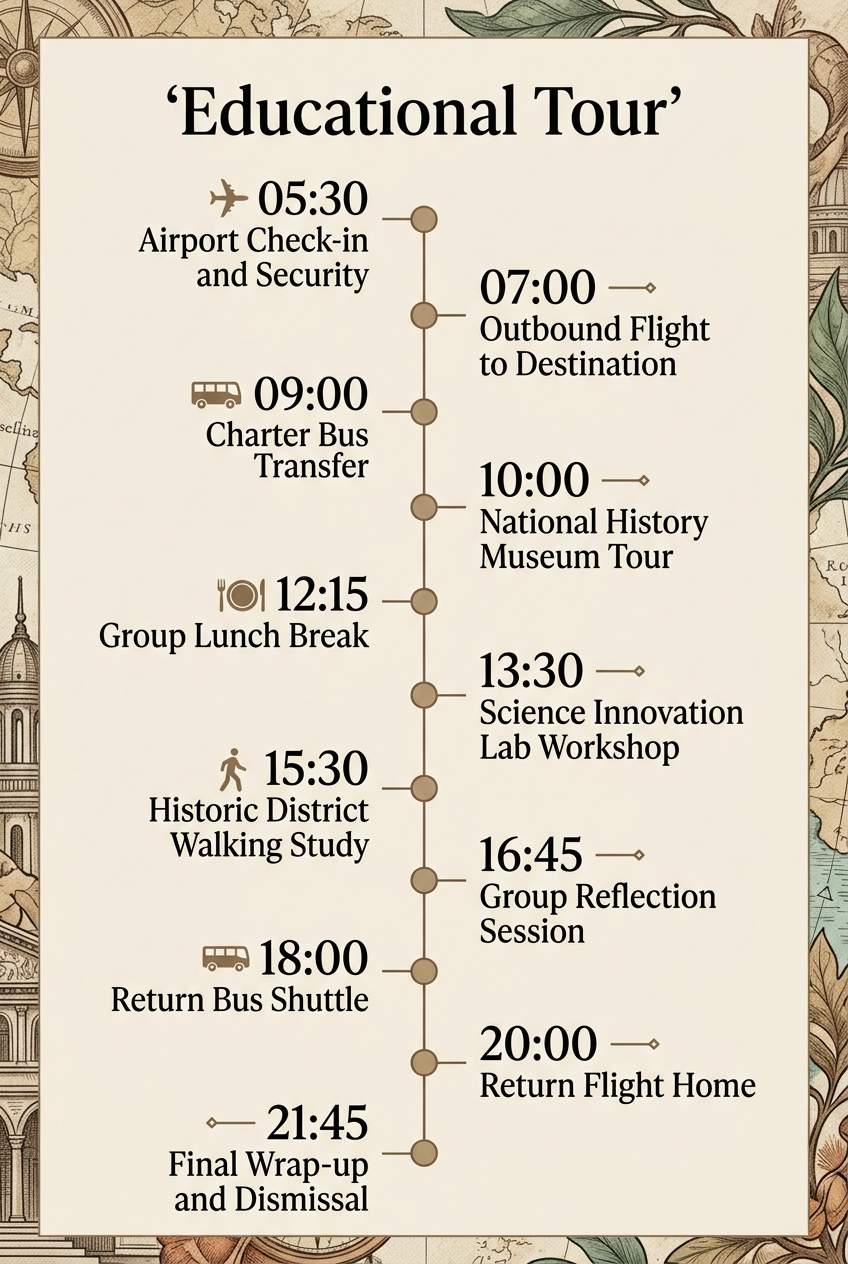
Why Educational Tours Need a Timeline
Managing dozens of students in high-traffic public environments presents unique administrative and logistical challenges. Without a clear, centralized timeline, small delays at security checkpoints or lunch venues can quickly compound, leading to missed group flights, shortened site visits, or frantic travel conditions.
- Enhanced Safety and Accountability: Precise schedules establish specific rendezvous points and mandatory roll calls, ensuring no student is left unattended during group transfers or free exploration windows.
- Seamless Multi-Vendor Coordination: Educational travel involves coordinating flight agents, charter bus drivers, venue coordinators, and catering staff; a shared master schedule keeps all vendors synchronized on group arrivals.
- Maximizing Academic Value: Setting clear time limits for field logbook entries and guided tours prevents fatigue while ensuring students cover all core curriculum objectives without rushing through interactive exhibits.
What to Include in an Educational Tour Timeline
A robust educational trip schedule must balance strict travel deadlines with engaging, hands-on learning moments. To maintain focus and physical energy, every itinerary should integrate the following foundational components:
- Transit and Security Buffers: Ample time allocated for airport baggage processing, TSA screening, charter loading, and traffic delays.
- Structured Site Visits: Guided gallery tours and interactive lab experiments led by subject-matter experts.
- Dedicated Mealtimes: Organised lunch and snack periods accommodated with clear dietary management tables.
- Academic Reflection Windows: Structured debrief sessions where students record field observations and synthesize learning in workbooks.
- Chaperone Rendezvous Points: Scheduled headcounts and group assembly checkpoints throughout the day.
Morning Transit and Airport Logistics
| Time | Event |
|---|---|
| 05:30 | Airport Check-in and Security |
| 07:00 | Outbound Flight to Destination |
| 09:00 | Charter Bus Transfer |
The success of any long-distance student trip depends on flawless early-morning airport logistics. Gathering students at 05:30 AM at the main departures hall provides necessary breathing room to verify government identification, distribute pre-printed boarding passes, and perform initial headcount audits before entering security lines. Moving a large cohort through airport screening naturally takes three to four times longer than individual travel, making a full 90-minute departure buffer essential.
Once airborne on Flight AI-402, chaperones use the relative quiet of the in-transit window to confirm day assignments and review emergency contact protocols. Upon landing at 09:00 AM, the group moves in an orderly line directly to the airport arrivals shuttle station. Boarding a pre-arranged private charter coach avoids the unpredictability of public transit, allowing leaders to brief students on city safety standards while traversing directly to the first academic venue.
Core Academic Exhibits and Lunch
| Time | Event |
|---|---|
| 10:00 | National History Museum Tour |
| 12:15 | Group Lunch Break |
| 13:30 | Science Innovation Lab Workshop |
Arriving at the National History Museum at 10:00 AM positions the student group ahead of peak general public crowds. Partnering with museum docents for a two-hour guided walk through the main gallery grounds student learning in tangible historical artifacts. Pairing students up ensures peer accountability during worksheet exercises, keeping learners engaged without allowing individuals to wander off into unassigned gallery wings.
By 12:15 PM, cognitive fatigue begins to set in, making a structured lunch break critical for maintaining afternoon focus. Utilizing the museum courtyard dining area allows chaperones to monitor the group in a controlled, semi-enclosed environment while accommodating dietary restrictions at clear service stations. Following lunch, the short walk to the City Science Center for the 13:30 PM Science Innovation Lab Workshop transitions students from passive observation to active, hands-on experimentation with renewable energy technologies.
Field Study and Group Reflection
| Time | Event |
|---|---|
| 15:30 | Historic District Walking Study |
| 16:45 | Group Reflection Session |
Moving outside the traditional classroom or museum hall at 15:30 PM introduces a dynamic spatial element to the day's study. The Historic District Walking Study in Old Town Heritage Square encourages students to analyze real-world architecture, local urban planning, and historic monuments while completing field logbook entries. Outdoor field studies require strict chaperone perimeter coverage to keep students contained within designated survey zones.
At 16:45 PM, the group transitions into the Heritage Square Conference Room for a crucial debrief session. Academic research from organizations like the Student & Youth Travel Association highlights that immediate post-activity debriefs dramatically improve knowledge retention. Faculty facilitators guide students through small-group discussions, allowing them to compare field logs, debate findings, and turn raw site observations into lasting insights before field logbooks are formally collected for assessment.
Evening Return and Student Dismissal
| Time | Event |
|---|---|
| 18:00 | Return Bus Shuttle |
| 20:00 | Return Flight Home |
| 21:45 | Final Wrap-up and Dismissal |
Re-boarding the charter coach at 18:00 PM marks the shift from academic delivery back to travel logistics. Conducting a full verbal roll call prior to coach departure ensures every participant is accounted for before entering evening highway traffic. Maintaining a clear line of communication with the driver guarantees the group reaches the airport terminal with plenty of time to clear return security and board Flight AI-409.
The late flight home offers students time to rest and process the day's events. Upon landing at 21:45 PM, chaperones escort the group directly to baggage claim for final pickup coordination. Establishing a clear dismissal protocol—where parents sign off before departing—guarantees a secure chain of custody and concludes the educational tour on a safe, professional note.
Just as structured planning keeps academic trips on schedule, organizers often apply similar timeline frameworks when coordinating school board milestone events using a board meeting schedule or planning staff celebrations with an anniversary party schedule.
Educational Tour Timeline vs Tourist Itinerary
It is common to confuse an educational tour timeline with a standard tourist itinerary, yet their operational priorities differ significantly. An educational tour timeline is driven by risk management, chaperone ratios, and explicit curriculum goals, whereas a general travel itinerary prioritizes leisure, flexibility, and individual sight-seeing.
| Operational Feature | Educational Tour Timeline | Standard Tourist Itinerary |
|---|---|---|
| Primary Goal | Structured academic outcomes & student safety | Leisure, relaxation, & personal exploration |
| Group Dynamics | Mandatory cohort movement & assigned pairs | Independent or small family movement |
| Pacing & Buffers | Rigid time blocks with built-in safety buffers | Flexible schedules adjusted on the fly |
| Accountability | Regular roll calls & Chaperone ratios | No formal attendance or tracking |
| Activity Type | Guided exhibits, workshops & field logs | Open sightseeing, shopping & dining |
While a tourist itinerary lists optional places to visit, an educational timeline operates as a binding operational blueprint that keeps dozens of participants secure, accountable, and punctual throughout the trip.
Who Should Use This Template?
This educational tour timeline is engineered specifically for group leaders, institutions, and educators who bear duty-of-care responsibilities for student cohorts. Chronolio provides tailored tools that support the distinct roles involved in executing faultless event schedules.
- K-12 School Teachers and Department Heads: Perfect for coordinating single-day out-of-state field trips, science fairs, and historical site visits.
- University Lecturers and Student Activity Directors: Ideal for orchestrating regional field research excursions, symposium travel, and college band trips.
- Educational Tour Operators: Highly effective for professional travel agencies managing multi-school student groups requiring precise vendor coordination.
- Youth Group Leaders and Non-Profit Directors: Excellent for guiding community youth programs, historical societies, and academic competition teams.
Whether you are managing academic trips or coordinating staff personal milestones like a birthday party schedule, baby shower timeline, or even formal ceremonies like a Christian wedding timeline or Catholic wedding timeline, structured timelines eliminate operational chaos.
How to Use This Template
- Download or Duplicate: Access the customizable online master schedule on Chronolio, or download the printable educational tour Word template or educational tour PDF template.
- Set Your Specific Travel Parameters: Input your exact flight numbers, airline departure gates, charter bus reservation times, and museum booking windows.
- Adjust Time Blocks for Group Size: Expand transit and meal buffers if managing groups larger than 40 students to account for longer loading times.
- Distribute Custom Views: Export chaperone-specific versions with contact phone numbers and student assignment lists while sharing a simplified view with parents and guardians.
Tips for a Successful Educational Tour
- Establish Clear Chaperone Ratios: Maintain at least a 1:8 or 1:10 chaperone-to-student ratio, assigning specific students to each chaperone for the entire day.
- Pre-Print Identification Badges: Equip every student with a lanyard containing emergency contact numbers, hotel or destination details, and chaperone names.
- Conduct Digital Headcounts: Utilize messaging apps or digital roster sheets to confirm attendance instantly across all chaperone subgroups at every transit node.
- Brief Venue Hosts Ahead of Time: Contact museum docents and lab facilitators 24 hours prior to confirm arrival windows and specific dietary accommodations.
- Maintain an Emergency Medical Folder: Keep digital and physical copies of student medical release forms, allergy lists, and insurance details with the primary tour leader.
- Enforce a strict Buddy System: Ensure students are never alone—even when using restroom facilities during venue visits or airport layovers.
Common Mistakes to Avoid
- Underestimating Airport Security Delays: Oversights occur when planners assume a student group can clear security as fast as individual business travelers.
- Overpacking the Academic Schedule: Cramming too many museum stops into a single day leads to physical exhaustion and reduced learning comprehension.
- Neglecting Ground Traffic Buffers: Failing to account for peak morning and evening rush-hour traffic during city charter transfers can result in missed flights.
- Unclear Parent Pickup Protocols: Omitting explicit dismissals procedures at airport baggage claims creates chaos at the conclusion of late-night arrivals.
- Forgetting Chaperone Communication Gear: Relying solely on cellular connections without portable power banks or designated chat channels leads to lost comms.
- Skipping the Debrief Session: Omitting structured reflection time turns an educational tour into an expensive, unstructured sightseeing trip.
In Summary
- What it is: A comprehensive master schedule designed to orchestrate student flights, charter transit, academic site visits, and group reflections.
- Who it is for: Designed for school educators, university faculty, tour operators, and youth group leaders managing group travel.
- Primary purpose: Ensures student safety, strict chaperone accountability, and high academic engagement through structured timing.
- Key logistics included: Airport security checks, charter transfers, museum gallery tours, lab workshops, reflection sessions, and dismissal checks.
- Key benefit: Prevents transit delays, eliminates group management stress, and guarantees clear duty-of-care compliance.
Planning a safe, engaging, and logistically sound student trip requires balancing tight travel windows with rich educational content. By using this proven master timeline, educational leaders, school administrators, chaperones, and tour operators can deliver a flawless experience from early morning airport departure to late-night parent pickup.
To download your customizable version or adjust times for your specific travel itinerary, click below to open the interactive template:
Customize Your Educational Tour Timeline