







Two clocks, and only one is on the timeline
The client's timeline says "19:30 — dinner".
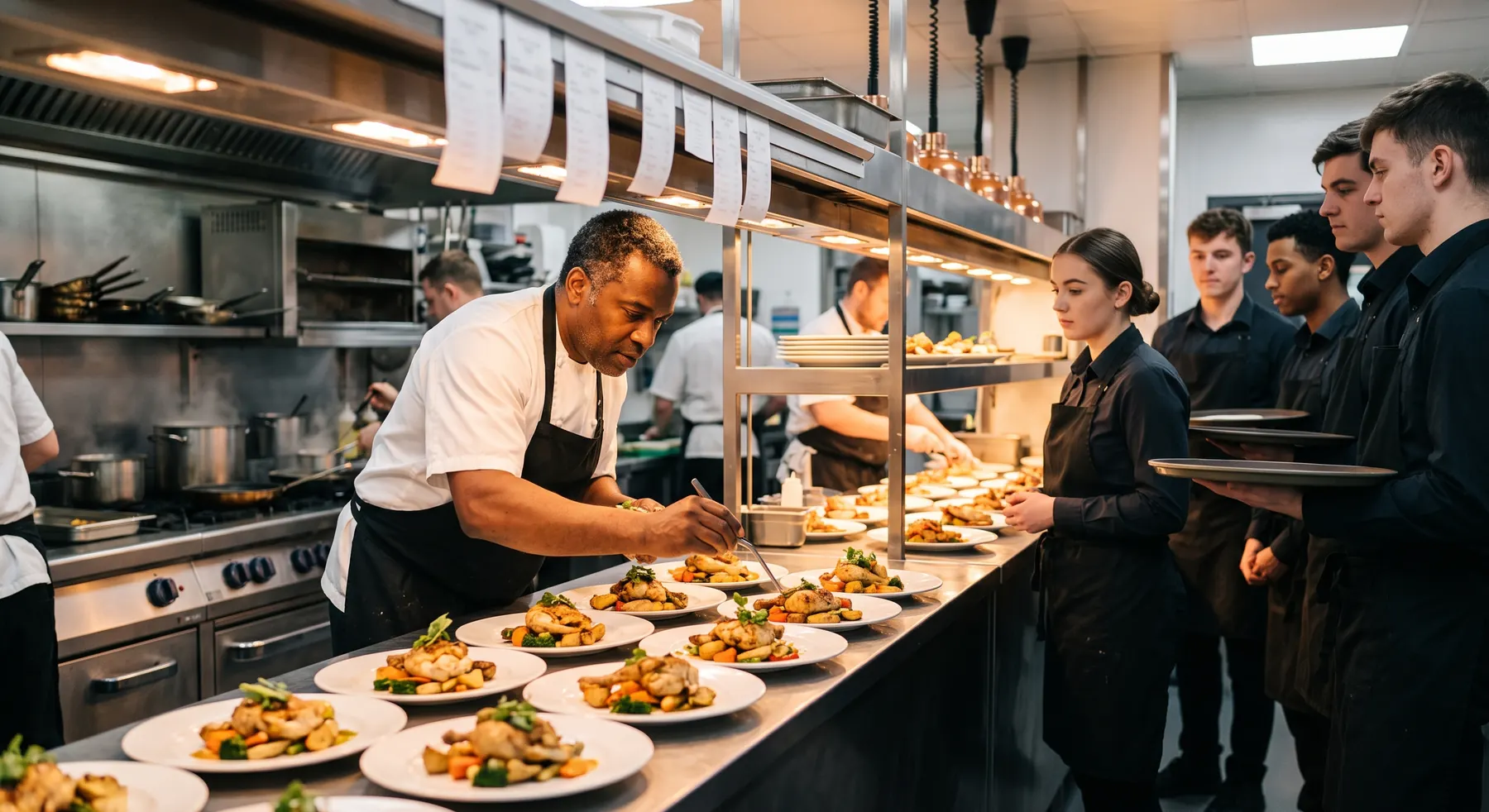
The kitchen's timeline, for 120 covers of plated service, says something closer to this: protein on at 17:45, sauces held from 18:30, garnish prepped by 18:45, plates in the warmer from 19:00, service brigade briefed at 19:10, first plates leaving the pass at 19:28.
Both documents describe the same dinner. Only one of them is in the client's hands, and the gap between them is where most catering failures live.
The important consequence is that "19:30 — dinner" is ambiguous in a way that costs about fifteen minutes. Does it mean guests are seated at 19:30, or that the first course is on the table at 19:30? A caterer reading the first and a client meaning the second have just built a quarter-hour of disagreement into the evening — and that quarter-hour lands squarely in the speeches.
Write service lines as plate-on-table times. "19:30 — first course on tables" is a number a kitchen can work backwards from. It removes the ambiguity for free.
The numbers that govern service
| Element | Realistic figure | Notes |
|---|---|---|
| Plated service, per course | 12–18 min | For 100–150 guests at proper ratios |
| Three-course plated dinner | 90–120 min | Including clearing and inter-course gaps |
| Buffet service | 30–45 min | Queue is the constraint; two lines halve it |
| Canapé reception | 90 min | Standard before guests need substance |
| Servers, plated | 1 per 10–12 guests | Below this, service degrades rather than slows |
| Servers, buffet | 1 per 20–25 guests | Plus one per station |
| Servers, canapés | 1 per 30–40 guests | |
| Kitchen access before service | 3–5 hours | Longer for temporary kitchens |
| Final headcount deadline | 7–14 days | Should be contractual |
The staffing ratios are worth dwelling on, because they are the figures clients most often try to trim and the ones that fail least gracefully.
Service does not degrade linearly. At one server per twelve guests, plates leave the pass and are collected immediately. At one per twenty, plates start waiting — and a plate waiting under a heat lamp for four minutes is a materially worse dish than the one the chef sent. The kitchen's quality and the front-of-house ratio are the same number, which is not obvious to anyone who has not run service.
Kitchen access is the whole timeline
If a caterer asks one question about a venue, it is this one.
Three to five hours before first service for a plated dinner, depending on menu complexity and whether the kitchen is a real one or a temporary setup in a marquee. A temporary kitchen needs longer, because it needs building before it can cook.
This is where catering timelines collide with venue turnarounds. A caterer who planned on 15:00 kitchen access, and discovers on the day that the previous event's load-out runs until 15:30, has lost half an hour from a chain with no slack in it. It does not compress; it emerges as a late main course.
So confirm kitchen access in writing, before the event timeline is finalised, and treat a change to it as a change to the whole evening rather than a logistical detail.
Build a service run sheet freeSpeeches, and why the kitchen needs them
Nobody plates into a speech.
A main course leaving the kitchen during a toast arrives either cold, because it waited, or during the punchline, because it did not. Both are bad, and the caterer is the one who gets blamed for the first.
So the kitchen needs the speech order and expected duration, and — more importantly — a signal. Speeches run long. A caterer working from a printed schedule that says speeches end at 20:15 will fire the main at 20:05, and if the best man is still going at 20:20, the evening has a problem that started fifteen minutes earlier in a room the client never sees.
The answer is a named person who signals the kitchen when the last speech begins. That is a thirty-second conversation on the day and it prevents the most common catering failure at any wedding. There is more on the cueing problem in the reception running order, and on what each vendor needs in who needs what, and when.
Headcount, and the dispute it causes
The final number drives purchasing, staffing, and equipment hire, and all three are committed before the event. A client who adds six guests four days out has added cost that has already been spent differently.
Contract it: a stated deadline, seven to fourteen days out, with a clear position on numbers above and below it. Most caterers charge for the confirmed number regardless of attendance and accept additions at a premium up to a cutoff. That is reasonable and clients accept it readily — provided it was stated at booking rather than discovered on the invoice.
Caterers working multiple events a week gain most from making the kitchen timeline reusable. The menu changes every time; the shape — access, prep blocks, brigade briefing, service, clear, load-out — barely changes at all, and rebuilding it per event is unpaid work that adds nothing.
What to ask the venue for
Four things, in writing, every time:
- Kitchen access time, and whether it is guaranteed or dependent on a previous event.
- What the kitchen actually contains — an "equipped kitchen" ranges from a full brigade setup to a sink and a worktop.
- Power and water, with locations. Marquee events in particular founder here.
- Load-out and waste disposal, including whether bins are emptied that night or left for you.
Venue managers who publish these four as a standard sheet get noticeably fewer day-of problems, because the caterer built the right timeline three weeks earlier instead of discovering the constraints at 15:00.
Service structures worth adapting sit in the corporate and wedding template collections.