







This Template at a Glance
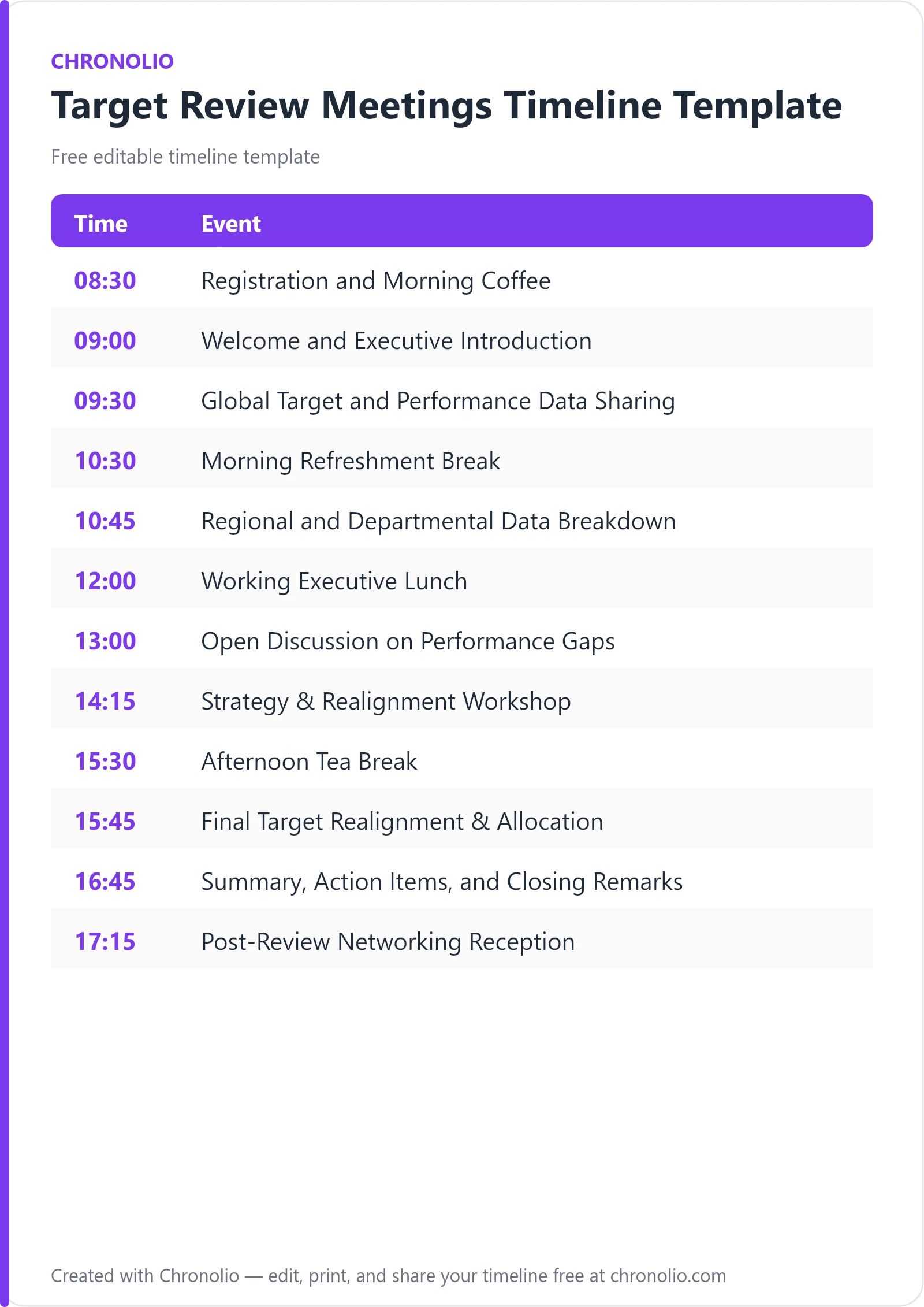
Here is the complete schedule this free template gives you — every time block, ready to edit, download, and share:
| Time | Event |
|---|---|
| 08:30 | Registration and Morning Coffee |
| 09:00 | Welcome and Executive Introduction |
| 09:30 | Global Target and Performance Data Sharing |
| 10:30 | Morning Refreshment Break |
| 10:45 | Regional and Departmental Data Breakdown |
| 12:00 | Working Executive Lunch |
| 13:00 | Open Discussion on Performance Gaps |
| 14:15 | Strategy & Realignment Workshop |
| 15:30 | Afternoon Tea Break |
| 15:45 | Final Target Realignment & Allocation |
| 16:45 | Summary, Action Items, and Closing Remarks |
| 17:15 | Post-Review Networking Reception |
What Is a Target Review Meetings Timeline?
Target review meetings are structured strategic sessions where corporate leaders, regional managers, and cross-functional teams assess operational performance against established key performance indicators (KPIs) and recalibrate future targets. A dedicated meeting timeline functions as the master blueprint for the day, keeping complex multi-department discussions on track and moving purposefully from high-level performance metrics down to individual accountabilities.
Having hosted hundreds of executive strategic sessions and quarterly business reviews, I can tell you that without a firm running order, high-stakes review sessions easily devolve into unproductive debate over missed targets or endless slide presentations. This template reflects real-world target review structures, designed to balance rigorous data analysis with constructive problem-solving. Whether you are running an executive review or preparing for a quarterly business alignment, having a structured schedule ensures every leadership voice is heard and every target is realistic. You can download this template as a customizable Word document or a printable PDF file to share with your executive team.
Edit This Target Review Meeting Timeline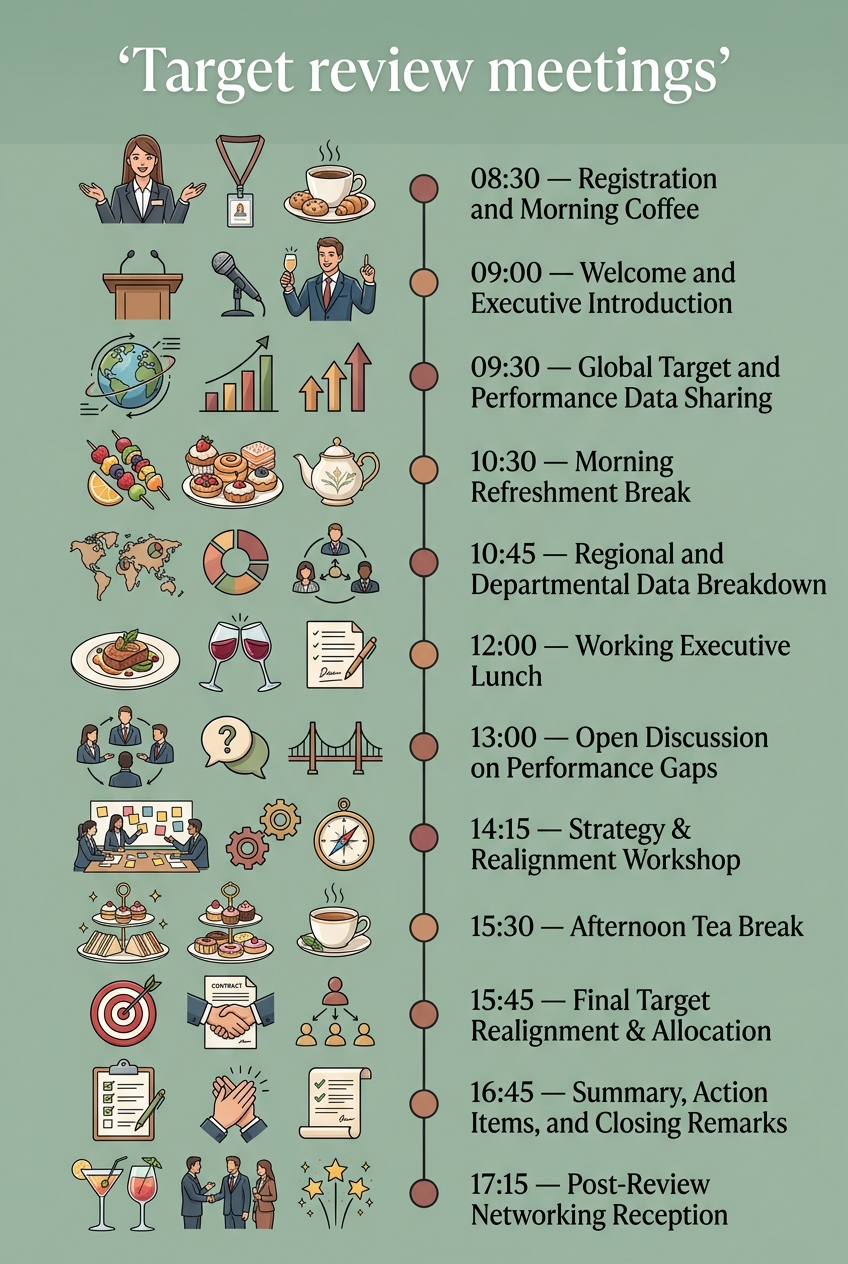
Why Target Review Meetings Need a Timeline
Executing an impactful target review requires orchestrating multiple executives, detailed financial reports, and cross-departmental priorities within a tight window. A precise schedule prevents data presentation overload from consuming the entire morning, leaving zero time for the strategic discussions that actually drive organizational growth.
Without structured time allocations, participants often become stuck defending historical variances rather than focusing on forward-looking realignment. Allocating fixed time blocks for gap analysis and breakout workshops ensures that teams pivot quickly from identifying problems to co-creating actionable solutions.
Furthermore, clear transitions keep high-level stakeholders engaged throughout an intense day. Much like keeping a structured timeline for formal enterprise events—or even balancing key moments in a corporate celebration using a board meeting timeline template or an anniversary party schedule—a disciplined corporate schedule maintains professional momentum from registration to the closing remarks.
What to Include in a Target Review Meetings Timeline
A successful target review meeting must move logically from macro analysis to tactical realignment. Here are the core phases every comprehensive review agenda should cover:
- Registration and Morning Hospitality: Informal gathering time for participants to arrive, network, check in, and receive meeting board packs.
- Executive Framing: A opening brief by leadership setting the vision, meeting ground rules, and overarching business context.
- Global Data & Performance Sharing: High-level presentation of company-wide revenue, operational metrics, and target achievements.
- Granular Departmental Breakdowns: Detailed review of regional, divisional, and team-specific performance data to isolate variances.
- Performance Gap Analysis: An open, collaborative forum addressing operational hurdles, market headwinds, and execution gaps.
- Strategy & Realignment Workshops: Small breakout group sessions dedicated to restructuring priorities and setting adjusted goals.
- Target Allocation & Deliverables: Formal presentation of updated targets, budget reallocations, and strategic milestones.
- Action Item Sign-off: Summarizing assigned accountabilities, follow-up dates, and executive closing remarks.
- Informal Networking: Post-meeting social time to solidify team cohesion and discuss next steps in a relaxed environment.
Phase 1: Registration, Executive Framing & Performance Data Sharing
| Time | Event |
|---|---|
| 08:30 | Registration and Morning Coffee |
| 09:00 | Welcome and Executive Introduction |
| 09:30 | Global Target and Performance Data Sharing |
| 10:30 | Morning Refreshment Break |
| 10:45 | Regional and Departmental Data Breakdown |
Starting bright and early at 08:30 in the Executive Foyer gives attendees a soft landing before diving into intensive data analysis. Providing morning coffee during registration allows leaders to connect informally, check in, and collect their physical board packs or review digital dashboards without feeling rushed into the main session.
At 09:00, everyone transitions into the Main Boardroom for the executive welcome. Setting clear expectations during the introduction ensures the room adopts a forward-thinking mindset rather than a defensive posture. By 09:30, leadership presents global performance metrics, establishing macro business context before diving into departmental specifics. Following a quick 15-minute coffee break at 10:30 to reset, the meeting resumes at 10:45 with granular regional data breakdowns, pinpointing specific variance drivers across individual teams before breaking for lunch.
Phase 2: Executive Lunch & Performance Gap Workshops
| Time | Event |
|---|---|
| 12:00 | Working Executive Lunch |
| 13:00 | Open Discussion on Performance Gaps |
| 14:15 | Strategy & Realignment Workshop |
At 12:00, participants move to the Dining Suite for a structured working executive lunch. A catered lunch provides crucial mental space for cross-functional networking, allowing regional heads and corporate officers to unpack the morning's data presentations in a conversational setting.
Reconvening in the Main Boardroom at 13:00, the schedule opens up for a candid discussion on performance gaps. Constructive debate around missed targets requires dedicated space so teams can air challenges, analyze market headwinds, and examine operational bottlenecks without feeling constrained by strict presentation slides. At 14:15, participants divide into Breakout Rooms A & B for strategy workshops. Splitting into smaller, focused working groups encourages hands-on problem solving, allowing teams to draft revised functional strategies and target adjustments for the coming periods.
Phase 3: Final Target Allocation & Closing Remarks
| Time | Event |
|---|---|
| 15:30 | Afternoon Tea Break |
| 15:45 | Final Target Realignment & Allocation |
| 16:45 | Summary, Action Items, and Closing Remarks |
After an intensive afternoon of group strategy work, a 15-minute tea break at 15:30 in the Executive Foyer offers essential decompression time before final decisions are codified. Brief refreshment breaks prevent cognitive fatigue from derailing key decisions during the final stretch of the day.
At 15:45, the entire assembly returns to the Main Boardroom to review the workshop outcomes. Reconvening as a unified body ensures alignment across all business units as leadership presents updated KPI allocations, revised resource distribution, and adjusted milestone targets. The formal work concludes at 16:45 with a tight 30-minute summary session, where action items are assigned, accountability owners are confirmed, and closing remarks solidify executive commitment.
Phase 4: Post-Review Networking Reception
| Time | Event |
|---|---|
| 17:15 | Post-Review Networking Reception |
The hard strategic work finishes at 17:15, transitioning attendees up to the Rooftop Terrace for a post-review networking reception. Ending intense strategy days with a relaxed social reception reinforces trust and helps repair any creative tension that may have surfaced during performance gap discussions.
Hosting evening drinks provides a natural environment for leaders to discuss cross-departmental collaboration, build stronger peer relationships, and celebrate shared commitments before returning to their respective business units.
Target Review Meetings Timeline vs Target Review Meetings Agenda
It is common for event organizers to confuse a review meeting timeline with a review meeting agenda, but they serve distinct corporate governance functions:
| Feature / Dimension | Target Review Meetings Agenda | Target Review Meetings Timeline |
|---|---|---|
| Primary Focus | Topics, discussion themes, and presenter lists | Exact clock times, room transitions, and event flow |
| Level of Detail | High-level summary of meeting subjects | Minute-by-minute operational schedule |
| Primary Audience | Attendees, board members, and presenters | Facilitators, venue operators, caterers, and coordinators |
| Operational Impact | Guides what will be discussed | Controls how the day stays strictly on schedule |
| Flexibility | High-level sequence can shift as needed | Fixed time blocks prevent room overruns and catering delays |
While a meeting agenda lists topic headers and presentation slides, a target review timeline defines real-time execution across locations, specifying exact start times, room moves, breakout shifts, and catering setups.
Who Should Use This Template?
This review meeting structure is engineered for organizations that manage complex performance metrics, multi-tiered leadership structures, or enterprise OKR/KPI cycles. Research on management execution published by Harvard Business Review consistently highlights that strategic performance management relies on clear communication channels and dedicated evaluation frameworks.
This template is ideal for:
- Executive Leadership Teams: Managing quarterly or annual corporate performance reviews.
- Regional & Divisional Directors: Assessing multi-market metrics and aligning localized targets with overarching company goals.
- Department Heads & Functional Leads: Analyzing team-level variances and requesting resource realignments.
- PMO & Strategy Officers: Facilitating structured planning days across enterprise business units.
- Growth & Sales Operations Managers: Reviewing revenue targets, quota attainments, and market performance metrics.
Chronolio offers customizable workflows tailored to the distinct roles involved in orchestrating enterprise meetings, ensuring smooth coordination between meeting chairs, facilitators, and logistics personnel.
How to Use This Template
- Download or Duplicate the Master Schedule: Access the timeline directly inside Chronolio, or download the pre-formatted Word version or printable PDF version.
- Set Your Target Review Date and Venue: Update the meeting date, location details, and dedicated room names (such as main boardrooms or breakout suites).
- Customize Presentation and Workshop Durations: Adjust session lengths based on the number of departments presenting performance data.
- Assign Discussion Leads and Presenters: Add names of executive sponsors, presenters, and breakout facilitators directly into the timeline notes.
- Distribute Pre-Reading Materials: Share the finalized timeline alongside board packs and performance reports at least 3 to 5 business days in advance.
Tips for a Successful Target Review Meeting
- Distribute Performance Data Early: Never use review meeting time for basic reading. Send metrics packs out days ahead so attendees arrive ready to discuss strategy.
- Maintain a Forward-Looking Ratio: Spend no more than 30% of the day reviewing past data; devote the remaining 70% to root-cause analysis, strategy realignment, and future targets.
- Enforce Strict Presentation Time Limits: Keep departmental metric presentations brief by requiring leads to highlight only major achievements and key variances.
- Use Neutral Facilitators for Gap Analysis: Designate an impartial chair or external consultant to moderate performance gap discussions, keeping conversations productive and objective.
- Define Actionable Breakout Objectives: Ensure every breakout workshop group leaves their session with three concrete, measurable target adjustments.
- Pace Breaks Strategic Realignment: Schedule short refreshment breaks after intense sessions to maintain energy levels and focus throughout the day.
- Re-anchor Personal and Team Events: Just as precision timing elevates enterprise strategy sessions, structured scheduling ensures balance for personal events—from organizing a birthday party timeline template to coordinating a milestone baby shower timeline.
Common Mistakes to Avoid
- Data Overload without Context: Presenting hundreds of spreadsheet rows without highlighting critical variances leads to executive fatigue. Focus on core metrics that drive strategic outcomes.
- Allowing Blame-Shifting during Gap Discussions: Unstructured gap analysis can descend into defensive posturing. Ground discussions strictly in verifiable operational data and constructive problem-solving.
- Neglecting Room and AV Logistics: Failing to test breakout AV equipment or hybrid video links in advance wastes precious meeting minutes.
- Overbooking the Agenda: Packing too many topics into single time blocks inevitably causes schedule overruns, forcing team leads to rush closing action items.
- Failing to Capture Clear Action Owners: Assigning updated targets without naming explicit accountable leads leads to poor execution after the meeting concludes.
- Skipping Informal Networking: Rushing attendees out the door immediately after closing remarks cuts off informal alignment discussions that often yield key strategic breakthroughs, as highlighted in organizational research by McKinsey & Company.
In Summary
- What It Is: A comprehensive, full-day timeline structured to transition teams seamlessly from historical performance analysis to future target realignment.
- Who It Is For: Executive teams, department heads, strategy leads, and operations directors reviewing business metrics.
- Key Phases Covered: Morning registration, global and regional data sharing, gap analysis discussions, strategy breakout workshops, final target allocation, and networking.
- Primary Benefit: Keeps complex multi-department meetings running on time while protecting space for high-value strategic decision-making.
- Download Formats: Fully editable and available as a downloadable Word document or printable PDF agenda.
Mastering target review meetings requires a careful balance between historical data analysis and forward-looking strategic execution. By implementing a proven timeline, executive leadership teams, departmental managers, and strategy officers can transform quarterly reviews from passive presentations into decisive, high-alignment strategy sessions that drive organizational performance.
Edit This Target Review Meeting Timeline