







This Template at a Glance
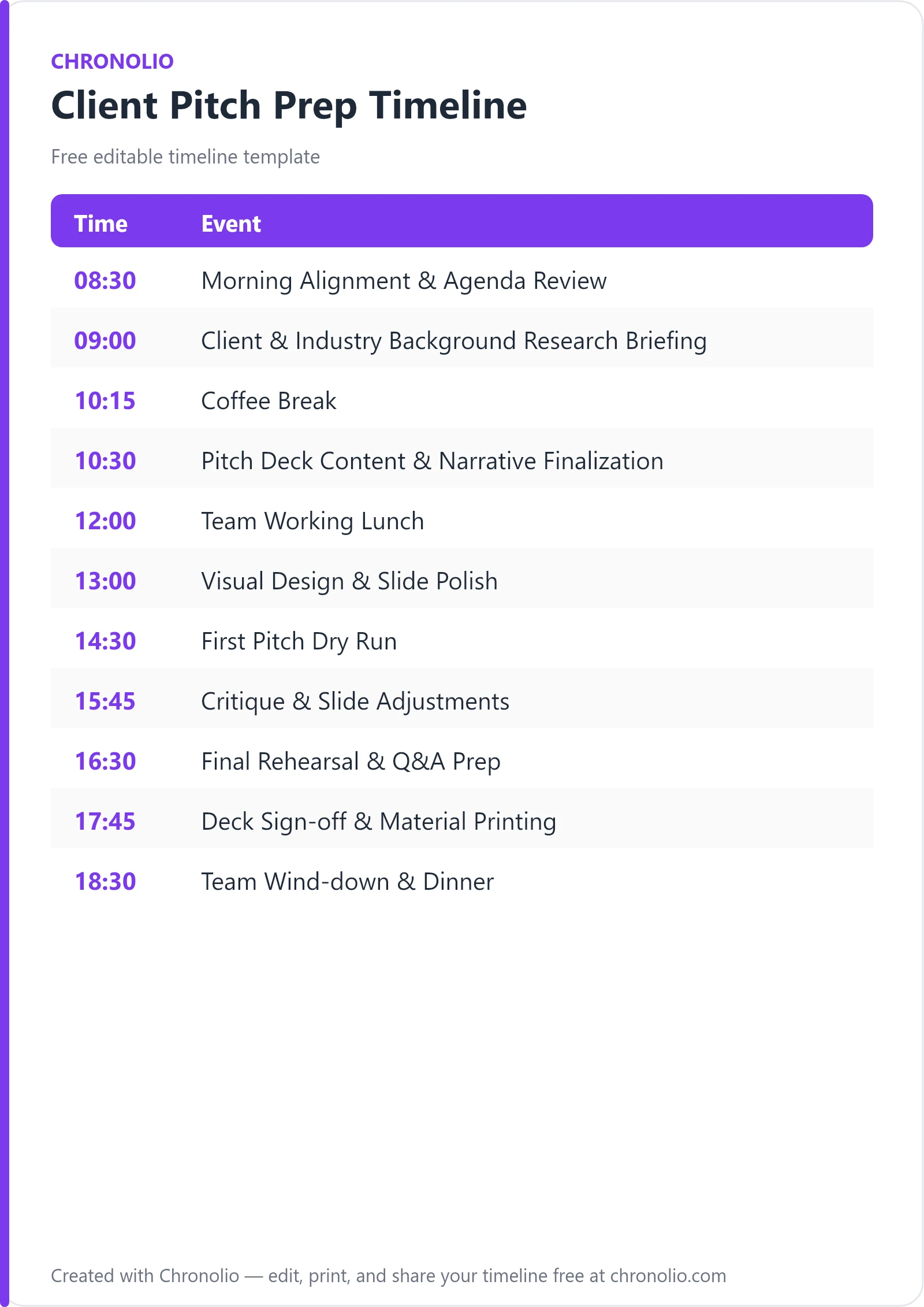
Here is the complete schedule this free template gives you — every time block, ready to edit, download, and share:
| Time | Event |
|---|---|
| 08:30 | Morning Alignment & Agenda Review |
| 09:00 | Client & Industry Background Research Briefing |
| 10:15 | Coffee Break |
| 10:30 | Pitch Deck Content & Narrative Finalization |
| 12:00 | Team Working Lunch |
| 13:00 | Visual Design & Slide Polish |
| 14:30 | First Pitch Dry Run |
| 15:45 | Critique & Slide Adjustments |
| 16:30 | Final Rehearsal & Q&A Prep |
| 17:45 | Deck Sign-off & Material Printing |
| 18:30 | Team Wind-down & Dinner |
What Is a Client Pitch Prep Timeline?
Client pitch prep is the strategic, internal workflow execution conducted by a deal team prior to presenting to a prospective client or major decision-maker. Running a successful pitch is rarely about individual brilliance on stage; it is the direct result of a rigorous preparation process that aligns strategy, narrative design, speaker handoffs, and objection handling long before stepping into the boardroom.
This client pitch prep schedule structures an entire intensive workday into clear, actionable blocks. Built on real-world agency and corporate business development best practices, this framework transforms chaotic last-minute slide edits into a predictable, calm preparation system. By systematically advancing from morning strategic research to afternoon dry runs and evening sign-off, your pitch team protects valuable mental bandwidth and delivers a winning presentation.
Customize Your Client Pitch Prep Timeline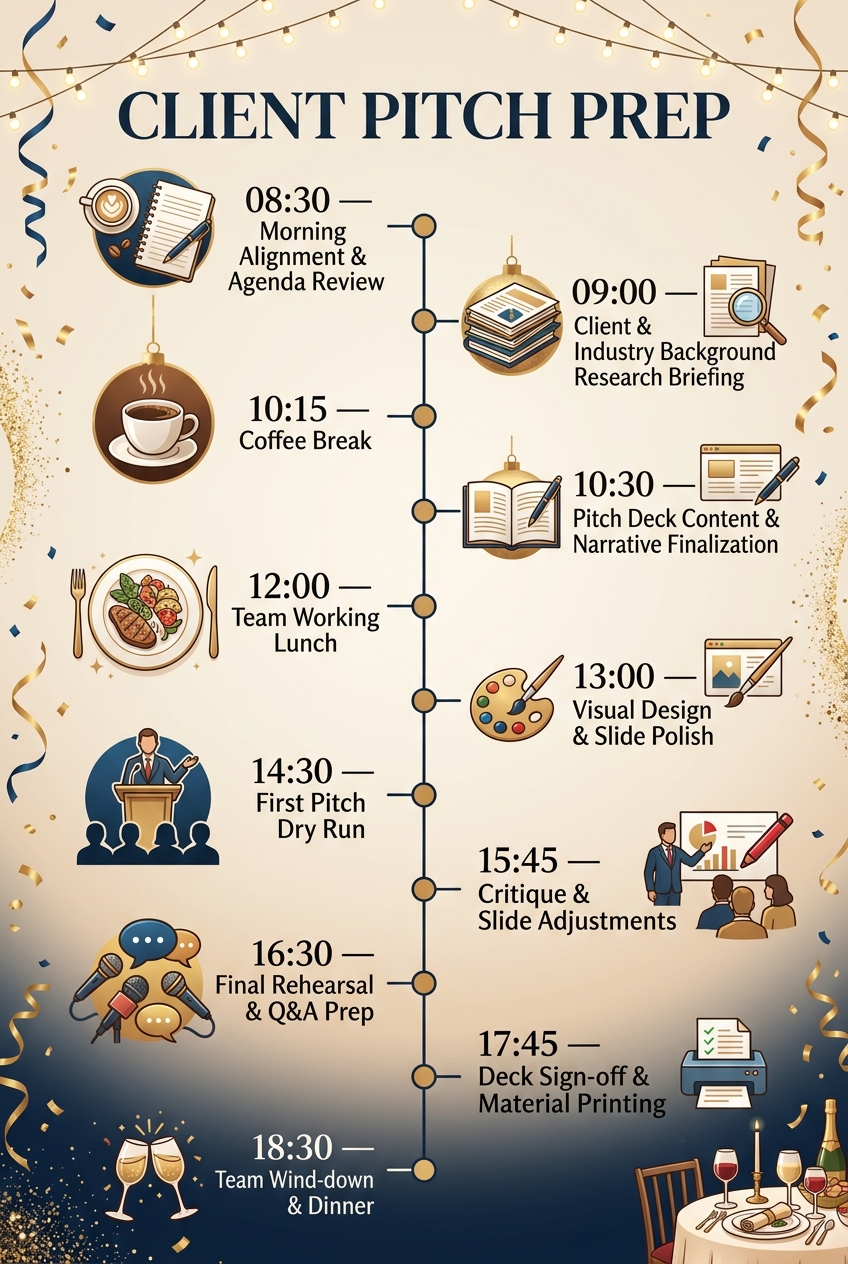
Why Client Pitch Prep Needs a Timeline
When high-stakes revenue or major contracts are on the line, unstructured pitch preparation almost always leads to midnight presentation revisions and fragmented team messaging. Without a disciplined schedule, teams spend four hours debating slide formatting and leave zero time for actual verbal practice.
A dedicated prep timeline establishes strict temporal boundaries for each stage of deal preparation. It forces the team to lock content early, shifting focus from slide creation to presentation delivery, body language, and team coordination.
Furthermore, a timed prep framework creates operational accountability across departments. Account directors, visual designers, strategists, and executive sponsors know exactly when their inputs are required and when handoffs occur, ensuring seamless collaboration across all roles involved in closing the account.
What to Include in a Client Pitch Prep Timeline
A complete preparation schedule must account for every phase of presentation readiness, balancing mental analysis with verbal practice:
- Strategic research alignment: Deep-dive analysis of prospective client stakeholders, industry news, and competitive positioning.
- Narrative arc finalization: Refining the value proposition, messaging structure, and strategic problem-solving arc.
- Visual design locking: Finalizing slide formatting, graphics, custom data visualizations, and media assets.
- Initial dry run: A timed complete walkthrough to evaluate narrative flow, slide transitions, and speaker synergy.
- Critique and slide edits: Targeted polish to remove verbal friction and fix design inconsistencies.
- Final rehearsal and Q&A defense: Simulated presentation including tough objection handling and prospective client Q&A.
- Executive sign-off and printing: Final deck export and physical collateral production.
- Team wind-down: Restful team connection to boost morale and reduce presentation anxiety before pitch day.
Phase 1: Morning Alignment & Strategic Research
| Time | Event |
|---|---|
| 08:30 | Morning Alignment & Agenda Review |
| 09:00 | Client & Industry Background Research Briefing |
| 10:15 | Coffee Break |
The morning begins by setting clear ground rules for the prep day in Main Conference Room A. The team aligns on the overarching pitch goals, target contract scope, and individual presentation assignments before opening any slide software.
Following initial alignment, the group moves into the Strategy War Room to review comprehensive intelligence on the client. Analyzing recent client news and competitive movements equips presenters with key context so their talking points align precisely with the prospective client's immediate business pressures. A quick pause in the Office Lounge gives everyone a chance to absorb key research takeaways before building out the deck narrative.
Phase 2: Narrative Finalization & Visual Design
| Time | Event |
|---|---|
| 10:30 | Pitch Deck Content & Narrative Finalization |
| 12:00 | Team Working Lunch |
| 13:00 | Visual Design & Slide Polish |
Transitioning back to the Strategy War Room, the team spends mid-morning refining the presentation narrative arc. The focus here must remain on persuasive storytelling and strategic value, ensuring every slide directly answers the client's RFP requirements. You can download baseline templates in Word format or access a print-ready PDF download to help team members take structured notes during storyboarding.
During a catered lunch in the Executive Dining Room, informal discussions center on presentation dynamics and establishing smooth transitions between co-presenters. Immediately after lunch, the design team takes over in the Design Studio to apply brand polish, custom data graphics, and polished layouts, ensuring the visual collateral matches the high quality of the narrative.
Phase 3: Rehearsals & Objection Handling
| Time | Event |
|---|---|
| 14:30 | First Pitch Dry Run |
| 15:45 | Critique & Slide Adjustments |
| 16:30 | Final Rehearsal & Q&A Prep |
The afternoon centers on active practice within the Main Presentation Room. The first dry run is a strict, timed walkthrough where presenters practice verbal delivery and slide pacing. Treat this run-through as live; co-presenters should observe without interrupting so timing issues naturally surface.
After the initial run, the team reconvenes in the Strategy War Room to address friction points, trim unnecessary slides, and tighten handoffs. The session culminates in a high-intensity final rehearsal where team members role-play challenging client questions and objection scenarios. Learning to navigate tough questions as a unified team builds immense confidence for the live meeting.
Phase 4: Sign-off & Team Wind-down
| Time | Event |
|---|---|
| 17:45 | Deck Sign-off & Material Printing |
| 18:30 | Team Wind-down & Dinner |
The late afternoon is reserved for executive sign-off in the Executive Boardroom. Once executive sponsors approve the final version, the presentation is strictly locked—no further slide edits permitted. The team exports digital copies and prints physical leave-behind booklets for prospective stakeholders.
Finally, the team leaves the office for a relaxed dinner at Bistro Downtown. Unwinding together helps reduce pre-pitch stress and ensures everyone enters the client meeting well-rested, energized, and completely aligned.
While this timeline is structured specifically for commercial pitch prep, managing time-sensitive group dynamics follows similar principles across many high-stakes operational events. Whether managing corporate governance schedules like a board meeting timeline or personal milestone celebrations like an anniversary party schedule, birthday party timeline, or baby shower timeline, dedicated agendas keep participants focused and calm.
Client Pitch Prep Timeline vs Presentation Agenda
It is critical not to confuse internal client pitch prep timelines with the actual presentation agenda shared with prospective clients.
| Feature | Pitch Prep Timeline (Internal) | Presentation Agenda (External) |
|---|---|---|
| Primary Audience | Internal pitch team, leads, and designers | Client stakeholders and decision-makers |
| Core Objective | Deck polishing, dry runs, and role clarity | Delivering value, solution overview, and closing |
| Time Horizon | Full day (8–10 hours prior to pitch) | 30 to 90 minutes on pitch day |
| Content Focus | Content edits, design, rehearsal, Q&A prep | Executive summary, pitch delivery, live Q&A |
While the external agenda dictates what the prospective client experiences, the internal prep timeline guarantees your team delivers that agenda flawlessly.
Who Should Use This Template?
This structured client pitch prep schedule is built for high-stakes business environments where presentation quality directly impacts revenue generation:
- Creative & Marketing Agencies: Pitched teams responding to major brand RFPs requiring strategy, creative concepts, and media plans.
- Management Consulting Firms: Strategy consultants presenting complex transformation proposals to C-suite executives.
- Enterprise B2B Sales Teams: Account executives and solution engineers staging technical demos for enterprise buyers.
- Startup Founders: Executive teams preparing for critical venture capital pitch sessions or strategic partner meetings.
- Investment Banking & Corporate Finance: Deal teams preparing pitch books for M&A advisory or capital raising meetings.
Chronolio offers full layout flexibility, allowing different corporate roles to adapt this template to their internal review workflows.
How to Use This Template
- Duplicate or Export: Load this timeline directly into Chronolio or download reference copies in Word or PDF format.
- Set Your Target Time: Adjust the schedule start time based on when your team begins prep on the day prior to the client meeting.
- Assign Specific Room Locations: Map out physical rooms (e.g., War Room, Design Studio, Boardroom) or virtual breakout links to keep the team moving.
- Designate Pitch Lead & Roles: Clearly assign who leads each dry run, who manages deck edits, and who drives Q&A prep.
- Enforce the Content Lock: Enforce a strict stop time for slide edits so the team focuses purely on delivery during final rehearsals.
Tips for a Successful Client Pitch Prep
- Enforce a strict deck freeze: Stop all slide design and copy changes at least 12 hours before the pitch. Last-minute slide tweaks break verbal muscle memory.
- Simulate the actual environment: Rehearse in a room with the exact AV setup, screen dimensions, and seating layout expected at the client site.
- Assign dedicated Q&A leads: Assign primary slide owners to handle specific topics (e.g., pricing, technical delivery, strategy) so speakers never talk over one another during client questioning.
- Film or record your dry runs: Replay recording clips during critique sessions to evaluate body language, eye contact, and pacing. Experts at Harvard Business Review emphasize that visual feedback dramatically improves executive presentation delivery.
- Prepare high-quality leave-behinds: Print professional physical collateral and load clean PDF files onto branded drives well before the evening deadline.
Common Mistakes to Avoid
- Over-indexing on slides over speaking: Spending 90% of prep time tweaking graphics and only 10% practicing verbal delivery.
- Allowing unassigned presenters: Having team members in the client room who do not have a defined speaking role or specific Q&A domain.
- Skipping the Q&A rehearsal: Practicing the main deck presentation perfectly but stumbling during unexpected client objections.
- Failing to check AV hardware: Assuming presentation clickers, adapters, and audio output will work without testing them during dry runs.
- Working past midnight: Running late-night editing sessions that leave presenters exhausted and off-key during the live pitch.
In Summary
- Strategic Focus: A client pitch prep timeline organizes internal agency and sales team preparation into structured phases.
- Balanced Workflow: Combines morning research and narrative finalization with afternoon dry runs and Q&A practice.
- Deck Protection: Mandates an early slide freeze to shift focus from graphic design to verbal delivery.
- Team Alignment: Prevents presenters from talking over each other and establishes clear subject matter leads for Q&A.
- Versatile Application: Serves agency pitches, enterprise B2B sales, consulting proposals, and venture funding presentations.
By maintaining disciplined timing throughout your client pitch prep, your team replaces anxiety with quiet confidence, ensuring that when pitch day arrives, your value proposition stands out and closes the deal.
Customize Your Client Pitch Prep Timeline