





This Template at a Glance
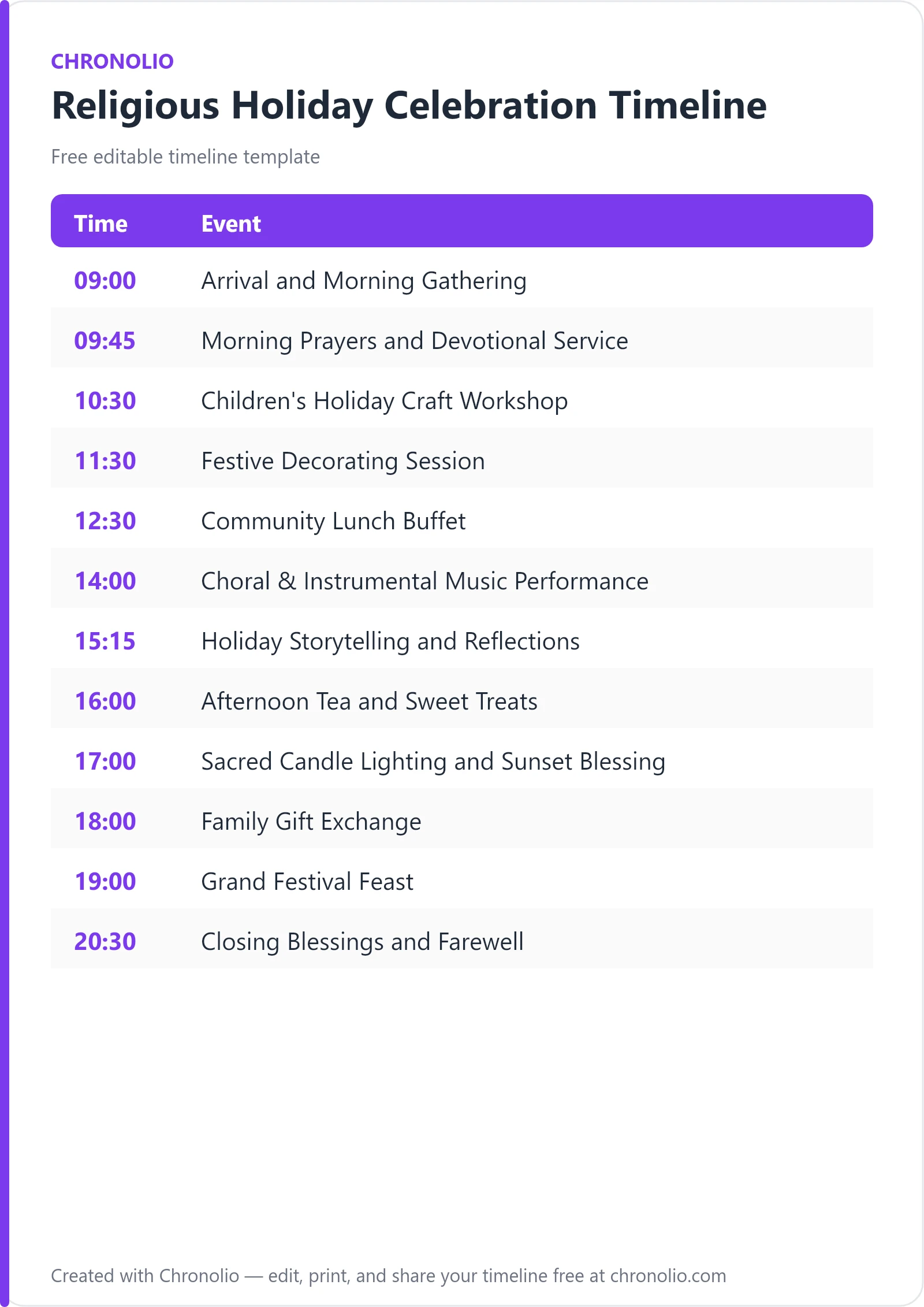
Here is the complete schedule this free template gives you — every time block, ready to edit, download, and share:
| Time | Event |
|---|---|
| 09:00 | Arrival and Morning Gathering |
| 09:45 | Morning Prayers and Devotional Service |
| 10:30 | Children's Holiday Craft Workshop |
| 11:30 | Festive Decorating Session |
| 12:30 | Community Lunch Buffet |
| 14:00 | Choral & Instrumental Music Performance |
| 15:15 | Holiday Storytelling and Reflections |
| 16:00 | Afternoon Tea and Sweet Treats |
| 17:00 | Sacred Candle Lighting and Sunset Blessing |
| 18:00 | Family Gift Exchange |
| 19:00 | Grand Festival Feast |
| 20:30 | Closing Blessings and Farewell |
What Is a Religious Holiday Celebration Timeline?
A religious holiday celebration timeline is an all-inclusive master operational schedule that organizes every spiritual, social, and logistical moment of a communal holy day. Whether you are welcoming hundreds of congregants to a regional worship center or hosting an intimate parish gathering, balancing sacred liturgies with family social hours requires clear temporal structure. Managing multi-generational crowds, catering staff, choir directors, and volunteer coordinators across multiple spaces—such as the main sanctuary, activity halls, and outdoor courtyards—demands a synchronized plan.
Having managed dozens of multi-room congregational festivals and sacred observances, I can assure you that a well-structured schedule prevents rushing during solemn prayers and avoids awkward dead time during food preparation. This template reflects proven real-world event structures, combining traditional devotional elements with modern event management best practices. By clearly mapping out transitions between worship, children's workshops, and communal feasts, you ensure that clergy, volunteers, and participants stay aligned and focused on the deeper spiritual significance of the day.
Customize Your Religious Holiday Celebration Timeline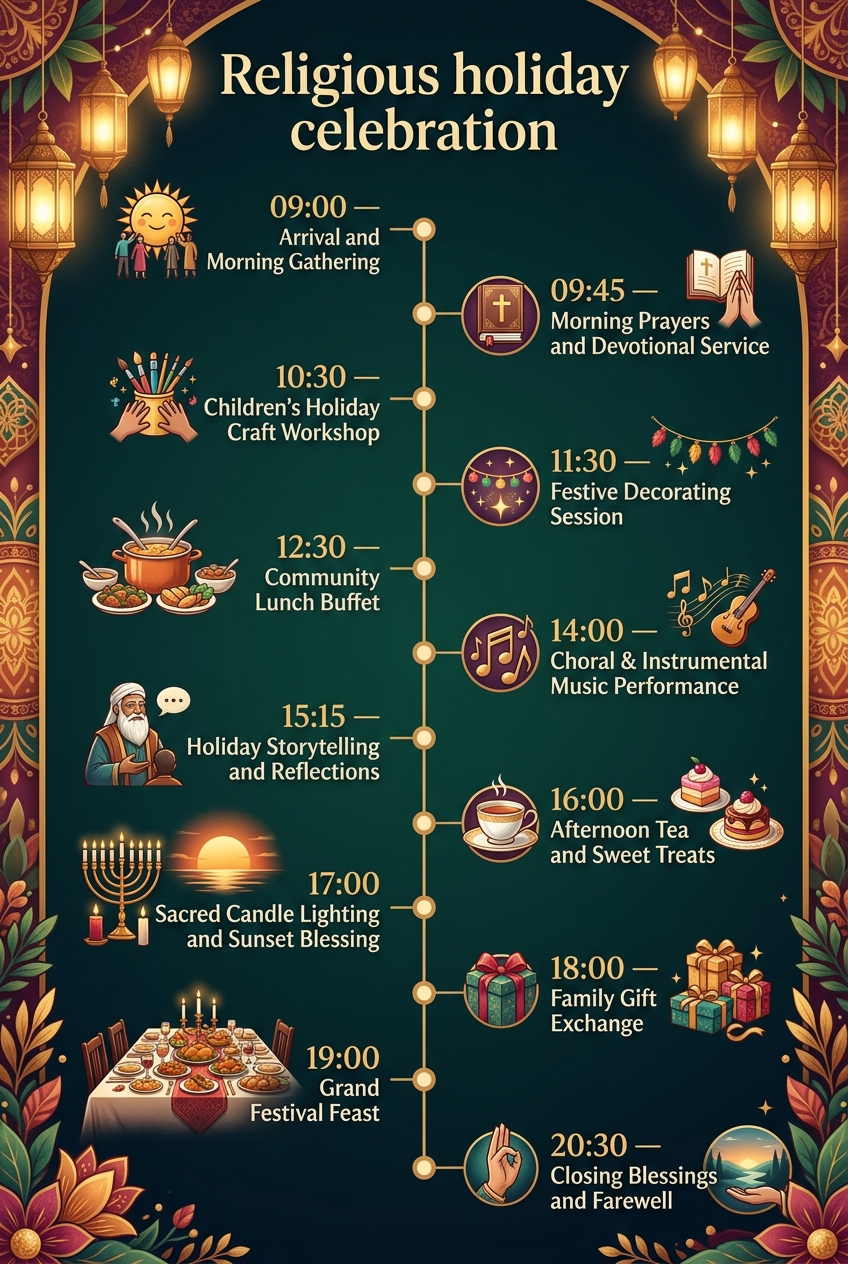
Why Religious Holiday Celebrations Need a Timeline
Organizing a major holy day involves coordinating many moving parts simultaneously. Without a clear schedule, sacred rituals risk feeling rushed or overshadowing social fellowship, leaving attendees confused about where they need to be. A centralized timeline acts as a single source of truth for clergy, worship leaders, facilities crews, and hospitality volunteers.
When multi-generational gatherings run late, families with small children or elderly members may become fatigued and miss out on crucial ceremonial moments. Establishing predictable start times for key events—like morning prayer, afternoon tea, and sunset blessings—ensures that everyone can participate fully without unnecessary stress.
Furthermore, multi-space facilities require rigorous coordination. If a youth craft session in the activity hall runs over, it can spill into the space reserved for community dining setup. A shared timeline establishes strict operational boundaries while giving hospitality staff the exact windows they need to prepare hot meals and transition room layouts seamlessly.
What to Include in a Religious Holiday Celebration Timeline
To build an engaging and spiritually uplifting holiday experience, your operational schedule should feature a balanced mix of reverent worship, active fellowship, and logistical buffers:
- Welcome and Registration Buffer: Dedicated time for arrival, warm greetings, coat check, and light morning refreshments.
- Liturgical and Devotional Services: Central worship sessions, scriptural readings, congregational prayers, and clergy addresses.
- Intergenerational Programming: Interactive craft workshops, lantern making, and educational activities tailored for children and youth.
- Collaborative Hall Decorating: Shared community activities to adorn common spaces with traditional seasonal symbols, flowers, and banners.
- Communal Meals and Refreshments: Structured buffet lunches, afternoon tea breaks, and a formal evening celebration feast.
- Cultural and Artistic Performances: Choir anthems, instrumental recitals, and traditional storytelling led by community elders.
- Sacred Rites and Seasonal Ceremonies: Outdoor or indoor candle lightings, sunset prayers, and symbolic holiday rituals.
- Closing Liturgy and Departures: Final benedictions, expressions of gratitude, and a coordinated send-off.
Morning Devotion & Interactive Workshops
| Time | Event |
|---|---|
| 09:00 | Arrival and Morning Gathering |
| 09:45 | Morning Prayers and Devotional Service |
| 10:30 | Children's Holiday Craft Workshop |
| 11:30 | Festive Decorating Session |
The day opens in the Community Center Foyer, where welcoming registration teams greet families with warm holiday greetings and light refreshments as soft background music plays. Allowing a 45-minute arrival window lets out-of-town guests find parking, hang coats, and settle comfortably before formal worship begins. At 09:45, guests transition into the Main Sanctuary for morning prayers, opening scriptural readings, and congregational hymns led by spiritual leaders, establishing a reverent and joyful tone for the observance.
Following the devotional service, the program branches out to accommodate different age groups. At 10:30, children move to the Youth Activity Hall for a craft workshop, where trained youth volunteers guide young participants through making traditional holiday lanterns and painted ornaments. Meanwhile, older youth and adults gather in the Main Celebration Hall at 11:30 for a festive decorating session. Working together to drape floral garlands and hang traditional banners builds a strong sense of shared stewardship and communal joy prior to lunch.
If your organization hosts other major milestone gatherings during the year, you can pair this framework with our Christian wedding timeline or review a Catholic wedding timeline when coordinating complex multi-space religious ceremonies.
Midday Fellowship & Musical Performance
| Time | Event |
|---|---|
| 12:30 | Community Lunch Buffet |
| 14:00 | Choral & Instrumental Music Performance |
| 15:15 | Holiday Storytelling and Reflections |
By 12:30, guests gather in the Dining Hall for a community lunch buffet featuring customary seasonal dishes. This 75-minute dining block serves as an vital social anchor, giving neighbors and visiting families dedicated time to reconnect over traditional cuisine. Hospitality volunteers utilize this window to reset the Main Sanctuary for afternoon arts programming.
At 14:00, attendees return to the Main Sanctuary Stage for a choral and instrumental performance. The choir and instrumental ensembles perform sacred carols and traditional hymns, inviting audience participation during well-known sacred melodies to deepen communal engagement. Immediately following the music at 15:15, community elders take the stage for holiday storytelling and moral reflections. Sharing scriptural teachings and ancestral history reinforces core values of gratitude, heritage, and shared faith across generations.
Twilight Ceremonies & Festival Evening
| Time | Event |
|---|---|
| 16:00 | Afternoon Tea and Sweet Treats |
| 17:00 | Sacred Candle Lighting and Sunset Blessing |
| 18:00 | Family Gift Exchange |
| 19:00 | Grand Festival Feast |
| 20:30 | Closing Blessings and Farewell |
At 16:00, the event transitions toward its evening phase with afternoon tea and holiday pastries in the Dining Hall. This quiet interlude provides a relaxing pause for conversation before dusk gatherings, allowing facilities staff to prepare the outdoor grounds for evening rites. At 17:00, as natural daylight fades, the entire congregation assembles in the Central Courtyard for the sacred candle lighting ceremony and sunset prayer. The flickering flames shining in the dusk symbolize spiritual renewal, light, and hope.
Following the courtyard ceremony, guests return inside to the Main Celebration Hall at 18:00 for the family gift exchange. Children and parents participate in this joyous tradition, creating cherished memories as gifts are distributed and unboxed in a festive room atmosphere. Similar family-centered gathering dynamics can also be found in our birthday party timeline and anniversary party schedule guides.
The celebration reaches its culinary peak at 19:00 in the Grand Ballroom with the formal Grand Festival Feast. Featuring specialized holiday recipes, formal toasts, and collective expressions of thanksgiving, this extended dinner block lets guests savor holiday traditions fully. Finally, at 20:30, everyone moves to the Main Sanctuary for closing blessings, a brief devotional reading, and final farewells, sending attendees home inspired and uplifted.
Religious Holiday Celebration Timeline vs Religious Order of Service
It is common to confuse an overall holiday celebration timeline with a religious order of service. While both are essential planning documents, they serve distinct operational functions and target different audiences:
| Feature / Aspect | Event Celebration Timeline | Order of Service (Liturgy) |
|---|---|---|
| Primary Scope | Full multi-hour or full-day event footprint | Specific worship service duration (e.g., 60 mins) |
| Key Content | Logistics, setup, meals, workshops, timing | Scripture readings, sermons, prayers, choral pieces |
| Primary Audience | Organizers, venue staff, caterers, volunteers | Worship leader, congregation, celebrants, choir |
| Locations Covered | Multiple rooms, halls, dining areas, outdoors | Single worship space or sanctuary pulpit |
| Flexibility | Dynamic; adjusted for food prep & transitions | Highly fixed by ritual, canon, or liturgical rubrics |
While the liturgical order of service governs what happens on the altar or pulpit, the master timeline coordinates every room, meal, and setup phase across the entire building.
Who Should Use This Template?
This master holiday schedule is engineered for faith-based organizers, venue managers, and community directors responsible for executing large, multi-faceted holiday events. chronolio supports the diverse roles involved in bringing sacred celebrations to life.
- Places of Worship & Parishes: Synagogues, churches, mosques, temples, and gurdwaras hosting annual holy days.
- Faith Community Centers: Cultural hubs and interfaith organizations conducting community-wide festivals.
- Youth & Campus Ministries: Student groups and religious education directors running holiday youth retreats.
- Interfaith Alliances: Civic committees hosting multi-faith celebrations and shared holiday meals.
- Clergy & Pastoral Staff: Religious leaders coordinating sacred services alongside social activities.
To consult academic and historical frameworks on interfaith holiday planning, explore resources provided by the Harvard Pluralism Project and Interfaith America.
How to Use This Template
You can adapt this timeline to your congregation’s unique customs and facility layout in just a few straightforward steps:
- Download or Duplicate: Open the editable Chronolio template above, or download our ready-to-use .docx format or .pdf format.
- Align Sunset & Ritual Times: Adjust the 17:00 Sacred Candle Lighting row to align precisely with your local sunset time or canonical prayer hour.
- Customize Activity Names: Modify specific workshop descriptions, prayer titles, and food service styles to reflect your religious tradition.
- Assign Room Venues: Confirm that every schedule block specifies the exact location (e.g., Main Sanctuary, Dining Hall, Central Courtyard).
- Distribute to Teams: Share tailored copies with catering managers, audio-visual technicians, youth coordinators, and clergy teams.
Tips for a Successful Religious Holiday Celebration
- Establish Clear Room Assignments: Clearly print locations on guest agendas to prevent bottlenecking in hallways during major room transitions.
- Coordinate Kitchen Timings Early: Meet with your culinary committee or external caterers two weeks prior to synchronize hot food service with devotional service end times.
- Assign Dedicated Youth Leaders: Ensure adult volunteers are stationed in craft areas so parents can participate fully in adult devotional sessions.
- Prepare Outdoor Weather Alternatives: Have a covered indoor backup plan ready for sunset candle lightings in case of rain or cold weather.
- Test Audio-Visual Systems: Conduct sound checks in the sanctuary and ballroom early in the morning to verify wireless microphone batteries and projector feeds.
- Designate Quiet Space: Set aside a smaller room for nursing mothers, elderly guests, or individuals seeking quiet prayer away from loud fellowship halls.
- Schedule Adequate Volunteer Relief: Rotate volunteer shifts at mid-day so hospitality staff can also participate in spiritual services.
Common Mistakes to Avoid
- Underestimating Food Buffets: Failing to open multiple buffet lines causes long meal queues that eat into afternoon performance blocks.
- Overpacking the Worship Agenda: Adding extra impromptu speakers can cause morning services to spill over, disrupting children's workshop start times.
- Ignoring Transition Windows: Forgetting to build 15-minute travel buffers between rooms results in chaotic, noisy hallway crowds.
- Forgetting Dietary Requirements: Serving unlabelled food during holiday feasts can inadvertently violate religious dietary rules for guests.
- Neglecting Evening Lighting Safety: Conducting outdoor sunset candle lightings without proper drip guards or wind lighters creates safety hazards.
- Failing to Print Physical Agendas: Relying solely on digital schedules leaves elderly congregants without clear timing information.
In Summary
- Comprehensive Scope: A religious holiday celebration timeline organizes sacred devotions, youth workshops, fellowship meals, and sunset rites across a full day.
- Target Audience: Designed for faith leaders, event coordinators, parish councils, and interfaith festival committees.
- Balanced Structure: Integrates solemn worship moments with active youth activities and communal dining.
- Multi-Space Management: Coordinates movement across sanctuaries, fellowship halls, activity centers, and outdoor courtyards.
- Enhanced Guest Experience: Keeps multi-generational crowds comfortable, informed, and spiritually engaged from morning arrival to final send-off.
- Fully Customizable: Easily tailored to match specific theological traditions, liturgical calendars, and local sunset times.
Executing an inspiring holy day requires balancing sacred tradition with practical event organization. By using this master schedule template, your leadership team can host a well-coordinated holiday celebration that honors your faith tradition, supports volunteer staff, and creates lasting spiritual memories for your entire community.
Customize Your Religious Holiday Celebration Timeline