





This Template at a Glance
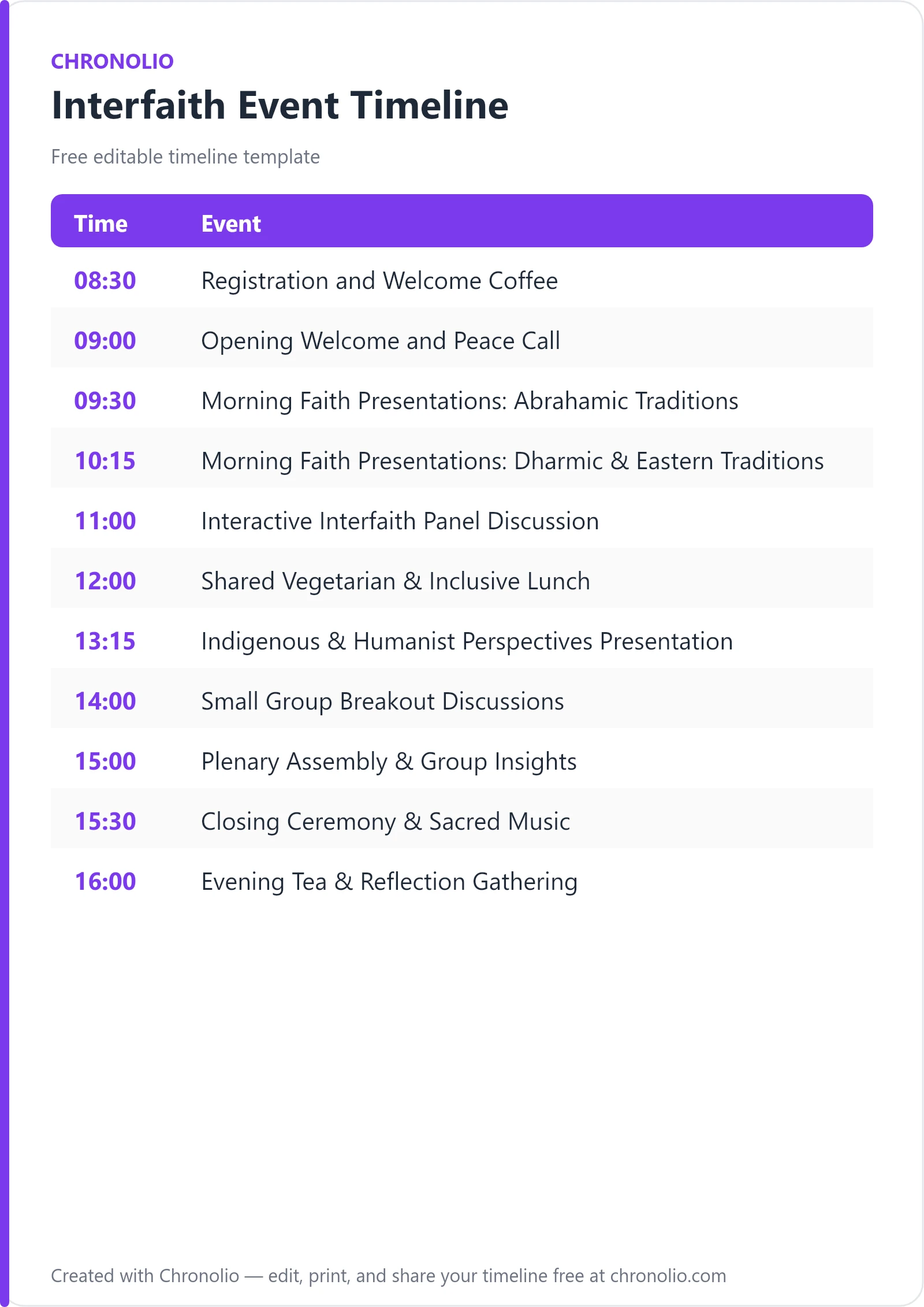
Here is the complete schedule this free template gives you — every time block, ready to edit, download, and share:
| Time | Event |
|---|---|
| 08:30 | Registration and Welcome Coffee |
| 09:00 | Opening Welcome and Peace Call |
| 09:30 | Morning Faith Presentations: Abrahamic Traditions |
| 10:15 | Morning Faith Presentations: Dharmic & Eastern Traditions |
| 11:00 | Interactive Interfaith Panel Discussion |
| 12:00 | Shared Vegetarian & Inclusive Lunch |
| 13:15 | Indigenous & Humanist Perspectives Presentation |
| 14:00 | Small Group Breakout Discussions |
| 15:00 | Plenary Assembly & Group Insights |
| 15:30 | Closing Ceremony & Sacred Music |
| 16:00 | Evening Tea & Reflection Gathering |
What Is an Interfaith Event Timeline?
An interfaith event timeline is a detailed operational schedule that coordinates every phase of a multi-faith symposium, peace summit, or community dialogue. It maps out exact start times for arrival receptions, peace invocations, speaker panels across various religious traditions, shared meals, and interactive workshops. Designing a successful interfaith event requires balancing diverse cultural customs, strict dietary requirements, and sacred prayer schedules within a single cohesive agenda.
This master template reflects real-world interfaith gathering structures and common industry best practices refined over decades of community building. Whether you are hosting an annual dialogue at a local cultural center or coordinating a regional civic summit, having a structured schedule prevents program delays and ensures every participant feels valued and respected.
Customize Your Interfaith Event Timeline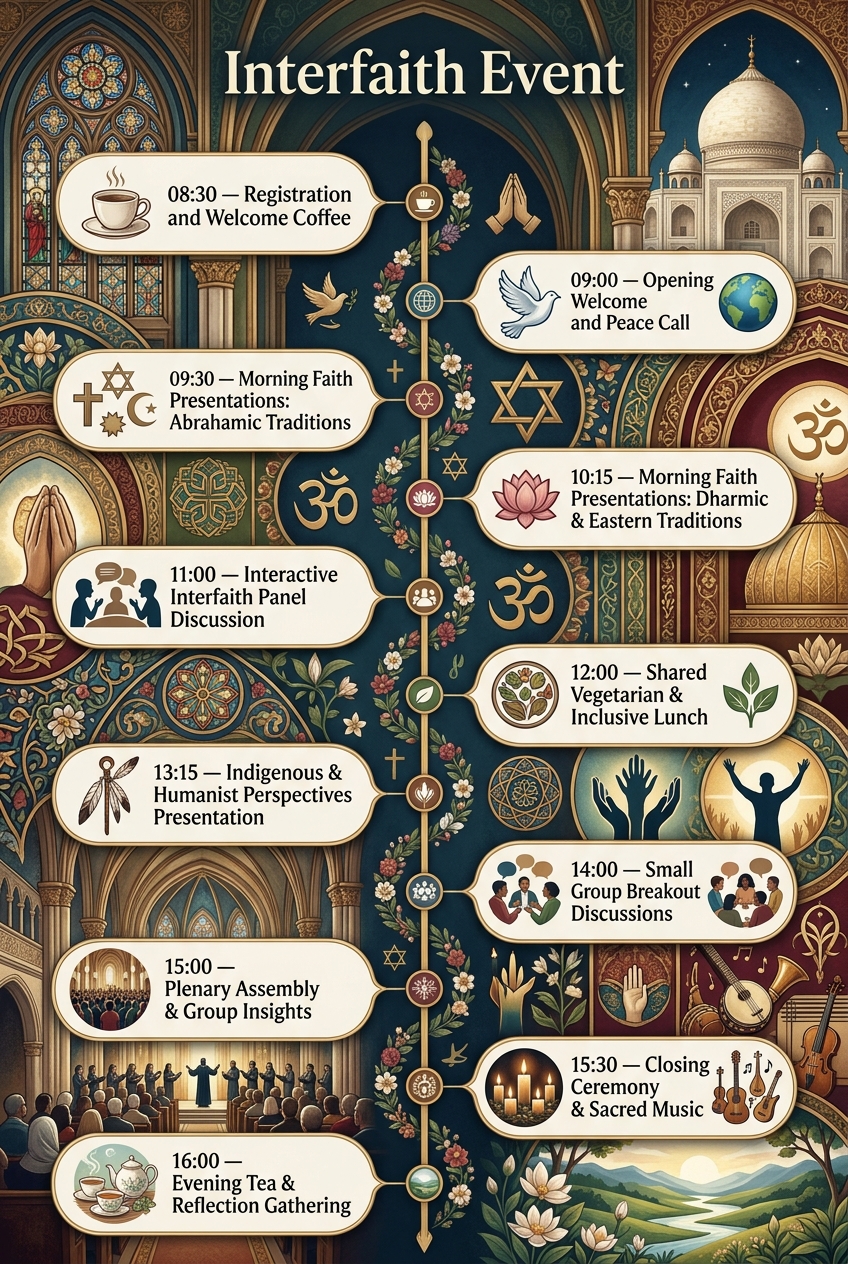
Why Interfaith Events Need a Timeline
Planning a multi-faith gathering involves balancing nuanced logistics that do not exist in standard corporate conferences. Without a tight, well-structured schedule, earlier discussions can run long, inadvertently cutting into the time allocated for subsequent traditions. A clear running order establishes visible equity among all participating faith leaders, showing that every voice receives equal standing and time.
Proper timing also ensures that hospitality and dietary commitments run smoothly. Coordinating meals that comply with Halal, Kosher, Hindu vegetarian, and Buddhist dietary practices requires precise coordination with venue caterers. When sessions run over, hot food spoils, venue staff get stressed, and participant networking time gets compressed.
Finally, a synchronized schedule allows attendees to manage their personal devotional practices. Providing predictable break times enables participants to step into dedicated multi-faith prayer rooms without missing core keynote presentations or panel discussions.
What to Include in an Interfaith Event Timeline
A robust multi-faith schedule must account for logistical setup, formal proceedings, and informal community connection. When building your master schedule, make sure to include:
- Arrival & Registration: A generous buffer window with light refreshments to handle check-in queues and informal networking.
- Inclusive Invocations: An welcoming opening ceremony that sets a spirit of mutual respect and collective peace.
- Categorized Tradition Presentations: Balanced thematic blocks grouping historical, regional, or philosophical worldviews.
- Interactive Panel Dialogues: Moderated question-and-answer periods where speakers discuss shared civic values and ethics.
- Dietary-Inclusive Shared Meals: A extended lunch period offering food suitable for all dietary restrictions in a communal setting.
- Small-Group Workshops: Facilitated breakout sessions that transform passive listening into actionable local community initiatives.
- Spiritual Closing & Sacred Music: Inspiring artistic elements, such as sacred music or poetry, that unify the assembly before departure.
Morning Registration, Invocations, and Tradition Presentations
| Time | Event |
|---|---|
| 08:30 | Registration and Welcome Coffee |
| 09:00 | Opening Welcome and Peace Call |
| 09:30 | Morning Faith Presentations: Abrahamic Traditions |
| 10:15 | Morning Faith Presentations: Dharmic & Eastern Traditions |
| 11:00 | Interactive Interfaith Panel Discussion |
The day opens in the main foyer of the Community Cultural Center, where attendees collect name badges, program booklets, and directional guides. Allowing 30 minutes for registration and welcome coffee ensures late arrivals do not disrupt the opening peace call. Serving light breakfast pastries alongside vegan and dairy-free options lets guests mingle informally before entering the auditorium.
At 09:00, organizers transition guests into the Main Auditorium for an inclusive peace call and welcome remarks. Structuring the morning presentations into two distinct 45-minute blocks—first Abrahamic traditions, followed by Dharmic and Eastern traditions—gives speakers sufficient time to articulate deep spiritual principles without rushing. Similar to the detailed ceremonial scheduling required in a Catholic wedding timeline or a Christian wedding timeline, honoring formal liturgical traditions requires dedicated, unhurried time slots.
At 11:00, the individual presentations converge into an interactive interfaith panel discussion. Positioning the panel directly after the keynote presentations allows the audience to draw immediate connections between the spoken tenets and modern community issues.
Inclusive Meal, Ethics Presentations, and Small Group Breakouts
| Time | Event |
|---|---|
| 12:00 | Shared Vegetarian & Inclusive Lunch |
| 13:15 | Indigenous & Humanist Perspectives Presentation |
| 14:00 | Small Group Breakout Discussions |
At 12:00, guests move into the Banquet Hall for a shared catered meal. Serving a fully vegetarian and plant-based lunch menu naturally accommodates Kosher, Halal, and Hindu dietary guidelines, eliminating cross-contamination concerns while fostering organic dialogue across tables. Much like managing food service in an anniversary party schedule, giving guests 75 full minutes prevents long buffet lines from cutting into networking time.
Reconvening in the Main Auditorium at 13:15, the program expands to include Indigenous and Secular Humanist perspectives on land stewardship, moral ethics, and civic responsibility. Broadening the scope beyond traditional world religions ensures all community ethics frameworks are represented.
At 14:00, participants disperse into Seminar Rooms A through D for small-group breakout discussions. Dividing a large audience into intimate 12-to-15-person circles encourages quieter attendees to voice their ideas, turning high-level dialogue into concrete community action plans.
Assembly Plenary, Sacred Music, and Final Reflections
| Time | Event |
|---|---|
| 15:00 | Plenary Assembly & Group Insights |
| 15:30 | Closing Ceremony & Sacred Music |
| 16:00 | Evening Tea & Reflection Gathering |
The afternoon culminates back in the Main Auditorium at 15:00 with a plenary assembly. Designated breakout leaders present key insights, common themes, and joint social justice commitments formulated during their small-group conversations, ensuring the day yields measurable community outcomes.
At 15:30, the formal program transitions into a closing ceremony featuring interfaith musical ensembles and sacred poetry. Performing art forms provide a non-verbal, emotional conclusion that transcends theological differences and leaves attendees spiritually uplifted.
The gathering concludes outdoors on the Garden Terrace from 16:00 to 17:00. Offering warm herbal teas and light snacks creates an informal, relaxed environment for participants to exchange contact information, debrief on the day's insights, and say personal farewells.
Interfaith Event Timeline vs Interfaith Meeting Agenda
Event organizers often confuse an operational timeline with a meeting agenda. While both document what will happen during an event, they serve entirely different functional roles for your team and audience.
| Feature | Interfaith Event Timeline | Interfaith Meeting Agenda |
|---|---|---|
| Primary Audience | Event planners, venue technicians, caterers, facilitators | Event attendees, guest speakers, board members |
| Level of Detail | Exact minute-by-minute cues, locations, setup notes | Broad time blocks, discussion topics, speaker names |
| Focus | Logistical execution, AV cues, room shifts, catering flow | Subject matter, learning objectives, discussion points |
| Usage | Backstage coordination and real-time operational control | Front-of-house guidance and attendee orientation |
An interfaith event timeline details operational movements, backstage cues, room assignments, and vendor handoffs across the facility. In contrast, a meeting agenda gives attendees a high-level overview of topic topics and speaker names without detailing production logistics. For internal governance or organizing committee meetings leading up to the summit, using a dedicated board meeting timeline is ideal for managing administrative prep work.
Who Should Use This Template?
This multi-faith event template is designed for organizers, leaders, and institutions seeking to foster inter-group harmony, civic cooperation, and cultural education. It adapts easily to various institutional settings and scale requirements:
- Regional Interfaith Councils: Organizing annual peace summits, inter-religious dialogues, and civic unity assemblies.
- University Chaplaincies: Hosting campus multi-faith awareness weeks, academic ethics panels, and student dialogue groups.
- Municipal Cultural Offices: Executing city-sponsored diversity celebrations, peace commemorations, and community heritage forums.
- Religious & Spiritual Centers: Partnering with neighboring houses of worship for exchange programs and joint service initiatives.
- Non-Profit Human Rights Coalitions: Bringing faith leaders together around climate justice, poverty alleviation, and social equity.
To support the diverse team members required to execute a large community event—from stage managers to catering coordinators—Chronolio offers customized workflow views for various operational roles.
How to Use This Template
- Duplicate or Download the Master Schedule: Access this editable template directly in Chronolio or download a copy in Word format or PDF format.
- Adjust Speaker and Session Lengths: Customize the presentation blocks to match the exact number of participating faith traditions and invited speakers.
- Confirm Room and Facility Assignments: Update room names (e.g., Main Auditorium, Banquet Hall, Breakout Rooms) based on your chosen venue layout.
- Distribute to Key Stakeholders: Share the master operational schedule with venue technicians, catering teams, session facilitators, and guest speakers at least one week prior to the event.
Tips for a Successful Interfaith Event
- Designate a Quiet Prayer & Meditation Room: Reserve a peaceful room equipped with plain floor mats, directional markers, and washing facilities so guests can fulfill devotional prayers without leaving the venue.
- Establish Clear Speaker Time Limits: Brief presenters in advance regarding strict time limits, using soft visual timer cards (such as 5-minute and 1-minute warnings) to maintain fairness.
- Label All Food Ingredients Explicitly: Ensure catering staff place clear ingredient cards in front of every dish on the buffet line, noting gluten-free, nut-free, Halal, Kosher, and vegan attributes.
- Provide Professional Stage Facilitation: Hire or designate a neutral, experienced moderator to introduce speakers, guide panel transitions, and manage Q&A periods impartially.
- Conduct Stage and Sound Audits Early: Test microphones, audio-visual slides, and stage lighting during the morning registration window to avoid technical delays once proceedings begin.
- Reference Recognized Interfaith Standards: Consult international bodies like the Parliament of the World's Religions or the United Religions Initiative for guidelines on inclusive dialogue protocols and language.
Common Mistakes to Avoid
- Overcrowding the Morning Program: Cramming too many faith presentations into a single morning block leads to presenter fatigue and forces moderators to cut off speakers mid-thought.
- Neglecting Specialized Dietary Needs: Assuming a basic vegetarian dish fulfills all religious food requirements can alienate guests who follow strict Kosher, Halal, or Jain practices.
- Forgetting Transition Buffers: Failing to schedule 10 to 15 minutes between main auditorium sessions and small-group breakouts creates hallway bottlenecks and delays the afternoon program.
- Inadequate Microphones in Breakouts: Expecting breakout group facilitators to speak over ambient noise without proper acoustic dampening or portable microphones leads to participant disengagement.
- Lacking Neutral Visual Decor: Displaying religious symbols exclusive to one faith tradition on the main stage can make other participating groups feel secondary; keep central stage backdrops neutral and inclusive.
In Summary
- Purpose: A master operational framework designed to coordinate multi-faith presentations, panel dialogues, inclusive meals, and community workshops.
- Ideal Audience: Interfaith councils, civic leaders, academic chaplaincies, houses of worship, and cultural non-profits.
- Key Timing: Features an 08:30 arrival window, morning tradition panels, a 75-minute dietary-inclusive lunch, afternoon breakouts, and a 16:00 reflection gathering.
- Core Benefit: Prevents schedule overrun, ensures equal presentation time for all traditions, and respects diverse prayer and dietary protocols.
- Customization: Fully adaptable in Chronolio or downloadable in editable PDF and Word formats for your planning committee.
Organizing a multi-faith summit requires balancing hospitality, strict timing, and diplomatic sensitivity. By following a structured interfaith event schedule, planners, venue operators, and committee chairs can foster a welcoming environment that honors every spiritual tradition equally. Customize your master schedule today to ensure your next community dialogue runs smoothly from registration to final farewells.
Customize Your Interfaith Event Timeline