







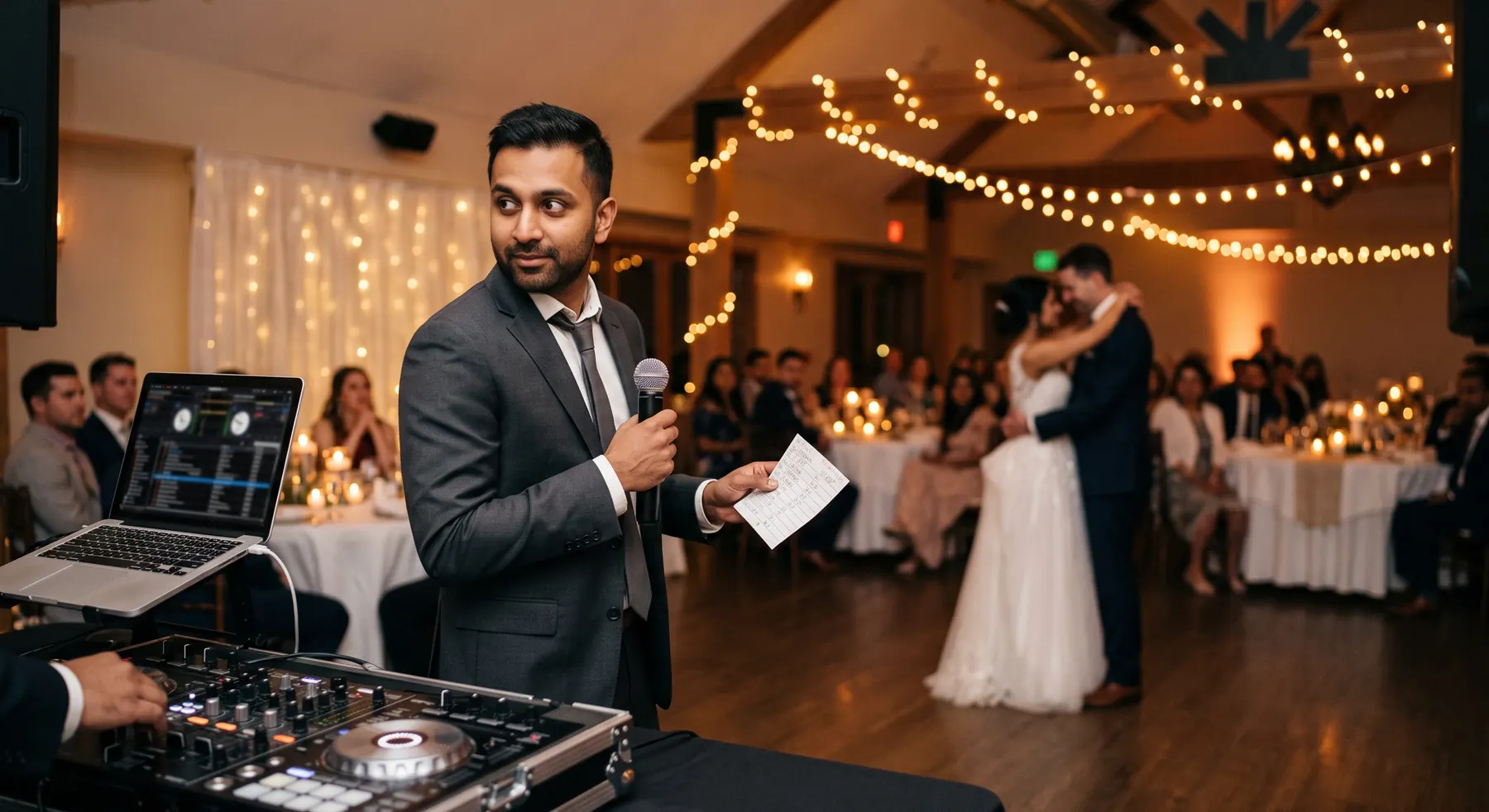
Why a reception is not a schedule
The ceremony is a schedule. It starts at a time, and it starts at that time because forty people are sitting in chairs waiting for it.
The reception is not. It is a sequence of events with elastic gaps, and treating it like a schedule is the most common reason a reception feels either rushed or dead.
Consider what actually happens. The best man's speech runs six minutes instead of three. The kitchen holds the main course because nobody plates into a speech. The main lands twelve minutes late, dessert follows it, and the first dance — scheduled on paper for 21:15 — happens at 21:34.
Nothing went wrong. That is a normal reception. But a DJ holding a printed schedule has spent the evening watching every line drift, and at some point stops trusting the document entirely. That is the dangerous moment, because now nobody is working from anything.
The distinction between a timeline, a schedule, and a cue-based running order is worth understanding properly — there is a full breakdown of the vocabulary here — because it changes what document you hand to whom.
The standard running order
This is the sequence, in the order it almost always happens:
| # | Event | Typical duration | Notes |
|---|---|---|---|
| 1 | Guests seated | 10–15 min | The MC's first real job |
| 2 | Grand entrance | 3–5 min | Names phonetically, in advance |
| 3 | Welcome / first speech | 3–5 min | Often the host or a parent |
| 4 | First course | 30–40 min | Anchor — the kitchen owns this |
| 5 | Main speeches | 15–25 min | 3–4 speakers, 3–5 min each |
| 6 | Main course | 45–60 min | Anchor |
| 7 | Cake cutting | 5 min | A photo moment more than an event |
| 8 | First dance | 3–4 min | Then open the floor immediately |
| 9 | Dancing | Open | The evening's actual purpose |
| 10 | Bouquet / garter | 5–10 min | Optional, increasingly skipped |
| 11 | Last song and send-off | 5 min | Anchor — often venue-mandated |
Two structural choices are worth making deliberately rather than by default.
Speeches before or between courses. Between courses is traditional and gives the kitchen breathing room. All-before-dinner gets them done while attention is highest and guests are sober, which some couples strongly prefer. Either works. What does not work is deciding on the day.
First dance immediately after the entrance. Unconventional, and genuinely effective when you want energy early, or when you have a guest list likely to drift outside after dinner. It also gets the couple's least favourite moment over with, which is a real consideration.
Speeches: the reliable overrun
If a reception runs late, speeches did it. Not the kitchen, not the photographer — speeches.
The mechanics are always the same. Four speakers are each told "about five minutes". Each takes seven, because nobody has practised and everyone has one more story. That is eight minutes of drift, and it lands squarely in the kitchen's schedule.
Three fixes, in order of effectiveness:
- Tell each speaker their time individually, in advance, in writing. "Three to five minutes" to a group means nothing. "You have four minutes, you're third" to one person means something.
- Have the MC introduce the next speaker immediately. The dead air between speeches — where the microphone is passed, someone finds their notes, and a table starts talking — costs more than the speeches themselves. Two minutes of gap, four times over, is eight minutes.
- Do not give the microphone to the floor. An open invitation for "anyone who'd like to say a few words" is how a 20-minute block becomes 50. If the couple wants it, cap it: two people, two minutes each, named in advance.
Who cues the DJ
This is the question most often left unanswered, and it is the one wedding DJs and MCs will raise first if you ask them what goes wrong.
The DJ needs to know, for every transition, who signals them. Not "the timeline says 21:15" — a person, visible, in the room, who nods.
The answer should never be the couple. They are seated, being photographed, and interrupted every ninety seconds by a well-wisher. They cannot be a reliable signal source, and asking them to be turns their own reception into a shift.
In practice the right answer is one of three people: the MC, the coordinator, or the venue manager. Any of them works. What matters is that it is one of them, agreed in advance, and that the DJ has been told which.
The same applies to the kitchen. The caterer needs a signal that speeches have finished, and if the answer is "they'll see", the main course arrives during the best man's punchline. There is more on what each vendor needs from the timeline in who needs what, and when.
Building it as a running order
What the DJ and MC actually want is not your planning timeline. It is a tighter document: a numbered sequence, names spelled phonetically, song titles, and a cue owner per line.
Numbering matters more than it looks. When something slips — and something always slips — "we're jumping to 8" instantly re-synchronises the MC, the DJ, and the coordinator. "Skip the thing after the speeches" does not. That is the difference between a run sheet and a schedule, and it is covered properly in what a run of show is.
For wedding planners, the useful move is generating both documents from one source — the couple's planning timeline and the MC's running order should never be maintained separately, because the moment they diverge, one of them is wrong and nobody knows which.
Build your reception running orderThe three anchors, again
If you take one thing from this: stop scheduling the reception minute by minute, and fix three anchors instead.
- The main course, because the kitchen cannot float.
- The bar close, because it is usually contractual.
- The last song, because the venue's licence says so.
Everything between them runs in order, at the pace the room sets. A reception that hits those three and lets the rest breathe feels generous. One that holds every line to a clock time feels like a conference, and by 21:00 it is fiction anyway.
Worked reception structures sit in the wedding template collection, and if your celebration spans a rehearsal dinner and a next-day brunch, the wedding weekend itinerary builder handles the multi-day shape.