







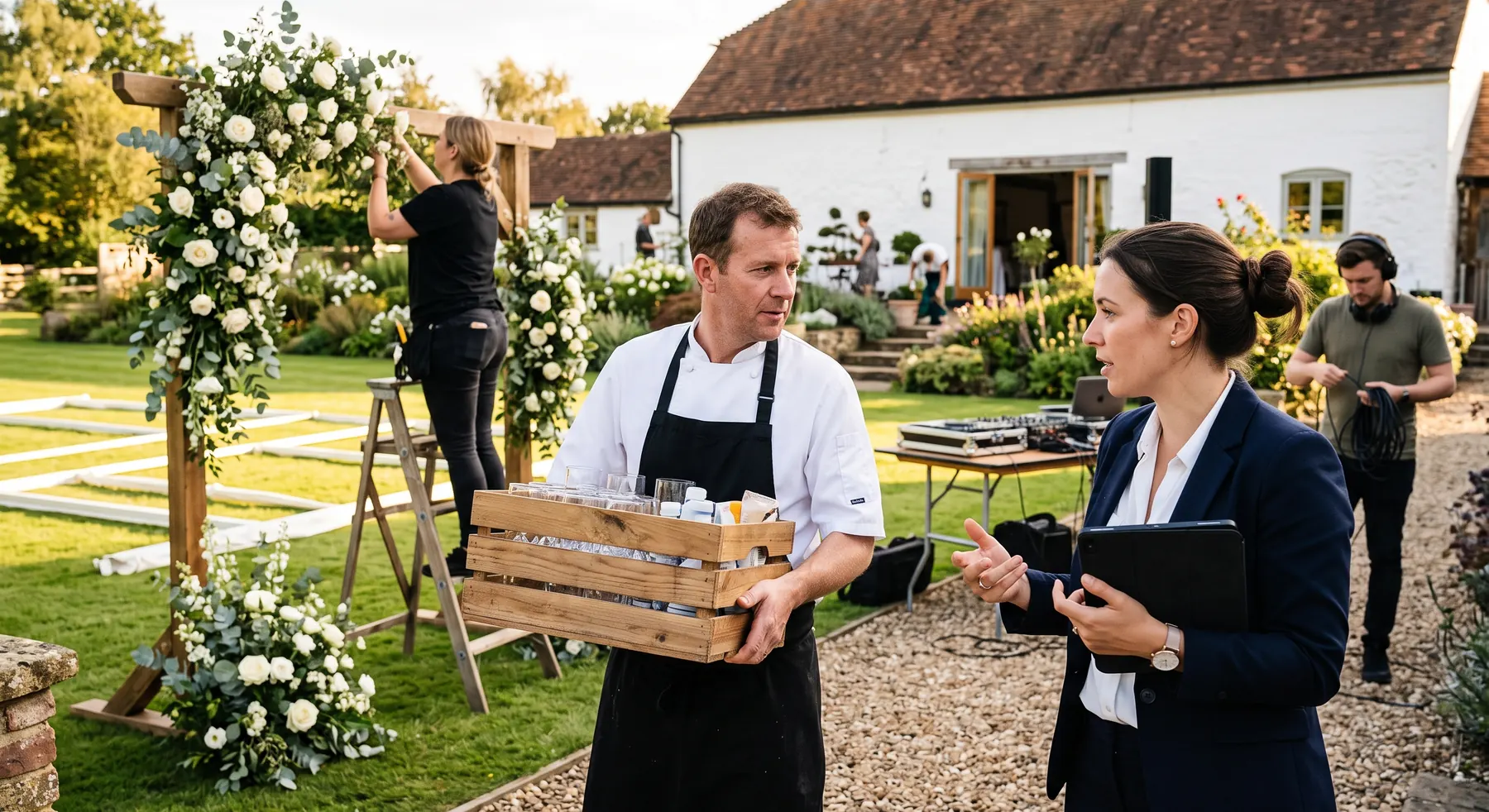
The one-PDF problem
Here is a failure I have watched happen more times than I would like, and it never involves a bad vendor.
The couple builds a lovely timeline. They export it as a PDF and email it to everyone: caterer, photographer, DJ, florist, venue, officiant. Nine people receive an identical document. Every one of them opens it, finds the four lines that concern them, and mentally discards the rest.
Then the ceremony moves twenty minutes later. The couple updates the timeline and re-sends it — to most people. The florist, who is CC'd on a different thread, never gets it. On the day, the arch is being dressed while guests are arriving.
Nobody was careless. The document was just wrong for the job. A wedding timeline is a master document that has to be read six different ways, and the work of a good planner is making sure each vendor reads their way correctly.
What each vendor actually needs
This is the table I keep, and it is the one thing I would put in front of a couple planning without a coordinator.
| Vendor | What they actually need | What they do not care about |
|---|---|---|
| Caterer | Service times, guest count, dietary count, kitchen access time, speech slots | Hair and makeup, photo groupings |
| Photographer | Sunset time, first look, family photo block, reception entrance, travel legs | Table linen, bar close |
| DJ / MC | Reception entrance, speech order and names, first dance, cake, last song, bar close | Morning prep, ceremony readings |
| Florist | Delivery window, ceremony dress time, reception flip window, collection time | Anything after setup |
| Venue coordinator | Everything — they are the fallback for every other vendor | Nothing |
| Officiant | Ceremony start, processional order, readings, signing | The entire reception |
| Hair & makeup | Ready-by time and the person order, nothing downstream | The whole evening |
| Transport | Pickup points, passenger counts, buffer for slow boarding | Programme detail |
Notice that only the venue coordinator needs the whole thing. Everyone else needs a window, and their real question is always the same: when do I start, when do I have to be finished, and who do I talk to if I am running late?
If a vendor cannot answer those three questions from the document you sent, the document has failed regardless of how detailed it is.
The four handoff moments
Timelines are not sent once. They are sent four times, and each send has a different purpose.
1. At booking — a draft. Rough, clearly marked as provisional. The point is not accuracy; it is to let an experienced vendor flag a structural problem while it is still cheap to fix. A caterer who sees a 90-minute gap between ceremony and reception with no canapés will tell you immediately. That is free consulting, and most couples never ask for it.
2. Four to six weeks out — the working version. Real times, still movable. This is when caterers build their kitchen schedule backwards from your service times, and when a photographer books a second shooter if the family photo list warrants it.
3. Ten to fourteen days out — near-final, with the confirmed headcount. The headcount is the part that matters. Catering, seating, and canapé quantities all key off it, and it is the number most likely to have drifted since booking.
4. Forty-eight hours before — locked. After this, changes get phoned, not emailed. Anything you send on the morning of the wedding will not be read by anyone who is already working.
Vendor by vendor, the detail that matters
The caterer
Caterers do not work from your timeline. They work from a kitchen timeline they build out of yours, and it runs earlier than you think — plated service for 120 guests starts in the kitchen well before your stated service time.
Give them service times, not activity names. "19:30 — dinner" is ambiguous; "19:30 — first course on tables" is a number they can plan against. The gap between those two readings is about fifteen minutes, which is exactly the gap that makes a main course arrive during a speech.
The photographer
Photographers need two things nobody else does: light and movement. Sunset time is a hard constraint they cannot negotiate, and every travel leg between locations is dead time for them.
They also need the family photo list, numbered, in advance — the single biggest timeline killer at any wedding. There is more on the arithmetic of that in the hour-by-hour wedding timeline guide, and photographers working multiple weddings a weekend usually have their own durations they will happily share if asked.
The DJ and MC
The DJ needs an order, not a schedule. Reception cues run late, early, or out of sequence depending on how the speeches go, so a DJ working from wall-clock times is working from fiction by 20:30.
What they need is the sequence, the names (phonetically, if they are difficult), and who signals each transition. Wedding DJs and MCs will tell you that "who cues me?" is the question most often left unanswered — and the answer should never be "the couple".
The florist
Florists have the narrowest window and the least flexibility, because they are usually working around a venue that is being used for something else until shortly before you arrive. Give them the delivery window and the flip window, and tell them who unlocks the door.
Stop the version problem before it starts
Every failure above is survivable. The version problem is the one that compounds, because each stale copy in circulation is a mistake waiting for the day it matters.
The fix is structural: share a link, not a file. A live link resolves to the current timeline every time it is opened, so there is exactly one copy and nobody is quoting March's plan in September. Vendors do not need accounts and they do not need to download anything — they bookmark a URL and it is right whenever they check it.
If you are coordinating multiple weddings at once, this stops being a nicety and becomes the job. Wedding planners running eight or nine events in a season cannot re-issue PDFs every time a ceremony shifts, and the evening spent doing it comes out of another client's planning time.
Build your wedding timeline freeEnter your ceremony time and the generator builds the full day around it, then recalculates everything downstream when a time moves — which is the arithmetic you would otherwise be doing at 23:00 the night before.
One person owns it
The last thing, and the cheapest to get right: one named person owns the timeline.
Not the couple and the planner. Not the planner and the venue coordinator. One person, named to every vendor, who makes changes and communicates them. Timelines do not usually break because somebody made a mistake — they break because two people each assumed the other was handling it.
Starting from scratch? There are worked examples in the wedding template collection, and if your celebration runs across several days, the wedding weekend itinerary builder handles that shape instead.