







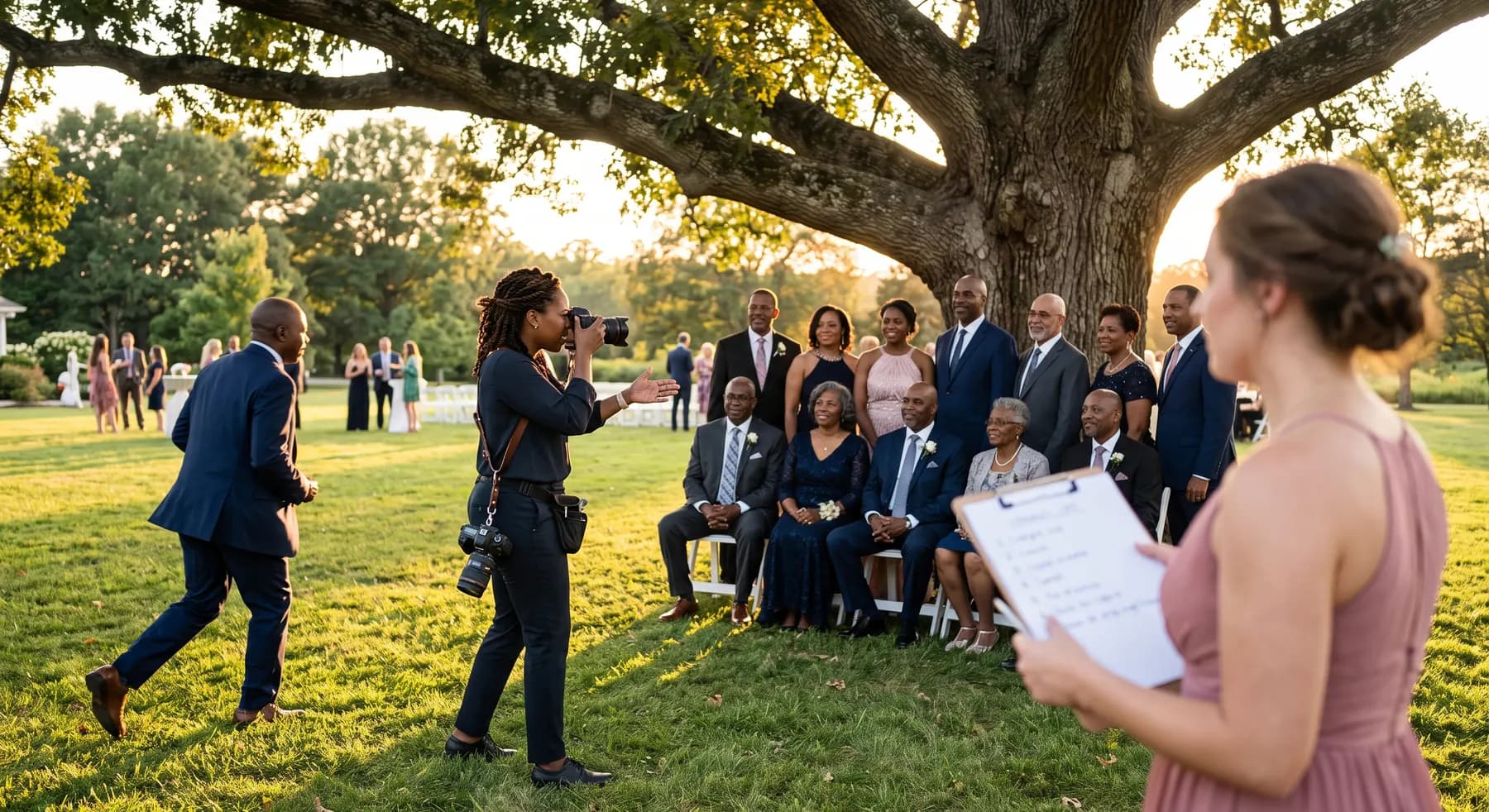
Why photography is the block that always overruns
Photography is the only part of a wedding day with a hard external deadline that nobody sets. Dinner can run fifteen minutes late. Speeches can be trimmed. The sun goes down at the minute it goes down, and no amount of goodwill moves it.
That is why photography is the block couples underestimate and planners argue about. Every other overrun is absorbed somewhere. A photography overrun is absorbed by the photographs.
The numbers below are the ones I use when I build a day, and they come from watching these blocks run at a venue rather than from a blog post. They assume one photographer unless stated otherwise.
The real numbers, block by block
| Block | Realistic time | What drives it |
|---|---|---|
| Detail shots (dress, rings, invitations, shoes) | 30–40 min | Whether items are gathered in one place beforehand |
| Getting ready, one location | 45–60 min | Room light; number of people |
| Getting ready, two locations | +30 min travel and setup | Distance, parking |
| First look | 20–30 min | Location privacy |
| Ceremony coverage | Ceremony length + 10 min | Confetti, congratulations |
| Family formals | 3–4 min per grouping | List length, and who is herding |
| Wedding party | 20–30 min | Group size, walking distance |
| Couple portraits | 30–45 min | Number of locations; weather |
| Reception details (room before guests) | 15–20 min | Whether the flip is finished |
| Golden hour top-up | 10–15 min | Optional but the best 10 minutes of the day |
Two of these deserve their own section, because they are where the time actually goes.
Family formals: the block that eats the day
If a wedding timeline collapses, it collapses here roughly eight times out of ten.
The arithmetic is unforgiving: 3–4 minutes per grouping, and the list grows quietly. Twelve groupings is forty minutes. Twenty groupings — which sounds excessive until you count divorced parents, step-siblings, and four grandparents who each want one — is over an hour of golden hour you will not get back.
The critical thing to understand is that the time is not spent photographing. A grouping takes about forty seconds to shoot. The other three minutes are spent finding Uncle Peter, who is at the bar.
So the fix is not a better photographer. It is:
- Write the list down and number it. Unwritten lists are open-ended by definition.
- Give it to someone loud who knows the family by face. Not the photographer, who is operating a camera. An aunt or a groomsman.
- Tell those people in advance that they are in photo 7. People who know they are needed stay findable.
- Do the largest groupings first, then release people in waves. Nothing kills momentum like holding sixty people for a photo of four.
A numbered list of twelve is a forty-minute block you can schedule around. An unwritten list is a hole in your timeline.
Portraits and the sunset problem
Couple portraits should start about 45 minutes before sunset, not at sunset. The light photographers are asking about is the half-hour before it, and a session that begins at sunset has already missed the thing it was scheduled for.
This is where a first look stops being a stylistic choice and becomes arithmetic. In midsummer, sunset is late and generous and you can do everything after the ceremony. In winter, a 15:00 ceremony that ends at 15:35 leaves you perhaps ninety minutes of usable light for formals, wedding party, and portraits — and formals alone can eat forty of it.
If those numbers do not fit, something has to move before the ceremony. That is what a first look is for.
Work out your photo timeline freeThe calculator works backwards from the actual sunset time for your date and location, applies these durations, and shows you where the blocks collide — which is the same arithmetic above, without the paper.
When a second shooter actually helps
Couples often treat a second photographer as a quality upgrade. It is really a scheduling tool, and it only compresses a timeline in specific situations:
- Two getting-ready locations. This is the clearest case. One photographer physically cannot cover both, and the travel leg between them costs 30 minutes of dead time.
- Guest counts above roughly 120. Formals get longer, and someone needs to be photographing the room and the arriving guests while the other works the list.
- Family lists above about 15 groupings. A second shooter can pre-assemble the next grouping while the first is shooting the current one, which is the only genuine way to cut that block.
Below those thresholds a second shooter adds coverage and angles, which is a real benefit — but it will not buy you time, and it should not be used to justify a compressed schedule.
Most photographers shooting weekends back-to-back have firm durations of their own and will tell you plainly whether your timeline is achievable. Ask them before you lock it, not after. That conversation is the single highest-value fifteen minutes in the whole planning process.
Fitting it into the wider day
Photography does not exist on its own. It negotiates with the ceremony, the canapés, and the reception entrance — and the couple cannot be photographed and greeting guests at the same time.
The general shape of that negotiation, and the three anchors everything hangs off, is covered in the hour-by-hour wedding timeline guide. What matters here is that 90 minutes of canapés is the minimum if you want portraits done properly without guests feeling abandoned. Anything less and you are choosing between your photographs and your guests.
For wedding planners building several of these a month, the durations above are worth saving as a reusable structure rather than rebuilding from a blank page each time. The list changes; the arithmetic does not.
Worked examples with photography blocks already timed sit in the wedding template collection, and the wedding timeline generator builds the whole day if you need more than the photography portion.