




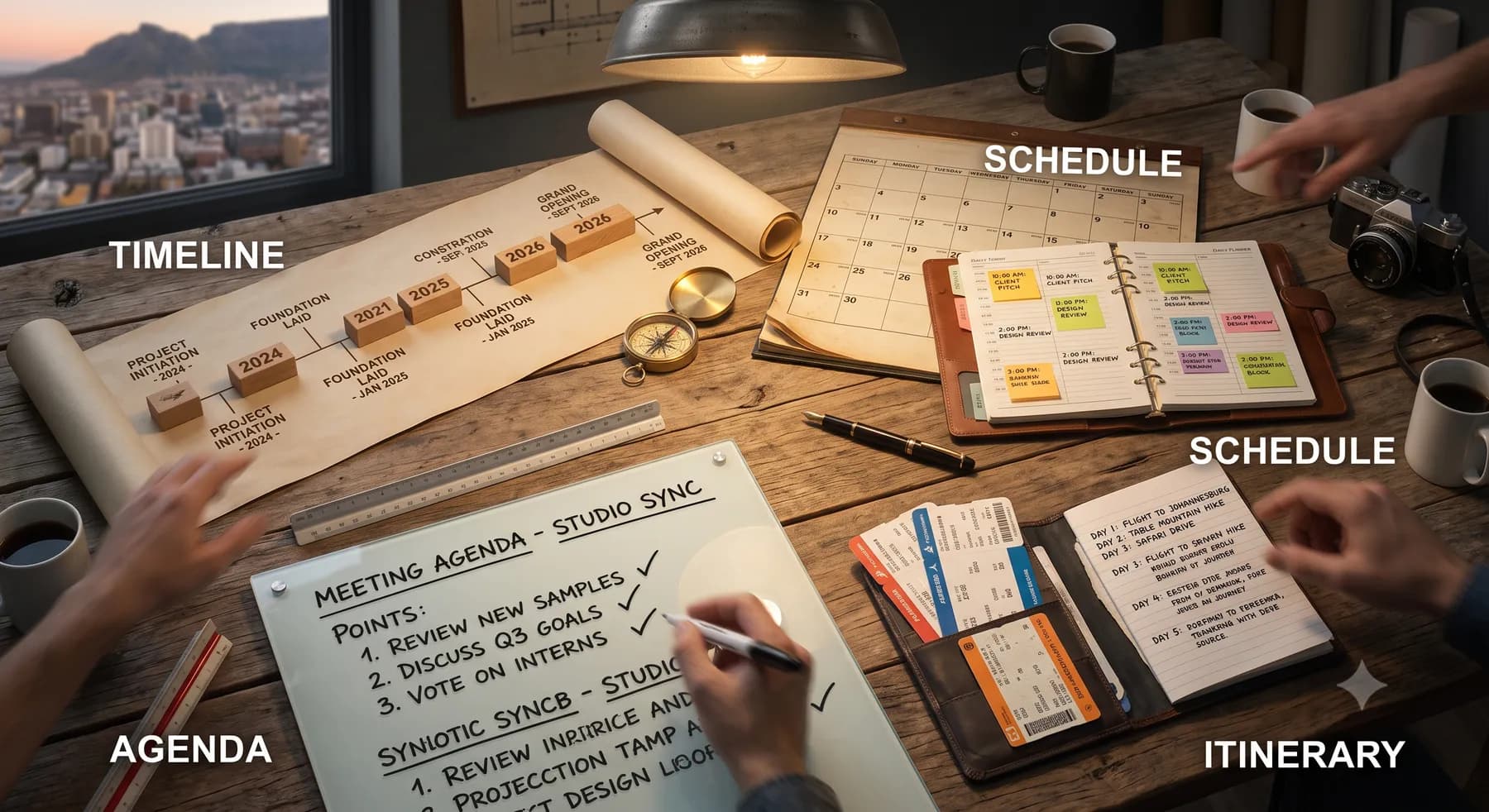
Four words, four different documents
Ask five event planners what the difference is between a timeline and a schedule and you'll get five confident, contradictory answers. The words get used interchangeably in casual conversation — but when it's time to actually build the document, the differences become concrete very fast. Each one answers a different question, is read by a different audience, and — this is the part most articles miss — is computed differently.
Here's the practical breakdown we use when building Chronolio.
Timeline: minute-by-minute, one day, internal
A timeline answers: "what happens at 14:30, and what does that mean for 15:00?"
It's the working document of an event day — every block has a start time and a duration, and the blocks are chained: when the ceremony moves thirty minutes, hair and makeup, the first look, and the family photos all move with it. That chaining is what makes timelines uniquely painful to maintain by hand, and it's why a wedding timeline is built backwards from the one fixed point (the ceremony) rather than forwards from the morning.
The audience is internal: the planner, the vendors, the wedding party. It's precise to the minute because the people reading it are the people executing it.
Build one when: the day has a fixed anchor moment and everything before and after depends on it. Weddings, product launches, award nights.
Schedule: who, where, and when — at once
"Schedule" is the broadest of the four words, and in everyday use it overlaps heavily with "timeline." But in its distinct sense, a schedule is allocative: it assigns limited resources — rooms, fields, people — across time slots. A conference schedule puts three parallel tracks into rooms; a tournament schedule puts teams onto fields. The hard part isn't the minutes, it's the collisions: no speaker in two rooms, no team playing twice at once.
If your document has columns for anything other than time — rooms, tracks, courts — you're building a schedule, and a flat list will fight you the whole way.
Build one when: multiple things happen simultaneously and something scarce (rooms, people, fields) has to be divided among them.
Agenda: topics inside a fixed box
An agenda answers: "we have exactly sixty minutes — how do we spend them?"
It's the inverse of a timeline. A timeline's total length is the output of its blocks; an agenda's total length is the input, fixed before you start, and the topics divide whatever remains after the fixed pieces (welcome, action items) take their share. That's why a meeting agenda without times next to each topic isn't really an agenda — it's a topic list with an expiry problem. The discipline of an agenda is entirely in the division.
Build one when: the container is fixed (a meeting slot, a workshop booking) and the content has to fit inside it. Meetings, workshops, training sessions.
Itinerary: days and movement
An itinerary answers: "where do I need to be, on which day, and how do I get there?"
It's the multi-day document — and its defining feature is that the days are independent. Friday's rehearsal dinner running long doesn't move Saturday's ceremony; each day has its own start and its own logic. That independence is exactly what breaks when people force a wedding weekend or a corporate retreat into one continuous timeline: an edit on day one ripples into day two, where it has no business being.
Itineraries are also the most audience-facing of the four — guests plan flights and outfits around them, which means they need publishing early and updating reliably.
Build one when: the event spans multiple days, especially with travel or accommodation involved.
Agenda vs planner: not the same thing
People also ask whether an agenda and a planner are the same. They are not. An agenda is a plan for one specific gathering: what will be covered, in what order, and for how long. A planner is a tool for managing your own time across many days, such as a diary, a to-do list or a calendar. A planner can hold agendas, but an agenda is never the whole planner.
Likewise, a calendar only says when something happens. It has no topics and no running order, so it cannot replace an agenda.
The cheat sheet
| Document | Time is… | Audience | The hard part |
|---|---|---|---|
| Timeline | Chained — one change cascades | Internal / vendors | Recalculating the chain |
| Schedule | Slotted across resources | Mixed | Avoiding collisions |
| Agenda | A fixed box to divide | Participants | Making it fit |
| Itinerary | Split into independent days | Guests / attendees | Publishing & updating |
Why this matters for the tool you pick
Most generic tools flatten all four into the same thing — a table with a time column. That works right up until the first change: the spreadsheet doesn't know your rows are chained, the document doesn't know your meeting is a fixed box, the design tool doesn't know anything at all.
Chronolio treats them as what they are. Describe your event and the AI timeline generator builds the right structure — chained blocks for a wedding day, divided time for a meeting, independent days for a retreat weekend — and keeps the math correct when everything changes. Which, in events, it always does.