







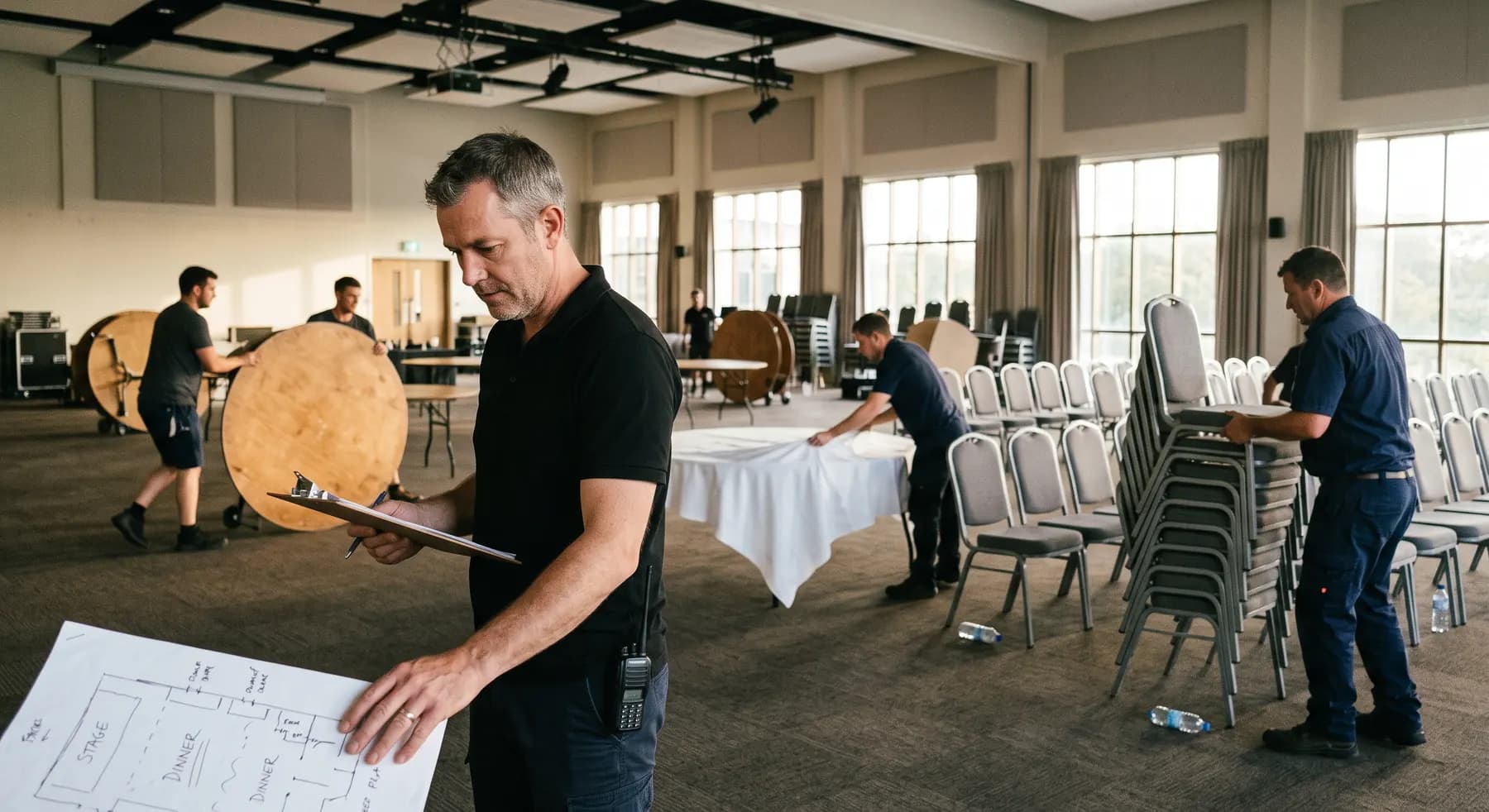
The economics, and why they bite
Every venue owner understands the maths. The room is a fixed cost whether it is occupied or not, so a second booking on the same day is close to pure margin. A venue that turns around well is a meaningfully better business than one that does not.
And every venue owner has also had the day where it did not work: the incoming florist standing in a car park at 14:00 because the previous event's hire company has not collected, the ceremony starting twenty minutes late, and a client who will mention it in a review.
The margin and the risk live in the same hour. What separates venues that run turnarounds confidently from those that gamble on them is not speed. It is knowing which dependency actually governs the window — and it is rarely the one on the schedule.
Real turnaround durations
| Turnaround type | Realistic window | Governing constraint |
|---|---|---|
| Reset, same layout, same client | 45–90 min | Cleaning and linen |
| Ceremony → reception flip, same room | 60–90 min | Guests being genuinely elsewhere |
| Full flip, layout change, same day, different clients | 4 hours minimum | Previous vendor load-out |
| Overnight turnaround | 8–12 hours | Access hours and staffing cost |
| Multi-day conference, daily reconfiguration | 2–3 hours | AV re-rig |
The row that causes the most trouble is the four-hour one, because it is the one clients most want to compress. An enquiry that asks "could we start setup at 13:00 if the morning event ends at 12:00?" is asking you to absorb a risk that is not yours, and the honest answer is usually no.
The dependency nobody schedules
Here is the thing that makes turnarounds fail, and it is almost always the same thing.
Your turnaround schedule says the incoming florist starts at 14:00. It does not say that the outgoing event's hire company has to have collected their furniture by 13:30 — because that is the previous client's vendor, working to the previous client's contract, with no relationship to today's incoming event.
So when they arrive at 14:10, your florist has lost forty minutes that nobody scheduled and nobody is liable for. The incoming client experiences a late setup. You experience it as your fault, and in their view it is.
The fix is contractual before it is operational:
- State a vacate time, not just an end time. The event ends at 23:00; the room is clear by 00:30. These are different clauses and the second one is the one that protects tomorrow.
- Make the client responsible for their third-party vendors' load-out, explicitly. Otherwise each vendor works to their own convenience.
- Price overtime. A stated per-hour overrun rate turns an argument into an invoice, and more usefully, makes the client the one chasing their hire company.
- Offer next-day collection with a storage fee. Often the cleanest answer: the previous client's decor moves to a storage area in fifteen minutes rather than being collected over ninety, and you have sold a small service instead of absorbing a delay.
The ceremony-to-reception flip
The flip deserves its own treatment because it happens during an event rather than between two.
Sixty to ninety minutes, and the binding constraint is that guests must be genuinely out of the room. Not "mostly in the garden". Out. A flip with twenty guests still finding their drinks takes half again as long and looks chaotic to the people watching it.
This makes the canapé window and the flip window the same constraint, which is a useful thing to state plainly to couples: ninety minutes of canapés is not generosity toward guests, it is the flip. Cut the canapés to an hour and you have cut the flip to an hour, and something visible will not be finished.
Two practical points. Decide in advance what happens to the ceremony chairs — relayed, removed, or stacked — because that single decision is often half the flip time. And give one person the flip, with the authority to call it done. Two people managing a flip produces a room where the top table is perfect and nobody laid the cutlery.
There is more on how this interacts with the rest of the day in the hour-by-hour wedding timeline guide.
Build a turnaround run sheet freeTwo events, one day
If you are running genuinely separate clients on the same day, three rules earn their keep.
Separate spaces or a four-hour gap. Nothing else reliably works.
Staggered vendor access, in writing, per vendor. Not a single "setup from 14:00" that eight vendors all interpret as "arrive at 14:00" and then queue at one loading door. Give the florist 14:00, the caterer 14:45, AV 15:15. This alone removes most turnaround congestion, and it costs nothing.
Different arrival and departure routes. This is the one people underestimate. The genuine risk in a two-event day is not the flip — it is the outgoing guests meeting the incoming ones. A departing wedding party crossing an arriving corporate reception is a memory neither client wanted, and no amount of scheduling discipline recovers it once it has happened.
Give the team a run sheet, not a schedule
Turnaround crews need the same document a production team needs: numbered lines, an owner per line, and a clear finish state. "15:00 — set room" is not actionable. "15:00 — 14 rounds of 10, chiavari, ivory linen, numbers 1–14 clockwise from the door — Sipho" is.
Venue managers running several turnarounds a week gain most by making these reusable. Your flip is the same flip most weekends; rebuilding the checklist each time is unpaid work, and a structure that is saved and adapted is faster and more reliable than a fresh document every Friday.
Your incoming caterers need the turnaround schedule too, and earlier than you would think — kitchen access time governs their entire service timeline, and a caterer who learns at 14:00 that the kitchen is not free until 15:30 has a problem that reaches all the way to the main course.
Structures for both sides of a turnaround sit in the corporate and wedding template collections.