








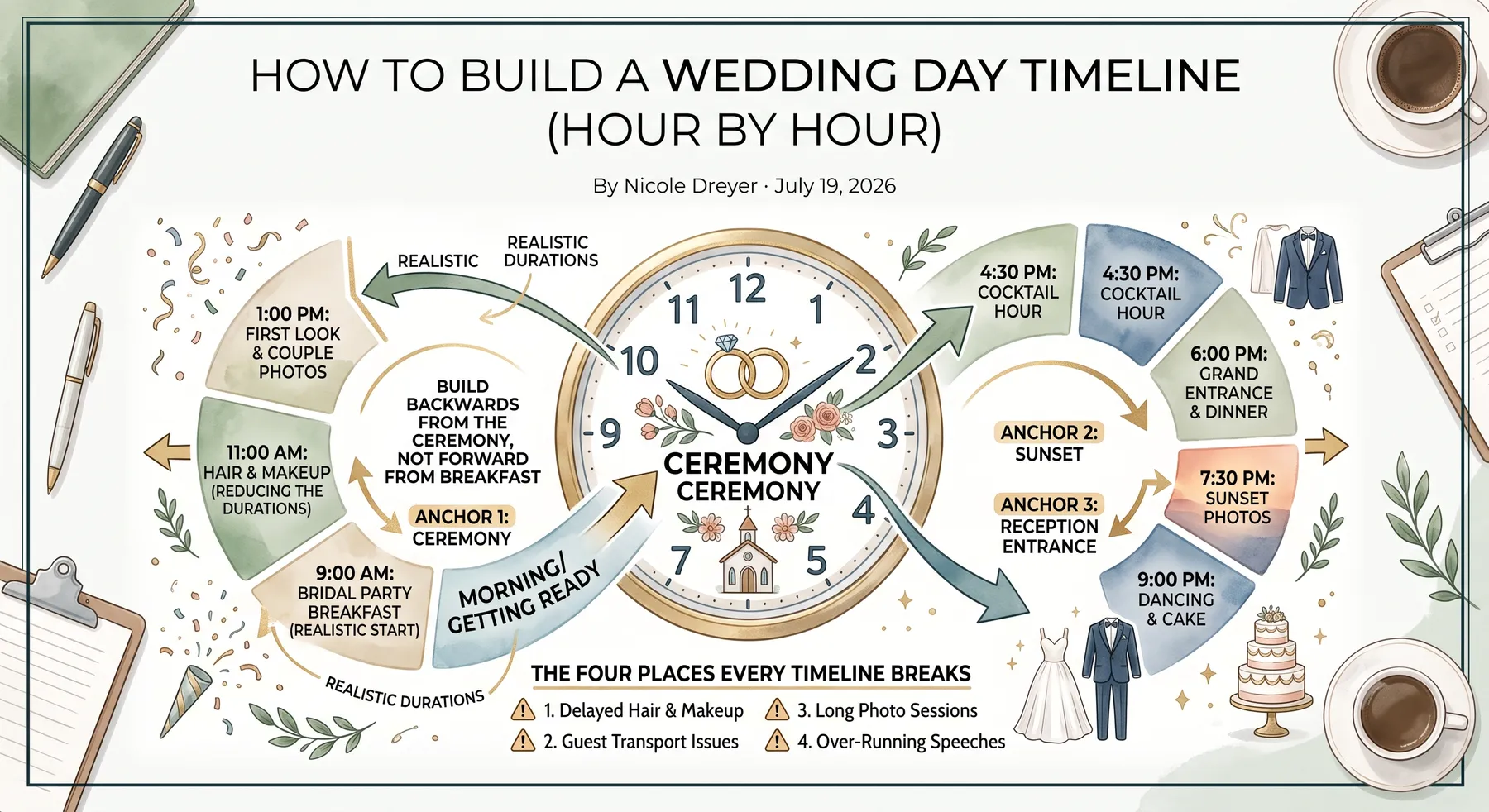
Start at the ceremony and work outwards
The single most common mistake I see — and I've hosted hundreds of weddings at our venue — is a timeline built in reading order. The couple starts at "8:00 — hair and makeup" and works down the page until they hit the ceremony, which somehow lands at 15:40 instead of 15:00.
A wedding day is not built forwards. It's built around fixed points, and the ceremony is the fixed one that everything else negotiates with. That's the structural difference between a wedding timeline and, say, a conference agenda that simply divides a block of time — a distinction worth understanding properly if you're new to the vocabulary, because it changes the math you use (timeline vs. schedule vs. agenda vs. itinerary).
So: write your ceremony time down first. Everything in this article happens relative to it.
Your three anchors
Before you schedule a single item, fix these three:
- Ceremony start. Usually set by the venue, the officiant, or the religious requirement. Non-negotiable.
- Sunset. Not negotiable by anyone. Look up the actual sunset time for your date and location — the Time and Date sunrise/sunset calculator or the NOAA solar calculator will both give you the exact minute. Your photographer's best light is roughly the hour before it.
- Reception entrance. The moment the evening's programme starts and the catering clock begins.
Everything else — preparation, first look, family photos, canapés, speeches — is an elastic band stretched between those three points. Once you know them, the timeline mostly builds itself.
The backwards build, step by step
Working from a 15:00 ceremony as the example:
| Time | Item | Reasoning |
|---|---|---|
| 09:00 | Hair & makeup begins | Count backwards from "ready" |
| 13:00 | Photographer arrives, detail shots | Dress, rings, invitations, shoes |
| 13:45 | Couple dressed and ready | Buffer before anything public |
| 14:00 | First look (optional) | Frees up post-ceremony time |
| 14:30 | Guests arrive | Thirty minutes of arrival is standard |
| 15:00 | Ceremony | The anchor |
| 15:30 | Ceremony ends, confetti | Budget 25–35 min for the ceremony itself |
| 15:45 | Family photos | The dangerous one — see below |
| 16:30 | Couple portraits | Aim at the golden hour, not before |
| 17:30 | Reception entrance | The second anchor |
Notice that hair and makeup — the thing most couples plan first — is the last number I calculate. It's determined entirely by everything downstream of it.
Realistic durations (the ones people underestimate)
These are the numbers I use, and they hold up:
- Hair and makeup: 45–60 minutes per person, and the bride goes second to last, not last — you want a buffer between her finishing and the dress going on.
- Ceremony: 25–35 minutes for a civil ceremony. Religious and cultural ceremonies vary enormously; ask the officiant for a real number rather than guessing.
- Family photos: 3–4 minutes per grouping. Not per person — per grouping. Twelve groupings is forty minutes, and twelve is a modest list.
- Travel between venues: your map estimate plus 50%. Wedding parties do not move at traffic speed. They move at the speed of the slowest person in formal shoes.
- Canapés and drinks: 90 minutes minimum if you want portraits done properly without guests feeling abandoned.
If you'd rather not do this arithmetic by hand, our free wedding timeline generator applies these durations from your ceremony time and recalculates everything downstream when a number changes. For the photography portion specifically, the wedding photography timeline calculator works backwards from sunset for you.
The four places every wedding timeline breaks
After enough event days, the failures become boringly predictable. It is almost always one of these four.
1. The family photo list
This is the number one timeline killer, and it isn't close. The list grows quietly — "oh, and one with the cousins" — and each addition costs three to four minutes of golden hour you cannot get back.
The fix is unglamorous: write the groupings down in advance, number them, and give the list to someone loud. Not the photographer — they're busy operating a camera. You want an aunt or a groomsman who knows the family by face and is comfortable shouting names across a lawn. A named list of twelve is a forty-minute block you can plan around. An unwritten list is an open-ended one.
2. No buffer anywhere
A timeline with no slack is a rumour. Something will run long — it always does. Build 10–15 minutes of buffer before every anchor, especially before the ceremony and before the reception entrance. If nothing goes wrong, you've gained a calm quarter-hour, which is worth having on its own.
3. Vendors working from different versions
The caterer has the timeline you emailed in March. The DJ has the one from June. The photographer has the one you revised last Tuesday. Everyone is competent, everyone is prepared, and everyone is wrong in a different way.
This is why the version of the timeline that matters is a live one. A shared link that updates when you edit means there's exactly one current copy and nobody is working from a stale PDF. If you must send documents, send them late and re-send them after every change.
4. Golden hour arriving without you
If your portraits are scheduled for 16:00 and sunset is at 17:45, you've put your best photographs in flat afternoon light and left the good light unused. Look up the real sunset time and work backwards. In midsummer this is generous; in winter it can mean the entire portrait session has to happen before the ceremony via a first look.
What about the rest of the weekend?
If you have a rehearsal dinner, a welcome drinks event, or a next-day brunch, those are a different document — an itinerary, spanning days and movement rather than minutes. The wedding weekend itinerary builder handles that shape, and there's a rehearsal dinner timeline template for the evening before.
It's also worth knowing that the average US wedding now runs to about 117 guests, according to The Knot's Real Weddings Study of roughly 10,000 couples married in 2025. Guest count drives almost every duration on this page — canapé service, seating, and especially that family photo list.
Get the day-of document right too
The timeline in this article is your planning document. On the day itself, your coordinator and MC need something tighter and cue-based — that's a run of show, and it's a genuinely different artefact (what a run of show is, and what goes in one).
And every timeline has a to-do list feeding it: confirm the PA, chase the florist's delivery window, send the final headcount. Those tasks belong attached to the timeline items they serve, not in a separate app you forget to open.
Want a worked example to start from? See the full wedding timeline for a 1pm ceremony, or read how other planners use Chronolio for weddings and photography scheduling.