





Why checklists work, and why yours probably doesn't
The best evidence for checklists doesn't come from event planning. It comes from surgery.
In 2009, a WHO study across eight hospitals — from Seattle and Toronto to Tanzania and the Philippines — introduced a 19-item surgical safety checklist. Major complications fell from 11% to 7%, and in-hospital deaths from 1.5% to 0.8%. The results held in both wealthy and low-income hospitals (Haynes et al., New England Journal of Medicine; Harvard's summary is the readable version).
Nineteen items. Surgeons — highly trained, highly motivated people — measurably improved outcomes by writing down things they already knew. Not because they were incompetent, but because under load, memory is the first thing to go.
Event days are the same shape of problem: many moving parts, high stakes, several people who each hold a piece, and a hard deadline that doesn't move. The lesson transfers almost directly. The failure mode is never "nobody knew" — it's "everybody assumed someone else had it."
Here's the thing, though: most event checklists still fail, and it's usually for a structural reason rather than a discipline one. The checklist lives somewhere else. It's in a notes app, a spreadsheet tab, or a project tool, while the actual schedule lives in a document. So the checklist gets opened on the days you remember to open it, which are not the days you most need it.
12 weeks out: lock the things others depend on
At this range you're fixing the constraints everyone else plans around. Get these wrong and the later stages inherit the problem.
- Confirm the venue contract, including access times — not just event times. The setup window is the number your suppliers actually need.
- Book the vendors whose calendars are scarcest: photographer, catering, AV, entertainment. In peak season these go first.
- Fix the run time. Not the detail — just doors, start, and end. Everything downstream is built against it.
- Establish the guest number you're planning to, with a date for when it firms up.
- Identify the single hard anchor. Every event has one immovable moment — a ceremony, a keynote, a broadcast slot, a sunset. Write it down and mark it as the thing that doesn't move.
4 weeks out: turn commitments into specifics
The vendors are booked. Now convert vague agreements into numbers someone can act on.
- Get delivery and arrival windows in writing from every supplier — not "the morning of," an actual window.
- Build the draft timeline. This is the point where the shape of the day becomes real. If you're running a wedding, the backwards build from the ceremony is the method; for a conference, the conference agenda builder handles parallel tracks.
- Circulate it for correction, not approval. Vendors will spot problems you can't see: the caterer knows their service takes 90 minutes, not 60.
- Confirm power, load-in access, and parking for anyone bringing equipment. This is the most commonly skipped item on this list and the most expensive to discover late.
- Assign an on-the-day decision maker who isn't you if you're also hosting.
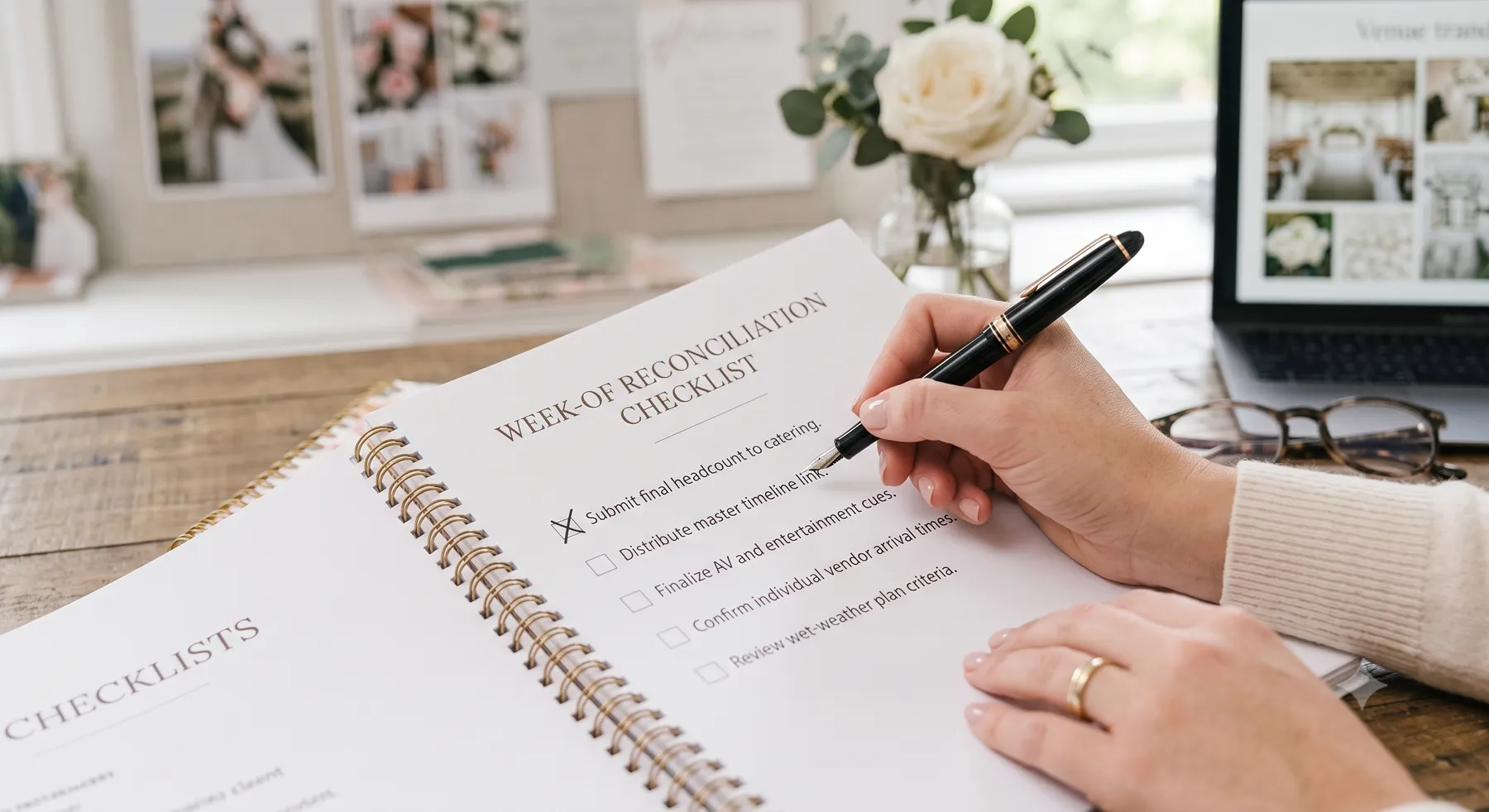
1 week out: the reconciliation pass
This week is about making sure everyone holds the same version of reality.
- Send the final headcount to catering by their stated deadline.
- Re-send the timeline — or better, send a live link so there's exactly one current version and no one is working from a stale attachment. Version drift between vendors is the single most common cause of day-of confusion I see.
- Write the run of show if the event has a programme with cues — speeches, AV, entertainment, awards. The planning timeline and the cue sheet are different documents with different jobs, and the AV desk needs the second one.
- Confirm arrival times individually. A group email is not a confirmation. A reply is.
- Check the weather forecast and make the wet-weather call criteria explicit now — what conditions trigger the backup plan, and who decides.
24 hours out: only the reversible things
The day before is not the day for improvements. Restrict yourself to verification.
- Physically test the AV. Sound check with the actual microphone the actual person will hold.
- Walk the space in the order the guests will move through it.
- Print the run sheet — twice. Phones die, venue Wi-Fi is a rumour, and paper doesn't need a battery.
- Brief the person who handles problems so you don't become the bottleneck for every question.
- Stop planning. Anything discovered now that can't be fixed in an hour is a day-of adaptation, not a task.
Keep the list with the schedule
Everything above is standard practice; you'll find versions of it in any planning guide. The part that's less standard is where the list lives.
A to-do item like "confirm the PA system" is not free-floating admin. It exists because something specific happens at a specific time — the 20:00 speeches — and it's only meaningful in relation to that moment. When the speeches move to 21:00, the task's urgency changes. When the speeches get cut, the task disappears entirely.
That relationship is exactly what a separate to-do app throws away. You end up maintaining two documents that describe the same event and drift apart the moment either changes.
This is why Chronolio's task management attaches tasks to the timeline item or event they serve, rather than filing them somewhere else. A task carries a priority, a due date, notes, and the vendor it's waiting on — and it sits against the moment it exists to protect. Your dashboard surfaces what's overdue first, and tasks stay private when you share the timeline, so the client sees the polished schedule and not your reminder to chase their outstanding balance.
For prep work spanning your whole business rather than one event, general tasks work the same way without being tied to a timeline at all.
The honest caveat
A checklist is a floor, not a ceiling. The WHO study didn't work because nineteen items covered every possible surgical complication — it worked because it made the team pause and speak to each other at three defined moments.
The same is true here. The value of this list isn't the items; it's that it forces a conversation at 12 weeks, at 4 weeks, at 1 week, and the day before. Adapt the contents to your events. Keep the checkpoints.
Starting from scratch? The free timeline tools will give you a structured first draft in a couple of minutes, and there are worked templates and planning guides for most common event types.